« Croque Renee | Main | First Time Lucky »
Friday, March 12, 2025
Fast Food… Chinese-Style
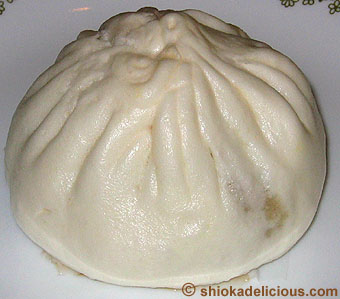
I am sure it has not escaped you that, in recent days, I have been rather, shall we say, pre-occupied with sandwiches. No, wait… please don’t switch blogs… not just yet… Today’s post is not about sandwiches, I promise. At least, not strictly speaking.
For lunch today, I had the Chinese version of a sandwich or a burger. Actually, I would consider this to be the original Chinese fast food. Forget burgers, forget sandwiches… for the Chinese, this has probably been the foremost “food on the go” since ancient times. What am I talking about? Why, the humble steamed bun… pau… bao, or whatever you may wish to call it, of course.
If I may say so myself, the pau is actually more convenient than the hamburger. Like its American counterpart, it consists usually of meat sandwiched within some bread. Only in our case, the bread fully envelops the meat, and thus eliminates the risk of the meat slipping out from the sides as you bite into the bun. I am sure almost all of us has experienced this at least once… you are in a rush, perhaps lunching as you drive or lunching at your work desk… you bite heartily into your hamburger… plop!… the meat pattie, ketchup, mayo, salad and whatever else was between the two halves of the bun slips without warning, messily, chaotically onto your lap, your keyboard… and there goes your favorite outfit… This doesn’t happen with a pau.
Plus, making the pau is a convenient one step process. The meat is steamed together with the bread – no hassle, no grease. And it is always served piping hot, straight from the steamer.
Much as I like burgers, and I really do, if I am given a choice, I would usually go for the pau. It is tasty and filling. It is cheap and convenient. For half the price of a burger, one can get a big chunk of juicy, moist and succulent meat enveloped by a layer of soft, tender steamed dough. It is a meal in itself.
My love for the steamed bun stems from childhood…
One of my most vivid food memories from my early childhood is the eating of a huge (I was much smaller then) meat pau for lunch. I was probably about 3-4 years old. And sometimes, when I got off the school bus at noon, mum would be waiting for me at the foot of our block of apartments, and together hand-in-hand we would stroll across the street to the neighbourhood pau shop and buy two “big paus” (da bao). We would then stroll home, and sit together, happily munching on our paus. Of course, childhood memories are often filtered through rose-tinted emotional lenses, but I do remember the wonderful warm feeling of just me and mum, sitting at the dining table, enjoying an incredibly simple lunch of a steamed meat bun. And so, for the unprincely sum of around S$0.60 to S$1.00 (if I recall correctly, I think each bun, in those days, was around S$0.30 to S$0.50), both our tummies were warmed and filled. The food may have been humble, but I felt like a princess.
I remember the bun was so big, it was almost a third the size of my face! And I had trouble biting fully into it. I would take small nibbles, working inwards from the edges… savoring in turn the soft, fluffy, warm white bun, then the steaming hot, salty, juicy, very flavorful meat. And through it all, there was always a sense of anticipation… waiting for my favorite part of the pau. I would slowly bite and munch until I hit the jackpot… that small wedge of hard-boiled egg hidden somewhere within that huge chunk of meat. And a grin would light up my face. And usually, mums being mums, my mum would pass me her wedge of egg too. Wow, double jackpot! I really felt like a princess.
So today, I want to pay tribute to the pau or bao. These are some of my favorite paus and pau shops…
Paus come either as savory or sweet. The most common savory fillings would be meat – pork, chicken or BBQ pork (char siew). There are also, of course, vegetarian vegetable buns too. And the sweet paus traditionally come filled with red bean paste (tau sar) or lotus seed paste (lian yong). Nowadays, there are new-fangled sweet fillings like pandan, corn, yam and even durian!
Let’s talk about the meat baos first. Most common are the da baos (literally, “big pau”) and char siew (BBQ pork) paus.
The da bao is called big pau, well, simply because it is big. Yes, the Chinese can be very literal sometimes! The da bao is approximately double the volume of a standard char siew pau…
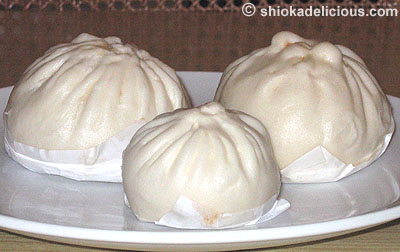
Inside the da bao is usually either pork or chicken.
You know that neighbourhood pau shop my mum and I would buy our da baos from, way back when I was a little girl? That was Kong Guan. It has of course now grown from that tiny pau shop in Eng Kong Gardens into a listed company churning out hundreds of thousands of steamed buns every year. It still produces the da bao, but sad to say, while we still love some of its other paus, its version of da bao no longer ranks among our favorites.
As of today (why today? you’ll find out later), this one ranks as our sole favorite da bao…
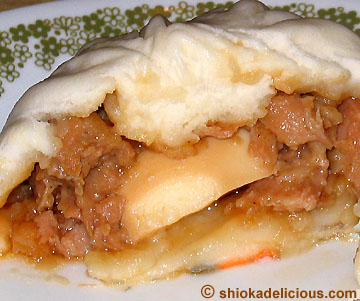
This is Teck Kee Tanglin Pau’s chicken da bao. The bun is very generously filled with flakes of chicken meat. It is very lean, with hardly any skin or fat – just the way I like it. And yet, the meat is incredibly moist, succulent and tender. Rich, flavorful juices ooze out of the meat with every bite. The filling is neither under-flavored nor overly salty. The meat is well-marinated and cooked just right. And of course, they still include that all-important wedge of hard boiled egg. At S$1.40 (US$0.80), it is an incredibly affordable meal.
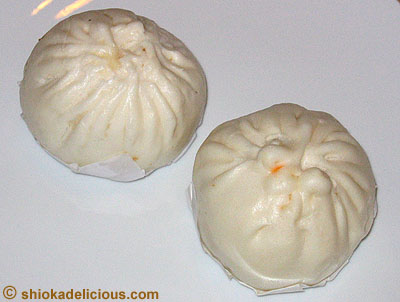
These are the da baos from Tiong Bahru Bao Shop, another of our regular bao stops. My mum bought these for our lunch today – one chicken da bao and one pork da bao. This was what prompted my spurt of nostalgia and inspired this post. I suddenly remembered all those times, as a little girl, when my mum bought two da baos for our lunches. Unfortunately, today’s lunch was a tad disappointing…
But first, how do you tell the chicken from the pork? The one with the orange dot is the pork da bao (above).
This is the chicken da bao…
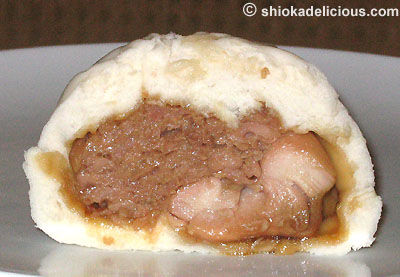
When I cut open my chicken da bao today, I was in for a little surprise. It looked completely different from the last time I had Tiong Bahru da bao, and from all the previous times I have had their chicken da bao.
Previously, the filling was one entire piece of chicken thigh meat, beautifully marinated in dark soy sauce. It was juicy, tender, succulent, flavorful and just very tasty. And of course, you knew it was the "real thing"… one whole piece of chicken thigh… not a mass of minced meat. A piece of chicken cooked whole invariably has a completely different bite and texture from that of minced meat. That was what I liked about the Tiong Bahru chicken da bao. It was different from all the rest. And so it had ranked securely, together with Teck Kee’s chicken da bao as my two favorite big paus. Depending on the texture I was hankering after, I would alternate between the two.
Today, my chicken big pau came with just one small (oh, okay, medium) sized chunk of chicken, and the rest was minced chicken (or at least it tasted like chicken) meat. Hmmm…
It still tasted pretty good – lean meat that was flavorful, juicy and succulent. But it just wasn’t the same. If I had wanted minced meat, I would have gone for Teck Kee’s version with chunks of meat, which even comes with the egg. Tiong Bahru has never included the egg in their chicken da bao, but I was willing to forego that for the texture of their whole piece of chicken thigh.
Now, their chicken da bao looks rather similar to their pork da bao…
My mum had the pork da bao today (on the left). Her only comment was: “they have changed the recipe”. And that said it all. Plus, there was no egg.
However, Tiong Bahru Bao’s char siew pau (BBQ pork bun) still ranks as our all-time favorite char siew pau. My mum has, on various occasions, declared it “the best char siew pau in Singapore”.
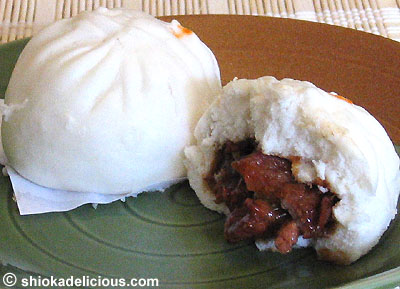
I too have to admit it is truly very, very good. Unlike a lot of the other char siew paus, this one is almost exclusively lean meat. (Although admittedly, there are some people who like their char siew paus with 50-70% fat instead of lean meat). Even though the meat is so lean, it is incredibly moist and tender. And here the char siew meat is cooked Hong Kong style – marinated in dark soy sauce and sugar. When cooked, the sugar caramelizes given an absolutely gorgeous flavor and color. Nicely sweet, salty and flavorful all at the same time. There is none of the usual red coloring in this meat filling – just natural flavors. I keep repeating myself, but the meat is so juicy, moist, very tender and succulent. Sublime!
So far, all the above paus have what I call “local skin” (I don’t know the technical name for it). The dough, although light and soft, is fairly dense and somewhat compact. This compares with what I call “Hong Kong dough”, which is fluffy…
This is admittedly not the best fluffy char siew pau that one can find. I bought it the other day whilst in Chinatown meeting a client. I was feeling hungry and bought it on my way home. I didn’t even look at the shop’s name from where I bought it. I passed by, saw it and bought it. There are better made versions, but it makes for good comparison of the different dough types. I like the the “Hong Kong dough” slightly more than I do the “local dough”. The former is usually only found in Cantonese restaurants that serve dim sum. On the whole, Singapore paus have the “local dough”.
However, regardless of the type of dough used, the bun should be soft, light and tender. And very importantly, the dough should not stick to the back of your teeth when you bite into it! That is a good gauge of how well made the dough is!
This Chinatown char siew pau has the normal bright red-colored meat filling…

You will notice that a lot of char siew paus have a mish-mash of styles – Hong Kong-style char siew with a local dough, and local-style char siew with Hong Kong-style dough!
As for vegetable paus, I like the version made by an elderly lady at Farrer Road Market. She hand-makes only a limited number each day, and they sell out fast. I haven’t had them in a very long time, so I’m not sure whether she is still making them, or has retired, like she has mentioned she was planning to do.
Now, for the steamed buns with the sweet fillings.
My favorite is the red bean paste (tau sar) bun…
Our favorite remains Kong Guan’s version. The filling is generous, and more importantly the tau sar (red bean paste) does not ooze rivets of oil which can leave an over-rich, over-satiated feeling. The bean paste is smooth and not overly sweet. Nice!
On a little side note, Chinese tau sar paus use a dark (almost black) smooth red bean paste, very different from Japanese red bean paste buns where the bean paste is a reddish brown, and usually has pieces of red bean interspersed throughout the paste.
To tell a tau sar pau (red bean paste bun) from a lian yong bao (lotus seed paste bun), again look for the little orange dot. Tau sar comes without the dot, and lian yong with.
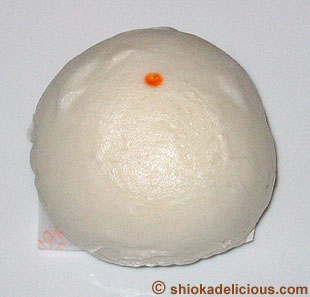
My mum also highly favors Kong Guan’s lian yong bao, because, she says, it is made with pure lian yong – i.e. lotus seed paste made purely from lotus seeds. A lot of the lian yong used in various Chinese buns, pastries and dim sum usually have either tapioca or sweet potato starch mixed into the paste, to add bulk and to enhance texture. Pure lian yong is a lot more costly.
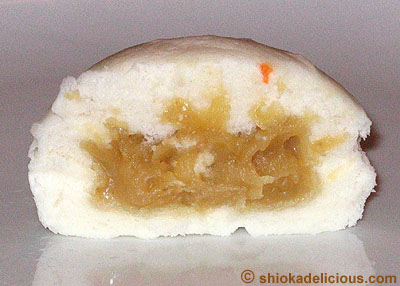
Pure lian yong has a purer, lighter yellow color, compared to the duller and darker color of regular lian yong. I personally don’t have preferences either way. I enjoy pure lian yong. But I also like the darker lian yong, especially in a bun that comes with a whole or half a salted egg yolk. Beautiful partnering of sweet and salty I say.
For Kong Guan paus, very often we buy them in the frozen family packs. In this instance, I will without hesitation say the frozen version is as good as their freshly made paus. And it is so convenient. We almost always have a pack or two sitting in the freezer. Anytime anyone feels like a snack or a light tea, simply pop one of the frozen paus into a bowl, which in turn goes onto a metal rack set into a small saucepan filled with an inch or two of water. Just steam the pau from the frozen state, no need to thaw. And within 12 minutes or so, you are ready to bite into a piping hot, soft, fluffy pau that taste freshly made.
There are literally hundreds of both big and small pau producers on our tiny island. I have not tried them all. But amongst those that I have tried, which number quite a few, time and again, I have returned to my favorites... Tiong Bahru Bao, Teck Kee Tanglin Pau and Kong Guan. I do not claim that they are the tastiest in the land, and would love to discover other wonderful, shiok pau eats. So, all recommendations are welcomed.
And the next time you feel like a hamburger… how about a da bao instead?
Copyright © 2004 Renee Kho. All Rights Reserved.
Please contact me for permission to copy, publish, distribute or display any of the images or text contained in this article.
03:38 AM in Tastes of South East Asia | Permalink
TrackBack
TrackBack URL for this entry:
http://www.typepad.com/t/trackback/532839
Listed below are links to weblogs that reference Fast Food… Chinese-Style:
» Pau or Bao or great buns of happiness! from da*xiang
It's almost 4 pm and things are moving really slowly here at work. My stomach wants a tea break, my brain is just sitting outside where the sun is shining and my eye see Renee's amazing post on pau/bao/Chinese buns.... [Read More]
Tracked on March 13, 2025 04:55 AM
» Pau and Da Hua from How Now, Brownpau?
PAU! Or Pao. It's the snack that bears my name. Last Saturday, after reading Renee Kho's extensive treatise on pao (found completely at random from... [Read More]
Tracked on March 25, 2025 06:46 AM
Comments
i love char siew paos the most... mmm... succulent, juicy char siew
Posted by: jasmine | March 12, 2025 07:16 AM
whats your opinion on muslim
paus?
I once had a chicken pau from a muslim
stall in NUS. Something was missing and
it finalliy hit with the last mouthful,
no taste of wine.
Posted by: Ken | March 12, 2025 09:55 AM
Yummm! This has been one of my favorites (I know it as siopao) forever, and I never get nearly as much of it as I want! I was a happy camper when I could get this for lunch as a kid, and I always thought it was weird that the other kids didn't know what it was.
Posted by: ladygoat | March 12, 2025 10:19 AM
Reminds me of my happy days when i was in Kuala Lumpur...the small van in Cheras sold the best tai pau in town...however the pork meat was slightly lighter brown in color instead of darker-soya type as shown here in the pictures...wonder how they prepared those?
Posted by: Tulip | March 12, 2025 07:22 PM
My personal test for pau skin, if the top layer can be removed easily, the pau skin would be fluffy and soft. If it just disintegrate in a soggy mess, chances are the skin would be too pappy.
No offence intended here Renee, but the only paus I would eat in Singapore are the ones at better Cantonese restaurants like Lei Garden and Crystal Jade. The local players have slipped too far in terms of taste and quality, there are merely a ghost of the real thing. Rubber skin, mystery meat slathered in too much MSG, oyster sauce and additives, no thanks.
There is hope yet, but not in S'pore. The pau shops in KL, many no-name places, but I can think of a few along Jln Ipoh and Cheras, make far superior versions. Their Da Bao skin is fluffy outside and inside, it is slightly softer from absorbing the meaty juices; in fact, some of us prefer the skin to the filling. The chicken comes in whole pieces, in fact, you can see the skin and bones, and the boiled egg is a generous quarter wedge.
Posted by: umami | March 12, 2025 09:15 PM
Nice post! I've tried rectangle-shaped pau, curry pau, and other fusion types, but nothing comes close to the traditional big pau and char siew pau. I like to dip my pau in garlic chili sauce (bottled). Am I alone on this?
Posted by: FatMan Seoul | March 12, 2025 11:57 PM
hi jasmine,
they are delectable indeed. : )
Posted by: Renee | March 13, 2025 03:29 AM
hi Ken,
I haven't actually had a Muslim/Halal big chicken pau before, come to think of it.
I've tasted halal char siew pau (not in S'pore tho'), made from chicken, and the versions I've had have been very tasty and fairly authentic - taste wise at least, tho' of course with chicken the texture is different compared to real char siew pork.
sorry, I'm not sure what could be the difference between the marinade of a halal bun and non-halal.
then again, I think each pau maker has his/her own marinade recipe.
I'm not sure, but I don't think wine is usually used in the marinade of Chinese paus, but I'm not an expert. : )
sorry I can't help shed more light on this...
Posted by: Renee | March 13, 2025 03:33 AM
hi ladygoat,
childhood food memories are so precious aren't they? oh yes, I remember my enjoyment of steamed paus for lunch as a kid too!
I've always wondered, is there any big differences between the Filipino siopao and the Chinese baos?
(assuming that is what you are referring to for siopaos?)
Posted by: Renee | March 13, 2025 03:40 AM
hi Tulip,
oh yes, the little vans selling goodies... forgot about those! some did indeed sell very good food!
I think maybe the lighter color of the meat is just from a marinade of light soy sauce, pepper and other seasonings, but without the dark soy sauce.
but I'm just guessing... : )
Posted by: Renee | March 13, 2025 03:45 AM
hi fatman seoul,
really? rectangular-shaped pau? that's very interesting.
can't say I've tried pau with garlic chilli sauce, though it sounds rather interesting ; )
I've many quirky food habits... but can't think of one related to pau-eating for the moment : D
Posted by: Renee | March 13, 2025 03:47 AM
A dash of chinese rice wine can be used to marinade the meat stuffing of the big pau. I find that it enhances the flavour. Of course, this differs from recipe to recipe.
Posted by: FatMan Seoul | March 14, 2025 02:38 AM
oh, ok, hadn't realized that commercially made paus used rice wine in the marinade. have never managed to taste it in the paus : (
but, yeah, if I ever made my own paus, I would definitely use a little rice wine...
thanks, fatman seoul.
Posted by: Renee | March 15, 2025 12:43 PM
Hi Renee, just wanted to tell you how much I adore your webpage. Your pictures are so lovely, and the paus...oh, they made me drool and wish that I were in Chinatown right now...:) Anything for the xiao long bao...or the ones with chives...yum!
Posted by: Cathy | March 16, 2025 11:55 PM
hi cathy,
it was so lovely to read your comment. thank you for your support and very kind words. I’m very happy to know that you are enjoying the blog.
ooh… yes! xiao long bao… and chives dumplings… very delicious indeed! I love them too!
Posted by: Renee | March 18, 2025 12:48 AM
im a first time reader...and I love this site...everything is so delicious sounding! And I love food! I was wondering if you had a recipe for any of this steamed buns. If not then where could I possibly get them from? I am located in the United States in the Midwest. It may not be possible but I figured I'd ask since google turned up nothing. Thanks so much...I look forward to reading a new adventure everyday.
Posted by: barb | March 18, 2025 05:59 AM
hi barb,
thank you for stopping by, and am very happy that you enjoy the site.
unfortunately, I do not have a recipe for steamed meat paus.
however, most good-sized Chinese restaurants (especially the Cantonese ones) which serve Dim Sum, would serve these paus, especially for brunch and lunch on weekends.
some Chinese cake shops/bakeries in Chinatown should also have these available.
hope that is of a little help.
and please do visit often : )
Posted by: Renee | March 19, 2025 03:08 AM
thank you so much. I have actually found many simple recipes for both the dough and the filling through Google. I havent looked in the asian bakeries and shops though. I cant wait to find them!
Posted by: barb | March 20, 2025 11:11 AM
hi barb,
good luck with the search. hope you manage to find some in your local Chinese restaurants or bakeries.
oh, and if you do make some of the buns from scratch, would you mind coming back and letting me know how it goes? I love hearing about other people's cooking/baking experiences, and just sharing and learning about food.
thanks : )
Posted by: Renee | March 20, 2025 02:43 PM
My friends and I attempted to make some steamed buns this evening. I began speaking of my quest to find the mysterious steamed buns. It turned out that my friend had a mix for the bun dough. It was the SIng Kung Corp. brand for Bot Bahn Boa. Some of us are vegetarians so we didn't make the bbq pork type. We couldn't find the red bean paste for a sweet bun so we improvised and made a paste of red raspberries. I just pureed the berries and mixed in lots of sugar and corn starch over high heat. This turned out amazingly well. My friends and I steamed them in a bamboo steamer to a successful end. I will email you the photos of the leftover buns with a cross section. Thanks for the inspiration for a night of fun!!! :)
Posted by: Barb D. | March 20, 2025 03:02 PM
Wow, Barb! That sounds so incredible! I love the creativity of a raspberry filling. What an innovative blending of East and West.
And they look really good too! Heh. Wish I could have a taste.
A resounding success on a first time outing in making steamed buns. I’m so impressed.
Now, you have me inspired to start making my own paus too. : )
Thank you so much for coming back and sharing.
(oh, and an email is on its way to you)
Posted by: Renee | March 21, 2025 01:25 AM
Mmmm... Tiong Bahru Pau.... =)
heya :-) Singaporean in exile here (studying in the States) and your blog is evil! The kaya entry had me eating my precious kaya stash with a SPOON. And now the pau cravings... oh man =)
Thanks for the tip on the Teck Kee Tanglin Pau; we drive by their storefront occasionally but have never gotten anything from there. My mum grew up in Tiong Bahru (she used to play with the man who's now inherited the cheng tng stall) and has always sworn by Tiong Bahru pau and chok. But now that they've changed their meat pau recipe, I don't know any more... I'll have to get her to try the Tanglin ones and report back, in lieu of my actually flying home and eating one!
y'know, my angmoh boyfriend still talks about the Tiong Bahru char siew pau, almost a year after he had them for the first and only time. =) they're just so good. *sighs and drools*
Posted by: Michelle | April 20, 2025 12:25 PM
hi Michelle,
thanks for taking the time to drop me a note, which I really enjoyed reading.
yes, I still like the Tiong Bahru char siew pau - yum! : )
oh yes, please do report back if your family does try the teck kee pau, and let me know what they think.
I'm always interested in finding out the food opinions of others : ) what to do? once a foodie, always a foodie! LoL.
Posted by: Renee | April 21, 2025 06:06 PM
Am Ipoh-mali currently living in the U.S.A. Saw the paus and kept drooling all over the place! Maybe some pau expert can spare me a good, "killer" pau dough recipe, soft and fluffy where the skin can be easily peeled off like the ones in the pictures, together with kaya and red bean paste recipes too. THANK YOU.
Posted by: Tee Alsberg | April 25, 2025 11:42 PM
tee alsberg - thanks for dropping by my site... glad you enjoyed the pics : )
Posted by: Renee | April 27, 2025 01:12 AM