« TGIF | Main | More Food Talk »
Sunday, March 07, 2025
Is My Blog Burning? – The South East Asian Tartine

Blog burning day is here again. This is the day when food bloggers from around the world cook up a storm based on a set theme. The excellent idea was cooked up and served by Alberto last month, and is this month inspired and hosted by Clotilde. The theme? Tartine. Which, as Clotilde elegantly puts it, is “a popular Parisian dish, in which different ingredients are arranged and served on a slice of bread – a sort of open-faced sandwich if you will”. How exciting! This leaves so much space for interpretation and innovation.
As I pondered on the theme, I decided I wanted to bring my Parisian friend, Tartine, to Asia and offer her a distinctly South East Asian experience. But, what constitutes “South East Asian”? I mean, we are such a hodge-podge melting pot of so many different cultures. Chinese food is no more South East Asian than Indian food or Malay food or Peranakan food. Hmmm… So, I finally decided to call upon my friends Roti, Satay and Floss from the Indian, Indonesian/Malay and Chinese epicurean community respectively and to enlist their help in coming up with something that would offer Tartine a tasty glimpse of South East Asia, all encapsulated in just one bite.
I asked but only two requirements of my willing helpers. First, it must not be a jarring culture shock that would send Tartine fleeing back to Paris, never wanting to set foot in Asia again. It had to be a harmonious snapshot of the three cultures. Elegance would be nice but was optional. Harmony and tastefulness were a must.
Second, the entire production must be ready to be served by dinner time. It was already 3 o’ clock on Saturday afternoon, which meant they had just over 4 hours to get the show on the road.
And so they were off…
The Indian Foundation
Roti returned soon after, all flushed and excited, bearing her find. She had found the perfect South East Asian representative of bread, she declared. I looked expectantly into her shopping bag, and pulled out two packs of frozen roti prata – plain and onion. I looked at Roti quizzically. She gushed: “it’s perfect! See, I was inspired by my own name – Roti. It also means “bread”. And roti prata is the perfect introduction to South East Asian breads, and it’s great for putting toppings on, and it tastes great, all crispy, light, fluffy and flakey, and….”
I stopped her before her face became any redder from all that excitement. Oh alright, we would use roti prata for the bread base. But really, I was expecting to make something from scratch, and not use something yanked out of the freezer box of a supermarket. Roti rolled her eyes. “Well”, she asked pointedly, “do you know how to do all that flipping and twirling? Because I don’t.” So, I conceded defeat. Besides, I have tasted this Spring Home brand of frozen roti prata before (yes, I finally admitted it), and it had tasted pretty good. And hey, I was all for ease and speed. So that settled it.
Whilst waiting for the others to return, Roti and I decided to start frying up the pratas. (Directorial aside: remember, this is a production where concepts of time and space are sometimes skewed. In real life, pratas are not amenable to early preparation).
Oh, by the way, maybe we should add at this juncture that roti prata goes by its other name, roti canai over in Malaysia… just in case you bump into it over on the other side of the Causeway, and fail to acknowledge it and it gets all offended and sulky.
Roti prata’s name label had declared that no oil was necessary in bringing it to its peak taste performance. We could heat it up either in a frying pan or in the oven. We opted for the former. But, just so as to ensure a truly tip-top display of taste, we decided a light coating of Pam cooking spray would help roti prata to its peak condition.
It was quite fascinating to watch… as roti prata started to metamorphosize from a flat, ghostly white nondescript being into a bubbly, puffy, tanned, golden brown beauty. Now, the key to keeping roti prata happy is to have the pan all nice and hot before putting it in. Next, don’t bother it once it goes into the pan! Let it sit happily, soaking up the heat. Wait until it starts to turn slightly translucent and starts puffing up with exuberance from all that warmth. Only then should you even dare to take a quick peek on its underside. If the bottom is showing signs of having had enough of the heat, and is all nice and golden brown, quickly flip it pale face down. When face is golden brown too, it’s done. Now, the golden rule (pun intended) here is to ensure roti prata doesn’t get too tanned. Over-do the heating, and you end up with one dark, moody and cranky roti prata which will be pretty much useless for any purpose. So, watch the heat and make sure roti prata doesn’t sit in it for too long. It’s sensitive like that.

Now, isn’t that some beauty?
As we began working on plain prata’s cousin, onion prata, Satay returned with the haul of her own treasure hunt.
The Indonesian/Malay Filler
Roti and I descended on Satay, all eager to see what she had found. Triumphantly, she pulled out a tub of peanut paste, a packet of err… more peanut paste, and erm… some ground peanuts… With our eyes opened wide, both Roti and I chimed in unison, “have you gone nuts??”

“Wait… there’s more”, promised Satay. She pulled out fresh de-boned chicken thighs, some beef tenderloin and some tempeh.
By now I was smiling. Oooh, tempeh! I like! I haven’t had it in a long time. How sweet of Satay to have remembered. Tempeh (cultured soy bean cake) is supposed to be good for you – what with all that protein, minerals and soy isoflavones…
Satay’s voice broke through my thoughts. “… and so I decided I would take inspiration from my name, Satay…” Inwardly, I rolled my eyes (humor me… just pretend this is possible). “We are going to do a combination of influences from the Indonesian salad gado-gado and the Malay satay, but without the sticks”, she continued enthusiastically. Roti and I listened intently. “Here’s the plan… we have the spicy peanut sauce from the gado-gado and satay, we have tempeh from the gado-gado and chicken like in satay. Oh, and since you mentioned that one of the guests doesn’t eat chicken, I got some beef too…”
“But you didn’t even buy taugay (beansprouts)”, I interjected abruptly.
“Oops! Never mind. We will use cucumber… there is cucumber in gado-gado too. And we’ll grate it so that it looks like taugay. How’s that?” She’s good. I’ll give her that. That was fairly quick thinking on Satay’s part. So, I decided to let her off.
“How are we going to bbq the meats?” asked Roti.
“No need for that. We’ll just sauté them in the wok”, replied Satay.
“But that’s not satay”, Roti persisted.
“I said influence of satay. I didn’t say satay”, irritation creeped into Satay’s voice.
“Okay, girls, I think we need to get cracking if everything is going to be ready in time for dinner”, I intercepted.
Phew! And so our attentions were diverted to getting all the stuff ready…
Peanut Sauce
As I examined the peanut pastes that Satay had bought, I thought out loud: “we are supposed to try and make things from scratch you know?”
“Dearie, we are not going to have time to pound all the spices and fry up the rempah (spice mix). It will take us a good 1-2 hours to get really fragrant rempah.” I sighed. Again, I conceded defeat. But it was okay. Afterall, I have been taking the peanut sauce shortcut all these years, so why should this time around be any different. And I was glad Satay had thought to buy the “home-made” version from my regular satay beehoon hawker, who sells her home-made peanut paste in little plastic tubs. Hers was always nicely fragrant with belacan, in addition to the usual spices.
The supermarket-bought pack of “instant peanut gravy” didn’t have belacan – it was a simpler “formulation”, with just the usual spices. It smelt less fragrant. We decided to use both anyway. The former for the chicken and the latter for the beef.
I set two saucepans on the stove, and emptied the peanut pastes into each one. Next, about ¾ to 1 cup of hot water was added to each pot. I normally would add just enough liquid to get the sauce to the consistency I want – sometimes I want it thicker and chunkier for use as a dip, and sometimes I prefer it more liquid when using it as a gravy to pour over bee hoon (rice vermicelli) to make satay bee hoon. (Okay, here’s a little confession. We took a little artistic license here. For aesthetic purposes – you see, we knew Tartine would be wanting to take pictures of the food – we added only ½ cup of water, so that things wouldn’t look too liquid in the photos. But ideally, it would be about ¾ cup to 1 cup. And this is just between you and me.) Now, of course, if you wanted to up the richness level by several notches, you could add more coconut milk instead of water. But that can make the coconut taste too overwhelming. Besides, the peanuts are already rather rich, so my personal opinion is that water works better. Your guests are less likely to feel jelak (our South East Asian lingo for “over-full, over-rich, sick”) too quickly.
As the sauces started to warm up, I rummaged in the pantry for some gula melaka (palm sugar) and dropped a small piece into each pot. I also added, as I normally do, a little more ground peanuts for added fragrance and to, well, make the peanut sauce more erm… peanutey. About five lightly heaped tablespoons was good enough.
And that was it. I allowed the sauces to simmer on low heat for about 15 minutes, and went to check what Roti and Satay were up to.
Satay Chicken
Satay had cut each of three pieces of skinned and de-boned chicken thigh meat into sixteen small bite-sized pieces, and seasoned the meat with about 1 tablespoon of light soy sauce, ¼ to ½ teaspoon of sugar and a little bit of cornflour. (We made enough to serve about 5 persons).
I watched as she heated a little oil in a frying pan and quickly sautéed some minced garlic and shallots. In went the marinated chicken. It was stir-fried until just about half-cooked. Then, right on cue, my peanut sauces were done simmering. One pot of the gravy was added to the chicken, and stirred well. We left the chicken to simmer in the sauce for a few minutes (3-4 minutes) to allow the meat to finish cooking and to absorb the flavors from the gravy.
Yay, the chicken was done.
Satay Beef
We repeated the process with the beef. We sliced it into fairly thin bite-sized pieces, and seasoned it with light soy sauce, sugar and cornflour. We sweated some shallots in hot oil, and added the beef. Again, as the beef reached half-doneness, we added the peanut gravy and left it to simmer for a few minutes.
Now, that was pretty easy… Satay and I grinned in satisfaction.
Tempeh
We looked over to see how Roti was doing. She had already finished preparing the tempeh, which she had cut into thin slices and fried in a little hot oil until they were beautifully golden brown. Very little oil was needed for this – only about 2-3 tablespoons for the entire batch.
The Supporting Cast
Roti had already begun to busily prepare our supporting cast members… the cucumber and onions.
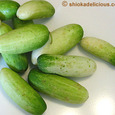
She used one Japanese cucumber. After removing the skin, she grated it into long elegant strips. We were all unanimous on this – Japanese cucumber was definitely sweeter, juicier and crunchier than the normal varieties. Good choice.
Two large onions were also cut into long strips, sautéed in a little hot oil and seasoned with light soy sauce and pepper. We took another creative license here too. Ideally, we wanted to caramelize the onions to a rich brown color, but we were ever aware that this would make the onions less than photogenic. And so we settled for a paler color and hoped Tartine wouldn’t notice the difference in taste too much.
Wow, we were done. The three of us stood in the kitchen proudly surveying our handiwork. Not bad for creativity on short notice we thought. But hey, where was Floss? What was taking her so long?
The Chinese Topper
Right on cue, Floss drifted (like Floss always does) through the door and dramatically placed a red and yellow plastic bag on the kitchen table. We waited, knowing full well a story was about to unfold, whether we wanted to listen to it or not.
“Yeah, yeah, I know I’m late”, Floss begins. “But I was wracking my brains trying to think of what to buy. And then… guess what?!”
“What?” we sighed.
“As I was walking down Orchard Road thinking and thinking, it suddenly hit me, I would bet my bottom dollar that both Roti and Satay would buy something related to their name…”
Suddenly, Floss’ eyes caught sight of the food spread on the table. “Aha! See I was right!” she yelped triumphantly. “Luckily, I too decided to buy something related to my name. Because just at that moment, I was passing by a Bee Cheng Hiang shop. Now, how is that for serendipity, huh? I was so sure it was a divine sign, telling me something. So, I went in and bought… (drum roll…) pork floss!”
“I knew Satay would probably buy chicken, but I don’t like the texture of chicken floss as much as I like pork floss, so I bought pork floss, and so there”, she continued. “Plus, it is krispee pork floss!”
“Pork floss is good, I like pork floss. Krispee pork floss is even better. And it will make an interesting topping for the satay chicken”, I smiled.
The Whole Ensemble
“Okay, girls, we are ready. Let’s get the show on the road”.
Roti and I worked on the satay chicken plating, while Satay and Floss did the beef sandwich.
I topped a nice crispy, flakey plain roti prata with some shredded cucumbers, while Roti arranged pieces of the beautifully golden brown tempeh on top of that…

Next, a generous serving of spicy, fragrant chicken with peanut gravy…

Finally, it was all topped with krispee pork floss…
Just then, Satay looked over and remarked: “it looks like a mountain… why is the floss pointed like that... like some kind of cone?”
“Oi! Don’t you come stabbing your finger into our satay chicken sandwich! You go back there and concentrate on your own beef sandwich.” Roti was on the defensive, brandishing a fork and waving it menacingly in the air. “Besides, it’s called style… you know? Have you seen those fancy restaurants? The higher you pile the food, the classier it’s supposed to be… you know?”
The rest of us could barely suppress our giggles.
“And let’s see you do any better”, challenged Roti.
Satay and Floss had placed some shredded cucumber on the onion roti prata, followed by the sautéed onions… (nice continuity there we thought, and praised the girls accordingly).

And they finished the sandwich off with a generous dollop of beef in satay peanut sauce and a sprinkling of toasted sesame seeds…

We stepped back to admire our creations. Not bad. Now, the test is in the tasting.
Just then, the doorbell rang. It was Tartine. Right on time.
[Fast forward one and a half hours later…]
Throughout the whole dinner production, Tartine had eaten with great concentration, eyes wide as she savored the different tastes and textures of South East Asia laid out before her. As the table cleared of all visible signs of food, she took the final sip of her warm teh helia (ginger tea) and sat back in her chair. Slowly a big smile started to form on her face. “When may I come again?” she asked. “Oh, anytime, we would love to have you back, anytime…” we chimed. Tartine smiled even wider. “It was good. I will be back…”
It was with a little sadness that we saw Tartine to the door. She kissed us on both cheeks, waved a cheery goodbye and walked off into the night.
Roti, Satay, Floss and I smiled at each other. It was a very pleasant evening. The company was scintillating, and our tummies were round and full. We sank onto the sofa, and I reached for the remote. The dishes can wait for tomorrow…
But before the curtain falls on this special multi-cultural South East Asian production, we would just like to highlight to you some of the other roles some of our main cast members play from time to time:
• fabulous Roti Prata often takes on a favorite breakfast role – sans embellishment, au naturel, fresh, hot and crispy, it is sprinkled with or dipped into sugar. Ah! Sweet simplicity!
• and of course, for all times of the day – breakfast, snack, lunch, tea, dinner or supper – Roti Prata is a favored companion of all sorts of curries: mutton, chicken, vegetable, dhal or whatever strikes your fancy. Curry without Prata and Prata without Curry, it just isn’t right…
• sometimes, Roti Prata goes the full hog and indulges in over-indulgence – it is stuffed with minced mutton or other meats, fried onions and egg before being fried to crispy perfection. For such illicit, artery clogging activities, it takes on the name of its alter ego, Murtabak.
• as for Satay Peanut Gravy, well, when it is not providing a warm bath for skewers of Satay Meat or skewers of Satay Celup or providing a spicy blanket cover for Gado Gado Salad, sometimes it likes nothing more than to chill out and spice up a plate of plain beehoon (rice vermicelli). And oh how it is loved whenever it reprises its role as Satay Bee Hoon.
• it is of course equally loved when it tops crispy deep fried tofu and takes on the character of Tauhu Goreng.
• and Floss… well, Floss is so versatile, it would probably take a book in itself to document its numerous and varied roles in the South East Asian culinary scene. So, that will have to be for another time and another place…
With that, we thank you for your patience and attention. The production was lengthier than we had planned. We hope you had as much fun as we did bringing this production to you. Until next time... au revoir!
Copyright © 2004 Renee Kho. All Rights Reserved.
Please contact me for permission to copy, publish, distribute or display any of the images or text contained in this article.
05:27 PM in Home Cook: Poultry & Meats, Home Cook: Sandwiched! | Permalink
TrackBack
TrackBack URL for this entry:
http://www.typepad.com/t/trackback/517290
Listed below are links to weblogs that reference Is My Blog Burning? – The South East Asian Tartine:
Comments
Ooohhh... I thought I could skip dinner tonight. But after seeing this, I am starving already!
Posted by: Gin | March 7, 2025 06:31 PM
Hi Renee. Thanks for visiting my blog. You have a truly great blog here yourself. And I see that we share many common interests, e.g. all things food, cooking, Jamie Oliver(?) etc. Really really grreeaatttt.
Do come back, ya?
Posted by: FatMan Seoul | March 7, 2025 07:06 PM
Bravo Renee!
This looks terrific and is extremely creative. I love that you opted for a South East Asian themed tartine, great idea!
Posted by: Deb | March 7, 2025 08:09 PM
hi Ginger,
oh no, don't skip dinner... do take care of yourself : )
Posted by: Renee | March 7, 2025 10:35 PM
hiya Fatman Seoul,
thanks for dropping by too, and for all the kind words.
very happy that you like the blog.
be sure I'll be visiting your blog very regularly : )
I have to admit to not knowing much about Korean food, so now I get to taste and learn vicariously through you.
feel free to visit anytime : )
Posted by: Renee | March 7, 2025 10:37 PM
hi Deb,
you're too kind.
I don't think I'm even half as creative as you are... you and your cooking are a constant source of inspiration!
Posted by: Renee | March 7, 2025 10:40 PM
Wow Renee. This is the best post ever! What a fantastic write-up! I also love how creative you are...*kow tow* :)
Posted by: Ariel | March 7, 2025 11:37 PM
Wow Renee. Those tartines look delicious! What wonderful combinations.
Posted by: Elise | March 8, 2025 02:01 AM
*drool*
and i still haven't eaten indian food. sigh. BUT! this week for sure. :)
check your email dearie. :)
Posted by: Wena | March 8, 2025 02:03 PM
This look delicious. And I love the SE Asian idea! Only one mean question ;-): how do you manage to eat it without everything dropping on your clothes?
Posted by: Alberto | March 8, 2025 06:45 PM
hi Ariel,
you're making me blush! pai sei leh...
but glad you enjoyed the post. : ) thank you.
Posted by: Renee | March 9, 2025 12:32 AM
hi Elise,
thank you so much for your encouraging and supportive words : )
Posted by: Renee | March 9, 2025 12:33 AM
hey Wena,
you have mail. : )
Posted by: Renee | March 9, 2025 12:36 AM
hi Alberto,
not a mean question at all (all questions are welcomed : ) )
well, the best way to eat it would probably be the traditional Asian way... with the hands!
one could flatten the fillings slightly and roll up the prata and munch on it like a roll...
or to do it the "real" traditional way... just eat it with your fingers... tear away a small piece of the prata from the side, pinch up abit of the various fillings, and put it in your mouth.
(and that's how pratas, naans etc are all eaten... just tear and dip or pinch)
the Malays and Indians eat everything with only three fingers of one hand, and the fingers never touch their lips. food is also taken from communal dishes with the same fingers, so these fingers are not allowed to touch the lips when feeding yourself!
everything, including the hottest (i.e. temperature) and wettest curries are eaten with the fingers!
no problems with food on clothes at all... just takes practice and experience ; )
but of course, one could also just use a knife and fork and eat it the "western" way ; )
Posted by: Renee | March 9, 2025 12:41 AM
Wow, what a towering tartine! It looks fantastic.
Posted by: Josh | March 9, 2025 02:12 AM
Renee,
My tartine is a satay too. How funny? I made it last weekend but didn't manage to post it until today.
Yours look very great. I love what you did with the cucumbers.
Pim
Posted by: Pim | March 9, 2025 10:30 AM
hi Josh,
thanks! yours was gorgeous too!
hey Pim,
that was a nice bit of synchronicity : ) Thai satay & Malay satay...
yours looked wonderful... yeah, I like using beef tenderloin too... another nice bit of synchronicity : )
Posted by: Renee | March 10, 2025 12:31 AM