« Luffa’d Chick | Main | Eating the Traditional Un-traditionally »
Tuesday, June 22, 2025
For the Love of a Poet
Once upon a time, during the Warring States Period of Ancient China, there lived a great patriot and poet called Qu Yuan. It was a calm, ordinary day when he received news that his beloved country had fallen into enemy hands. Devastated and inconsolable, he threw himself into the river and drowned. The villagers, on learning of Qu Yuan’s suicide, rushed in their boats to try to save him. When they failed both to save him and to find his body, they became worried that his corpse would be eaten by the fish in the river. They thus came up with the ingenious idea of throwing packets of rice into the river to feed the fish, in the hope that the hungry creatures would not then feed on Qu Yuan’s body. Every villager also brought out their drums and gongs; and with great fervor, they beat upon them, creating a huge din, hoping to scare away the “river monsters” that they believed to be living in the waters. They were prepared to do anything to preserve the body of their beloved Qu Yuan.
And so it is that each year, on the 5th day of the 5th lunar month, Chinese all over the world pause to commemorate the death of Qu Yuan, who is considered to be the first great poet in Chinese history. On this day, dragon boat races are held in recollection of the villagers’ rescue attempts; drums and gongs are beaten during the races in the same way that the villagers had beaten on theirs during their sorties on the river; and rice dumplings are made and eaten by each family in remembrance of the packets of rice that were thrown into the river to preserve Qu Yuan’s body.
Over time, as society advanced and grew in prosperity, the plain rice dumplings evolved into elaborate affairs, filled with meat and various other ingredients. Each dialect group, and indeed every “Overseas Chinese” community dispersed across the globe, developed their own unique interpretation of the rice dumpling. Each family would also have their own cherished recipe for the “tastiest” dumpling. And so it is with mine.
Although rice dumplings are now readily available in the stores and can be eaten throughout the year and not just during Duan Wu Jie (or Dumpling Festival), they somehow take on added meaning and special significance during the festival. For my family, while we are quite content to buy ready-made rice dumplings during normal times, when it comes to the Dumpling Festival, something always seems amiss if we do not make our own. And no matter how many luxurious and scrumptious versions of rice dumplings I may have tasted, there is only one that I want for Dumpling Festival – a simple, unassuming dumpling filled with ground peanuts. For me, this dumpling defines the festival.
Both my grandmothers made these peanut dumplings; my aunts and my mum still makes them; and now I too am learning to make them. Rice dumplings filled with ground peanuts seem to be a peculiarity of the Brunei, Sarawak (Miri) and Sabah (K.K.) regions. I have never seen them sold in Singapore, or even Peninsular Malaysia. And they are the only variety that I yearn and long for each year when Dumpling Festival rolls around.
Usually, about two weeks before the festival, my mum and I will start to busy ourselves buying the ingredients, prepping them and making the dumplings. It is something I look forward to every year. It is hard work, but so much fun; and that indescribable feeling of satisfaction that comes from seeing the family enjoy the dumplings makes all the effort well worth the while.
This year, however, we were very late in getting started. And it wasn’t until this past weekend that we managed to make the dumplings; just two days before the festival itself!
The prepping work starts the day before the actual wrapping of the dumplings. And it is probably best to try and get as much of the preparations that can be done ahead of time done, ahead of time. It makes for a less frazzled, more relaxed experience when it comes to making the dumplings, a process which in itself can take up a full morning and afternoon, depending on how many dumplings are made.
Prepping the Ingredients
Bamboo Leaves
The dried bamboo leaves used to wrap the dumplings are sold in bundles, together with the hemp strings used to tie the dumplings. This is the traditional way to secure the dumplings. Nowadays, the factory-produced dumplings tend to come tied with multi-colored nylon rafia instead!
[We usually try, wherever possible, to buy the larger sized leaves, as this allows us to build bigger dumplings that can be filled more generously with all the scrumptious stuff!]
The night before, the leaves are submerged in a large tub of just-boiled hot water, and left to soak overnight. The next morning, each leaf is carefully washed and wiped clean. Then, they all go into a large stock-pot or any other pot that can hold them comfortably, and boiled in water for about 1 to 1½ hours, or until they are soft and pliable. This is an important step; if the leaves are not soft enough, they have a tendency to split when you are trying to wrap the dumplings, making it difficult to shape the dumpling and to keep the fillings from spilling out.
After they have been taken off the heat, leave the bamboo leaves soaking in the pot until just shortly before they are to be used. Then, drain them in a big colander. Do not dry the leaves. It is important that they still be slightly damp when used to wrap the dumplings.
Mushrooms
The day before, soak the dried Chinese mushrooms in water for about 10 minutes; drain and rinse well. Next, bring a pot of water to a rolling boil; lightly season the water with a little cooking oil and sugar, and add the mushrooms. Simmer on very low fire until tender (approximately 2 hours, depending on the size of the mushrooms).
Drain and de-stem the mushrooms. Cut smaller mushrooms into halves, and larger ones into threes.
Marinade them with some hoisin sauce, light soy sauce, sugar and pepper, and leave to macerate in the fridge overnight. This makes for gorgeously flavorful and succulent mushrooms!
Pork
Pork belly is the most commonly used cut of meat in rice dumplings. We, however, have a preference for using shoulder meat; we find it to be more flavorful than the belly. It is also less fatty, but with just the right amount of fat to produce melt-in-the-mouth tender meat and to give a nice lusciousness to the rice and other ingredients in the dumpling as it cooks down. We think it makes for a wonderful combination of smooth, sensual mouth-feel, rich flavor and melting tenderness. Still, either cut of meat works beautifully; use whatever makes you the most comfortable.
Clean the pork and remove the skin. Cut into medium sized chunks. [We find that it is best not to have the meat pieces too large, as these tend not to reach the right tenderness in the fairly short 1½ hours cooking time for the dumplings.]
Season the meat with some hoisin sauce, light soy sauce, sugar and pepper. And leave to marinade overnight in the fridge.
The next morning: in a little hot oil, sauté some minced garlic until soft and fragrant. Add the pork and quickly brown the pieces on all sides. As soon as the meat changes color, add a little dark soy sauce, and mix well. Remove the meat from the heat, drain and reserve the gravy. Set the meat aside to cool.
Ground Peanuts
These can be prepared the day before too, to make for less work on the day itself.
Take some skinless raw peanuts – the smaller varietal is better than the larger one – and roast in the oven until a light golden color. Allow to cool completely before blitzing them in the food processor.
How coarse or fine the peanuts should be really depends on personal preference. We sometimes make them slightly chunky; other times we have them ground fairly fine; and yet other times, we do two batches, and make dumplings with peanuts of different fineness!
[We use a lot of peanuts in the dumplings… usually about 700-800g for about 20 dumplings!]
Glutinous Rice
Rinse the glutinous rice, then soak for about 2½ hours; this can be done on the morning itself or the night before, whatever works best for you. Drain well.
In a little hot oil, sauté some minced garlic until fragrant. Add the rice, together with a pinch of salt, a little bit sugar, a dash of light soy sauce and the reserved gravy from the sautéed pork (above). Stir well so that each grain of rice is well coated with the oil and all the flavorings. Remove from the heat, and allow to cool.
[While the common practice is to leave the rice in dumplings plain and white, our family tends to prefer a little color in ours; and the pork gravy does a wonderful job of imbuing the rice not only with color but also wonderful rich flavors.]
Dried Scallops
Soak in hot water for about 10-15 minutes and drain well. Sauté very quickly in a little hot oil to release the flavors and aromas. Set aside to cool.
[As the scallops have to be shredded before being used in the dumplings, it is a lot more economical to buy the ones that come chopped or broken, rather than the more expensive whole ones.]
Dried Shrimps
Again, soak in some hot water for about 10-15 minutes, and drain well. In a little hot oil, sauté until nicely fragrant. Leave to cool. Coarsely chop and set aside.
The dried scallops and dried shrimps are optional; add them or leave them out as your palate dictates. You also don’t have to use both of them together; either on their own would add a nice nuance to the other dumpling ingredients. An alternative would be shredded dried cuttlefish (prepped in the same way) – my maternal grandmother loved using this in her dumplings, but I was never one for dried cuttlefish in mine. I always felt its flavors and aromas to be a little too aggressive and overpowering for the other ingredients.
Another ingredient that we usually use is Chinese chestnuts. This year, in our rush, we forgot to buy any, so we had to leave them out. [But as it turned out, the whole family actually preferred the dumplings without the chestnuts! The consensus was that without the chestnuts taking up precious space in the dumplings, there was room for more of the other delicious stuff like the meat and the mushrooms, which everyone agreed were way more flavorful and enjoyable than chestnuts. So I suspect the chestnuts have now come off the ingredients list permanently, at least for this family.]
Wrapping the Dumplings
Shaping the Leaves
This is going to sound a whole lot more complicated written out and explained in words than it really is; so don’t let the descriptions faze you. It is rather simple really; it just takes a little bit of practice to turn it into a smooth and quick process that produces perfectly shaped and uniformly sized dumplings each and every time.
The first goal is to create a cone-shaped receptacle with two bamboo leaves.
Taking two pieces of similar-sized bamboo leaves, line them up stem to stem. If one leaf is larger than the other, place the larger leaf under the smaller one. Holding the leaves horizontally, with the shiny sides facing you, have the bottom/outer leaf slightly offset from the top/inner one by about ½ inch or so; that is, you should see the outer leaf peeping out over the top edge of the inner leaf.
Looking along the length of the leaves from their stems, at just slightly past the halfway mark, make a small fold at the point where the top edge of the inner leaf meets the outer leaf. Twist both ends of the leaves, and bring them together, to create the conical shape. The tips of the leaves will be the slightly shorter end, and should be on the inside of the cone.
The key is to not have the fold (bottom right hand corner of picture) wider than ½ inch. The larger the fold, the smaller and shallower the cone, and thus the less stuff you can fit into the dumpling. Having said that, you also do not want the fold to be overly narrow, as that would increase the likelihood of the dumpling coming apart during the tying and cooking processes.
Adjust the leaves slightly if necessary, to get a snug fit of the outside leaf against the inside leaf – there should not be a gap between the two leaves. At this point, ideally, you should have in your hands, a tall, evenly shaped cone.
Now, for the fun part, the fillings…
Filling the Dumplings
The way my mother and I fill our dumplings is very different from the “standard” way of filling dumplings; it is catered to our family’s specific preferences when it comes to dumpling eating!
For a start, we tend to reverse the rice and filling ratios. Usually, dumplings have a rice-to-filling ratio of maybe 70:30 (or if you are lucky, 60:40). More often that not, it is rice that predominates, and the filling is, well, just a bonus. We, on the other hand, usually do a 30:70 rice-to-filling ratio. Or at least, my mother does. I personally tend to prefer slightly more rice in my versions of the dumpling, and thus go for a 40:60 ratio. We just feel that it makes more taste-sense to have more of the fillings than rice, since it is in the various ingredients that all the flavors can be found, and not in the rice. Of course, bottom-line considerations dictate that store-bought dumplings would rarely practice such a belief; and thus one of the joys of eating home-made dumplings.
Next, we like to do the “dumpling stopper” in our own little special way. The “dumpling stopper” (as we call it) is that small triangle of rice that is always found at the tip of the dumpling, where rice has been placed at the bottom of the leaf-cone to act as a “stopper” to prevent any potential “leakage”. And it is this triangle of plain, none to flavorful rice that is the family’s biggest gripe about eating store-bought dumplings. Very often, that uninteresting piece of rice is left abandoned and uneaten on the plate when all else has been devoured. So, for our home-made dumplings, we create a peanut-filled rice “stopper” instead.
Holding the leaves as you would an ice cream cone, drop a small amount of rice into the cone. Using the back of a spoon, spread the rice out onto the sides of the cone, creating a hollow, into which you put a little of the ground peanuts. Top with a little more rice, and level the surface. And there you have it; a “dumpling stopper” made of ground peanuts enveloped in a thin layer of rice. When cooked, the rice will be beautifully fragrant and tasty from the ground peanuts inside.
The final difference is in the way we layer the rice and various fillings. Most commonly, dumplings are made sort of sandwich style. You have rice on either end – in the tip and at the broad top end; and then you have the fillings all lumped together in the middle. We prefer to layer the rice and fillings alternately; this allows for an exquisite intermingling of flavors as the dumplings cook. The rice becomes filled with the rich tastes of the meat and mushrooms; and eating the dumpling becomes a pleasure, with each mouthful filled with a nice balance of all the different ingredients, instead of having a mouthful of just plain rice, or a mouthful of nothing but the fillings.
So, here is how it goes…
Over the rice “stopper”, sprinkle a thin layer of ground peanuts. Add 2 pieces of mushrooms, a small dollop of dried scallops or shrimps, and a nice chunk or two (depending on the size of your chunks) of meat. Follow this with a layer of rice. Next comes another piece of meat, a further piece of mushroom, and a little more dried scallops. Add a thin layer of rice, and finish off with a generous helping of ground peanuts.
And it should look something like this. Notice how my mum’s is always tall, slender and elegant, while mine…
…is somewhat more fat and squat! 
Essentially, what this all means is that there really aren’t any “rules” or “this is the way it should be done” standards when it comes to how the dumplings are filled. Whatever makes your taste-buds swoon and sigh with pleasure is the “best way” that it should be done – for you. Feel free to experiment and play with the ingredients and just have fun layering and stuffing the dumplings.
There is only one small proviso. Avoid packing the ingredients too tightly into the cone; the rice needs a little space to expand as it cooks, otherwise you end up with very hard, undercooked and unpalatable rice. At the same time, we don’t want the ingredients to be too loosely assembled; there should not be gaping spaces – so use the rice as a “space-filler” in between the meats, mushrooms and other fillings.
Wrapping and Tying the Dumplings
Once filled, the dumplings are ready to be wrapped up and tied.
Holding the filled cone securely, fold down the extended ends of the leaves over the dumpling.
Using the same hand that is holding the dumpling, press down on both sides to form a triangular shape.
With the other hand, fold the excess leaves over onto the side to complete the pyramid shape. If necessary, snip off the pointed stems to neaten up the dumpling.
Taking a piece of hemp, wind it around the dumpling twice on the vertical axis. Make a double knot to secure.
[The key is to use your fingertips to keep the hemp snugly wound round the dumpling as you make the knot; the pyramidal shape of the dumpling does mean that the hemp is going to slip and slide and come loose if you don’t. At the same time, remember not to grip the dumpling! It’s a subconscious thing; we don’t realize we are doing it, but in our bid to keep the hemp secured around the dumpling, we tend to apply too much pressure. Not only does that result in misshapen dumplings but also a highly compacted one that will cook out rather hard and dry. The idea is to tie the dumplings fairly firmly but not tightly. It shouldn’t be too loose either, or we will end up with glutinous rice soup when the dumplings come apart as they are boiled! It sounds a little complicated; but all it really takes is just a little practice to get the hang of it.]
Then twine the hemp around the dumpling on the horizontal axis, and secure with a double knot.
[This is how both my mum and I do it; it ensures a very secure dumpling that will not come apart or have stuffing oozing out during the cooking process; we also don't get the deep indentation that is commonly seen where the string has been tied real tight, and where in that area, the rice doesn't cook as nicely as in the rest of the dumpling. Ours is probably not the most professional way of tying dumplings; the true expert would require only just that two times around the vertical axis with the hemp, and all sides of the dumpling would be secured. But hey, as long as the dumplings look nicely shaped and taste good, we are not going to quibble about an additional round or two with the hemp string!]
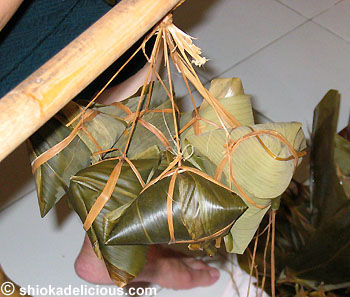
And so we work steadily, making 9-10 bushels of 10-12 dumplings each. It’s quite a sight to behold; we set up little “work stations” in the kitchen with bamboo poles stretched out across table and counter tops, from which we hang the knotted hemp. As the dumplings are tied on, we end up with a whole row of hanging green bushels. A rather delicious sight if you ask me!
Cooking the Dumplings
The dumplings are boiled in large pots of water. A little planning ahead will help make the cooking process a lot smoother and quicker.
Before you start making the dumplings, bring one (two is even better) large stock pot or the largest pot you have, filled half to two-thirds with water, to a boil. This will take awhile, so by the time your first few bushels of dumplings are done, the water will be ready too.
We use two pots - a large commercial-sized stock pot that we normally use to double-boil bird’s nests in, and a large pot that hawkers normally use to cook curries with - to cook the dumplings!
When the water comes to a rolling boil, add a little bit of salt (not too much, or the dumplings will be too salty). [We add about 2 teaspoons of salt into our large pot of water.]
When the dumplings are ready to be cooked, place them into the boiling water and simmer on low-medium flame for about 1½ to 1¾ hours, depending on the size of the dumplings. [Ours this time round took 1¾ hours and came out perfectly cooked.] The rice should be nicely soft with a little bite. It may take a little trial and error to get the timing right; too long and the rice is mushy, not long enough and it is hard and dry. But 1½ hours is a very good gauge; most of the time, any adjustments should usually be only 10-15 minutes on either side of that.
It is important to make sure all the dumplings are submerged in the water; any that are above the water line will not cook properly. Several bushels can go into one pot at the same time, as long as the dumplings are not too cramped up in the pot.
When the dumplings are cooked, remove from the pot and place on wire racks to drain and cool.
In the meantime, bring the water back to a boil, ready to receive the next batch of dumplings.
Eating the Dumplings
After a hard day’s work, it was time to sit back and enjoy the fruits of our labor.
We were very happy with the results of this year’s dumplings. The rice was beautifully soft and translucent, with just the right blend of fluffiness and sticky chewiness.
And oh, the pork! That bowled me over – melt-in-the-mouth tender and richly flavored. I would say it was probably the best meat we’ve made in dumplings for the last couple of years. I loved it!
The mushrooms were sensuously succulent, and the peanuts (my favorite part of the dumpling) offered a wonderful aromatic and fragrant finish. The seasonings were all very well-balanced and cohesive. Very nice!
[Sorry, a little messy, I know; I was chaffing at the bit to tuck into my dumpling!]
Just a little word on storing the dumplings: they can be stored in the refrigerator for about 3-5 days; or if frozen on the day they are made, they will keep in the freezer for several months. But I would say they are still best eaten within 3-4 weeks; I find the dumplings start to be a tad less flavorful if kept longer than that. For us, after the requisite gift-giving to relatives and family, the remaining dumplings are usually gone within a week or two!
To serve frozen dumplings: simply steam, straight from the freezer (without defrosting), for about 25-30 minutes.
And how do you tell if a dumpling is past its eat-by date? After it has been steamed, and when you cut or break open the rice, if you see thin, stretchy, clear strands (almost similar to spider cobwebs) stretching from the rice, then the dumpling is only fit for the dumpster… sorry.
My mum learnt to make rice dumplings as a young woman, watching and helping her mother each dumpling festival. She was the only daughter who picked up the skill; her two sisters were never interested enough. And I think it has been her quiet yet deep wish that I will in turn continue the tradition of making dumplings each and every Dumpling Festival. And so it is that I have, for the past couple of years, slowly learnt and practiced making them. It is true; dumpling making is a skill that is honed through years of loving dedication to a tradition that is centuries old. It is all about practice and experience. My dumplings may still be a little misshapen and not terribly elegant compared to my mum’s (and for each one I successful wrap, my mum makes two!), but hopefully by the time my own daughter (should I have one someday) is ready to learn the art of dumpling making, I will be ready to teach her and pass on the baton of tradition.
Wishing all Chinese a Happy Duan Wu Jie!
And happy dumpling eating!
Copyright © 2004 Renee Kho. All Rights Reserved.
Please contact me for permission to copy, publish, distribute or display any of the images or text contained in this article.
02:03 PM in Festivals: Sights & Tastes | Permalink
TrackBack
TrackBack URL for this entry:
http://www.typepad.com/t/trackback/852613
Listed below are links to weblogs that reference For the Love of a Poet:
Comments
Wow Renee, if you call this "a simple, unassuming dumpling filled with ground peanuts" I'd like to know what the assuming ones look like ;-). As usual, great post, it's always a pleasure to read your well detailed descriptions.
Posted by: Alberto | June 22, 2025 02:52 PM
Ground peanuts? Must be a regional variation?
My mother and her sisters use either mung beans or black-eyed peas!
Posted by: glovefox | June 22, 2025 04:11 PM
Renee,
Brilliant post! You have such talent and patience to learn how to do this. Never in my wildest dreams would I ever think of trying to make something like this. My thought is always...they're so inexpensive, so I should just buy them. I'm sure you must have enjoyed these. Homemade is always the best because you can make them the way you like them! =)
Posted by: Reid | June 22, 2025 04:35 PM
Happy Dumpling Festival! Renee, your dumpling looks really yummy. From memory, my grandma uses peanuts too in her dumpling but i couldnt remember if it's ground or whole. having been overseas for so long, i sure miss homemade dumpling! Once, we tried to make these yummy dumpling at home but it turned out bad and we ended up cooking glutinous rice instead.
Have you tried sweet dumpling? Last year I had the pleasure to try a red dates filled dumpling from the northern province of china. It was surprisingly good. But then again i prefer my dumpling to be savoury!
Posted by: pinkcocoa | June 22, 2025 04:41 PM
thank you thank you sooooo much for sharing!
Posted by: bess | June 22, 2025 05:54 PM
our family has the usual fillings
pork, mushrooms and chestnut.
we also add whole red beans to the glutinous rice.
the result is a dumpling that isn't too saltish and has a different texture from normal.
Its supposed to be hokkien style but most people i
know haven't tasted this variation.
anyway i'm suffering from tooooo-much-bak-chang syndrome ( indigestion : P)
Posted by: ken | June 22, 2025 06:05 PM
Hi Renee
Oooh...the bak chang photos look so-o good! My mom-in-law who is Hakka uses red beans for her bak changs. Personally I prefer the Nyonya ones myself.
I have yet to attempt to make a single one in my life - here in Malaysia they are so readily available and afffordable, I usually buy them! This year I read some restaurants here actually churn out the giant ones that weigh up to 1kg! The filling include roast duck meat, abalone and a whole load of good stuff - yet to try any of these myself though. One company even has ready-packed and frozen ones available this year which you can microwave or steam prior to consumption.
Posted by: Alice Yong | June 22, 2025 06:33 PM
Hi Renee, it's been a while since I visited your blog. Anyway, good to know you're blogging your way to stardom. :o)
I miss rice dumplings. Can't find them here even if I paid through my nose. Less than an hour ago, a friend of mine from HK called me up and told me that he was in town and had brought some for me all the way from one of HK's famous store. Wow! Can't wait to get it from him.
I like the nyonya ones and the pork ones with chestnut and yellow beans. Yummy!
Anyway, have a good dumpling day and if I don't get to drop by by Thursday, HAPPY BIRTHDAY!!
Posted by: FatMan Seoul | June 22, 2025 08:03 PM
Oh wow, those look so good. I'm glad you did a posting on this because I've been tempted to try and make it :).
Posted by: Jas | June 22, 2025 10:46 PM
Wow, this is a great post...my mom just brought home a bunch of these rice dumplings from taiwan, since my grandma in the last few years has set up a small business selling them from a stand in front of her house...apparently they've developed a good following. I also make rice dumplings with my mom (guess it's in the genes) but we dont usually add the peanuts, and that's a huge ratio of filling to rice! it looks so awesome! maybe i should make that suggestion the next time my mom and I make some...we usually do the pork, the mushrooms, and chestnuts, sometimes mung beans and a salted egg yolk too. Mmmmm. Happy Duan Wu Jie to you too!
Posted by: soopling | June 23, 2025 01:01 AM
hi Alberto,
thanks! : )
oh, you should see some of the... erm... "luxury" dumplings that the hotel chefs churn out nowadays with abalone and what not... ours are definitely "unassuming" in comparison : ) : D
glovefox,
yeah, as mentioned in the post, this is an East M'sia/Borneo variation.
whereas the mung beans and black-eyed peas versions are very common in s'pore and west malaysia, though some families in east malaysia also make dumplings with them in it.
Reid,
thanks : )
I guess I'm sort of very traditional in that way... and the older I get the more I believe in holding on to cultural traditions (lol. is my age showing?!)... I think that is what defines a person... sort of like: it doesn't matter where I'm living, in the West or in Asia, what makes me Chinese are my roots and cultural traditions.
I actually feel rather sad that a lot of Chinese find such "roots" irrelevant nowadays.
just makes me more grateful that my family is the sort that celebrates each festival and try to keep the customs alive... : )
sorry, I'm rambling... and having said all that, you're right... I wouldn't make these dumplings more than once a year! LoL! back-breaking work I tell you! : p
the taste is worth it though : )
hi pinkcocoa,
happy dumpling festival to you too! : )
yeah, I like the sweet alkali (ki zhang) dumpling too... especially the ones filled with red bean paste... (I'll be posting about them tomorrow)... my late paternal grandmother used to make them... but nowadays without her around, we are too lazy to make them, so we just buy them...
and instead of the usual dipping in sugar, I like to eat these with kaya and peanut butter! : D
I think some years back, I did try the date version you mentioned... from Northern China too... but I guess I'm still slightly more partial to our red bean paste version : )
hi bess,
my pleasure : )
glad you enjoyed it.
Posted by: Renee | June 23, 2025 01:52 AM
hi ken,
ooh... the red-bean-in-the-rice version is rather uncommon... I think I've only seen and eaten it once... made by a friend's family... I think they were hokkien too...
how nice that your family still makes the dumplings the traditional way : )
haha. I know what you mean... too much dumplings can not only throw a spanner in the digestive system, but can also, erm... create difficulties in the toilet department too! ; D
hi alice!
me too... under normal circumstances, I like the Nonya (dried shrimp) version... but when it comes to dumpling festival, only this home made version will do for me... I know, I'm weird.
in s'pore we are also awash with all the "luxury" and "designer" versions too... but, I don't know... for me personally, I find they seem to take away the "true" meaning of the festival... but that's just my opinion : )
I also worry for the day when no one knows how to make these dumplings anymore, and kids grow up not knowing any of the Chinese traditional cultural customs, and it just becomes another occasion to buy dumplings from the shop : (
anyway, happy duan wu jie to you and your family! : )
hey FMS!
so nice to have you back! : )
nice to have you back blogging after your little bout of jet-setting too ; )
erm... who? me? stardom? really don't think so... : p
wow, talk about a lucky devil! a dumpling all the way from HK... and hand-delivered too! now who's the VIP star, huh? ; D
a very happy dumpling festival to you too! and thanks for the b'day wishes : )
hi Jas,
oh, I hope you get a chance to try making some... quite a lot of fun (even though it's hard work too)...
happy dumpling festival!
hi soopling,
how lucky of you! to get dumplings made by grandma... I loved the dumplings made by both my grandmothers... but unfortunately, both have passed on now, so only memories left...
oh yes, I really like the mung bean and salted egg yolk combination too, but I've never made them before... we usually buy them instead... lazy ; )
happy duan wu jie to you and your family!
Posted by: Renee | June 23, 2025 01:59 AM
Wow and wow again! You make it sound sooooo simple but I know it isn't because I've watched it being done and you have to have nimble fingers to do the wrapping. I've tried the ones with the addition of red beans and I've also tried the savoury ones with the mung beans (I think this is a Cantonese version but I may be wrong) but not the peanut addition. Looks good and I can imagine the taste too. Mmmmmmmm.......
Posted by: belinda lee | June 23, 2025 07:53 AM
it looks so yummie....i miss the nonya dumpling that is usually dip in sugar....and sadly i cant seems to fold the triangle thingy when my mum was teaching me few years back...so i never get to make dumpling...
Posted by: husky9 | June 23, 2025 01:23 PM
hi belinda,
I think you're right... the mung bean version is Cantonese.
the peanut version is very good... but then again, I'm biased ; )
heh. I was all over the place when I first learnt to make the dumplings... very ugly creations indeed! lol! I'm slightly better now, but not much! slowly getting there though - I hope!
isn't it amazing how something that looks so simple like a dumpling can involve so much work and skill?
hi husky9,
you sound like a good cook... maybe it was just a bad first try those many years ago... I'm sure you could probably do it in a cinch now : )
Posted by: Renee | June 23, 2025 07:20 PM
hi renee,
thanks :blush: i am still a food newbie...i love eating..coming from singapore....heehee
Posted by: husky9 | June 23, 2025 11:38 PM
husky9,
: )
Posted by: Renee | June 24, 2025 04:34 PM
Wow! What scrumptious-looking dumplings! We call them "machang" or "lomaikai" here in the Philippines. Whatever you call them, though, they're a major treat. (Urrrgh, it's been AGES since I've had any!) Your recipe is worth trying; maybe I'll whip up a batch this weekend for the 'rents - even if Dumpling Festival's long past!
Posted by: Midge | September 8, 2025 10:59 AM
hi Midge,
I love "zhong zhi"! they are very scrummy indeed.
we also have the Chinese dim sum dish "lo mai kai" but although that is also made with glutinous rice, it is steamed rather than boiled (as with these zhong zhi).
Posted by: Renee | September 8, 2025 01:48 PM