« Crunch Time | Main | Loh Dou Fung Shang Shui Hei! – Part II »
Wednesday, January 28, 2026
Loh Dou Fung Shang Shui Hei! – Part I

Loh! Loh! Loh dou fung shang shui hei! (Toss, toss, toss till the wind grows and the water rises! i.e. tossing up good luck, fortune and prosperity). This is the chant which is echoed across South East Asia throughout the 15 days of the Lunar New Year celebrations, as plate after plate of this colorful fish salad, known as “yu sheng” (Mandarin) or “yu shang” (Cantonese), is tossed and devoured with delight.
This dish has its beginnings in Singapore, with historical roots in Southern China. And it has now made its mark around the globe, and is loved and enjoyed by not just the Chinese, but by other Asians and Caucasians as well.
The Story Goes…
The dish “yu sheng” in its current, colorful form, with all the intendent auspicious symbolisms, was created by four Singaporean master chefs Hooi Kok Wai, Lau Yoke Pui, Sin Leong and Than Mui Kai, in the mid-1960s.
However, its roots stretch far back to the small coastal villages of Guangzhou province in Southern China. Its origins are found in a simple village practice of the poor Chinese fishermen of the past. To celebrate the seventh day of the CNY or ren ri (Humanity’s birthday), these ancient fishermen had a tradition of feasting on the one commodity they had in abundance – fish (“yu”) – which was also synonymous with abundance and prosperity due to the sound of the word “yu”. As these fishermen spent long periods out at sea, the fish was simply sliced and eaten raw, the simplest and freshest way – no cooking required.
This cultural practice was then brought to Singapore by our migrant founding fathers, a large majority of whom hailed from the Southern provinces of China. However, given the different living conditions here, the fish was no longer eaten raw, but instead evolved into fish porridge (yu shang zhuk or raw fish porridge) served at roadside stalls. The thin slices of raw fish would be added to piping hot white rice porridge, the heat of which would quickly cook the fish slices through.
In the mid-1960s, the four master chefs were inspired to create a unique CNY dish using the strips of raw fish from the porridge. They combined the raw slices of local fish known as ikan parang with a mélange of vegetables, both fresh and pickled – ranging from shredded carrots and radish, to pickled and candied ginger, cucumber, winter melon and even jellyfish. All tossed and mixed together with a plum sauce dressing. The colors were bright, cheerful and enticing. The symbolisms were auspicious. The taste was a tantalizing tangy sweetness.
And Now…
In the almost 40 years since, the dish has evolved further. But the essence remains the same. The base ingredients are: 1) fish, 2) shredded white radish, green radish and red carrot, 3) 9 varieties of pickled and/or candied vegetables.

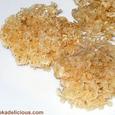
(Starting from the red mound in the upper left hand corner, and going counter-clockwise): 1) red pickled ginger, 2) preserved vegetable strips, 3) green preserved cucumber strips, 4) preserved melon strips, 5) yellow ginger, 6) purple preserved vegetable strips, 7) candied winter melon, 8) diced dried Mandarin orange peel, 9) pickled leek.
(Center mound): Shredded white radish, shredded red carrots and shredded green radish. The serving portions of these three vegetables descend in this order, with the green radish being present in the smallest amount among the three, as the latter is the least “naturally sweet” of the three vegetables, and oftentimes has a touch of “sappiness” to it. The white radish is naturally crispy, crunchy and sweet, as is the red carrot, which is somewhat “harder” in texture. I personally prefer to have the last two in almost equal portions or with the red carrot just a tad less than the white radish. With all three combined, there is an interesting mix of different textures and tones of sweetness.
To all this is added deep fried, crispy dough crackers (“pok chui”), ground peanuts and roasted sesame seeds. Everything is then tossed together with a little peanut oil and the plum sauce dressing.
In recent years, in order to entice jaded Singaporean tastebuds, restaurant chefs have also started using alternatives to the traditional raw ikan parang (wolf herring I think) fish slices. Raw salmon, raw tuna, raw mackerel or smoked salmon yu sheng have been around for many years. Now there is lobster, abalone or even geoduck yu sheng. Yes, there is sometimes no longer any “yu” (fish) in “yu sheng”  That's why I prefer calling the dish "loh hei" rather than "yu shang" or "yu sheng".
The last one or two years have also seen new flavors in the dressings used – Thai-style sweet, sour, spicy dressing; mala (Szechuan “numbing” hot spicy peppercorn) dressing; Peranakan-style dressing; Japanese-style dressing and so on. Traditionalists among Singapore foodies balk at such twisting of the yu sheng taste. However, they are others who welcome the change. Personally, I’m all for using different fish and seafood, and even meat, in the salad, but I still prefer the cleaner and “purer” taste of the “traditional” plum sauce dressing.
Another change that has gone largely un-noticed is that when it first started, this loh hei yu shang dish was only served on the 7th Day of the Lunar New Year or ren ri (humanity’s birthday) – in keeping with the ancient traditions of the village fishermen of long ago. It was served along with noodles (symbolizing longevity). However, nowadays, it is eaten throughout the 15 days of the Lunar New Year celebrations, and very often, even before the New Year, as enterprising restaurant owners cash in on the popularity of the dish.
My family makes all our loh hei at home, and one variation that we like is using shredded roast duck breast meat instead of the usual raw salmon or smoked salmon. Sometimes we end up eating loh hei as many as 8-10 times in the space of 15 days, and the thought of more salmon or fish loh hei simply does not appeal anymore. And so a duck alternative makes a welcome change for the tastebuds. The denser texture of the meat gives a stronger bite to the salad, and the smoky aromatic flavors of the roast duck adds a distinctive twist to the dish.
I find that fish, seafood or meats with stronger flavors work better in the loh hei, as they add an additional layer of flavor to the intricate and richly complex taste matrix of the salad. Naturally bland seafood or fish that take their flavors from surrounding ingredients seem to work less well – eg abalone, lobster sashimi etc. So my personal preference is to use things like smoked salmon or smoked tuna, and roast duck.
Tossing Around the World
Close to 40-years on, this Guangzhou-inspired, Singapore-created salad can now be found in parts of the world as far-flung as New Zealand, the UK and the US. It now makes its appearance on the CNY menus of Singaporean/Malaysian and some Chinese restaurants in major cities like New York, London, Sydney and Melbourne, as well as in countless homes in towns and cities across the Western hemisphere. And here, more innovation has taken place. With lo hei ingredients not readily available at grocery stores in these countries, creative home chefs have come up with various alternatives for “pok chui” ranging from using deep fried wantan wrappers to using cornflakes!
Our next door neighbour, Malaysia, has also taken heartily to this dish. This is now a ubiquitous addition to CNY menus for almost all Chinese restaurants and eating houses there, and is served in the run-up to and during the full 15 days of the Lunar New Year. However, the Malaysian version is uniquely Malaysian, and looks and tastes rather different from the Singaporean version.
Pre-packed loh hei ingredients are now also now imported from Singapore and readily sold in supermarkets in predominantly Malay/Muslim countries like Indonesia and Brunei.
Strangely enough, lo hei has yet to take root in Hong Kong. Most restaurants there do not feature this CNY dish, although it is well-known that many Hongkongers, including many celebrities, love this dish, and have been known to have relatives or friends cart back packs of the dish’s ingredients from Singapore.
The dish is also slowly making its way back to the place of its historical birth. Certain hotels in major Chinese cities like Shanghai now serve this dish, although it has yet to establish a firm presence in the local restaurants. However, given the Chinese penchant for all things associated with “prosperity” and “good fortune” the tide in mainland China is surely changing. And so, this Chinese migrant dish is finally going home…
Tomorrow, how to make and toss loh hei yu sheng…
* The above is based on information taken from an article by Solomon Lim that appeared in The Straits Times on 18 January 2004.
Copyright © 2004 Renee Kho. All rights reserved.
Please contact me for permission to copy, distribute or display any of the images and text contained in this article.
02:00 PM in Festivals: Chinese New Year 2004 | Permalink
TrackBack
TrackBack URL for this entry:
http://www.typepad.com/t/trackback/414884
Listed below are links to weblogs that reference Loh Dou Fung Shang Shui Hei! – Part I: