« Of Butterflies and Lighted Candles | Main | Skeletons in My Bread Cupboard »
Friday, March 26, 2025
Hainanese Infatuation

I recently re-discovered a great food-love of mine. Kaya. That rich, highly aromatic jam of egg and coconut milk. It is aptly named, this jam. “Kaya” is Malay for “rich”.
This is probably the original South East Asian jam. It may sound surprising, but Asians don’t have a history or culture of fruit preserves. Sure, we preserve fruits. But usually only as dried or candied fruits. Not as preserves.
Kaya is what many Singaporeans and Malaysians grow up eating on their morning breakfast toast. Kaya toast is a near sacred institution in these two countries. (More on this in my next post.)
There are essentially two broad styles of kaya – Hainanese and Nonya. The former evolved from the Hainanese migrants who landed on our shores, many of whom ended up working as cooks in coffeeshops or in the homes of the colonial masters. The latter emerged from the kitchens of the very food-proud Straits Chinese or Peranakans. The basic ingredients and method of preparation for both are the same. Large amounts of eggs, coconut milk and sugar are slowly cooked down, in a double boiler, until it becomes a luscious, redolent, thick, smooth cream or paste. It is a laborious process. The mixture has to be constantly stirred. It involves standing at the stove, without moving away, for 2-3 hours, stirring continuously. It takes patience, dedication and yes, a lot of arm strength. It sounds terribly simple, but to get the jam to a smooth, non-lumpy texture, with a glistening sheen requires experience – quite a lot of experience, be it your own or that of the person who taught you how to make the kaya. And that was the way the very often closely guarded recipes were handed down, by word of mouth, from master to disciple. I remember when my mum was trying to pick up tips on kaya-making, it took a lot of persuasion before some (not all) would impart a few of their secret tips to making excellent kaya.
The difference in the two styles lies in the flavoring and the treatment of sugar. The Hainanese-style kaya (the brown one) is colored by caramelized sugar, which also imparts a different richness of aroma and flavor to its sweetness. The Nonya-style kaya (the green one) is flavored, and therefore also naturally colored, by highly aromatic pandan (screwpine) leaves.
As a kid, I adored kaya. I had it for breakfast. I brought it to school for my morning break. And sometimes, I had it again for tea in the afternoon. The kaya I ate every day was home-made by an elderly woman, and bottled in little glass jars that she had collected from somewhere, cleaned and re-cycled. Each morning she would be at the market, selling her home-made kaya.
I didn’t know it at the time, but the ones she made, and the ones which I loved so much were of the Hainanese style, or at least her version of Hainanese-style kaya.
I remember the breathtaking aroma of the coconut milk each time the jar was opened. I remember the intensely sweet taste of the jam. (It’s amazing how sweet kids like their food.) I remember the caramel-y undertones of the jam. I also remember the kaya’s bright orangey-red color. There was none of the “dull” natural brown of caramelized sugar for this elderly “auntie”. No, instead the jam was “brightened up” (as she used to say) with the addition of bright color additives. And how I loved the smooth, almost runny, creamy texture. The taste of a piece of toast, covered with melted butter and rich kaya… sublime!
As an adult, we bought our kaya from the supermarket. Mostly Nonya-styled. These were commercialized, mass-produced versions, churned out of large vats in a sterile factory. They were starchy modern incarnations of the original. Gone was the loving process of manually stirring the rich potion to bring it to its peak fullness of flavor and texture. Starch was added to aid the thickening process, and to give the jam a glistening glossiness. Additives were also added to stabilize the product and prolong shelf-life. Gone was the need to eat up the jam within one week of purchase. The modern versions could keep for weeks on end. Gone too was the assurance and knowledge that the jar of kaya we bought was freshly made the previous night, and not weeks or maybe months before. Pretty soon, gone too was my interest in kaya. The aromas and flavors no longer titillated.
For years, I stopped taking kaya altogether. I found new and more interesting taste-bud teasers like peanut butter, nutella and fruit preserves to top by bread and toast with. Then, a few weeks ago, I had a tryst with destiny. While browsing the supermarket (yes, it’s one of my favorite activities), I caught sight of this jar of kaya (see top picture). It was the packaging that initially grabbed my attention. It had a rather “classy” label for a jar of kaya. Definitely different from the normal kaya packaging that I was so used to seeing. It even had a small little gift tag attached to the back of each jar. I liked this updated, modern new look.

The price was also definitely “classy” – at almost double of the best-known, and probably best-selling brand of kaya.
It was a brand I hadn’t seen before. Kaya House. They offered both the Hainanese and Nonya versions. It was the former that called out to me. It was less commonly available. Most brands only rolled out the green Nonya kaya. I popped one into the shopping cart.
Since then, there has been no turning back. I’ve fallen in love all over again. It’s very different from the version that I ate as a kid. And yet in some ways it is rather reminiscent of the taste of old that I remember so well.

Some would contend that Kaya House’s version of Hainanese kaya does not have the best texture and aroma that can be found. And yet, I am so incredibly infatuated with it.
The color is a nice, natural brown of caramel. No color additives. (In fact, no preservatives too.) It smells and tastes of coconut milk and caramelized sugar, and yet is not overly sweet. The texture is not the smoothest, with a slightly grainy feel, but only a tad so, with no effect on the mouth-feel of the jam. In fact, I find that appealing. It gives a sort of rustic, home-made feel to the kaya. It has the consistency more of a thick paste rather than of a custard. Yet, it spreads easily and smoothly.
It seems to have become highly popular. I went through my first jar so quickly that I had to restock soon after. It was sold out at my regular Cold Storage outlet. I bought another jar when new stocks arrived. On my next trip to the supermarket, just days later, it was sold out again. And interestingly, it is always the Hainanese version that sells out the quickest. This new brand seems to have answered an unspoken cry of desire. People are perhaps tired of the Nonya kaya. We want change. And now we have gotten it. Kudos to Kaya House.
So this is my current food infatuation. I eat it with everything. Toast, bread, cream crackers, Ritz crackers…
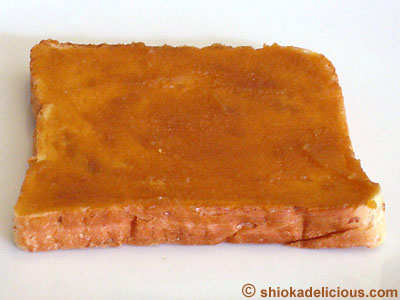
The simplicity yet eloquence of a piece of kaya bread.
Talking about bread… oh gosh… of late, I have been imbibing toast/bread like there is no tomorrow. That’s next… my wild and quirky adventures with bread…
Copyright © 2004 Renee Kho. All Rights Reserved.
Please contact me for permission to copy, publish, distribute or display any of the images or text contained in this article.
02:12 PM in In My Shopping Basket | Permalink
TrackBack
TrackBack URL for this entry:
http://www.typepad.com/t/trackback/577219
Listed below are links to weblogs that reference Hainanese Infatuation:
Comments
OK, now I have serious cravings for kaya toast! However, am going to indulge in a bowl of Sarawak laksa tomorrow. Will think of you! ;-)
Posted by: joyce | March 26, 2025 11:21 PM
when making it, does it have to be stirred in one direction only?
:)
Posted by: Alistair | March 27, 2025 04:27 AM
gosh renee, i love reading your website because you're much more well-versed in matters of my own food heritage than i am! i am hainanese, and i remember my grandparents (now deceased) making the hainanese kaya when i was a kid, but i had no idea what went into it. and i haven't had it for over a decade now. i am going to have to search for it at cold storage... thanks so much!
Posted by: Po | March 28, 2025 10:06 AM
hey joyce,
now you have me thinking about Sarawak laksa… hmmm… me thinks I should get off my lazy b*** and go make some… : p
in the meantime, have some on my behalf ya? ; )
hi Alistair, but of course ; )
Posted by: Renee | March 28, 2025 03:02 PM
hiya Po,
nice to hear from ya! ; )
oooh, you had home-made kaya as a kid? wow, I’m jealous! ; ) that must have been fantabulous! nothing quite beats the home-made taste, huh?
Posted by: Renee | March 28, 2025 03:03 PM
The golden Kaya - to me when I visited my granny in Malaysia, my family there who is Hakka would make the Golden Kaya, so is it a Straits Chinese product as opposed to Hainanese product>?
STirring in one direction- thats one thing I cant understand - physics and chemistry-wise it shouldn't make a diff but all good cooks claim it does. WHy?
Posted by: mrbbc | March 28, 2025 07:37 PM
This sounds absolutely amazing, Renee! I've made coconut curd before (same ingredients but only cooked very lightly), and now I'm toying with the idea of making this...
Posted by: Angela | March 29, 2025 06:47 AM
hi mrBBC,
it can get a little confusing… :)
the golden variety of kaya is referred to as Hainanese-style kaya because it has its roots in the Hainanese-owned and run kopitiams of old - and not because it originated from Hainan in China or that it is a uniquely Hainanese delicacy.
the style became very widespread throughout the migrant Chinese community, and were made by hokkiens, hakkas and many other Chinese dialects.
however, this style of kaya was and is still termed hainanese-style (as can also be seen on the jar’s label in the top picture).
my mum is hakka and my dad foochow, and my grandparents on both sides made the hainanese-style kaya.
Straits Chinese refers to the peranakans or nonyas. and their kaya is of the green variety. and that style of kaya (even when cooked by non-Straits Chinese : )) is referred to as nonya kaya.
hope that helped clarify it a little. : )
Posted by: Renee | March 29, 2025 05:35 PM
hi Angela,
oh, I think you would enjoy this coconut “jam” a lot. the aroma is pretty amazing (if you like things coconut) : )
do let me know how it goes if you ever try it out. : )
Posted by: Renee | March 29, 2025 05:38 PM
I just had to say that Nonya Kaya is one of my favorites! I like it spread thick on a piece of toast with my coffee in the morning.
Posted by: reid | March 31, 2025 02:22 PM
Hey Reid! Hi.
Yay. Another kaya fan. : )
Have to say, kaya and toast is one of the yummiest things to have for breakfast, I think.
Posted by: Renee | March 31, 2025 11:08 PM
Hey Renee, I chickened out of making actual kaya (the thought of standing and stirring for two hours put me off, I'm afraid). However, I did make some of the coconut curd I was talking about (http://www.aspoonfulofsugar.net/blog/2004/04/coconut_honey_curd.html)... I'm now wondering if the kaya could be made in the microwave too...
Posted by: Angela | April 6, 2025 06:55 PM
hi-ya Angela,
ooh, your coconut curd looks beautiful! now I'm tempted to try this one out some day : )
is the lemon tartness very distinctive or more like a background note?
yeah, the stirring is a real bummer... one of the reasons why I hardly ever make my own kaya : )
hmmm... I've never tried it... not sure kaya will work in the microwave though... I think the very large quantity of eggs in the recipe would be a problem.
depending on the recipe, some call for as many as 20 eggs, and others may require equal parts eggs, sugar and coconut milk. and eggs don't usually respond well to long cooking times in microwaves (from my own experience that is).
even by the "hard manual labor" method ; ), with constant stirring, it is fairly easy to get a grainy or even lumpy texture on the kaya.
but hey, it could be interesting : ) ... will you be trying it out?
Posted by: Renee | April 7, 2025 03:46 PM
Talking about Hainanese Kaya, i myself is a die-hard hainanese kaya lover. Many of the so called hainanese kaya in the market are no longer authentic in taste and those available commercially in the supermarket are overly strong in coconut taste and far from home-made taste. I have tried home made hainanese kaya from Kaya King and it taste very delicious. They do delivery but only Tampines area.
Posted by: JT | April 11, 2025 04:25 PM
hi JT,
oh, this is interesting. would you have a number or address you could pass to me? I would love to check them out. do they sell at retail at all? or is this purely a home-based business?
(if you prefer, you can email me the number and address rather than posting it here)
Posted by: Renee | April 13, 2025 02:42 AM
hi, my father is a great fan of the hainanese-style kaya.True to his hainanese origin ;P. I wondered if anyone can tell me how to make it for his upcoming b'day? Thanx;=)
Posted by: Xan | April 20, 2025 02:50 AM
hi Xan,
sorry, don't have a tried-and-tested recipe to share unfortunately.
Posted by: Renee | April 20, 2025 04:00 AM
Hi Renee, sorry for the late reply. Here's Kaya King tel no: 93883950. Look for Kim.
Posted by: JT | May 2, 2025 01:13 PM
hi JT,
thanks! will check them out : )
Posted by: Renee | May 3, 2025 01:40 AM
Hi Renee,
Hainanese kaya is originated from Wenchang Province, in the island of Hainan. In local language, they are called "keh-iya", which means "add coconut" in Hainanese. When kaya arrived in strait, they were called by Malays as "kaya" due to the difficulty in pronunciation. Nonya learned kaya from Hainanese and made their own style. I should say, the way Hainanese makes kaya is pretty different from the rest, so as coffee.
Posted by: TJ | May 6, 2025 11:14 AM
hi TJ,
that's fascinating... thank you!
Posted by: Renee | May 7, 2025 01:23 AM
Ever wonder before how Nyonya family learnt Kaya making from Hainanese? By inviting them, the handsome hainanese eligible bachelors to "marry into" the family.
Posted by: ace | May 7, 2025 09:46 PM
I tried making kaya but the color is not brownish, instead, it is quite grayish. Is is beacuse of sugar? whould i use brown sugar or white sugar?
thanks.
Posted by: obet | July 12, 2025 10:39 AM
hi obet,
hmmm... greyish? haven't come across that before...
white sugar is fine... not sure what method you are using, but it is important to get the sugar caramelized (but not burnt) first...
good luck!
Posted by: Renee | July 12, 2025 01:38 PM
Hi Renee,
Sorry, should be greenish.
What i did, I put egg and sugar first, after sugar is dissolved, i put on the coconut milk.
I will try caramelized the sugar first.
thanks!
Posted by: obet | July 14, 2025 12:27 PM
hi Obet,
sorry, I think I'm getting slightly confused : )
are you trying to make Nonya kaya or Hainanese kaya?
if Nonya kaya, it should be green... from the pandan.
and in which case, you would not caramelize the sugar, as the brown when mixed with the green of the pandan will give a rather unappetizing color : )
if making Hainanese kaya, then the sugar should be caramelized but no pandan juice is used - at the most just a bundle of knotted pandan leaves is added for some aroma/fragrance.
and oh... it's probably best to avoid using aluminium pots to cook the kaya... certain pots can give the kaya a sort of greyish tinge.
hope that helps.
let me know how it goes : )
Posted by: Renee | July 15, 2025 04:14 AM
I live in The USA state of Texas.How would I go about getting some Kaya,both brown and green.
Posted by: Stephen | August 29, 2025 02:41 AM
hi Stephen,
thanks for stopping by! : )
unfortunately, I can be of no help at all in the hunt for kaya in Texas.
maybe you can try the Chinatowns in the major cities? perhaps some of the larger Asian supermarkets or grocery stores may carry some imported Singapore/Malaysian brands of kaya.
you may have more luck finding the green (Nonya) variety than the brown (Hainanese) one.
sorry I can't be of more help.
good luck with the search : )
Posted by: Renee | August 31, 2025 01:03 AM
Hi!
I lurve your kaya post! So tempting: reminds me of my days in Singapore and KL as a kid. I live in Manila now and we have kaya sold in the supermarkets (labeled as "coco jam" or "latik"). Much as kaya on kopitiam bread is tempting, we have a custom here in the Philippines where warmed kaya is served over hot suman sa lihiya (it's a glutinous rice dumpling steamed in banana leaves) - a sensual experience! I'll send a recipe along soon as I can for your personal enjoyment. ^_^
Posted by: Midge | September 6, 2025 07:40 AM
hi Midge,
I've never had suman (would you believe!), but it sounds wonderful! especially with the warmed kaya.
I'll have to make it a point to try some soon : )
ooh, a recipe (if possible) would be lovely too ; )
thank you!
Posted by: Renee | September 7, 2025 03:34 AM