« January 19, 2026 - January 25, 2026 | Main | February 2, 2026 - February 8, 2026 »
Sunday, February 01, 2026
Happy Chocolate Day!
I just found out that it’s Chocolate Day today. I never knew there was such a day. But hey, I’d be the last to complain! From now on, this date will be marked into my diary every year.  So, to all fellow chocolate-lovers (chocoholics?), a very happy chocolate day! May we have a sublime out-of-this-world chocolate experience today…
I love chocolate. Period. In all forms and guises. I melt in the presence of fresh hand-made truffles and pralines. Ooohh… Leonidas’ chocolate truffles!! Now, this is one way to get me to do anything you want!  Royce Chocolates work too! Exquisite quality chocolates at non-designer prices. I especially love chocolates with nuts in them. I also love dark chocolate... pure, simple dark chocolate (at least 75%)… Valrhona’s Guanaja 70%, Lindt’s Excellence 85%… Sigh!
But I also have some perennial “chocolate candy” favorites which I grab from the supermarket or petrol kiosk. These are what I call my “comfort chocolates”. I’ve always liked Kit Kat (the UK- or Australia-made versions – hard to find in Singapore where it is usually the Thailand-made version). When I’m feeling lousy, this one always does the trick. Strangely, I’ve never taken to other chocolate-covered wafers like “Take Six” (is that what it’s called? Can’t remember. The one by Cadbury’s).
Once in a while I like Malteses. I like sucking on them until the little balls burst in my mouth, releasing the sweet, melting malt honeycomb centers!  A recent addition to my “I like” chocolate list is Kinder Bueno. And of course, the ubiquitous Ferrero Rocher does it for me too. A combination of wafer crunch, fragrant and aromatic nut, smooth and chocolatey praline center always works well. And oh! Don’t you just love Reese’s Peanut Butter Cups? Oh, oh, oh… am I getting a craving now!
And I haven’t even started on my favorite chocolate cake, brownie, cookie, ice cream, tart, pie, fudge, sauce… Muahahaha… oh, I love chocolate!!
What’s your favorite chocolate? What gives you a tingle all over and puts a smile on your face?
Happy Chocolate Day!
* picture courtesy of Leonidas
02:29 PM in Food and Drink | Permalink | Comments (12) | TrackBack
Friday, January 30, 2026
The Loh Hei Chronicles
Someone asked for pics of the roast duck loh hei. So, here is a tongue-in-cheek mini-chronology of my loh hei "adventures" so far this year…
Okay, think along the lines of the song “the 12 days of Christmas”… and here we go…
On the Eve of New Year’s, my family gave to me…

…roast duck loh hei.
Another person asked the auspicious significance behind “duck”. I don’t think there is any. No one really makes duck loh hei – at least not that we have come across. This is exclusively a Renee’s mum invention. Hey, this is a privilege, ya know? I’m sharing a “family secret”  And a very yummy “secret” at that. Well, it is now longer a secret.
It just so happened that a few years back, we were having fish loh hei yu shang almost everyday throughout the New Year period, sometimes even twice a day, and we were so sick of the taste, that my mum just decided: “okay, let’s try something totally different… how about roasted duck breast meat”. And lo and behold, a new loh hei was born. Duck meat just seems to work very well.
Oh, come to think of it… one can accord auspicious symbolism to “duck”. Back in the early-mid 90s, a lot of homes displayed small table sculptures of wooden, crystal or natural stone ducks, as it was taken to mean “luck” (get it? “duck”… “luck”…). Also, ducks swim in water, and water signifies wealth and money. So there you have it… duck is auspicious!
On the first day of New Year’s, my family gave to everyone… salmon loh hei (see previous 2 posts for pics of salmon loh hei).
On the third day of New Year’s, I gave to some friends who gathered in my home… more salmon loh hei.
On the fifth day of New Year’s, my family gave to ourselves…

…char siew (bbq pork) loh hei.
This was an “accident”. We weren’t planning to have loh hei that day. But we had tapowed home (bought takeaway) char siew for lunch, and had bought too much of the bbq pork. What to do with all the leftovers? Then, a moment of inspiration… let’s try char siew loh hei! So, my mum and I whipped out the radishes and carrots… and started grating and wringing.
Another “lit light bulb” moment… hey, there are still some roasted cashew nuts leftover from CNY baking… wonder what that will taste like in the loh hei… so, that went in too. (9 o’ clock in the picture).
End result? Sorry, folks. It doesn’t work. For some reason, char siew just doesn’t work in loh hei. The texture and taste of the meat just doesn’t gel with the rest of the salad. We didn’t like it. And I don’t recommend putting whole nuts into loh hei. That doesn’t work either. It completely disrupts the balance of textures in the salad.
Oh well, now we know. Stick with roast duck!
On the seventh day of New Year’s, we celebrated our collective birthday by giving to ourselves… more duck loh hei!
And now, on the ninth day of New Year’s… erm… I’m still waiting for my next loh hei session…
Maybe a vegetarian loh hei… I’ve never actually had a vegetarian loh hei, and am not sure what restaurants use in place of the fish/seafood. I think putting mock duck or mock abalone (made from wheat gluten and sold in cans) might be interesting. Or for a healthier version (the mock abalone/duck has to be deep fried first before using), maybe the flavored tau kwa (firm pressed bean curd) sold in the supermarkets. They come in flavors like teriyaki and five spice. These would be simple to use… just cut into strips and serve. Hmmm… now, that’s an idea…
Akan datang…
05:52 PM in Festivals: Chinese New Year 2004 | Permalink | Comments (1) | TrackBack
Thursday, January 29, 2026
Loh Dou Fung Shang Shui Hei! – Part II
Preparing lo hei yu shang at home is quite a lot of work, but oh, so fun! And in my humble opinion, so much tastier than the restaurant version, simply because we can tailor the dish to exactly how we like it to taste.
The Groundwork
This is my family’s version of loh hei. It differs very slightly from the versions served in restaurants. We have omitted and/or substituted some of the side ingredients (which I will point out as we go along). Our presentation of the dish and the “procedure” for tossing the salad has also been modified very slightly.

The pickled and preserved vegetable condiments, candied dried fruit peels, crunchy deep fried dough crisps, ground peanuts and sesame seeds are all bought ready-prepared. We buy them in “bulk” sizes, enough for around 10 large servings of loh hei. However, they are also available in “gift packs” of individual servings, and these sometimes come with pre-shredded radish and carrots, and even the raw fish.
These colorful preserved/pickled vegetables are supposed to be ready to use straight out of the tub, but we like to “dry” them out more, to enhance their texture. Using a muslin cloth bag, we squeeze out all possible moisture from these condiments. Once this is done, they can be refrigerated and will keep for several weeks.
The fresh vegetables – i.e. the shredded radishes and carrot, are prepared only on the day the loh hei is to be served.

Once the white radish, green radish and red carrots have been peeled and chopped into large chunks, they are kept soaked in cold water prior to being shredded.
(It is possible to substitute the green radish with cucumber. However, the latter will provide less color appeal due to the lighter color of its flesh, and the texture and moisture level – and thus the “crunch” – will be different too).

A mandolin makes short work of the shredding process. This can be bloody work, quite literally. So, mind those knuckles and fingers! The plastic “protector” (not sure what that is called actually) is absolutely wonderful. It secures the vegetable, and also ensures that most of the vegetable gets shredded (minus additional flavorings of human skin and blood! ), leaving only the thinnest slice of vegetable that can’t be used up.
Personally, I prefer the vegetable strips to be as thin as possible. Too coarse, and somehow the salad doesn’t look quite as elegant and the “mouth-feel” of the vegetables changes. Minimal pressure is applied when “grating” the vegetables to ensure long slim strands. But avoid getting the strands too thin and wispy though, as they are liable to break into a zillion tiny pieces when the time comes to “squeeze” them.
The vegetables are grated into a bowl of water.

Once shredded, the vegetables are given a rinse through, under running water (to remove any potential sappiness) and then drained well. Avoid keeping the shredded vegetables soaked in water, as this tends to cause them to break into tiny pieces during the “drying” process.

Now, this is the part when male assistance and strength is useful and desirable. Or at least, it is for me anyway, in order to get sufficient “dryness” and thus crunchiness and crispiness into the vegetables.
Again, using a muslin cloth bag, small batches of the shredded vegetables are “wrung out” (yes, much like wringing out a wet towel) to remove as much of their juices as possible (without breaking the strands). It is very important to get them as dry as possible. We find this step really determines the final texture, bite and thus taste of the salad.
An interesting aside: restaurants, because they have to prepare tens of kilos of these shredded vegetables each day, use a washing machine (yes, the type we use to do our laundry in) to spin out all the vegetable juices. Otherwise, it would take hours and hours, not to mention many raw palms, to manually wring out that amount of shredded radish!

Once done, the vegetables will feel “dry” to the touch, and have a certain “crispiness” to them. They should be kept chilled in the refrigerator until they are to be used.

The fish to be used in the salad (in this case, smoked salmon) also needs to be cut into smallish bite-sized pieces or strips, and then chilled until use.
The Partners in Crime

There are five other “side ingredients” that are only added to the plated salad in the presence of the guests. These are the ground peanuts (left foreground), toasted sesame seeds (left middle), pok cui or deep fried dough crackers (top left hand corner). The amount to be used depends upon the size of the salad (i.e. the amount of shredded radishes and carrot). In fact, the quantities of all other ingredients, namely the fish and the preserved/pickled condiments, also depend upon the quantity of shredded vegetables (and the number of people to be served). The aim is to achieve a nice balance of taste, color and texture between all the various ingredients, and this comes from a combination of instinct and trial-and-error.
The shredded radishes and carrot provide a fresh crunch, the various pickled/preserved vegetables give the salad sweetness, the different gingers add aroma, the dried orange peel gives fragrance and sweetness, the candied winter melon also adds sweetness, the peanuts add beautiful fragrance and aroma, as does the sesame seeds, while the pok chui adds delicious crunchiness and crispiness. Everything should be in balance. The salad should not be overly sweet nor overly tangy. It should not be bland (from too little of the pickled and preserved condiments). There should be enough fish so that one can taste the distinctive flavors of the seafood, and yet it should not be so abundant that it overpowers everything else. No single individual flavor should stand out. Everything melds into this harmonious, yet incredibly complex taste sensation, with many layers of different flavors and aromas. So simple, and yet so rich in complexity.
The colors are important too. With a little experience, one can usually judge how much of the pickled and preserved stuff as well as the dried peel to place on the platter. Once the salad has been tossed, there should be a nice balance of red, green, yellow, orange etc running through the entire salad. Of course, in an informal setting, it is still not too late at this point to add any ingredient that seems somewhat lacking and simply mix it into the already tossed salad. Just let your eyes and tongue be the guides.
The oil and the plum sauce dressing (right of picture) are also only added to the salad at the table. Instead of using plain uncooked peanut oil (as in the restaurants), we prefer to use garlic oil. This is just some finely chopped garlic quickly sautéed in a little peanut or vegetable oil, and then allowed to cool to room temperature again. I think this adds so much more flavor to the salad then just plain oil. And the taste of the oil changes – it softens and has less “edge” after being quickly heated through and sautéed. Only a tiny amount of oil is needed for a large salad for 10-12 persons – maybe 1½ to 2 tablespoons of the garlic oil only. I find the much larger amounts used in restaurant versions makes the salad rather cloying on the palate, which limits the amount of loh hei one can handle at any one seating.
We use my mum’s own plum sauce dressing concoction. It’s an extremely simple recipe. Bottled plum paste (we prefer the Woh Hup brand – after tasting many brands, we find this one nicely balanced, neither overly sweet nor overly sour, as some of the other brands can be – plus, it is free of MSG, colorings and preservatives) is placed in a saucepan and heated on low heat. When it comes out of the jar, it is a very thick paste, but as the plum paste warms up, its consistency lightens and liquefies somewhat. The taste and texture of the plum paste evolves and changes once it is heated and cooked through.
Stir gently to get a smooth silky, somewhat thick sauce. Add a little light soy sauce, sugar, a pinch of salt and white ground pepper to taste. The seasonings are added very much according to personal preference. My mum doesn’t have any accurate measurements for this unfortunately. As usual, she uses the “agak-agak” (estimation by feel and taste) method. If I was to hazard a guess, I would say perhaps around one teaspoon of sugar, same amount of light soy sauce, maybe around 1/8 teaspoon of salt and just a dash of pepper for a 400g jar of the plum paste. For most of our cooking, we like to use both salt and light soy sauce, as they each have a different type of “saltiness”, and it just gives an added dimension of flavor to the dish.
One can definitely play around with the sauce and find something that suits personal preferences. It also depends very much on the brand of plum paste used. The amount of sugar or light soy sauce added will depend on what needs to be balanced out in the original paste.
Bring the sauce to a boil. Remove from the heat as soon as it starts to boil. We don’t want to over-cook the sauce, which changes the plum sauce's consistency completely. But it is important to bring it to a boil though. This sauce can be kept at room temperature in a jar (even in the tropical heat) for 2-3 days, provided it has been allowed to come to a boil before being cooled.
The sauces used in restaurants are slightly different from the one we use. Each restaurant will have its own unique sauce recipe. Some of them might add a fruit jam of some kind for added sweetness. Or some simply add sugar. This can sometimes be a little overpowering, as a lot of the condiments – pickled vegetables, preserved vegetables, dried fruit peel, and candied winter melon – are already very sweet in of themselves. Other versions may have white vinegar added to the sauce. This gives the dressing a “harder” edge and can sometimes be overly sour and vinegary for the salad. I think a better way to add tanginess would be with fresh lime juice, if the preference is indeed for more zest and tang. A lot of restaurants simply use straight (uncooked) plum paste/sauce with no other added flavorings.
This year, we also tried out Kwong Cheong Thye’s proprietary “Raw Fish Sauce” (see very first picture of this post) which they had specially introduced as a “time-saver” for home-preparation of the loh hei salad. However, the family still prefers my mum’s recipe.
In addition to the above five side ingredients, restaurants also usually have four others: ground pepper, cinnamon powder, five spice powder and lime juice. We add the first into the sauce itself instead of serving it up separately. By allowing it to heat through with the dressing, the flavors meld together better and has a “softer” more cohesive taste. We omit the next two as our family finds them rather jarring in the overall taste combination of the salad. A lot of people do like the addition of the cinnamon and five spice. For us, to date, in the last 10 years that we have been serving up loh hei at home, none of our guests have missed these condiments, and everyone has raved about the flavors of the final salad. So, it’s a personal choice whether to add these two aromatics.
For those concerned about losing out on the auspicious connotations… there is no tradition of symbolism associated with cinnamon or five spice powder. However, because these flavorings are among those served up by the restaurants, they have come up with lucky-sounding sayings to go with these condiments. Ah! The wheels of big business!
We only add the lime juice if we are using raw fish in the salad, otherwise we omit that too. Yes, not even when using smoked salmon. We use it to lightly "cure" the raw fish, otherwise we feel that the lime juice, even in small amounts, tend to tip the flavor balance too much into the tangy quadrant. Plus, it doesn’t really work with things other than fish, such as duck or abalone. Again, it is down to personal taste preferences whether to add it or not.
The Presentation
The salad is ready to be plated. There are dozens of ways to plate this. I’ve seen some really imaginative ones, some really elegant ones, some very rustic, down-to-earth ones, and some very casual ones too. So, it’s just you, your own imagination and the desired effect you are trying to achieve.
This is my preferred plating…

We use a large white platter 18” in diameter to serve the salad in. (I’m still looking for my ideal 24” or even 30” wide platter ) I like some height to the salad, so I usually pile the white radish, red carrot and green radish neatly into a graduated “tower”. This also shows off the vibrant color combination of the three different vegetables to good effect. Usually, we serve the salad with the fish already plated, as opposed to adding it to the platter in front of the guests, as happens in restaurants. I just think it adds so much to the visual appeal of the salad to have the fish beautifully ringing the shredded vegetables, instead of being somewhat unceremoniously dumped on top of the vegetables in the presence of the guests. This is another reason why, if entertaining, I like to use smoked salmon rather than other types of fish, for its gorgeous rich color. White colored fish and other seafood (lobster, geoduck or even abalone) do not create quite the same visual impact.
I also sometimes like to create two mounds of each of the pickled/preserved condiments across the plate from each other (depending on how many people I’m trying to feed, and how big the salad is). This allows for a more even and thorough mixing of the ingredients into the salad. Sometimes, amidst the madness and chaos that reigns during any loh hei session, the ingredients do not get thoroughly mixed in, and so some diners end up with whole mouthfuls of red ginger for example, whilst others don’t get to taste any.
(For descriptions of the various pickled and preserved vegetable condiments, please refer to Part I).
The 5 side ingredients are placed in small bowls, ready to be added to the platter just before the tossing.
(Oh, by the way, the above picture shows a portion big enough to serve between 10-14 people, depending on how big a serving each person gets. This may help as a gauge as to how much of each ingredient to use).
The Fun Begins…
The tossing of yu sheng in restaurants is a rather ritualized procedure. As the server adds the various ingredients to the dish, auspicious sayings are uttered. While these sayings may vary slightly from restaurant to restaurant, the essence of the phrases remains the same: wishes and hopes for prosperity and abundance in the year ahead.
The original sayings are in Cantonese, although most restaurants in Singapore have servers who do the honors in Mandarin instead.
* The version below is edited and modified from an article by Solomon Lim that appeared in The Straits Times on 18 January 2004, and is based on the Swissotel Merchant Court Hotel’s version.
As the dish is placed on the table, the server says: “gong xi fa cai, wan shi ru yi” (congratulations and may you be prosperous, may everything go according to your wishes).
While squeezing the lime over the fish: “da ji da li” (good luck and blessings).
While placing the fish over the shredded carrot and radish: “nian nian you yu” (may you have an abundance of wealth every year).
While sprinkling the pepper on the dish: “hong yun dang tou” (may you have good luck at your doorstep).
While sprinkling the cinnamon powder: “qing chun chang zu” (may you be forever young).
While pouring the peanut oil: “rong hua fu gui” (may you enjoy prosperity).
While pouring the plum sauce: “tian tian mi mi” (may sweetness enter your life).
When adding the pok chui crackers: “man di huang jin” (may gold fall at your feet).
The salad is then tossed by all diners using chopsticks.
Now, Renee’s family’s version…
Generally, we leave the saying of all the auspicious sayings to the actual tossing.
First though, a few pointers. Loh hei is best done standing, around a round table if possible. Loh hei can (and usually does) get rather messy. It is not uncommon for the entire dining table to be splayed with flying vegetables! Yes, people do get caught up in the overwhelming excitement of the tossing and saying of auspicious wishes… So be prepared.
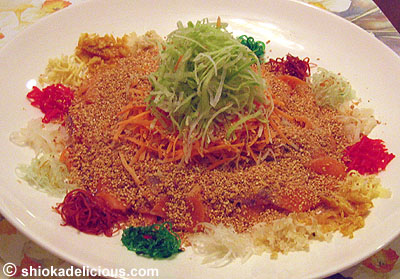
When all the guests are gathered around the table, we add the toasted sesame seeds and the ground peanuts, sprinkled around the shredded vegetables.
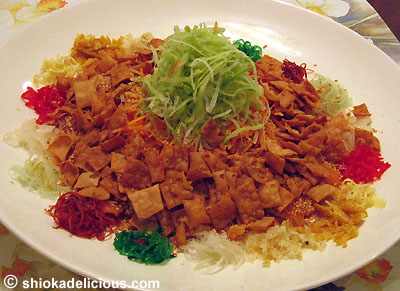
Next, the pok chui are sprinkled on top.
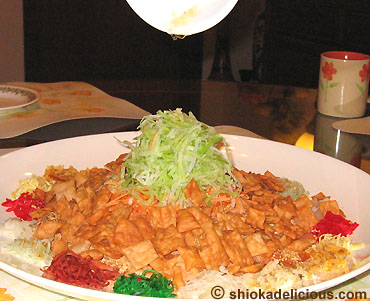
The garlic oil is drizzled over the shredded radish. We prefer to drizzle the oil on the shredded vegetables. I know it doesn’t seem like it should make much of a difference, but it does seem to. Somehow, having most of the oil coat the shredded vegetables during the toss seem to work better. But that’s just our opinion.

Finally, the plum sauce is drizzled over the vegetables and the other ingredients. (Again, the amount of plum sauce used depends on the size of the salad. The aim is to get a salad that is neither too “wet” nor too dry. The salad should just hold together without any perceptible appearance of the sauce, if that makes sense. Experience helps in determining how much sauce to use. Or simply add more sauce during the tossing process if the salad is turning out too dry. I think it is better to add less to start with if unsure, as it is easier to add than to remove. A too “wet” salad will feel too cloying on the palate.)
And then… the frenzy begins. Everyone, armed with a pair of chopsticks, starts tossing the salad with gusto (sometimes too much gusto!) The higher the salad is tossed, the better, as it symbolizes growth, progress and going to great heights.
It is a fairly common sight to see people in restaurants or at functions (especially at large raucous gatherings) toss the salad outwards rather than upwards, splaying the vegetables right across the table. This is considered “not good” as it signifies the throwing away and the “wasting” of the good luck, prosperity and abundance that is being tossed up! For the same reason, the entire salad must be eaten up, with none left over. So make sure to divide up and serve the entire salad.
While tossing the salad, everyone utters auspicious wishes or sayings. It’s pretty much free for all. Each person contributes whatever comes to mind. It can be all said at the same time. It really doesn’t matter. It makes for a noisy, boisterous, happy and tremendously fun occasion.
Some of the sayings that can be uttered (in either Cantonese or Mandarin):
• Loh hei! Loh hei! Lou dou fung shang shui hei! (toss, toss, toss till the wind grows and the waters rise)
• Xin nian kuai le (happy new year)
• Shen ti jian kang (good health to all)
• Xin xiang shi chen (may your heart’s desires be realized)
• Yi fan feng soon (may all things be smooth sailing in the year to come)
• Nian nian you yu (may there be abundance every year)
• Ma dao chen gong (may all endeavors be successfully completed – literal translation: when the horse arrives, the work is accomplished)
• Bu bu gao shen (growth and success at every step)
• Shen yi xin rong (may business boom and grow)
• Shi ye jing bu (may your career advance – i.e. promotions)
• Hua kai fu gui (abundant blessings and prosperity)
• Hong yun dang tou (may you have good luck at your doorstep)
• Da ji da li (good luck and blessings)
And so on…

This is the final, very, very delicious result! Now, this is what I call a truly shiok experience!
Here’s to tossing up a great and wondrous year ahead!
07:08 PM in Festivals: Chinese New Year 2004 | Permalink | Comments (5) | TrackBack
Wednesday, January 28, 2026
Loh Dou Fung Shang Shui Hei! – Part I

Loh! Loh! Loh dou fung shang shui hei! (Toss, toss, toss till the wind grows and the water rises! i.e. tossing up good luck, fortune and prosperity). This is the chant which is echoed across South East Asia throughout the 15 days of the Lunar New Year celebrations, as plate after plate of this colorful fish salad, known as “yu sheng” (Mandarin) or “yu shang” (Cantonese), is tossed and devoured with delight.
This dish has its beginnings in Singapore, with historical roots in Southern China. And it has now made its mark around the globe, and is loved and enjoyed by not just the Chinese, but by other Asians and Caucasians as well.
The Story Goes…
The dish “yu sheng” in its current, colorful form, with all the intendent auspicious symbolisms, was created by four Singaporean master chefs Hooi Kok Wai, Lau Yoke Pui, Sin Leong and Than Mui Kai, in the mid-1960s.
However, its roots stretch far back to the small coastal villages of Guangzhou province in Southern China. Its origins are found in a simple village practice of the poor Chinese fishermen of the past. To celebrate the seventh day of the CNY or ren ri (Humanity’s birthday), these ancient fishermen had a tradition of feasting on the one commodity they had in abundance – fish (“yu”) – which was also synonymous with abundance and prosperity due to the sound of the word “yu”. As these fishermen spent long periods out at sea, the fish was simply sliced and eaten raw, the simplest and freshest way – no cooking required.
This cultural practice was then brought to Singapore by our migrant founding fathers, a large majority of whom hailed from the Southern provinces of China. However, given the different living conditions here, the fish was no longer eaten raw, but instead evolved into fish porridge (yu shang zhuk or raw fish porridge) served at roadside stalls. The thin slices of raw fish would be added to piping hot white rice porridge, the heat of which would quickly cook the fish slices through.
In the mid-1960s, the four master chefs were inspired to create a unique CNY dish using the strips of raw fish from the porridge. They combined the raw slices of local fish known as ikan parang with a mélange of vegetables, both fresh and pickled – ranging from shredded carrots and radish, to pickled and candied ginger, cucumber, winter melon and even jellyfish. All tossed and mixed together with a plum sauce dressing. The colors were bright, cheerful and enticing. The symbolisms were auspicious. The taste was a tantalizing tangy sweetness.
And Now…
In the almost 40 years since, the dish has evolved further. But the essence remains the same. The base ingredients are: 1) fish, 2) shredded white radish, green radish and red carrot, 3) 9 varieties of pickled and/or candied vegetables.

(Starting from the red mound in the upper left hand corner, and going counter-clockwise): 1) red pickled ginger, 2) preserved vegetable strips, 3) green preserved cucumber strips, 4) preserved melon strips, 5) yellow ginger, 6) purple preserved vegetable strips, 7) candied winter melon, 8) diced dried Mandarin orange peel, 9) pickled leek.
(Center mound): Shredded white radish, shredded red carrots and shredded green radish. The serving portions of these three vegetables descend in this order, with the green radish being present in the smallest amount among the three, as the latter is the least “naturally sweet” of the three vegetables, and oftentimes has a touch of “sappiness” to it. The white radish is naturally crispy, crunchy and sweet, as is the red carrot, which is somewhat “harder” in texture. I personally prefer to have the last two in almost equal portions or with the red carrot just a tad less than the white radish. With all three combined, there is an interesting mix of different textures and tones of sweetness.
To all this is added deep fried, crispy dough crackers (“pok chui”), ground peanuts and roasted sesame seeds. Everything is then tossed together with a little peanut oil and the plum sauce dressing.
In recent years, in order to entice jaded Singaporean tastebuds, restaurant chefs have also started using alternatives to the traditional raw ikan parang (wolf herring I think) fish slices. Raw salmon, raw tuna, raw mackerel or smoked salmon yu sheng have been around for many years. Now there is lobster, abalone or even geoduck yu sheng. Yes, there is sometimes no longer any “yu” (fish) in “yu sheng” That's why I prefer calling the dish "loh hei" rather than "yu shang" or "yu sheng".
The last one or two years have also seen new flavors in the dressings used – Thai-style sweet, sour, spicy dressing; mala (Szechuan “numbing” hot spicy peppercorn) dressing; Peranakan-style dressing; Japanese-style dressing and so on. Traditionalists among Singapore foodies balk at such twisting of the yu sheng taste. However, they are others who welcome the change. Personally, I’m all for using different fish and seafood, and even meat, in the salad, but I still prefer the cleaner and “purer” taste of the “traditional” plum sauce dressing.
Another change that has gone largely un-noticed is that when it first started, this loh hei yu shang dish was only served on the 7th Day of the Lunar New Year or ren ri (humanity’s birthday) – in keeping with the ancient traditions of the village fishermen of long ago. It was served along with noodles (symbolizing longevity). However, nowadays, it is eaten throughout the 15 days of the Lunar New Year celebrations, and very often, even before the New Year, as enterprising restaurant owners cash in on the popularity of the dish.
My family makes all our loh hei at home, and one variation that we like is using shredded roast duck breast meat instead of the usual raw salmon or smoked salmon. Sometimes we end up eating loh hei as many as 8-10 times in the space of 15 days, and the thought of more salmon or fish loh hei simply does not appeal anymore. And so a duck alternative makes a welcome change for the tastebuds. The denser texture of the meat gives a stronger bite to the salad, and the smoky aromatic flavors of the roast duck adds a distinctive twist to the dish.
I find that fish, seafood or meats with stronger flavors work better in the loh hei, as they add an additional layer of flavor to the intricate and richly complex taste matrix of the salad. Naturally bland seafood or fish that take their flavors from surrounding ingredients seem to work less well – eg abalone, lobster sashimi etc. So my personal preference is to use things like smoked salmon or smoked tuna, and roast duck.
Tossing Around the World
Close to 40-years on, this Guangzhou-inspired, Singapore-created salad can now be found in parts of the world as far-flung as New Zealand, the UK and the US. It now makes its appearance on the CNY menus of Singaporean/Malaysian and some Chinese restaurants in major cities like New York, London, Sydney and Melbourne, as well as in countless homes in towns and cities across the Western hemisphere. And here, more innovation has taken place. With lo hei ingredients not readily available at grocery stores in these countries, creative home chefs have come up with various alternatives for “pok chui” ranging from using deep fried wantan wrappers to using cornflakes!
Our next door neighbour, Malaysia, has also taken heartily to this dish. This is now a ubiquitous addition to CNY menus for almost all Chinese restaurants and eating houses there, and is served in the run-up to and during the full 15 days of the Lunar New Year. However, the Malaysian version is uniquely Malaysian, and looks and tastes rather different from the Singaporean version.
Pre-packed loh hei ingredients are now also now imported from Singapore and readily sold in supermarkets in predominantly Malay/Muslim countries like Indonesia and Brunei.
Strangely enough, lo hei has yet to take root in Hong Kong. Most restaurants there do not feature this CNY dish, although it is well-known that many Hongkongers, including many celebrities, love this dish, and have been known to have relatives or friends cart back packs of the dish’s ingredients from Singapore.
The dish is also slowly making its way back to the place of its historical birth. Certain hotels in major Chinese cities like Shanghai now serve this dish, although it has yet to establish a firm presence in the local restaurants. However, given the Chinese penchant for all things associated with “prosperity” and “good fortune” the tide in mainland China is surely changing. And so, this Chinese migrant dish is finally going home…
Tomorrow, how to make and toss loh hei yu sheng…
* The above is based on information taken from an article by Solomon Lim that appeared in The Straits Times on 18 January 2004.
02:00 PM in Festivals: Chinese New Year 2004 | Permalink | Comments (0) | TrackBack
Crunch Time
I’m back! Yes, it’s been a while… What have I been up to? Stuffing my face… feasting… eating… delicately munching… tasting… imbibing… chewing… ingesting… gobbling… Errr… Okay, I think you get the picture… I now have truly well-exercised, well-toned, thoroughly worked-out jaws! LoL.
I had a grand time this New Year. I hope those who were celebrating also had a wonderful and meaningful New Year’s with family, friends and loved ones.
I thought I would take a break from my PC. Are you kidding? Withdrawal symptoms? Who? Me? No way. Sure, I can just chill… No problems. Yeah, right! Well, I fought a good fight. I stayed away for… err… longer than I’ve ever stayed away from my PC! I am proud of myself. I didn’t even surf. Imagine that! Yes, it is now proven, I can live and survive without my mouse!
Seriously, though, there was a legit reason for trying (trying being the operative word) not to post anything with lots of photos. I need more highway space. Thank you to the nearly 1000 visitors that visited this site each day over several days of the past week! Wow! I am completely stunned. I was completely caught off guard. I never expected it. I am humbled. I am flabbergasted. I am troubled. Within those few days, I busted my monthly bandwidth allowance by a whopping 374%! Kudos to Typepad. They have generously kept this site up.
All is well… and so, I am back! I can’t wait to share the loh hei pics. Loads and loads of pics. Ahhh… loh hei yu shang. My favorite New Year dish. Akan dating… coming tomorrow (erm… actually, it should be today already, shouldn’t it). The seventh day of the CNY is “yu shang day”, so pretty appropriate, no?
Alrighty… I shall scoot off now to start sorting through those loh hei pics…
12:54 AM in Crumbs & Tidbits | Permalink | Comments (2) | TrackBack