Sunday, November 30, 2025
Pho Temptation
A group of us went to check out Pho Temptation, a relatively new Vietnamese restaurant along Killiney Road, at lunch today. This is a subsidiary or franchise (not too sure which exactly) of the main outlet in Melbourne, Australia. And friends who have eaten regularly at the Melbourne outlet have said the food is good.
Unfortunately, the pleasant dining experience in Australia does not seem to have been translated into Singapore.
The Vietnamese spring rolls (S$3.00 for 2 rolls) (~US$1.80) were “simple”. There were no mint leaves, no basil, no prawns in the rolls – just a small piece of (rather dry) chicken meat, rice vermicelli, shredded carrots and salad. The accompanying dip was not the normal fish sauce-based peanut dip – but hae chor (prawn paste) with ground peanuts. We would have preferred the traditional fish sauce dip.
The deep fried spring rolls (S$3.00 for 4 pieces) had nice, very crispy skin, but otherwise were fairly ordinary. The fillings were again very simple - just carrots and rice vermicelli.
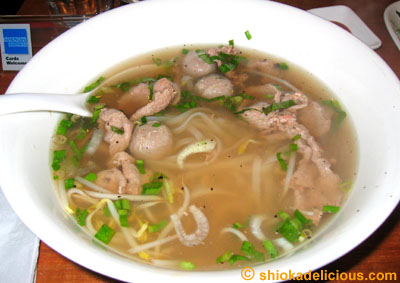
I had the Beef Steak & Beef Balls Pho (S$7.50) (~US$4.50). There did not seem to be a strong presence of beef stock in the soup base. To be frank, it tasted of just msg, flavoring and water. I don’t like salty food, and yet I found the soup to be rather bland and tasteless. Unfortunately, the nice thin slices of beef were also over-cooked and rather tough, dry and chewy. The beef balls were not bad though – nice springy texture, and the flat rice noodles were nice and smooth.
The Beef Brisket, Beef Steak & Beef Balls Chilli Pho (S$7.50) was more “flavorful” due to the chilli oil added to the standard basic Pho soup, but was otherwise similar to my dish. Oh, this had some lettuce leaves thrown in, whilst mine didn't. And this was served with round rice noodles instead of the flat noodles. (Perhaps they had run out of the flat variety).
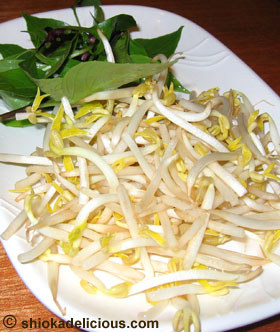
Each noodle dish came with a side serving of mint leaves and raw beansprouts. Perhaps, the latter would have tasted better and complemented the noodles more if they had been very, very quickly blanched in boiling water, just to get rid of the “grassy” raw taste, which given the blandness of the stock, overwhelmed the other tastes in the noodle dishes.
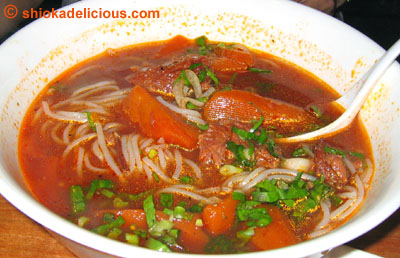
The Beef Stew (S$6.50) (~US$3.90), which was highlighted as a “special”, had a nice gravy, though a little on the watery side. The beef was over-cooked, dry and chewy.
The Chicken and Rice (can’t remember what it was called exactly on the menu) (S$6.50) pretty much tasted like how it looked on the plate. Normal…
Everyone ordered the “Three Colors” drink, except me. It had red agar-agar cubes and a couple of red kidney beans in bright red syrup water; some chendol in bright green pandan syrup; very rich and thick coconut cream; topped with coarse crunchy shaved ice. I had a sip – very, very sweet! The pandan flavoring was a little overpowering. But if you like the taste of very, very rich coconut cream, this would be a nice drink.
Service was indifferent at best. Ok, I agree, generally, Singapore is not known for very friendly service, and so we shouldn’t be surprised if we don’t get greeted with smiles or that there were no “thank yous” as we left. However, when we asked the waiter for recommendations from the menu, he just stood there looking at us as if we never asked him a question! He was completely unresponsive to any questions we had! Well, we gave him the benefit of the doubt – maybe he was just having a bad day. However, in the time that we were there, we did not see a single smile from a single staff member to a single customer!
The table tops were sticky from not having been wiped down properly. The music was loud – and… believe it or not, it was heavy rock and either house or acid music (we weren’t sure which exactly). Yes, I know, our ages are showing! But still, hardly what we would call appropriate music to be playing during lunch time in a restaurant that hopes to appeal to a wide cross-section of consumers. Towards the end, the music was grating on us so much that all we wanted to do was finish the meal and get out of there.
There was no service charge or GST.
Are we tempted to return to taste temptation again (pun intended)? The above experience speaks for itself.
After lunch, we walked past two other Vietnamese restaurants in the same block of shophouses. Yes, there are now THREE Viet eating places in that short stretch of 20-something shops. So, one would have thought that given the competition, standards would be held at a high level. Maybe we’ll give the other two a try the next time.
Pho Temptation
73 Killiney Road
Singapore 239528
Tel: 6732 8032
Copyright © 2003 Renee Kho. All rights reserved.
Please contact me for permission to copy, distribute or display any of the images and text contained in this article.
02:27 AM in Lion City Shiok-Eats: Asian | Permalink | Comments (2) | TrackBack
Friday, November 28, 2025
Teochew Steamed Fish

This is a nice, light, tangy fish dish that’s very easy to prepare. It’s done in the classic Teochew style, which is an amalgamation of sourness, sweetness and saltiness. When all the tastes are well-balanced, it produces a dish that is refreshing and light on the palate, with no hint of fishiness.
The Teochews almost always use the Pomfret fish for this dish, although I suppose other lean, firm-fleshed fish would work equally well (I’ve never tried this personally).
Once the fish has been gutted, salt is rubbed into the cavity and then rinsed well to remove all traces of fishiness. The fish is lightly seasoned with pepper (especially in the gut cavity). Generally, I leave out the salt when seasoning the fish as there will be plenty of saltiness coming from the other ingredients in the dish.
The fish is very simply topped with strips of salted vegetable (giam cai), around 3 pieces of sweet sour preserved plum (sui suan mei), 2-3 large fresh tomatoes that have been quartered and lots of julienne of young ginger. Very often juliennes of red chillies are also added for color and just a touch of heat and spiciness. (I didn’t have any chillies in the fridge today, so that was left out).
The gravy is just a simple concoction of light soy sauce, sugar (to balance out the sourness of the plums and the saltiness of the giam cai) and garlic oil (finely chopped garlic stir-fried in oil). I think bottled sesame oil could very easily be used as a substitute for the garlic oil, if preferred, although the minced garlic does give an added taste dimension to the fish. All the ingredients are dissolved in Chinese rice wine, and poured over the fish. Proportions for the ingredients depend somewhat on the size of the fish, and on personal preferences. Today I used about 5 tbsps each of light soy sauce and Chinese rice wine, around 1 tbsp of sugar and 3 cloves of garlic sauteed in a little vegetable oil.
For a large fish like today’s, steam for 8-10 minutes. For smaller fish, I tend to steam just 6-8 minutes. I really don’t like over-cooked fish. There’s nothing worse than over-cooked fish. It’s dry, it’s scratchy on the throat, it tastes like dressed up cardboard. Yuk! This is one of my biggest gripe about a lot of restaurants, even top ones. A lot of the time, everything is cooked right, except the fish. [Incidentally, in my humble opinion, that’s how you can tell how good a chef is – by how well he cooks his fish, and in a Chinese restaurant, by how well he steams his fish, where not only the fish texture but also ensuring there is no "fishiness" are major factors. Heat control and timing is absolutely key]. Anyway, enough about that… sorry, didn’t mean to gripe so much… it’s always best not to get me started on over-cooked fish! : P
Once the fish is done, turn off the heat, and quickly sprinkle some julienne of spring onions on top of the fish, cover again briefly and allow the residual heat to slightly wilt the spring onions before serving. And there you have it, a fish dish that’s done in just a few minutes, and it’s pretty yummy too!
Happy fish steaming!
Copyright © 2003 Renee Kho. All rights reserved.
Please contact me for permission to copy, distribute or display any of the images and text contained in this article.
11:21 PM in Home Cook: Fish & Seafood | Permalink | Comments (2) | TrackBack
Thursday, November 27, 2025
Ole! Chocabanana!
I just didn’t feel like working today. I was in one of those lazy, lethargic moods. And so I decided my weekend was going to start on a Thursday afternoon! ; D Hey, this is one of the (very) few privileges of working from home and running my own business... I can choose to have Friday come one day early! LoL.
Had an urge to bake something… anything… Saw the leftover chocolate chips from baking the cookies on Sunday, and thought I should try to use them up. Saw the bananas hanging there, starting to get a little over-ripe. And the proverbial lightbulb went off in my head… Visions of the gorgeous chocolate and banana cake I saw at Secret Recipe on Tuesday came to mind. Of course, theirs was this thoroughly decadent, elegant cake with layers of whipped chocolate fresh cream, slices of bananas, rich chocolate cake, all covered with chocolate ganache. I wasn’t about to attempt anything like that – but, a nice rustic, down-to-earth homemade banana cake with chocolate chips would be perfect for tea. Somehow, the fusion of chocolate and banana is always pure alchemy.
I hunted through some recipes and settled on trying the following:
2 c. plain flour
1 tsp baking powder
1 tsp baking soda
½ tsp salt
1 c. granulated sugar
2 eggs
¼ c. butter, softened
1 c. mashed bananas (I used 2 big ones)
½ c. lite sour cream
1 tsp vanilla
½ c. chocolate chips
- combine all the dry ingredients, except the sugar. When baking cakes, I like to sieve the flour twice, to give a lighter, fluffier crumb.
- sprinkle some sugar over the bananas before mashing them. This prevents them from oxidizing and turning brown (a tip I learnt from my mother).
- beat the sugar, butter and eggs on medium speed, until smooth.
- add in the bananas, sour cream and vanilla, and beat till smooth (the batter will be fairly liquidy).
- fold in the flour mixture.
- fold in the chocolate chips.
- pour into a greased 9x13” baking pan. I like to put a piece of greaseproof paper at the bottom of the pan to prevent the bottom of the cake from getting too crusty.
- bake about 25 minutes (or until skewer comes clean) at 175C/350F.
I was very surprised by the result. This cake was very good! (If I may say so myself). It didn’t bake into a very “tall” cake, but the crumb was very moist, soft and fluffy. I loved the color too – I like my cakes a beautiful, rich golden brown. Perhaps I could have added more chocolate chips, if I have had more available. But that may have made the cake a tad too sweet. It was very good as it was, and especially good when still warm from the oven.
And the reactions of the family? Two thumbs up!
Copyright © 2003 Renee Kho. All rights reserved.
Please contact me for permission to copy, distribute or display any of the images and text contained in this article.
06:44 PM in Home Baker: Lighten Up! Cakes | Permalink | Comments (0) | TrackBack
Sweet, Sweet Potato
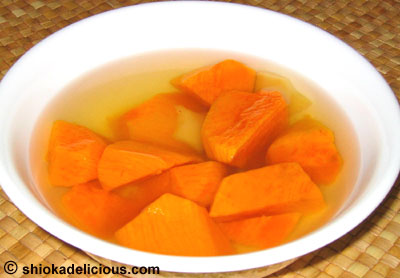
Didn’t get around to having breakfast or lunch yesterday – work is always a little crazy after a public holiday or weekend. (Tuesday was the Muslim New Year: Hari Raya Aidilfitri). So, I just had a bowl of sweet potato syrup soup.
This is a firm favorite of a lot of Chinese families. It is usually cooked as an after-dinner dessert. And there are many variations. The Cantonese (especially in North Asia) like it light, with just sweet potato boiled with water and rock sugar. The Peranakans add yams, sago and coconut milk to make the rich dessert, Bubur ChaCha. Chinese in South East Asia may add sago and/or pandan leaves to the Cantonese version.
My family usually cooks the sweet potatoes with ginger, sago and rock sugar. Yesterday, it was just ginger, pandan leaves (as an aromatic) and rock sugar. It’s great as a sort of “de-tox” for the digestive system after the previous day’s rich foods. Ginger helps relieve indigestion, bloatedness or wind. Pandan water (leaves cooked in water) is great for reducing uric acid, and it adds a very nice fragrance to the sweet potato soup too.
Just boil the chunks of sweet potato with maybe 2-3 good sized chunks of young ginger and enough water to cover. Tie a few pandan leaves together into a bundle, and drop it in to flavor the soup. (This is removed before serving). Add rock sugar to taste.

We usually get two varieties of sweet potatoes – the yellow fleshed with the lighter skin and the orange fleshed with a darker skin. I prefer the latter, which is sweeter, more moist and fluffier than the former. I think the Americans call the latter “yams” whilst we know them as a type of sweet potatoes. Hmmm… what do the Americans call the tuber that has slightly purplish flesh that we actually call yams?
PS. Another variation that I do with this sweet potato soup, especially when it is cooked with sago, is to have it cold from the fridge, and add a little soy milk (sweetened or unsweetened) – tastes pretty good!
Copyright © 2003 Renee Kho. All rights reserved.
Please contact me for permission to copy, distribute or display any of the images and text contained in this article.
06:12 PM in Home Cook: Light Touches | Permalink | Comments (0) | TrackBack
Que Pasa
And so we sat, and chatted, and chatted, and chatted… In the meantime, the rainy, overcast skies gave way to sunshine, then to twinkling stars, as the street lamps lit and the café emptied out…
We adjourned to Que Pasa for dinner. This pub/bar has been around for ages (more than 10 or 15 years maybe?), and I haven’t been there in a good many years. It has since re-positioned itself as a Tapas Bar, with a fairly extensive menu of light finger food. Their dishes are not the traditional Spanish-inspired tapas, instead, definitely more along the lines of American bar food with touches of traditional English pub food. Serving sizes were also American-sized, rather than traditional tapas quantities.
I wasn’t expecting much… it’s a bar… and I guess one doesn’t really go to a bar for good food. But I was surprised, and very pleasantly so. The food was good!
The mini-burgers were juicy and succulent. Tasted like home-made real beef patties, not the frozen stuff. And the wedges were really good! Crispy on the outside, very fluffy on the inside, with a nice touch of cayenne and spice.
I really liked the beef stew too. (Sorry, no pictures). Very tender beef with just enough bite, and a sprinkling of crunchy tendon. It was served with fresh, crusty foccaccia, perfect for dipping into the very flavorful, rich gravy.
Very nice deep fried wings too. Very crispy – even after the wings had gone cold.
Only the Special Selection: Assorted Tapas didn’t do very much for me. [Only remembered to take the picture after most of it was devoured! But who said food blogs are always just about pretty pictures anyway] ; ) It was a selection of three types of olives, some sautéed mushrooms, thick slices of chorizo (I think) and slices of baguette topped with slices of firm Italian cheese (not sure which). I’m not an olives person, neither am I really a sausage person. Only tried the cheese and the mushrooms. Have to admit though, from the looks of the picture, my friend did a really good job! ; D
I really enjoyed the dinner. And being a week-day evening, it was nice and quiet. No ear-splitting music, heaving crowds, nor eye-stinging smoke. The pub was fairly empty, with a laid-back, almost serene atmosphere. For once I could take in and enjoy the architecture and décor of the re-stored Peranakan heritage house that the pub was situated in. It all reminded me of the family-like atmosphere of English pubs on Sunday afternoons, when families gathered for hearty, rustic English lunches. And so we sat, ate and chatted some more, late into the night. I liked it, I liked it a lot. Definitely worth a return visit to try out some of the other dishes on the menu.
Que Pasa
7 Emerald Hill Road
Singapore 229291
Tel: 6235 6626
Food: 4 / 5
Service: 4½ / 5
Ambience: 4 / 5 (on non-weekend nights)
Price: $$
$ <15
$$ 16-30
$$$ 31-50
$$$$ 51-75
$$$$$ >75
Copyright © 2003 Renee Kho. All rights reserved.
Please contact me for permission to copy, distribute or display any of the images and text contained in this article.
03:57 AM in Lion City Shiok-Eats: Western | Permalink | Comments (2) | TrackBack
Secret Recipe
A very dear, old gal-pal was in town for a short visit. (No, it’s not the gal-pal that’s old, but the friendship – all of 22 years to be exact! And no, we aren’t that old, we were just at a tender age when we became friends). ; P
So, we met up for tea on Tuesday at Secret Recipe.
I like the Henry Park outlet. Unlike the other outlets, this one is not situated in a crowed, busy shopping mall, but in a small cluster of quiet, sleepy neighbourhood shops. The pace slows down… families linger over a light meal or a cup of coffee. No hustle and bustle, no hassle…
This Malaysia-based chain of cake shops/cafes is famous for its utterly decadent cakes and desserts – rich creamy cheesecakes, dark fudgy chocolate cakes and brownies etc.
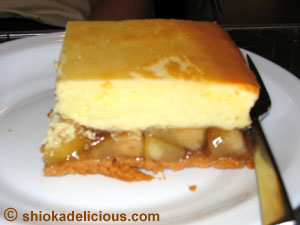
My friend had the apple cheese slice, and it looked really good – a crispy biscuit base, generous chunks of apple, all topped with a layer of baked cream cheese.

I had the moist chocolate cake. Ok, I admit, it looks plain messy in the photo. But that’s because I asked for it to be served warm, and the chocolate fudge/ganache topping melted when the cake was heated. And looks are deceiving. This cake was really good… we are talking seriously rich, seriously fudgy, seriously chocolatey cake. For a chocoholic like me, this was pretty much heaven! A layer of mocha in the center gave the cake a whole new dimension. Shiok, shiok, shiok!
The only difficulty with visiting this café… trying to decide which cake or dessert to order. And if you’re on a diet, stay well clear!
Secret Recipe
42, Henry Park
Holland Grove Road
Food: 4½ / 5
Service: 4 / 5
Ambience: 3½ / 5
Price: $
$ <15
$$ 16-30
$$$ 31-50
$$$$ 51-75
$$$$$ >75
Copyright © 2003 Renee Kho. All rights reserved.
Please contact me for permission to copy, distribute or display any of the images and text contained in this article.
03:03 AM in Lion City Shiok-Eats: Cakes & Desserts | Permalink | Comments (2) | TrackBack
Assam Fish Curry
Here’s the recipe that I promised for the Assam Fish that my mum cooked on Sunday…
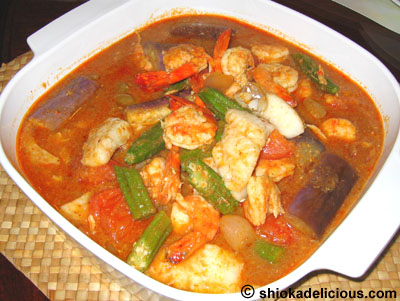
This is essentially a Nyonya or Straits Chinese dish - an interesting amalgamation of Chinese and Malay influences. The Nyonya or Peranakan culture is a unique and very elaborate one which originated from the Peranakan (Straits Chinese) of Malacca over 400 years ago, and was the result of inter-marriages between Chinese immigrants and local Malays.
From intricate hand-beading on shoes and clothes to labor-intensive, time-consuming grinding of spices to make dishes with complex preparation procedures, the Nyonyas (female Straits Chinese – males are known as Babas) were fiercely proud of their unique culture and their standards for detail, quality, creativity and craftsmanship.
Traditional Nyonya food requires hours and hours of preparation, starting from the pounding and grinding of the all-essential rempah (or spice mix) that forms the basis of all the dishes. Nyonya housewives of the past literally spent their entire days in the kitchen cooking up dishes for their families. Indeed, it is often said that in those days, a Nyonya matriarch would decide upon a prospective bride for her son by listening to the pounding of spices by the young lady. From this she would be able to tell how devoted and skilled the prospect was in her cooking, and thus worthy of marrying into her family!
Nowadays, Nyonya food is also native to Singapore as well as Penang in Peninsula Malaysia, and enjoyed by Chinese, Malays, Indians and Caucasians alike. However, there are some distinct differences that have evolved in the Nyonya food found in Singapore, Melacca and Penang. Malaccan and Singaporean Nyonya food, on the whole, have also taken on Indonesian influences, due to geographical proximity, and are generally sweeter, richer in coconut milk, and has the addition of more Malay spices like coriander and cumin. Penang Nyonya food incorporates Thai cooking styles, with greater tones of sourness, and the greater use of hot chilies, fragrant herbs, and pungent black prawn paste (belacan).
Anyway, back to the fish… we cooked this from store-bought, ready-prepared Assam Curry Paste. Unfortunately, we don’t have the time nor the inclination to spend hours and hours pounding and frying the spices to cook just one dish for dinner. Alas! The lost art of patience and dedication in this fast-food world of instant noodles and burgers! Just give us the taste, minus the hassle.
The main ingredient of the paste is assam jawa (tamarind fruit) which gives the dish its distinctive sour, tangy taste. The pulp of the fruit is pounded together with things like shallots, garlic, lengkuas (galangal), buah keras (candlenut), serai (lemongrass), daun kesom (laksa leaf or Vietnamese coriander), chillies, tumeric powder, belacan and sugar. The paste is then fried in oil until the flavors of all the ingredients have melded together.
We used two types of fish – seabass or cod and small local fish for which I do not know the proper English name. A direct translation of the Chinese name would be “small silver fish”. Hmmm… not much help I know. But any type of firm-fleshed fish would suit this dish fine – tenggiri, even garoupa and mahi-mahi I would think.
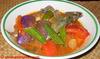
Normally, the fish would be cooked in the gravy, however, this time around, we steamed the fish separately first for about 5 minutes or so. These small silver fish are very bony, with REALLY tiny bones, so we didn’t want to cook them in the gravy and maybe have them break apart, dispersing their tiny bones into the gravy.
We also steamed the eggplants for about 5 minutes, and par-boiled the okra/lady’s fingers for about the same amount of time.
Whole shallots (to give added sweetness to the gravy) were given a quick sauté in hot oil, before the prepared assam curry paste was added. We added more assam juice for extra tanginess. Then some sugar and soy sauce (or salt, if preferred) was added, to taste. Unfortunately, a lot of my home recipes won’t have exact measurements – both my mum and I (me learning from her) tend to cook with the agar-agar (guesstimate or instinctive) method. Just add what feels, looks and tastes right, and the dish will come out right. I do apologize if some of these recipes appear rather vague.
Once the curry has come to a rolling boil, pop in the shelled and deveined prawns (seasoned with pepper and soy sauce or salt). [Add the fish at this point too, if it was not steamed beforehand]. Next, add the diced tomatoes. Simmer till the seafood is cooked through (about 5 minutes). Add the steamed okra and eggplant. Mix well.
The gravy is done. Pour over the previously steamed fish and serve. The gravy is really good with steaming white rice or mopped up with chunks of crusty bread!
Happy Assam Curry-ing!
Update (31/12/03): As I was replying to an email query about this recipe, I realized I had forgotten to clarify something.
I forgot to mention that only fresh fish that has not been frozen and thawed should be used for steaming. (Some fishmongers sell defrosted fish together with fresh without differentiation, so it might be best to ask). Previously frozen fish, when steamed, tends to have a very "fishy" taste, and the texture becomes rather "off", for want of a better word. The only exception to this would be fish like Chilean seabass or cod (sometimes known as "snowfish" in Asia). This fish is absolutely fine for steaming even after being stored in the freezer for months.
If using frozen fish for this dish, it would be best to fry the fish instead. If using fish fillets, gently dry the fillets with kitchen towels, pat a light coating of cornflour onto the fillets on all sides and pan-fry in hot oil. Similarly, for a whole fish, lightly coat the fish with cornflour and liberally sprinkle salt and pepper in its cavity before frying.
The fried fish can then either be added into the gravy for the last 5 minutes of cooking time or it can be plated and the cooked gravy poured over it.
Copyright © 2003 Renee Kho. All rights reserved.
Please contact me for permission to copy, distribute or display any of the images and text contained in this article.
02:26 AM in Home Cook: Fish & Seafood | Permalink | Comments (2) | TrackBack
Tuesday, November 25, 2025
An Urban Legend in My Kitchen: Chocolate Chip Cookies

This post reminded me of the famous (or perhaps more accurately, infamous) email about the Neiman Marcus cookie recipe, that did the rounds a long time ago. I had read it, and even filed it (somewhere), thinking that I would try out the recipe and see how good it really is. That was many, many years ago, and no, I never got round to baking those cookies. So Alberto’s photo and happy results with the “official” Neiman Marcus recipe inspired me enough to fire the oven and get a-baking…
I contemplated doing the email version of the recipe, but it required a few more ingredients than the “official” recipe, and I didn’t have everything readily available on hand… so, the “official” recipe it would be…
Even then, I tweaked the recipe a little. I used reduced fat “I Can’t Believe It’s Not Butter” instead of regular butter. Ya, I know, I know, you’re thinking: that’s like ordering a pizza with the works, and asking for a diet soda to go with it… or like having a double cheesecake with extra whipped cream but drinking a skinny latte… where’s the logic in that?!?! And hey, chocolate chip cookies are chocolate chip cookies… they are MEANT to be sweet, indulgent things in life. But a gal sometimes just want to have her cake, or in this case, cookie, and eat it too… you know? Besides, that was the only “butter” I had in the fridge. So, it was either that, or no cookies. And the family readily plumped for cookies, albeit not “real” ones, as one person sagely put it!
Also, I reduced the brown sugar slightly to ¾ cup. That wasn’t such a good idea. Whilst the cookie was still sweet enough, I think it would be just fine or better with the full measure of sugar. And I think I would prefer to use a touch more espresso powder the next time round.
This baking was a “team effort” – see my earlier post… and perhaps the results we got reflected that : )
The cookies were good, with loads of chocolate chips and nice flavor. But somehow we got cookies that had a more cake-like crumb, rather than the chewy texture that Alberto got. Hmmm… I suspect it could be the over-enthusiastic heaping of dough onto the cookie sheet? Our cookies were rather “thick” (and chunky?) and perhaps thus baked out into a cake-like texture rather than a cookie texture. Perhaps we should have flattened out the dough slightly before baking it. I had assumed they would “spread” as they baked, but they didn’t.
But they were still good. In fact, I had planned to melt down some chocolate chips, and drizzle it over the top of the cookies, but never got a chance to do so. The cookies were being popped into anticipating mouths so quickly, as they came out of the oven, that they were all gone before I could even get going on the melted chocolate chips! Oh, and the cookies tasted very good dunked in hot (and iced) chocolate! Shiokadelicous indeed!

Here’s the recipe (without my tweaks):
½ c unsalted butter, softened
1 c brown sugar
3 tbsps granulated sugar
1 egg
2 tsps vanilla extract
½ tsp baking soda
½ tsp baking powder
½ tsp salt
1¾ c flour
1½ tsps instant espresso powder, slightly crushed
8 oz semisweet chocolate chips
- combine all the dry ingredients together
- cream the butter together with the sugars, until fluffy
- beat in the egg and vanilla extract
- mix the dry ingredients into the butter mixture
- stir in the chocolate chips
- drop large spoonfuls onto a greased cookie sheet (and flatten slightly)
- bake at 190C or 375F for 8-10 mins, or 10-12 mins for crispier cookie
Recipe said it would make between 12 to 15 cookies. We managed 16 very good-sized ones.
Happy chocolate chip cookie-ing!
Copyright © 2003 Renee Kho. All rights reserved.
Please contact me for permission to copy, distribute or display any of the images and text contained in this article.
02:23 AM in Home Baker: Cookies | Permalink | Comments (4) | TrackBack
Sunday, November 23, 2025
Warm, Lazy Sunday: Food and Family
We spent the day with my family today. And the theme of the day: food, eating, cooking and baking…

Everyone gathered for a light brunch of Cantonese-style rice porridge bought from the market hawker center. This is the style of porridge both my mum and myself prefer - it is cooked for many hours, so that all the grains of rice have been cooked down and almost dissolved into a smooth, thick almost soup-like gruel. The ideal would be to cook the porridge over a charcoal fire rather than a gas flame or electric hotplate. This lends an added dimension to the aroma and taste of the porridge. The men however prefer the Teochew style porridge, which has whole grains of rice is a watery gruel, and thus has more “bite”.
The Cantonese porridge (S$1.20) (~US$0.70) from this stall is very well done – beautifully smooth consistency. It’s served here with fried, crispy, crunchy small anchovies and some spring onions. Unfortunately, no you tiao (deep fried dough sticks) today – a favorite in our family, which adds a nice flavorful crunch to the porridge.
Dessert was some tau sar piah (red bean paste pastry). Buttery, flaky pastry that melts in the mouth, with a smooth, sweet bean paste filling. Yum!
Then, I decided I wanted to make the chocolate chip cookies that Alberto had posted about. I haven’t baked any cookies in a long, long time. And today, I was just itching to fire up the oven. So, everyone got into the act, with suggestions, opinions and helping hands! A case of too many cooks, err….? Well, stay tuned to find out the results of our little family-bake session tomorrow when I post the recipe. Meanwhile, here’s a teaser… ; )
For dinner, my mum decided to cook a seafood assam curry (prawns and fish in a tamarind curry gravy). Very nice! The pictures and recipe tomorrow…
It has been a wonderful day. Lots of chat and laughter over the kitchen table. Isn’t this what memories are made of? Shared family experiences over very simple activities. Ok, you're thinking... she's getting a little too soppy and sentimental here… But, it has been an enjoyable, heart-warming day…
Copyright © 2003 Renee Kho. All rights reserved.
Please contact me for permission to copy, distribute or display any of the images and text contained in this article.
11:21 PM in Food and Drink | Permalink | Comments (2) | TrackBack
Isola

We had dinner at Isola last Sunday. We had noticed the 7-month-old small, cosy bistro/café whilst driving by many times previously, and finally decided to give it a try.
The bistro is small and cosy, decorated European-style - with dark wood furniture, gilded mirrors… Actually, I don’t remember much about the décor… my only sensory memory of the physical surroundings is just an overall sense of noise, smells and crampness. The place was almost full when we got there just after 7.30pm (we took the last available table inside). The total of 10 tables or so were all set very close to each other, due to the space constraints, and so each table’s conversations were competing against each other and against the fairly loud (too loud?) background piped music, as well as the noise coming from the open-concept kitchen. All the smaller tables, which we were at, were placed extremely close to the open-kitchen – our table was actually only about 2-3 feet away from the start of the kitchen counters! So it meant that the smells of the cooking clung tenaciously to our hair and clothes even hours after we had left the restaurant.
The food, on the whole, was fairly well-executed, although there were a couple of misses. The menu was kept small, featuring what the chef does best. The food is contemporary European, with a strong leaning towards Italian influences. We had ordered a pasta, a fish and a sandwich, along with a side dish of sautéed wild mushrooms and a starter of garlic bruschetta.
The garlic brushchetta (S$5.50+++) (~ US$3.30) was done with Italian ciabiatta bread (a crusty slipper-shaped bread – which is what “ciabiatta” means actually, a slipper), instead of the usual slices of baguette or French loaf, which was a nice surprise. Very crispy and garlicky, which we liked, but also very, very greasy – a bit too generous with the butter we thought. After only 2 small pieces each, we had enough.
The pan-fried seabass (S$21.00) (~ US$12.40) was well-executed – smooth, succulent, juicy flesh, and a nicely crisped skin. Unfortunately, it was somewhat bland – the fish had just a seasoning of salt and pepper before being pan-roasted. Perhaps it would have been nicer if it had been served with either a sauce or a flavorful, light broth, which would add flavor to the fish, whilst still keeping the dish light and healthy. We like seabass / cod a lot – it’s a fish with great texture, and one that is hard to cook “wrong”, but it is not a flavorful fish in itself, instead, its fatty flesh absorbs and carries very well all the flavors it is cooked or served with.
The menu had listed the fish as being accompanied by potato gratin and tomato ragout, however it came on a bed of boiled, unflavored spinach, and topped with some chicory tossed in a very light peppery vinaigrette.
The chef’s very light touch with flavors was again seen in the crab linguine (S$15.50) (~ US$9.00). I sneaked a taste… it tasted light and fresh. The crab sauce was made up of a light broth base, no tomato paste, and some finely chopped fresh tomatoes and parsley, and a light sprinkling of toasted pinenuts. The waiter had said it was a spicy dish, but we couldn’t taste any chillies or heat/spiciness at all. Nice dish if you are looking for pasta without strong, powerful flavors.
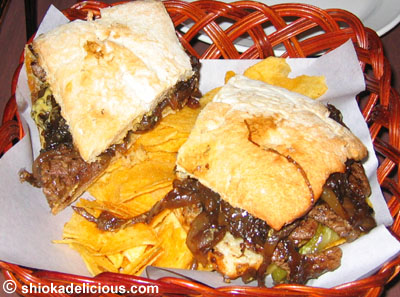
The steak sandwich with caramelized onions (S$12.00) (~ US$7.00) had looked interesting on the menu, so I ordered that as well. Compared to the two mains, this was at the other extreme of the flavor scale! Again, nice crusty ciabiatta was used. The small portion of fairly thick beef slices (not the thin slices that the waiter had promised) were heavily coated with a very strong black pepper sauce. Yet, even the overly strong taste of peppercorns was overwhelmed by the even stronger taste of the spread they had very liberally applied on the bread – we guessed it was maybe a combination of English mustard, mayonnaise, vinegar and maybe even a touch of wasabi? We couldn’t quite make out what ingredients had gone into the spread, but there was definitely an ingredient that had a really weird and unappetizing taste. Somehow the combination, whatever it was, just didn’t work… we cringed when we tasted it. So, I ended up taking the sandwich apart, scraping as much of the spread off as possible, and piling the rather tough, overcooked beef onto just the top half of the ciabbiata. Created a right mess on the plate I did. Quite a disappointment. The only saving grace I suppose was the rather nice store-bought packaged chips that came with the sandwich.
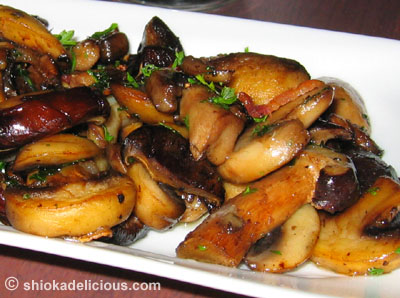
The sautéed wild mushrooms (S$3.90) (~ US$2.30) we thoroughly enjoyed though… beautiful balance of flavors, and sautéed just right. Flavorful. Yum!
For dessert, a listing of “Affogato” (S$5.50) (~ US$3.30) on the menu caught our eye… not something that is found very often in restaurants in Singapore. In fact, I haven’t seen it on any other menu in town. It sounds simple enough… vanilla-bean ice cream served with freshly-brewed espresso poured over it. We were intrigued… if done right, it would offer a wonderful taste experience of contrasts… the coldness of the ice cream melting into the hot espresso, the sweetness of the ice cream counter-balancing the bitterness of the coffee. Sorry, no pictures… we were too busy trying to slurp up the ice cream before it very quickly melted into the espresso! Can’t say we enjoyed it… the very small serving of ice cream meant that it had all melted within seconds, and the espresso was “over-done”. The very strong bitterness suggested that the coffee grind had been “cooked” too long. Unfortunately, all we ended up tasting was the overwhelming bitterness of the coffee and nothing else.
The same bitterness was experienced in their café latte… a bitterness which lingered and lingered on the tongue and in the mouth, long after dinner was over.
The service was very friendly, prompt and efficient. Everyone was quick with information and suggestions. Perhaps not very observant though… we had created a huge, messy pile of uneaten bread and scraped off fillings from the sandwich, yet we were never asked if the food was ok, or whether we enjoyed the food, or more importantly perhaps, what we weren’t enjoying about the food (as evidenced from the pile of “waste” on our plate). Oh well, maybe I’m just being nit-picking.
Overall, the food was definitely above average, the service very friendly, and the prices very reasonable. I think the chef has the right concept… trying to create light, healthy dishes using high quality, fresh ingredients and cutting out the heavy creams, butter and sauces etc. This is what a lot of people are looking for when dining out nowadays. And “light and healthy” and “full of flavor” are not mutually exclusive objectives. It can be done. My personal preference would be that the main courses be slightly more “flavorful”. And it would be good if the light touch extended to some of the other menu items, like the over-buttered bruschetta and the heavily flavored sandwich.
Would we return? Probably not, unless we were in the area, and wanted a quick meal. And not on a crowded weekend evening.
Isola
559 Bukit Timah Road
#01-01 Kings Arcade
Tel: 6467 8680
Food: 3/5
Service: 4/5
Ambience: 2/5
Price: $$
S$15 & below : $
S$16-30 : $$
S$31-50 : $$$
S$51-75 : $$$$
> S$75 : $$$$$
Copyright © 2003 Renee Kho. All rights reserved.
Please contact me for permission to copy, distribute or display any of the images and text contained in this article.
04:25 AM in Lion City Shiok-Eats: Western | Permalink | Comments (0) | TrackBack
Saturday, November 22, 2025
Stewed Dog

There was still some leftover stew from Thursday night sitting in the fridge. Today, the beef tasted absolutely fantastic. Having been heated through again, the flavors were so much richer and more intense, with a divine melt-in-the mouth texture. So, for breakfast, decided to put some of the stew into a hotdog bun, and topped it off with some cheese. Popped it into the toaster oven for 2 minutes to heat the bread through and melt down the cheese. Wasn’t sure what it would taste like – cheese with soy sauce flavored beef? - but it tasted really good! It was a good breakfast!
Copyright © 2003 Renee Kho. All rights reserved.
Please contact me for permission to copy, distribute or display any of the images and text contained in this article.
11:47 PM in Home Cook: Light Touches | Permalink | Comments (0) | TrackBack
Friday, November 21, 2025
Beef Stew
Cooked beef stew – fusion style - for dinner last night.

I like to use beef shin – the small amount of tendon in the meat makes for a more tender, smoother texture and bite. I also like to cook it with more gravy, so that the leftovers can be used the next day to top egg noodles, rice vermicelli or even pasta. Overnight, the gravy and meat tastes even better – all the flavors seem to have meld together even more - and makes for really yummylicious beef noodles!
I used just over a 1kg of beef, chopped into fairly large chunks. After lightly browning some minced garlic in hot oil, the beef was added and quickly browned to seal in the juices. Then added all the seasonings - around 4 tbsps of light soy sauce, 2 tbsps of dark soy sauce, 4 tsps of sugar and pepper to taste. All these can be adjusted for personal preferences and according to the amount of beef that is being used.
Just a quick sauté to coat the beef evenly with the flavorings, then water or beef stock is added, to completely cover the beef – (again, this can be adjusted to personal preference as to how much gravy is wanted). Leave to simmer slowly on fairly low heat.
After about an hour, the diced onions (lots of it) are added. A further hour later, blanched, skinned and diced tomatoes (again lots of it) are added. Both add a nice natural sweetness and tanginess to the stew. Finally, about 30-45 minutes before the stew is done, drop in the chunks of carrots, celery and potatoes. Yesterday, had a small flower of cauliflower left lying in the fridge, so threw that in as well – and it tasted pretty good! I prefer to add these ingredients at various intervals so that I can control the texture. I like the onions and tomatoes to be cooked down so much that they practically dissolve into the gravy, making for a naturally thick, rich, sweet and flavorful sauce. The shorter cooking time for the vegetables means that they still have some bite to them.
And for lunch today, the family had the remaining stew with flat egg noodles – yum!
Copyright © 2003 Renee Kho. All rights reserved.
Please contact me for permission to copy, distribute or display any of the images and text contained in this article.
05:38 PM in Home Cook: Poultry & Meats | Permalink | Comments (0) | TrackBack
Thursday, November 20, 2025
Honey, Honey, Honey
Mmmm… this is one of my favorite cakes – the Honeycomb Cake (S$0.70 per piece) (~US$0.40). Bought them yesterday at lunch from the old-style, traditional bakery next to the market, and had them for tea yesterday and today.

Of Indonesian origins (known as Bolu Sarang Semut in Indonesian, I think), this cake has a beautifully rich dark caramel color and unique flavor from the use of gula melaka (palm sugar). The palm sugar gives it a very distinct aromatic sweetness. But I think one might be able to get a close approximation by caramelizing normal granulated white sugar - perhaps?

What’s unique about this cake is its texture – it has a honeycomb-like texture. It’s not soft or crumbly like normal cakes, but is slightly springy to the bite, due to the honeycomb structure of the dough. And this is how you can tell the skill of the baker that made the cake. It is not easy to get this honeycomb effect. A really skilled baker will be able to bake a cake that has the honeycomb structure throughout the cake, whilst a less successful version of the cake may only have the honeycomb effect through the top half of the cake.

Copyright © 2003 Renee Kho. All rights reserved.
Please contact me for permission to copy, distribute or display any of the images and text contained in this article.
06:10 PM in Snack Attack! | Permalink | Comments (0) | TrackBack
The King of the King of Fruits
It’s November… and that means it’s durian season! Yes, this is the time of the year when this so-dubbed “King of Fruits” is piled high at all the fruit stalls along Sims Avenue / Geylang Road, and at every neighbourhood fruit stall too.
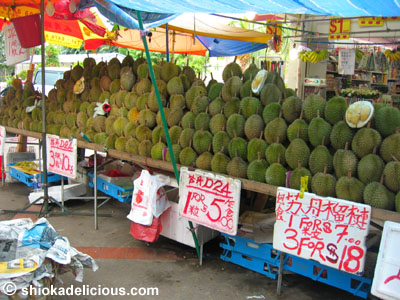
It used to be that we only get to taste the durian twice a year – June/July and November/December, with the major harvest being at the end of the year. However, in recent years, it seems that the fruit has become available all year round. Hmmmm… are the farmers fertilizing the tree a lot or crossbreeding or something to get the trees to flower and bear fruit year round? Isn’t that a rather worrying thought? Seems rather unnatural, I feel. Anyway, the November/December period is still the main harvest – when the fruit is at its tastiest and most abundant.
This year, the harvest has apparently been even more abundant, and prices have fallen dramatically. So, on our way home yesterday from lunch, we couldn’t resist picking up a few Sultan D24 durians. I like to buy the “real fruit”… don’t like those that now come shrink-wrapped and packed in sterile white unimaginative styroform boxes.
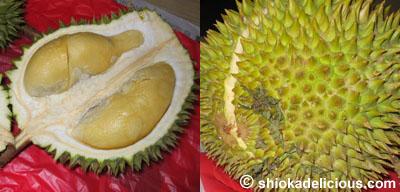
Sultan D24 is considered the King of the King of Fruits. Adored by durian connoisseurs for its perfect balance of sweetness and bitterness, for being beautifully smooth and creamy, and yet not mushy. Its flavors (when one finds a good fruit) are rich, aromatic and absolutely shiokadelicious!
Although recently it would seem that its position as the best in durian breeds is slowly being usurped by the XO durian – which is supposed to be even creamier, even sweeter and more bitter (?)… I don’t know… I’m not a real connoisseur, though I thoroughly enjoy the fruit – in all its guises…
This fruit is so adored that it now appears in just about all possible forms – from durian mousse cake, durian swiss roll, durian pancake, durian cream puffs, to durian ice cream, durian pudding, durian ice kacang and even durian mooncake! I’ve heard that someone somewhere in Singapore is also serving up durian roti prata/roti canai (the crispy, flaky pan-fried Indian pancake, which is normally served savory and eaten by dipping into curry)! Haven’t tried it, and somehow not inclined to either! Some of these permutations work very well, and my family loves them – such as durian cake, durian cream puffs and durian ice cream. However, some just tastes weird, like durian mooncake. But it’s all personal preferences I guess, because there must be people who like them… pastry shops and hotel delis roll them out big-time each year for the mooncake festival.
We like to freeze extra durian. They keep very well in the freezer for months. I also like to remove the flesh from the seeds and mash it into a thick rich, chunky pulp, which can then be mixed into semi-softened vanilla ice cream for a quick-and-easy home-made durian ice cream, or simply scooped over vanilla ice cream as a rich, aromatic topping! Yum, super yum!
And if you’re concerned about assaulting those around you with smelly breathe after indulging in durian, here’s a quick “old wives’ tip” for removing the very strong smell of the durian from your fingers and mouth… Use one of the empty segments of husk, sprinkle around ¼ to ½ tsp of salt into the cavity, dissolve in some water, drink out of the husk and rinse your mouth with the salted water. This also helps prevent sore throats too, which can happen from eating too much of the fruit.
And to remove the smells from your fingers, simply place the empty husk under running tap water, and rinse your hands in the water that has passed through the husk (as my mum is seen doing here View image).
Finally, to balance out the yang or “heatiness” of the durian, it is believed that one should also consume mangosteen after eating durian. This fruit with the deep purple/burgundy hard husk, which hides small segments of sweet white fleshed seeds, is said to have a yin or “cooling effect”, and will prevent the sore throats and hoarseness of voice that says: uh-oh… had too much durian! : D

Happy Durian-ing and Mangosteen-ing!
Copyright © 2003 Renee Kho. All rights reserved.
Please contact me for permission to copy, distribute or display any of the images and text contained in this article.
04:37 PM in Other Shiok-Eats, Tastes of South East Asia | Permalink | Comments (0) | TrackBack
Wednesday, November 19, 2025
The Lunch That Wasn't
Had cravings for noodles today. But not just any noodles (mee) though... wanted kon loh mee - as distinct from wantan mee. Although both are noodles tossed in special sauces and topped with slices of char siew (roast pork), they taste completely different. Not sure what the exact differences are in the sauces used, but the texture of the noodles used is very different too. The noodles used in the Hong Kong style wantan mee is a lot more chewy or springy, due to the large amounts of alkaline water used in the making of the noodles. The noodles used in the Malaysian-style kon loh mee are slightly thicker and have a much softer bite. I personally am more partial to the Malaysian-styled noodle, whilst most Singaporeans prefer the so-called "Q-Q" texture of the Hong Kong noodles. Unfortunately, I have not been able to find a true authentic Malaysian-style kon loh mee in Singapore in all these years. It's usually the Hong Kong version that is served in all the hawker centres, food courts and restaurants. But all this changed last week...
Last week, my mum ta-powed (bought takeaway) from the market hawker centre, and lo and behold! the noodles tasted just like the Malaysian kon loh mee! Stole a couple of mouthfuls from her, and it tasted really good! The sauce tasted right, the noodle texture was right. Wow!
And today, I just had to have that noodle... but alas, it was not to be. Found the stall all shuttered and locked up. The owner was off on a week-long vacation. Sigh!
And so it was back to our regular chye tow kueh stall. This is small chunks of steamed radish cake fried with eggs and chye poh (preserved radish). It comes in a black or white version, with the former being fried with dark sweet sauce and the latter with just light soy sauce.
This particular stall - Red Hill Carrot Cake (#01-380 Red Hill Market Food Centre, Blk 85 Red Hill Close) - is our favorite. I think it serves a very good version of this dish. The radish or carrot cake have a good balance between the cripsy exterior and soft insides. It's run by a mother and daughter team, with the father helping out with the serving. Personally, I have a preference for the mother's version - which has more of the "chau-ta" or burnt/crispy bits, making it that extra bit more tasty ; )
It was the daughter manning the stove today, but we are such regulars of the stall that they know exactly how we like the dish. The father was thoroughly bemused that I had shown up with my digital camera and was taking snapshots of them and the food. He was so facinated with the camera that he ended up watching me take the shots, and wanting to play with the camera, rather than serving his customers! LoL!

That's the very young looking father in blue in the foreground, and the daughter in her regular "protective gear" of cap, long-sleeved polo tee and gloves, cooking up plates and plates of the carrot cake. Why the "protective gear"? To protect her skin and hair from the grease and intense heat! Cute, huh?
Unfortunately, none of the pics of the carrot cake turned out. For some unknown reason, the food in all the pics came out with eery red hues, similar to the bright red color of the plate it was being served on! Alien food! Hmmm... what happened there?
But here is a pic of the plate of char kuay teow we also ordered. Flat rice noodles fried with egg, beansprouts, fishcake and very often, clams. (S$2 for regular; S$2.50 with an additional egg). Again, it comes in either the black of white version. This is the white version. I sneaked a few mouths, but found this version from a previously un-tried stall rather too oily for my liking.

In case some of you are wondering what a hawker centre is... it is a customized, non-airconditioned building with rows and rows of small stalls. Each specializes in just one or two dishes, such as chicken rice, or noodles etc. This is where one can find some of the best and most authentic local Singaporean dishes. And it is very, very cheap. For S$2-5 (~US$1.20-3.00) one can have a delicious meal. And so it is a common sight to see professionals in their business shirts and ties, or suits lunching in these centres. It can get sweltering hot and humid in these places, but the food is really good!

Almost all of these stalls are family-run, with the owners being true specialists in the dishes they sell. Many of them have been cooking just that particular dish for 10, 20 and even 30+ years! Unfortunately, when many of these hawkers retire, their dishes disappear with them, as their children are often unwilling to continue the business. They are open 7 days a week, for 8-12 hours a day. No breaks... maybe only 1 week off during Chinese New Year, and for some, no break at all for as long as 10 or more years!
These were originally itinerant hawkers, plying their trade from mobile push-carts in the streets in the 50s and 60s. Then, for hygiene and health reasons, the Government relocated them to specially built buildings with running water and proper waste disposal. And now these hawker centres are found in every residential neighbourhood and even right in the heart of the business and financial district.
Copyright © 2003 Renee Kho. All rights reserved.
Please contact me for permission to copy, distribute or display any of the images and text contained in this article.
11:53 PM in Lion City Shiok-Eats: Hawkers | Permalink | Comments (0) | TrackBack
Maiden Post
A few months ago, I stumbled upon my first food blog (yes, I know, I'm a late starter in this department), and was hooked. I thoroughly enjoyed the entertaining, sometimes humorous, write-ups, and absolutely drooled over all the glorious photos of food, food and more food. It was a feast for the eyes, and food for the soul. I was inspired to start my own food blog... Well, it has taken this long... but I've finally gotten round to doing it.
Many sites were inspirational. Here are just a couple of them. Thanks to Wena and Wena's spunky grandma ; ) for reminding me how precious and heart-warming home-cooked food is. So often I found myself nodding as I read her posts: yeah... we cook that at home too... so similar yet so different. I was facinated.
I'm just bowled over by Deb. Pregnant and yet so inspired and dedicated to cooking for colleagues and loved ones, and to experimenting with food and recipes, and producing the most incredibly tasty looking results ever.
I've always loved food, and used to dream (many years ago) of owning a cafe or bistro. Now, I'm inspired to cook for loved ones. This blog is also a tribute to my mum and her wonderful cooking. As she passes her recipes to me, I now realize that they are more than just recipes, they also embody the love and warmth of family and represent warm memories joy and laughter.
This is my trail for food that is SHIOK!
Copyright © 2003 Renee Kho. All rights reserved.
Please contact me for permission to copy, distribute or display any of the images and text contained in this article.
02:45 AM in Crumbs & Tidbits | Permalink | Comments (2) | TrackBack