« January 2004 | Main | March 2004 »
Thursday, February 26, 2025
Saffron
I was asked if I was okay with having dinner at Saffron on Tuesday. Okay? Are you kidding?! If I had a video phone, the person on the other end of the line would have seen me nodding my head so furiously that I was beginning to look like those Chinese “bu dao woong” (“won’t fall over”) dolls I used to play with as a kid. “Oh yes, let’s, let’s… please, yes…” I was beginning to sound like I was about to… Never mind. Don’t worry, we’re still talking about food here. I can of course be excused for my “exuberant enthusiasm” – I haven’t had North Indian for at least a couple of months.
I would never pass up a chance to savor North Indian cuisine. I probably enjoy it more than I do South Indian food. I like the more complex layering of different spice notes, with chilli heat forming but part of the overall picture, and balanced out with the smooth subtlety of either yogurt, milk or cream, compared to the stronger and perhaps more dominant notes of chilli and coconut cream in Southern dishes. And of course, being the bread person that I am, naans, bhaturas and rotis are all close to my heart…
Saffron is billed as a North Indian Bistro and Tapas Bar. (Yes, the irony of it all… an Indian restaurant partly calling itself something quite Spanish. As is very often the case in Singapore, a word with a specific meaning is taken and used so much that it takes on a whole new meaning and is used to define and describe a broad category of things or even a style of doing things similar to or just inspired by the original meaning of the word). Located on Circular Road in the heart of the business district, Saffron caters mainly to the professional crowd.
The décor is what I would describe as “contemporary Indian”. Dark furniture with clean lines in the style of maybe a modern, hip New York bistro provides the contemporary touch. The dimmed lighting adds a touch of formality to the casual furniture. Indian artifacts provide the Eastern accents. And of course, the all important strong whiff of Indian spices and cooking as one walks through the door lends the final touch of authenticity.
We happily munched on the papadums with the accompanying dip and chutney whilst we perused the menu. I was delighted to see that they offered toasted papadums instead of the usual deep fried ones. This is one happy trend that I’m glad to see spreading in Singapore. I think it started with the hip and upmarket Vansh, which rolled out their cigar-shaped toasted papadums over a year ago. And since then, a lot of the Indian restaurants in the city have followed suit. Saffron’s came folded into wedge-shaped pieces, a la the Chinese kueh sapit (love letters).
These were good. The spicy and peppery tones of the papadums were not tongue searingly overwhelming, as they often are wrought to be. The chutney was good. Not sure what it was though. It wasn’t mango. We thought possibly apple? Or maybe pear? Whatever it was, it was nicely sweet, slightly crunchy with nicely balanced hints of spice. The creamy mint dip was slightly less successful with us. Perhaps it was the color - a not too natural green. The flavor was okay – very creamy though. Maybe too creamy.
There were actually no tapas (as in sampler sized dishes) listed on the menu. The listings looked like regular “order and share” dishes, and looking around at the other tables, we realized their portions were fairly generous. Wanting to try as many of their dishes as possible, we decided to skip the normal Indian appetizers of pakoras and samosas and go straight on to the mains.
The lamb ribs (S$22.00; US$13.00) came highly recommended on the menu. And we had to agree. They were good! Each rib came with a thin layer of meat that was meltingly tender and completely infused with flavor, evidence of careful marinating and slow and patient cooking. The meat was held to the bone only by the skin of the ribs, which is usually removed but kept in this instance, perhaps precisely to hold the meat to the bones and not have it disintegrate into the gravy. It was that tender.
The spice flavors were intense, and yet perfectly natural. That is the only way I can think of to describe it. There wasn’t even a hint of gaminess. Earlier, as we placed the order, I had the slightest moment of hesitation - lamb ribs are usually strongly gamey, unless cooked absolutely perfectly. And here the worry was completely unfounded.
The gravy was divine. Sinful, but exquisite. Most of the fat had been cooked out of the meat and into the gravy. That was what made it so good. But that was also what would probably send my cardiologist into a right tizzy. Still, we couldn’t resist mopping up all that tasty, thick and rich stuff with our naans.
Next was the Jhinga Masala (S$17.50; US$10.50) – tiger prawns in a tomato and onion sauce. The prawns were very fresh, with beautiful crunchiness. The gravy was less intense than that of the ribs, but again nicely balanced, with just enough creaminess – perfect with the naans. The fresh coriander sprinkled on top added a nice refreshing note. (You will notice, as we go along, that the chef had a great fondness for coriander. It was liberally sprinkled on almost all the dishes. Luckily for us, everyone in our party loves coriander. So the chef did right by us on that score). I also liked the chunks of soft, sweet onions in the gravy. It made for more textural interest, rather than the usual purely creamy gravies.
Here’s a slightly better (not much, but slightly better) view of the prawn…
This chicken dish was from their “Monthly Specials” menu. Each month they feature dishes from a different area of India. I can’t really remember what this dish was called – Murg Laziz (S$13.50; US$8.00), if I’m not wrong. Chicken with a creamy almond and cashew nut gravy.
Big pieces of bone-in chicken were cooked in the very, very creamy gravy. We found this a little too creamy for us. There was obviously a lot of cream in the gravy, and some coconut cream too, with more of the latter poured over the top just before it was served. We found the spice balance less finely tuned in this dish, with the cream and coconut cream forming strong, dominating central tones. This was perhaps just a little too rich for our palate.
I really liked their Murg Briyani (chicken saffron rice) (S$13.50; US$8.00). The chicken was moist and tender. Every single grain of rice was infused with wonderful flavor. Again, kudos to the chef for the fine balance of spices. Apart from the usual ground spices cooked into the rice, I think I also saw some whole green cardamoms and whole coriander seeds. There was also enough of a hint of saffron. They did use a tiny bit of orange coloring in the rice, but for once, I didn’t mind – it just made the rice looked even more delicious and enticing. The light sprinkling of crispy fried shallots and chopped fresh coriander (cilantro) leaves on top of the rice were the perfect finishing touch.
The rice was very moist and fluffy. Some people could possibly find it too moist for a briyani. However, our party actually enjoyed the textural uniqueness of this version. It made for an interesting change from the usual harder and dryer versions one normally finds. It was moist without being mushy – each grain of rice was nicely defined and whole.
I have to admit, guiltily, that I polished off a large portion of the rather substantial pot of rice! And I think my dining companions let me, just so to assuage their guilt a little of having deprived me of my naan…
We had ordered 2 plain naans (S$2.90 each; US$1.70)…
The plain naans were very good. Almost reminiscent of Shahi Maharani’s when they had their original naan Master Chef when they first started out in Crowne Plaza’s annexe building. The first time I ate Shahi Maharani’s naans, I almost cried. They were really, really good. Unfortunately, changes before and after their move to Raffles City have altered my naan experiences there, and I have yet to find a close enough replacement. Saffron gave a glimmer of hope. The naans on Tuesday were quite delectable, especially when they first came out of the oven. Nicely crispy on the outside and slightly fluffy on the inside.
I never got to try the garlic naan. And there’s a rather humorous story behind this. The restaurant was very busy that night, and the kitchen was perhaps struggling a little. And so, our food was somewhat tardy in arriving at the table. The restaurant managers were extremely apologetic and wonderful about it. When the food finally arrived, my two dining companions could barely conceal their impatience as they waited for me to do my stuff with the camera. I had just finished snapping the garlic naan, and I looked down to switch off the camera and place it on the table. I looked up one and a half seconds later, and all I was looking at was an empty bread basket! That certainly gave a whole fresh new perspective on the saying “gone in the blink of an eye”! All I saw were two slightly guilty smiles flanked by rounded cheeks bulging with garlic naan! I could only guess that it must have been as good as, or maybe even better than, the plain naans, given the speed and ferocity with which it disappeared! 
This was a pleasant surprise at the end of the meal. It came with the compliments of the restaurant manager, perhaps as apology for the tardy food. This was the prettiest presentation of kulfi (Indian ice cream) that I have seen. Usually, it just comes served in a bowl – even at high end restaurants. Here, the fresh home-made mango kulfi was cut into bite-sized round disks and displayed, together with prettily cut apple, in the shape of a peacock’s tail. Toasted almonds, chocolate sauce and a fruit-based sauce added the rather elegant finishing touches. I really appreciated their attention to detail and presentation. This was so traditional and Indian (peacock symbolism), and yet so modern and Western all at the same time.
The mango kulfi itself was very good too. It didn’t have the tooth-aching sweetness of the usual kulfi. It was very sweet, but just enough to re-balance our palate from the preceding spice-filled food. The texture was nicely smooth and creamy. A beautiful sweet note with which to end the meal.
It was a very satisfying meal. The portions were definitely more generous than the standard servings in almost all Indian restaurants. Even with the delicious food, we struggled a little to finish everything. And, I have to say, the service was excellent. For a city where indifferent or sometimes even brusque service can be all too common, this was such a heart-warming change. Staff was attentive without being intrusive. They noticed the details, the small things. Empty beer and drink glasses quickly caught their eye, and a polite, quiet query about a refill would follow. Unobtrusively, glasses were re-filled. They noticed when we started to look a little impatient about when our food would be arriving. Without us enquiring about the food, they apologized and tried to speed things along for us. We were impressed.
Perhaps the only thing that marred the very enjoyable culinary experience was the acoustics of the place. I think it was just a factor of the physical construction of the restored shophouse. It was full house on Tuesday night, and with the tables placed closely together in the limited space, conversations started echoing around the high-ceilinged area. As each diner in the restaurant strained to hear their companions, the louder they spoke to make themselves heard. The louder the noise levels got in the restaurant, the more we strained to hear and be heard. And so it went. This is perhaps not a place for quiet, intimate conversations. But for highly enjoyable food and excellent service, Saffron is a good place.
Reservations are recommended. There are a limited number of tables, and even though we were there on a Tuesday evening, it was full house, with some tables already having done two turns during the time we were there.
Saffron Bistro
50 Circular Road
Singapore 049405
Tel: 6536 5025
Fax: 6536 0852
Closed on Sundays
[Note: Each month, Saffron offers a supplementary “Specials” menu which highlights the culinary specialties of a region of India. The month of March will feature dishes from Kerala, and April will highlight specials from Hyderabad.]
Copyright © 2004 Renee Kho. All Rights Reserved.
Please contact me for permission to copy, distribute or display any of the images or text contained in this article.
11:30 PM in Lion City Shiok-Eats: Indian | Permalink | Comments (12) | TrackBack
Wednesday, February 25, 2025
Ra-Ra-Ramen!

We made some Japanese-inspired ramen for lunch last Sunday.
For those who know me, this must sound pretty amazing – me, eating soupy food for the second time within three days! First it was the fishball beehoon soup, and now ramen in miso soup. I was a little surprised with myself too. But there you go. Life is full of surprises. 
I’m not a soupy-food person, generally. I’m okay with soups, just not soupy foods – you know, like soup noodles, soup bee hoon and others of that ilk. When eating out, almost invariably, I would order my noodles “dry tossed”. I hardly even look at the “noodles in soup” section on menus. At home, my noodles are usually “dry” too – be they fried, tossed, whatever. Even when I resort to instant noodles, it’s Mi Goreng only for me. For the same reason, I don’t really like Teochew porridge, which quite literally is pretty much watery rice. But I like Cantonese porridge which is not soupy. Oh wait. There’s one exception. I like mee sua in soup. Yeah, I know, my many quirky food idiosyncrasies. It’s not like I don’t eat soupy food, mind you. I do. Just not very regularly. Okay. Not very often at all. But I do.
Anyway, so it was on Sunday that we had some ramen in miso soup.
We didn’t make a “proper” miso soup – i.e. using dashi stock with miso. We had just made a huge pot of fresh chicken stock that morning. And there’s nothing quite like freshly boiled pure chicken broth, and so we thought it would be really nice to just add some miso to that, and make some tasty soup. The white miso was dissolved in a little of the chicken broth before being added to the rest of the barely simmering stock. We had planned to add some kombu (dried seaweed) into the chicken broth to simmer for a while before adding the miso. It didn’t happen. More on that later.
I am perpetually perplexed and dumb-founded by the different miso that line the supermarket cooler shelf. There must be a good 10-15 varieties at least, just for white miso alone. And that’s only at Cold Storage, and not even at the Japanese supermarkets. The names are all different, but they look pretty similar and their ingredients are the same or very similar. The Japanese names are different, but the English translation is always “soy bean paste”. That’s not much help is it? So, which one to use for which purpose? I usually end up standing for a good few minutes in front of the chiller staring at the different packs of miso. Sometimes, someone takes pity on the “damsel in distress” and makes a suggestion. Other times, another equally clueless and confused person joins me to stare at the miso. Eventually, a pack of miso will usually take pity on us, call out our name, and we hastily take it home with us.
Ramen in miso soup has to be the quickest and simplest dish to make, and yet it is tasty and fulfilling in a very comforting sort of way.
The dried ramen was cooked in a separate pot and then placed in the serving bowls, before the miso soup was added. The noodles were then topped with various ingredients. We did a schizophrenic mix of Japanese, Chinese and Western! Thin slices of Japanese fish cakes (these ones from Cold Storage were less refined and smooth compared to the ones we picked up previously from Kimesawa), slices of Chinese BBQ pork (char siew), some kombu and because we like veggies a lot, some raw shredded carrots and cucumber. And yes, I’m very big on colors… I want different colors in my food.
Oh yes, back to the kombu. Now, this was supposed to have gone into the chicken stock to be simmered for a short while. But we clear forgot about it. In fact, we didn’t remember until the noodles were ready, and everything was plated, then suddenly someone exclaimed “where’s the kombu?” It was still happily and blissfully soaking away in its own private water bath. And so, belated, we quickly heated up the kombu and simply plonked it onto the already plated noodles.
Please excuse the rather uninspired plating in the photo. By then, I was too hungry to worry about the aesthetics and the positioning of the ingredients. And my poor ramen, by the time we got our kombu act together, and I got my camera act together, it had busily and thirstily slurped up much of the miso soup and was already becoming fat and flabby (as you can tell from the photo)!
But, still, it was good. Light yet robust. Delicate yet hearty. Refreshing yet warming. Healthy yet fulfilling. Simple yet flavorfully and texturally complex. Quick and easy, yet nicely appealing. Need I say more? It was a tasty Sunday brunch.
Copyright © 2004 Renee Kho. All Rights Reserved.
Please contact me for permission to copy, distribute or display any of the images or text contained in this article.
05:00 PM in Home Cook: Rice, Noodles etc | Permalink | Comments (9) | TrackBack
Tuesday, February 24, 2025
Great Balls of F… Fish!

Made this for lunch last Friday. Home-made fish balls with some bee hoon (rice vermicelli) in a vegetable soup.
I had wanted something light, healthy, colorful, and quick and easy to prepare, and I didn’t want instant noodles. It so happened that my mum had just bought some “ma kau” (sorry, I don’t know the English equivalent for this… Chinese mackerel maybe?? if such a thing exists!) fish meat from Chinatown that same morning. Aha! Fresh home-made fish balls from very fresh fish meat. Sounded perfect.
This stall at the Smith Street wet market sells copious amounts of this fresh fish flesh (try saying that really quickly ten times in a row ) everyday. Two elderly Cantonese ladies sit there the whole morning just scraping meat off the fish and beating it into a smooth pulp. The beating is done by hand (I think) in a large wooden bowl, with maybe just a little salt water added to the fish meat. By the time my mum got to the stall they were out of the ready-prepared fish pulp, and were still in the midst of preparing the next batch. Not wanting to wait, my mum simply bought the scraped fish mash, and had planned to beat it into the smooth pulp herself when she got home. I was lazy and couldn’t be bothered, so I gave the fish meat only a quick mash before shaping them into balls. I thought it produced a rather interesting texture - different from the usual fish balls. There was a less refined, almost rustic, look, feel and texture to my fish balls.
Wanting to keep the taste of the fish balls as “pure” as possible, I added only a bit of salt water (rather than salt itself, as salt water, according to my mum – and I’ve learnt not to question her culinary wisdom on such things – enhances the texture and smoothness of the fish meat) and a little pepper to the meat. Then it was simply rolled into tiny bite sized balls. No flour or other binder was needed.
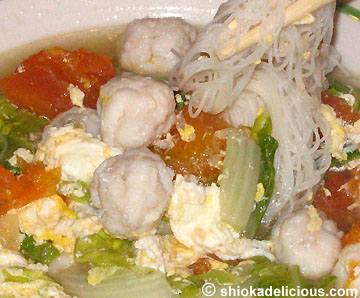
Next, I brought some chicken broth to a boil, added in some fresh veggie and tomato, and seasoned the soup to taste. When the vegetables were almost at the doneness I wanted, in went the fish balls. As they started to float to the top (indicating they were cooked), I let the soup come to a quick rolling boil, and quickly added in two lightly beaten eggs (seasoned with a dash of light soy sauce and pepper). I reduced the heat, and quickly but gently swirled the eggs to form smooth loose strands throughout the soup. Just before the eggs were fully cooked, I turned off the flame and allowed them to finish cooking in the residual heat, so that the egg texture would stay smooth.
Unfortunately, after removing the soup from the heat, I discovered that not all the fish balls were fully cooked through. Like I said, I was feeling lazy. So instead of removing the undercooked fish balls from the soup and cooking them again separately, I just plonked the whole pot back on the flame for another minute or two. The result? Somewhat overcooked eggs with a slightly “rough” texture (as you can see from the picture). They tasted fine. But I’m just picky sometimes about the eggs having a smooth, refined texture.
At this stage, this chunky concoction already made for a delicious stand-alone soup. But I wanted to make a full meal of it, and so while the soup was cooking, I also boiled some rice vermicelli in a separate pot of water. It’s best not to cook the vermicelli in the soup, as this tends to turn the soup "cloudy", and makes it that little bit less visually appealing. My laziness and hunger again dictated that I didn’t bother with the cold rinse for the bee hoon. Once it was cooked, and the soup was ready, I added the two together, and it was good to go. Time to eat!
Oh… and where’s the bee hoon in the picture you ask? Err… let’s see… it’s… here… 
Copyright © 2004 Renee Kho. All rights reserved.
Please contact me for permission to copy, distribute or display any of the images or text contained in this article.
11:57 PM in Home Cook: Fish & Seafood, Home Cook: Rice, Noodles etc | Permalink | Comments (11) | TrackBack
Monday, February 23, 2025
Sweet and Sour – A Reflection of Life?

After posting about Hillman last Friday, it occurred to me that while I have talked a lot about how much I love sweet and sour dishes and about the ones I have eaten at various places, I have never posted my own recipe for sweet and sour fish, sweet and sour prawns, sweet and sour pork or basically, sweet and sour just about anything you choose. So, here it is… my family’s version of the sweet and sour sauce…
The sauce is very versatile and can be used for a lot of things – fish, prawns, pork and chicken just to name a few. For fish, there is the choice of using a whole fish, lightly coated with cornflour and fried; or using small pieces of fish fillet, coated with batter and deep fried…

If you look carefully enough, you should be able to see a few pieces of fish fillets peeking out from under the vegetables and sauce topping.
At home, a lot of the time we buy just the tail section of a large garoupa (see first picture), instead of the whole fish, as we find the meat more succulent and with less bones! Prawns can also be either lightly dusted with cornflour or dipped in batter. For pork, usually small pieces of pork tenderloin, coated with a light batter, are used, but I suspect one could just as easily use ribs, lightly dusted with cornflour before being deep fried, as another tasty option. Again, with chicken, the more common practice would be to use small pieces of chicken fillets coated with batter, but equally, it should be fine to use whole chicken pieces with bone-in. Although I have never tried it, I would think firm pressed tofu or tau kwa, coated in light batter and fried, could be an option for vegetarians. Sweet and sour tofu. Why not?
First though, maybe I can share a few tips that I have picked up from my mum about preparing the various seafood or meat, and which I find rather useful:
• For fish: after cleaning the fish, pat dry with paper towels and simply sprinkle with some pepper and refrigerate until it is ready to be cooked. Just before frying the fish, season it with a little light soy sauce and Chinese rice wine, before coating it with cornflour or batter. It is not advisable to season the fish too early, as it tends the make the flesh go “mushy” (or “mei” in Mandarin) and it loses its texture and bite.
• For prawns: always wash the prawns before shelling them, and do NOT wash them again after they have been shelled (my mum drummed this prawn-preparation fundamental into me when I first started out cooking). It affects the texture of the prawns. Devein the prawns, pat dry with paper towels, and again like the fish, sprinkle only with pepper and refrigerate until ready to use. The seasonings of light soy sauce and rice wine go on just before cooking.
• Just as an aside: if freezing prawns after purchasing them, do not wash them. Simply place them, with shells intact, neatly in freezer bags in single layers and freeze. According to my mum (another “food fundamental” that she drilled into me), prawns do not keep well – even in the freezer – after they have been washed, and even if they are then well-dried with paper towels. Their flesh will taste mushy (“mei”) when they are subsequently cooked. Simply defrost and wash and clean them before cooking.
• For pork and chicken: season the meat with some light soy sauce, a dash of dark soy sauce (optional – leave out if you wish for a lighter color), a little sugar, a dash of sesame oil and pepper to taste.
• Frying the seafood or meat: either lightly coat meat with cornflour and fry; or use a batter made from “specialty crispy deep frying flour” and water.
The Sauce
Mixture A
½ large onion – cut into squares
2 red chilli – seeded and cut into squares (optional)
1 large tomato – seeded and diced
½ cucumber – peeled, seeded and cut into squares
2 pieces fresh pineapple (optional – leave out if unable to get nice fresh pineapple, as this is not easily substitutable with the canned version)
1 clove garlic – minced
Mixture B
3 tablespoons plum sauce
2 tablespoons tomato sauce (ketchup)
1 tablespoon sweet chilli sauce
1 tablespoon sugar
1 tablespoon rice vinegar
1 tablespoon light soy sauce
salt to taste
½ small bowl hot water
Mixture C
A little cornflour
Some hot water
Once again, all the above quantities are estimations or based on the “agak-agak” method, as we like to say . I do apologize to those who like to have precise recipes and measurements. Unfortunately, almost all Chinese family recipes do not come with exact quantities. Our mothers, and their mothers before them, all cooked from instinct and experience. Recipes are passed down from generation to generation verbally, with nothing written, nothing noted. And each generation may tweak the recipe slightly to suit personal tastes, and so it goes on. So it is with me. When I learnt to cook, my mum would just stand by the stove while I cooked, and tell me the steps, ingredients and any special tips she learnt along the way through hard-earned experience as we went along. And that was it. After that, it was for me to follow or adapt as I wished.
The ingredients in Mixture A are for the vegetable topping in the sauce, so just use as much or as little as you like. Other vegetables can be substituted – such as green bell pepper instead of cucumber and so on. A nice mix of colors in the vegetables adds a nice touch to the dish.
Mixture B can also be varied according to personal preferences – whether one wants it sweeter, more tangy or with a stronger chilli note. I find that the quantities I use sometimes vary according to how my taste buds are feeling on that particular day! And of course, the amounts would vary according to the amount of seafood/meat being used, and how much gravy you would like the dish to have. I personally prefer to have a little more gravy to mix with rice and so on.
• Mix all the ingredients in Mixture B together. Set aside.
• In a hot wok or pan, sauté the minced garlic and vegetables in a little hot oil. Add Mixture B, and allow it to come to a boil.
• Add Mixture C (just enough to thicken the sauce). Return the sauce to a boil, and remove from the heat.
• Pour over ready-cooked (and fried) fish, prawns, pork or chicken just before serving, and serve immediately. Try to avoid adding the sauce to the seafood/meat too early, as they will turn soft from sitting in the gravy for too long.
A perfect balance of sweet and sour… a little like life itself, n’est-ce pas?
Copyright © 2004 Renee Kho. All rights reserved.
Please contact me for permission to copy, distribute and display any of the images and text contained in this article.
05:45 PM in Home Cook: Fish & Seafood | Permalink | Comments (5) | TrackBack
Friday, February 20, 2025
Hillman

It’s been a long, long time since I last posted about one of my dining out experiences, simply because, a lot of the time, I haven’t felt much like taking photos. I just wanted to enjoy the food and company without having to worry about pictures. The rest of the time, the occasions had not been appropriate for food photo taking. However, a few nights ago, we popped into Hillman for a simple and casual dinner, and I allowed the camera to come along for the ride.
The last time I ate at Hillman, they were still at their old premises on Cantonment Road. That was indeed a long time ago. But I have fond memories of their fish head claypot and paper wrapped chicken – probably the two dishes that have made them famous and for which locals and foreigners alike flock to their restaurant.
The new outlet on Kitchener Road is split into two levels, with the lower level taking up only one small shop unit. I didn’t venture upstairs, but I presume the upper level is significantly larger. Diners now get to eat in air-conditioned comfort. Gone is the open-air kopitiam (coffee shop) concept with old whirring fans and 1970s’ beer advertisement posters of comely, scantily-clad women gracing the walls. I miss that actually (the whirring fans that is, not the beer posters). For me, that was part of the charm of eating at the old Hillman. Seemingly gone too are the tables after tables of Japanese male expatriates enjoying a claypot dinner with bottles after bottles of Tiger beer. There were still a few tables of Japanese diners, mostly families with young children in tow.
One thing that hasn’t changed much is the fairly long wait for the food to arrive at the table, so don’t arrive overly hungry.

We had wanted to order either the fish-head claypot or fish claypot – their signature dishes. The lady boss highly recommended the Eight Stars Pot (S$12.00 for small; US$7.20), which she said included a mixture of fish, prawns and meat. After a little hesitation, we decided to take her up on her suggestion. No harm trying something new.
There were pieces of battered (no, no violence involved, just a quick dip in a mixture of flour and water ) and deep fried fish fillets, prawns, chicken chunks, thin pork slices, three types of mushrooms, whole small white onions and various vegetables all cooked together in a rich flavorful stock/gravy. The fish and prawns were very fresh, but unfortunately, two out of the three types of mushrooms had come from a can. The dish was tasty (I kept thinking how delicious it would be to cook some noodles in the gravy). However, I can’t say it was extra-ordinary. One can very easily find the same dish in a lot of places.
Also, if our memories serve us right, we remember the fish-head being cooked in the claypot itself. The Eight Stars Pot looked like it was cooked in a normal pot and then served in the claypot. It does make a difference to the taste.
We agreed we will stick with their famous fish-head / fish claypots the next time around.

This is the other dish that they are known for – paper wrapped chicken (S$16.00 for 10 pieces; US$9.60). Boneless pieces of chicken thighs were marinated with their very, very tasty proprietary (and secret) recipe, wrapped in paper pockets then deep fried. The meat was very flavorful – the care in the marinating process showed. The deep frying turned the chicken a gorgeous golden brown but without crisping the outside of the meat, so it was tender, juicy and succulent, if a tad oily. Here is a piece of chicken with the paper wrapping off. I mangled it a little while trying to undress it… it was a very camera-shy piece of chicken meat, and clung tenaciously to its paper covering. What can I say?
Their paper wrapped chicken was still as finger-lickin’ly (yes, I’m mangling the English language too) good as ever.

Nearly every table had an order of fried rice. We figured it must be really good. And so, we too ordered a plate – the shrimp and egg fried rice (S$5.00 for small, which is probably good for 3 persons; US$3.00). The wok hei (smokiness from the wok) was pretty good, and each individual grain of rice was nicely defined. However, we prefer fried rice with a slightly softer, fluffier grain – we found the rice grains in their version to be rather hard, dry and undercooked.

And of course, I had to have my beloved sweet and sour prawns (S$10.00 for small; US$6.70). Actually, it was a toss-up between the sweet sour prawns and the sweet sour fish, both of which are my weaknesses. This time around, the prawns won out. I liked their version. I thought it was well-made. The nicely large-sized prawns were very fresh and crunchy. They were dusted with just the lightest coating of flour before being deep fried and mixed with the sweet and sour sauce. The sauce looked rather red, but I think it was from the ketchup and chilli sauce used to make it – and not from added coloring. The balance of sweet and sour was very nicely tuned. I single-handedly polished off most of the dish! *gulp*
We were very tempted to order the gui hua chi (sharks fin scrambled eggs, served wrapped in raw lettuce leaves). We like this dish a lot, and apparently Hillman does a very good version of this. However, we had already ordered quite a lot of food for just 2 people. So, that will have to be for our next visit.
It was a good dinner, at reasonable prices. Despite the quantity of food, there was nary a scrap of food left on all the plates by the time we were done!
We noticed that the tables with Japanese diners received complimentary desserts, but none of the “local” tables got any. Hmmm…
Still, satiated, we ambled happily off into the night, stroking our significantly rounded tummies!
Hillman Restaurant
135 Kitchener Road
Singapore 208518
Tel: 6221 5073; 6296 6961
Open Daily
11.30am – 2.30pm
5.30pm – 10.30pm
Copyright © 2004 Renee Kho. All rights reserved.
Please contact me for permission to copy, distribute and display any of the images and text contained in this article.
11:30 PM in Lion City Shiok-Eats: Chinese | Permalink | Comments (4) | TrackBack
Wednesday, February 18, 2025
Doing the Tim Tam Slam

What do you get when a couple of full-grown adults start acting like 5 year olds? A lot of silliness, fun and a huge sugar rush, that’s what.
Last Sunday was one of those warm and still afternoons shrouded in a heavy blanket of quietness and tranquility. I was “innocently” snacking on some Arnott’s Tim Tams in the kitchen. But within minutes, everything had dissolved, literally, into a hilarious, messy but glorious jumble of belly-aching laughter and a lot of chocolate goo!
My love affair with chocolate Tim Tam’s began over 20 years ago, and throughout this time, none of the ardor has waned. In that time, I’ve tasted cookies or bickkies (as the Aussies would say) that were elegant, delicious, refined… works of art even. But I can never resist an Arnott’s Tim Tam. This surely must be one of Australia’s most endearing food symbols.

There is just something totally knee-weakening about those two slices of smooth, crunchy, crispy chocolate biscuits, sandwiching a layer of sweet, rich chocolate cream and all completely covered with a layer of rippled milk or dark chocolate (I personally prefer the latter).
I remember 20 years ago, when Tim Tams were still not available in South East Asia, each time a relative or friend traveled from Australia, there would be pleas all round for some Tim Tams to be brought back. And huge cardboard boxes (those used by farmers to pack apples for export) of these biscuits would be brought back (no doubt to the intense amusement of customs officers) and distributed, with each family rationed to maybe only a couple of packs of these divine indulgences. Each piece of Tim Tam was slowly savored and enjoyed… for who knew when our next “shipment” would arrive.
Now, of course, Tim Tams are readily available in all supermarkets, but they have lost none of their charm and appeal. I hear that there are now recently-launched alcohol-flavored Tim Tams. They’ve yet to hit our shores, but… hmmm… not sure I would like my Tim Tam “adulterated” like that… then again, I might just fall in love all over again.
Back to the slam… What is it? Until last Sunday, I’ve never actually done the Tim Tam Slam. (Yes, I was a 'Slam Virgin', I have to admit). I had only heard about it from my brother a long time ago, and the information was filed away into one of the dusty corners of my mind under the “interesting but not immediately useful” folder.
And so there we were, happily munching through a stack of Tim Tams, when I had one of those blinding flashes of genius (ahem!)… let’s try the Tim Tam Slam (sometimes also known as the Tim Tam Explosion or Shotgunning a Tim Tam). Is this sounding violent enough for you?
Okay, okay, there really isn’t any violence involved. Trust me. At least not of the type that will get you arrested.

A piece of Tim Tam is taken, and two tiny bites are taken out of two diagonally opposite corners of the biscuit. The key to Slam success is to take as small a bite as possible. Difficult I know when it comes to biting into a Tim Tam, but believe me, you will be glad you did. Then again, you may like the result of NOT taking small bites out of the Tim Tam. How much risk can you take? Do you like living dangerously?
Now, this is where the fun and the “violence” come in…

Dunk (gently, please…) one of the bitten-off corners into your favorite beverage - coffee, latte, cappuccino, rich chocolate, Milo or just good wholesome milk (hey, why not?) - and, with the other bitten-off corner in your mouth, suck… hard. As if using the Tim Tam as a straw to draw the liquid into your mouth. As soon as you feel the beverage touching your tongue, give a final suck, and “slam” the whole biscuit into your mouth. Now, stop… breathe deep… and savor… all that intense, rich, sweet, gooey, chocolatey goodness assaulting every single taste bud on your tongue. Don’t worry about the copious goop dripping from the corners of your mouth, rolling down your chin, dribbling onto your shirt and coating your fingers. This is NOT meant to be dignified, elegant, dainty or clean.
Of course, practice makes perfect. After a while, you will (hopefully) be able to get the whole saturated biscuit into your mouth before it disintegrates. Hey, what better excuse to finish that entire pack of Tim Tams… just so you can get it juuuusst right. And as an added bonus, at the end of it all, you get to drink that cup of beverage "enriched" with oh about a dozen or so Tim Tam-worth of chocolate. For beginners or ‘Slam Virgins’, I suggest you start with a cold beverage… iced chocolate, iced milo, iced latte, whatever… (I love Tim Tams with icy cold soy milk). It helps you stay in control a little more. Of course, once you are a seasoned ‘slammer’, by all means, go for the real thing… hot chocolate, hot coffee… Now, that is a real slam!
Should there ever be occasion when your body’s sugar level is found “lacking”, try this*… melt a bar of Toblerone chocolate (broken into chunks) in some milk, over a low flame. Once dissolved, pour into a mug and top with some marshmallows. And then… do the Tim Tam Slam. This will surely redefine the term “a sugar high”!
* [taken from here]
Sometimes, we just want to let the child in us out for a while... be messy… laugh until our belly hurts… roar with laughter until we are near collapsing on the floor… and feel the glorious sensation of a chocolatey glob crawling down our chin like some scene out of a C-grade horror movie.
Life is good!
Copyright © 2004 Renee Kho. All rights reserved.
Please contact me for permission to copy, distribute and display any of the images and text contained in this article.
11:57 PM in Snack Attack! | Permalink | Comments (14) | TrackBack
Delectable Morsels
I discovered these delicious morsels while following links…
More appetite-whetting pics and recipes… from Tripe ‘E’ Cooks.
This was a treat for the chocoholic in me… chocolate alchemy… does that sound divine or what?
Want to snack, but without the calories? Check out this Snackspot.
Now, this is what I call guilt-free, sinless indulgence!
(What I wouldn’t do for a Dairy Queen Triple Chocolate Utopia right now! Heaven indeed!)
(And I’m still waiting for the day when the golden arches and BK burgers I order look as tall, perky, fresh and luscious as those pictures. Why do I suspect it will be a very, very long wait?)
Talking about burgers… well, burger me!
Often maligned, but secretly loved?
But, if you are looking for a little more “refinement” and “grace”… how about the nice English tradition of afternoon tea? Mmmm… yes, let’s do have a nice cup of tea and a sit down…
Now, this is the life…
You won’t believe your eyes for this one…
If you are a sushi and sweets lover like me, you’ll also be wishing that they ship internationally. Kooki, indeed!
So, okay, I admit defeat. I’m not such a candy “connoisseur” afterall… sigh!
Fancy yourself a candy bar expert? Take the test.
If not, you can always start a new hobby.
[via the foodsection]
Copyright © 2004 Renee Kho. All rights reserved.
Please contact me for permission to copy, distribute and display any of the images and text contained in this article.
11:51 PM in Crumbs & Tidbits | Permalink | Comments (3) | TrackBack
Tuesday, February 17, 2025
Great Finger Food: Honey Ribs

It’s been a long time since I’ve had these honey pork ribs. My mum used to make them fairly regularly. But the preparation is fairly involved, requiring several stages, and more often than not, in the mad-mad rush of daily living, it is usually the easy-to-prepare, no-fuss dishes that get put on the dinner table. And thus this recipe was relegated to the “firm favorite, tried-and-tested, but forgotten” category.
I decided to resurrect it the other night, as I searched for a delectable, addictive finger food recipe. There is something rather sexy and sensuous about eating food with your fingers, especially the type of food that leads you to constantly lick your fingers because it is so good. You get the picture…
The combination of ingredients may sound a trifle odd, but the end result is anything but. Curry powder and honey, you ask? It works, and works very well too. Actually, there is no honey involved. Instead it is caramelized sugar that gives these ribs their rather unique texture – a deliciously crispy and sweet “crust” – and not to mention their gorgeous color. The curry powder does not overwhelm. It sort of sits in the background and adds a subtle spiced overtone to the meat.
These ribs are perfect for munching on while lounging on the sofa and chatting or just staring at the goggle box. Once you start on the first piece, it’s near impossible to stop.
I used just under 1 kilogram of pork loin back ribs (i.e. baby back ribs) the other day for two people. No, it is not a lot at all. In fact, we were still wanting more long after the last piece of ribs had been devoured! The quantities given in the recipe are based on my “look, see, feel” method of cooking – yet again. And can be easily scaled for varying amounts of ribs.
• Remove any excess fat and skin from the ribs, and divide into single ribs of about 1½ to 2 inches in length (for easy eating). Marinade the meat with approximately 2 tablespoons light soy sauce, 1 teaspoon sugar and 2 tablespoons curry powder (any meat curry powder will do fine). [Update (23/2/04): Toru tried using five spice powder instead of curry powder, and it seems to work well too.]
• Steam the ribs for about 45 minutes or until tender. [Update (1/3/04): I prefer using loin back ribs for this dish as they are more tender and leaner. However, pork spare ribs may also be used. As the latter’s texture is usually more sinewy and less tender than that of loin back ribs, they will require a longer period of steaming – perhaps 1 hour or more.]
• Remove the ribs from the gravy that is produced during the steaming process. Save the gravy for use in cooking other dishes or stir-frying vegetables. Allow the ribs to cool slightly.
• Lightly coat the cooled ribs with cornflour, and deep fry in hot oil until golden brown. Drain well and place on paper towels to soak up the excess oil.
• Heat a non-stick wok or frying pan on very low heat and add a tiny amount of oil to the hot pan. Add 3 tablespoons of sugar, and allow it to melt. Initially, the sugar will harden before it dissolves into a liquid. Heat control is very important to prevent the sugar from burning. Quick actions are also of the essence for this stage of the preparation. It is best to have everything ready around you so that you can work quickly and smoothly. This is where everything can go from nicely done to burnt in several blinks of an eye.
• Once the sugar has melted, very quickly add about 2 tablespoons of light soy sauce. Immediately add the cornflour-coated ribs, and toss quickly so that all sides of each piece of ribs are evenly coated with the sugar syrup. There should be just enough syrup to coat the ribs without any excess, producing nice dry ribs without any gravy.
• As soon as the ribs are coated with the sugar and a slightly crispy “crust” has formed (only a few minutes is required), sprinkle some chopped coriander or green onion for color and aroma, and immediately remove the ribs from the heat.
Now that I’ve “rediscovered” these ribs, I don’t intend to wait too long until my next rendezvous with this recipe. Hmmm-mmm… these are GOOD!
Copyright © 2004 Renee Kho. All rights reserved.
Please contact me for permission to copy, distribute and display any of the images and text contained in this article.
04:10 PM in Home Cook: Poultry & Meats | Permalink | Comments (10) | TrackBack
Monday, February 16, 2025
Red Rice

After a gastronomic weekend, all I wanted was a light dinner tonight. Something easy on the digestive system. For me, this usually means a simple meal of rice and lots and lots of vegetables.
At home, I only eat red rice. Yes, the rice is naturally red, or more accurately, reddish black when uncooked, and red when cooked. It looks a little like the black glutinous rice used to cook pulot hitam (a dessert porridge of black glutinous rice cooked in sugar syrup and served with a dash of thick coconut milk), but it is completely different. This red rice has the flavorful nuttiness of (Western) wild rice, but with the soft fluffiness of regular white rice (if cooked right). I much prefer this red rice over brown rice too, as I find the latter to be rather “hard” and chewy even when cooked with plenty of water.
I cook the red rice as I would regular white rice… into the rice cooker, with just a tad more water… and it comes out soft and fluffy. No pre-soaking, no extra long cooking time.
It’s supposed to be good for you too, replete as it is with abundant B vitamins and folic acid.
I’m so used to eating this rice now that sometimes when I do eat white rice, I miss the nutty flavors and “bite” of the red rice. Food even tastes different when eaten with white rice.
[Unfortunately, the red rice is not available in Singapore. We buy ours from Brunei. It is also available in Sarawak and Sabah, and the rice is usually grown by the indigenous natives of these two Malaysian states.]
Tonight, we had three vegetable dishes, and this is one of my favorites…

Cauliflower stir-fried with tomatoes and carrots. What do I like so much about this dish? I love tomatoes. Especially when they have been cooked down, and are soft, tender and richly flavorful. I love the taste of the gravy, robustly flavored with the fresh tomatoes. Absolutely delectable when poured over steaming hot rice. I enjoy the natural tanginess and sweetness of the tomatoes. I just think it complements the cauliflower really well. The carrots give added color as well as a different texture and sweetness. It’s simple and it’s good.
Firstly, blanche, peel, seed then dice large ripe tomatoes.
Heat a wok or any other frying pan and add a little oil. Allow the oil to heat until the palm, when held a couple of inches above the surface of the pan, senses heat rising from the oil. Add minced garlic and chopped shallots, and quickly sauté until they are fragrant but not brown. Add the carrot slices, and after a quick sauté, followed by the cauliflower. After another brief sauté, add the seasonings: light soy sauce, salt, sugar, pepper and some hot boiling water or chicken/vegetable stock/broth*. Cover the pan, and allow the cauliflower to cook until it is slightly tender (approximately 5 minutes). Add the tomatoes, and re-cover the pan. Allow the tomatoes to cook down until soft and mushy, and partially dissolved into the gravy (approximately 5 minutes). Remove from the heat and serve.
[The cauliflower may alternatively be par-boiled in water first, so that the cooking time required during the stir-fry is reduced.]
This cauliflower-tomato dish is based on the standard “basic” vegetable stir-fry method, which can be used to sauté all sorts of vegetables and legumes, with variations only in the timing of the adding of different vegetables or parts of the vegetables; the cooking time; and the seasonings used.
The “de rigeur” steps are:
• heat pan
• heat oil, until slight warmth is detected at the center of the palm, when it is held a couple of inches above the surface of the pan
• sauté minced garlic, shallots or both (or sometimes just ginger eg for kai lan)
• add vegetables in stages, in the order of ease of cooking, with those with the longest cooking time going in first, such as the stems of green leafy vegetables, carrots and so on, followed by the leaves of the vegetables or other quick-cooking vegetables. This allows for even crunchiness in all the vegetables in the final dish.
• add seasonings (various combinations of light soy sauce, tiny bit salt, a little sugar, pepper, sometimes oyster sauce) together with some hot boiling water or broth/stock* once the vegetables have turned color
• cover the wok or pan, and allow the vegetables to cook until the pan cover is warm to the touch**
• uncover, remove from the heat and serve
For certain vegetables, such as kai lan, a little rice wine is added just before the vegetable is removed from the heat.
A slight variation to the routine is when sautéing beans or other long-cooking legumes. The beans are sautéed in the hot oil until their color has changed before adding the minced garlic. As the beans require a fairly lengthy cooking time, this will prevent the garlic from burning. Then, simply add the seasonings and cover the pan** as per normal.
* Chinese stir-frying of vegetables always involves the adding of a little water/stock - even in vegetable dishes that appear "dry" at the end – i.e. no gravy. This is true of both home and restaurant cooking. The amount of water/stock added will determine how much gravy, if any, the final dish will have. Adding just a little bit of water/stock, which will be absorbed during the cooking process, will result in a “dry” dish.
** This little trick was taught to me by my mum, who in turn learnt it from her mum. It’s a quick and easy way to know when the vegetables have been thoroughly cooked through without having to constantly lift the pan cover to take a peek, and thus disrupting the temperature in the pan.
Why do we add liquid and cover the pan? The reasoning is to quickly and thoroughly cook the vegetables in a very short time, and to maximize the heat in the pan. The Chinese are quite particular about having the vegetable being completely cooked through, and yet still crunchy. Just sautéing without adding liquid or covering the pan will generally result in a vegetable that is not completely cooked through and the "crunch" is different. And sautéing until the vegetables are completely cooked will result in rather unappetizingly yellowed vegetables. Adding liquid and immediately covering the pan and allowing the vegetables to cook through will ensure a nice green color plus well-cooked vegetables.
Note: Chinese stir-fries are usually done on a gas-stove, so perhaps the timing and the control of heat may need to be adjusted for an electric stove, and may require some experimentation. The level of crunchiness can also be adjusted to suit personal preferences.
Happy vegetable stir-frying!
Copyright © 2004 Renee Kho. All rights reserved.
Please contact me for permission to copy, distribute and display any of the images and text contained in this article.
10:40 PM in Home Cook: Rice, Noodles etc, Home Cook: Vegetables | Permalink | Comments (4) | TrackBack
The Fruit of Life

Happy Monday everyone! Hope it was a wonderful, loving and fulfilling weekend for all.
I shan’t post about my Valentines weekend … however, in keeping with the theme of love – love… the food of the soul, the essence of life… I hereby present “the fruit of life”. This is the sapodilla fruit whose Chinese name “ren shen guo” translates into “the fruit of life”.
This is an exquisite tasting fruit. My only regret is having discovered it only very recently. When I tasted it for the very first time a few weeks back, it sent me into raptures of ecstasy. The explosion of a multitude of flavors and taste sensations on my palate was exhilarating. Oh, indeed! The rather plain and unassuming brown exterior of this “fruit of life” belies an incredibly rich and complex flavor.
It is sublimely sweet… almost like drinking or eating pure nectar. And yet, so complex, with notes of rich dark caramel overlayed with light feathery honeyed tones. It is as if the fruit has been lovingly, gently and slowly cooked down to a rich caramelized flavor. Yet, it is natural, it is fresh, it is refreshing. The flesh is tender yet not mushy, smooth yet with the slightest touch of textured graininess. Every bite offered up mouthfuls of intense juicy nectar. Sublime. Exquisite. Rapturous. Wondrous. Fabulous. The Nectar of the Gods? Close, pretty close.
[Update 29 May 2025: Following some feedback about the experiences some readers have had with this fruit, I've shared a little more about my experiences with choosing and eating this fruit. The new post can be found here.]
Copyright © 2004 Renee Kho. All rights reserved.
Please contact me for permission to copy, distribute and display any of the images and text contained in this article.
03:20 PM in Other Shiok-Eats | Permalink | Comments (6) | TrackBack
Thursday, February 12, 2026
System Re-Boot
Usually after a period of rich foods and just general gluttony, my body feels really sluggish. I feel sluggish. Energy levels dip, patience levels dip, mood levels swing… and I just feel… well, you know… blaaaahhh… And I’ve been feeling like that since Chinese New Year, what with multiple BIG meals each day, every day for two weeks! Plus all those cookies, cakes and sweets. Acck! My poor body!
So this week, I decided it was time for a system reboot!
I really enjoy fruits – almost all kinds of fruits. But, for some reason or another, I seem to have great affinity for orange and yellow colored fruits. (Hmmm… what does that say about me? Anyone know anything about color psychology? ) Whenever my body is in need of a “detox”, suddenly all it wants to eat is fruits, fruits and more fruits. I’m not really into juicing. I feel intense pleasure biting into a succulent, juicy, sweet, luscious piece of fruit, and feeling the sweet nectar explode in my mouth. I love savoring the different textures and the different notes of taste, flavor and sweetness. Ah! Pretty close to heaven!
So, in the good wholesome tradition of the Sound of Music , here are a few of my favorite fruits…

My all time favorite: papaya! But not just any papaya though. I only like the Hawaiian paw paw, or variations thereof. Yes, I know, I’m fussy.
The Hawaiian paw paw is easily the sweetest, juiciest papaya I know of. The flesh is very smooth and refined, and not fibrous as our local papayas (those big elongated ones) tend to be. We can’t get Hawaiian paw paw in Singapore, but the small papayas that we get from Solo, Indonesia (usually) and occasionally from Taiwan are quite similar and are very good too. The slightly mango-shaped one I had this morning for breakfast (above) was soooo sweet and juicy! The Solo papayas are almost a bright orangey red compared to the lighter bright orange of the Hawaiian paw paw. Their flesh is slightly less refined (and occasionally rather fibrous) compared to their Hawaiian cousins. But hey, they make my day. Waking up to a piece of this fruit always brings a smile to my face. My difficulty is in restraining myself, trying not to eat too much and not to eat it everyday… the skin turns yellow from the excess beta-carotene. 
I have only one gripe about buying fruits in Singapore. All our fruits are imported, and a lot of them have to travel literally thousands and thousands of miles to get here. This means we never get tree-ripened fruits. They are all picked while still far from ready, and are allowed to ripen on their long journey over here, or to ripen only a few days after they come home to my kitchen. Sure, some fruits still manage to ripen fairly well under such conditions, but there is still a big difference between these and tree-ripened fruits.
But I’m nit-picking here. I truly think we are so very fortunate living in Singapore. We are so blessed to have a HUGE variety of fruits available to us, from all corners of the globe and almost throughout the entire year. There is almost no seasonal restriction on us. In the middle of the year, we get summer fruits from the Northern Hemisphere… cherries, strawberries and all the other luscious summery fruits from Europe and the US. At the end of the year, we get the same fruits from Australia and New Zealand.
I think a lot of the times, Singaporeans take for granted the variety of foods we have. For mangoes alone, we get to choose from those that come from Mexico, Argentina, Pakistan, India, Philippines, Thailand, Malaysia, Indonesia and Australia. On the supermarket shelves are persimmons from the US, Europe, China, Australia and Israel. We get to enjoy all the tropical fruits that our region has to offer, plus the full range of temperate fruits – year round – imported from Australia/New Zealand, and Europe, US and South America. These fruits are so commonplace in all the supermarkets (even the neighborhood ones) that their presence has become de facto and expected. What should be “exotic and foreign” fruits have become run-of-the-mill for us.
Speaking of persimmons… this is another one of my favorites! Yep, it’s orange too.

I only like the small Sharon persimmons from Israel. The tag line for them, as printed on their boxes, is: “the sweetest persimmon in the world”, and I’m inclined to agree. You will be hard pressed to find a bland, tasteless Sharon persimmon. Every single fruit is super sweet, lusciously succulent and oozing with juiciness, without (and this is important) the sappiness found in almost all Chinese and Australian persimmons. The latter ones, even when very ripe, leave a very uncomfortable gummy after-feel in the mouth that doesn’t go away readily. I’m not sure why this is so. The different growing conditions, maybe? The different soil, climate and growing procedures, maybe?
The Sharon persimmons are much smaller than the other persimmons, but they really pack a tasty and flavorful punch. These are wonderful not only for eating as is, but also in fruit salads and sometimes for baking too. I like to cut them down the cross section rather than down vertically, as this reveals a very pretty star- or flower-shaped pattern on the persimmon slice and makes for a rather nice presentation, I feel. The one I had this morning (please excuse the condensation on the fruit in the picture) had a pattern that looked more like a swaying coconut tree! The first time I had one like that. How nice!

I just bought another two boxes yesterday. Yes, the family likes them that much! I think they have two seasons a year – mid-year and year-end. The current season is probably reaching its tail-end, so we’re enjoying these whilst we can.

Another seasonal fruit that I like a lot. Honey kumquats. Available only during CNY, these honey kumquats are different from the sour ones that hang on the kumquat bushes we display in our homes during CNY. These tiny fruits (seen in picture being compared with the mini mandarin oranges) are sweet, slightly crunchy with a very unique and rather strong fragrance. We simply pop them into the mouth and eat them whole - skin and all. Except the pips of course. Although those are edible too, if you want (and if you are lazy ), just rather bitter.
According to our friendly fruit seller at the wet market, these are really good for helping with digestion and for the larynx. So, if you are wanting honeyed vocals, this is the fruit to get. They taste pretty good when made into a honey kumquat drink. Sooths and cools the throat.
I had been hoping to have some leftover from CNY to maybe bake a kumquat tart or a chocolate kumquat cake. I think that would be interesting. But no such luck. Next year, perhaps…

Of all the banana varieties we get, I like these the best. They are called “mi jiao” in Chinese. Not too sure what their Malay name is. These are tiny bananas – usually no more than 2-2½” (5-6cm) long, and at the very most 3” long. These are so very hard to find in Singapore, but abundant in Malaysia. I have only managed on occasions to get them from some of the fruit stalls that line the streets of Little India at night. They are different from the similar-sized but fatter “pang jiao” which can be easily found here. The texture and sweetness of the “mi jiao” are very unique. When ripe it still has a certain bite to it, and doesn’t become mushy like the pang jiao. Their sweetness is also more complex in tones than the pang jiao.
Come to think of it, we have quite an array of bananas, and I don’t even know the names of many of them. Of course, there are the more common ones like pisang mas (sometimes also called pisang emas i.e. golden banana). So called because of its sweet golden yellow flesh. Then there are the cooking bananas used in making the Asian fast-food “pisang goreng” (banana fritters). The most commonly used one being pisang raja (literally translated as “banana king). Others used in Asian cooking include pisang nangka and pisang nipah, among others. There are also the red bananas from Indonesia (don’t know their Malay name). And of course not forgetting the regular white-fleshed Cavendish bananas. Talk about going bananas over banana names!
Oh! Just remembered a yellow colored (okay, yellow-ish colored) fruit I really like but which is currently not in season… the golden kiwi. This is the one with the pointed, not rounded end. I much prefer this to the regular kiwi fruit. More times than not, the latter tends to be somewhat sour, while the golden kiwi is generally sweet. It’s a personal preference thing… I don’t like sour fruits of any sort.
Okay, enough of the orange and yellow fruits already! Here’s a nice blue colored one I picked up from the supermarket yesterday.

Berries are always rather expensive in Singapore. This small 150g punnet from Australia was S$4.50 (US$2.70) because it was on special offer at NTUC yesterday. Normally, this would be around S$7.00 to S$8.50 a punnet, which works out to a whopping S$56.00 (US$34.00) per kilo! But hey, they had to get on a plane to get here. I usually grab some when they go on offer, as I do like fresh blueberries so. This is probably the only berry I really like. I’m not much of a strawberry person even (shock! horror! but it’s true). Cherries I like, and like a lot. But they aren’t berries, are they?
Oh dear, I seem to have gone on a bit. I'm sure you can tell by now... I really like fruits! The list of my likes can go on forever... but I won’t.
Ah, fruits… the nectar of Nature that makes life so sweet!
Copyright © 2004 Renee Kho. All rights reserved.
Please contact me for permission to copy, distribute and display any of the images and text contained in this article.
11:46 PM in Other Shiok-Eats | Permalink | Comments (13) | TrackBack
Wednesday, February 11, 2026
A White Breakfast

I had a white-colored breakfast today. It wasn’t planned, it just happened that way. After getting home from Pilates class this morning, I had barely enough time to hop in the shower, change, grab some nosh (and take some pictures ) before having to dash out again to meet a client.
I pulled from the fridge the first things that caught my eye when I opened the refrigerator door. There was half a tub of natural set “European style” yogurt, leftover from cooking last night’s dinner. A quick sprinkle of home-made honey roasted sesame cashew nuts (leftover from CNY) sweetened the yogurt and gave a nice aromatic crunch.

Then, a packet of Unicurd’s almond flavored tofu dessert. I like this a lot actually. It is essentially silken tofu, sweetened with a little syrup and flavored with almonds. It also comes in green tea (which I like), regular (good for adding own flavors) and mango (which I don’t like) flavors. It’s very similar to the traditional Chinese “dao fu hua” soybean curd dessert, only maybe slightly firmer (so that it holds the cube shape very nicely). I think Unicurd’s version is minus the Plaster of Paris that is usually added during the making of the traditional dao fu hua. Forgot to double check the ingredients listing on the package on this. Also forgot to take a picture of the packaging before chucking it away. I find this very convenient. It’s versatile too. One can create many different desserts and snacks with this.
So that was my breakfast. It looks light, but it was actually quite filling, and gave a nice little protein boost too. I like to have a sweet start to the day. Actually, it doesn’t have to be sweet. It just has to be non-savory. For some reason, my body finds it too much of a rude awakening to have to start the day with something like eggs and ham, or even the traditional Chinese breakfast staple of congee with savory condiments. And my stomach churns at the mere thought of having fried bee hoon or noodles for breakfast. Give me cereal or bread any day. Okay, there is one exception… dim sum. But then again, that usually happens at brunch.
What did you have for breakfast today?
Copyright © 2004 Renee Kho. All rights reserved.
Please contact me for permission to copy, distribute and display any of the images and text contained in this article.
11:03 PM in Home Cook: Light Touches | Permalink | Comments (8) | TrackBack
Tuesday, February 10, 2026
Konlo Mee

I like noodles. Probably more than I like rice. Noodles can be stir-fried or deep-fried. They also come served in flavorful broths. But my favorite way of eating noodles is kon lo (or literally, “dry tossed” in Cantonese). This is Chinese comfort food. A plate of noodles that have been boiled in water, tossed with some light seasonings and topped with various toppings ranging from minced meat and fish balls to bbq pork or raw vegetables. Konlo noodles nourish not only the body but the soul.
First though, perhaps a word about the general genre of Chinese “dry tossed” noodles and the specific name “konlo mee”.
There are numerous variations of “dry tossed” noodles, not only from one region and dialect of China to another, but also from one overseas Chinese community to another. The differences come in the toppings or ingredients used to make up the dish; in the seasonings used; and in the types of noodles used. Northern Chinese noodle dishes tend to use wheat noodles whereas the Southern Chinese favor rice noodles. Hong Kongers prefer egg wheat noodles, while the Taiwanese, like the Northern Chinese use more hand-pulled wheat noodles. In South East Asia, just about anything goes! Further variations come in the shape and textures of the noodles – flat, round, thin, thick, soft and smooth or springy and chewy. Different noodles are used for different dishes.
The two most famous, or at least best known “dry tossed” noodles from China would be Sichuan’s Dan Dan Mian (noodles topped with spicy minced meat) and Beijing’s Zha Jiang Mian (noodles topped with minced meat in fried soy bean paste). Hong Kong has her Wantan Mein, while Taiwan has her cold noodle dish of hand-pulled noodles topped with shredded raw vegetables and either sesame or peanut paste.
Singapore, being the culinary melting pot that it is, has versions of all the above. Perhaps what could be considered more uniquely South East Asian would be konlo (dry tossed) noodles with minced meat or fish balls and fish cakes. Now, just to make things a little more complicated, konlo noodles are not called “konlo” in Singapore. One would be hard-pressed to find the term “konlo mee” listed on the menu boards in the hawker centers and food courts of Singapore. Minced meat “dry tossed” noodles go by the name “bak chor mee”. And fish ball noodles are called, well, fish ball noodles. Naturally.
The term “konlo mee” is (correct me if I’m wrong) pretty much an East Malaysian/Borneo thing. Taken from the Cantonese words for “dry tossed” (kon lo), it evolved into the English spelling “kolo” mee. It is mainly a dish of wheat noodles topped with minced meat (pork or chicken).
What then is the difference between Singaporean bak chor mee and Malaysian kolo mee? Quite a lot. It’s all in the seasonings used and the texture of the noodles. I am a HUGE fan of Sarawakian and Bruneian konlo mee, and I have not really been able to find a close enough version in Singapore. (I’ve written about my ongoing quest previously). The latter has chewier noodles, or what we call a “Q-Q” texture, and very often uses a seasoning sauce that includes tomato sauce (ketchup) and chilli sauce.
So, the terms “kolo mee” and “konlo mee” are, to me anyways, interchangeable. And I use the latter term to refer to “dry tossed” noodles in general as well as Malaysian “kolo mee”. Complicated I know.
Anyway, here are my home versions (one can come up with countless versions) of konlo or dry tossed noodles…
First off, preparing the toppings…
There are really no limitations as to what can go on top of the noodles. Whatever appeals to your palate at that moment in time would be a good guide.
It could be as simple as minced pork or minced chicken stir-fried with a little minced garlic, and seasoned with light soy sauce. It could be slices of store-bought bbq pork (char siew), or a few fish balls and fish cake slices. It could be leftovers from the previous night’s dinner!

When making konlo noodles at home, a lot of the time I like to make a dark soy sauce diced chicken “gravy” (above picture, top) for my noodles. If I’m wanting a vegetarian version, I cook an oyster sauce-rice wine mushroom topping. I prefer using Chinese dried mushrooms (above picture, bottom right), although sometimes I may use a mixture of mushrooms such as Japanese enoki and shitake mushrooms, together with round field mushrooms and so on. Occasionally, carrots add a dash of color (below picture, top right hand corner).

Diced Chicken in Dark Soy Sauce
I normally use de-boned chicken thighs, simply because I find brown meat more flavorful and I prefer the texture. However, breast meat is an easy substitution. After being diced, the chicken meat is marinated with 2 tablespoons light soy sauce, ¼ to ½ teaspoon sugar, ½ teaspoon sesame oil and around ½ tablespoon cornflour (this would be good for 4 pieces of thigh meat), and left to sit for 20-30 minutes.
In a little hot oil, quickly sauté some minced garlic and finely chopped shallots. Add the chicken, and give it a quick stir-fry. Once the meat has changed color, add 2 tablespoons of dark soy sauce, and a dash of pepper. When the mixture comes to a boil, add a little cornflour/water mixture to thicken the gravy. Bring the sauce to a boil again, and remove from the heat.
*Mushrooms or other vegetables may be added to the chicken for added interest, flavors and textures.
Oyster Sauce – Rice Wine Mushrooms
Most of the time I use dried Chinese mushrooms simply because we always have a bunch of them pre-prepped sitting in the freezer, and all I have to do is defrost a few, slice and I’m ready to cook.
Sauté some chopped shallots in hot oil, and add the thinly sliced mushrooms. Just a quick stir, and the seasonings go in: some light soy sauce, dark soy sauce (only a tiny bit, enough to give the gravy some color), oyster sauce, sugar, salt and pepper. All the flavorings are added according to personal taste preferences and can be readily adjusted or substituted. I find mushrooms cook really fast – at most 4-5 minutes, depending on the type of mushroom used. Any longer and they will become too mushy. Add a little cornflour/water mixture to thicken the gravy. Once the sauce returns to a boil, add some Chinese rice wine or white wine. Return it to a boil to burn off some of the alcohol. Ideally, it would be great to flambé the mushrooms upon adding the wine. That really adds to the flavor of the mushrooms. But I don’t know how to flambé, have never managed to do it properly and am generally wary of having flames leap into my frying pan!
Vegetable Accompaniment
I usually also have some green veggies to place on the side of the noodles, simply for the color. I like cai xin with small yellow flowers (see above pictures) a lot. But any green vegetable would do – regular cai xin (a.k.a. chai sim), kai lan or even spinach.
Bring a pot of water, seasoned with a little cooking oil, sugar and salt, to a boil, and add the vegetables. Remove from the heat once the desired tenderness is reached, drain and they’re good to go.
Alternatively, (if you are less lazy than me!), the vegetables can also be stir-fried with chopped garlic and seasoned with a little light soy sauce and pepper.
Crossing the Cold River
Next, the noodles. Any type of noodle can be used – flat rice noodles (kuay teow or ho fun), thin round rice noodles (mee sua or mian sian), flat wheat noodles (mee pok), round egg noodles, spinach noodles, carrot noodles, rice vermicelli (bee hoon) and even macaroni and other pastas.
The ideal way of cooking noodles is what I call the “three dip” method. Actually, I think there is a more eloquent name for it… something about crossing a cold river… but the poetic term eludes me for the moment.

Three pots of water are required. Two pots of boiling water, and one pot of cold (not iced) water. The noodles are first cooked in the first pot of boiling water (furthest left in picture). Once cooked, they are quickly plunged into the pot of cold water (furthest right). Finally, they are dipped into the second pot of boiling water (middle) to heat them through again, and then drained.
Why the need for this 3-step procedure? It enhances the texture of the cooked noodles, and also, quite importantly, prevents the cooked noodles from clumping together into a sticky mess. The first pot of boiling water cooks the noodles. It also “rids” the noodles of some of their alkalinity (from the alkaline water with which some wheat noodles are made) as well as the flour that sometimes coats certain types of noodles. The cold “bath” gives the noodles nice “bite” – a “Q-Q” texture. The final pot of boiling water simply heats the cooled noodles through again. We don’t want to put the noodles back in the first pot of boiling water with all the dissolved flour and alkaline water.
This method is used by all hawkers and restaurant chefs to cook all types of noodles. Even noodles that will be served in a soup are first cooked this way, and then added to the broth and heated through to allow the flavors to meld. This keeps the flavors of the broth “pure”.
Saucing It Up
Once cooked, the noodles are immediately tossed with the seasonings. This can be done on an individual serving basis or the entire batch all at once. I do the latter when I’m lazy and not inclined to offer diners any options. Otherwise, I’m quite happy to do it on a plate-by-plate basis, and one can thus actually vary the seasoning sauce according to the preference of each diner.
Again, the options are limitless. Here are just some of the combinations I use frequently:

For the mee sua (rice noodles) we had on the 7th Day of CNY, it was just some light soy sauce, some garlic oil (minced garlic sautéed in vegetable oil), a little bit sugar and a dash of sesame oil. This is “neutral” dressing for the noodles, and suits most people, unless they really dislike garlic in any amount.
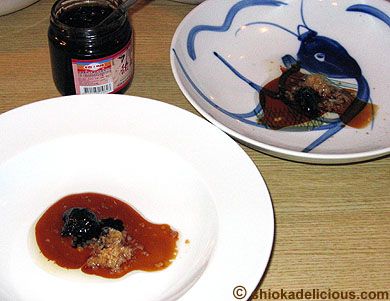
When I am tossing the noodles by individual servings, I use various sauce recipes according to the preferences of the diner. I just place the seasonings in each individual plate, and have them ready and waiting. The noodles are cooked in individual portions too, and as soon as they are drained, they go straight onto the plate, and I just toss them in the plate that they will be served in.
The picture above shows a sauce made up of some sweetened soybean paste (the little jar in the photo), light soy sauce, garlic oil and a dash of sesame oil.
Other sauce combinations I like using:
• Sweet dark soy sauce, light soy sauce, chilli paste (either home-made or store bought), garlic oil, and a dash of sesame oil.
• Sweet dark soy sauce, fish sauce and garlic oil.
• Sweet dark soy sauce, light soy sauce, garlic oil, dash of sesame oil and pepper.
• Ketchup, oyster sauce, dash of sesame oil and pepper.
• Ketchup, chilli sauce or chilli paste, oyster sauce, light soy sauce (tiny bit), garlic oil and a dash of sesame oil.
• Ketchup, chilli sauce, oyster sauce, fish sauce, sugar (tiny bit) and a dash of sesame oil.
• Hoisin sauce, oyster sauce, light soy sauce, garlic oil, dash of sesame oil and pepper to taste.
All sorts of combinations will work really. The possibilities are pretty much endless. Whatever takes your fancy… swap the seasonings around, add some, remove some, substitute some. It’s fun!
Looking East, Looking West
Finally, the plating.
The “eastern” way…
For informal occasions, once the noodles have been tossed in the serving plates, I simply top them with the meat sauces and vegetables, or the diners help themselves to the sauces. (The above is the mee sua from the seventh day of CNY again).
Or the “western” way…

Same mee sua (rice noodles), different style.
Any which way they come, I simply love “konlo” noodles!
Copyright © 2004 Renee Kho. All rights reserved.
Please contact me for permission to copy, distribute and display any of the images and text contained in this article.
11:30 PM in Home Cook: Rice, Noodles etc | Permalink | Comments (15) | TrackBack
Monday, February 09, 2026
Oh Sweet Valentine
Spotted in today’s papers:
“Get steamy this Valentine’s Day in a Hot Chocolate Milk Bath to soften the skin, followed by a Chocolate Crunch Scrub. Next is the Cocoa Cocoon, which evens out skin tone and hydrates dry skin. The 2 ½ hour experience ends with a Mocha-Mania Massage. The guilt-free alternative for chocoholics to savour their favourite food, without the calories”.
This is what a local spa is offering as a Valentines special.
A part of me finds this rather icky. But the chocolate fanatic in me is absolutely blown away by the idea of swimming and wallowing in chocolate, being enveloped in and smeared with chocolate. It’s like the wildest nightmare and sweetest dream come true all at the same time! Remember those times when you saw the most decadent, elegant and delicious chocolate creations, and just wished you could not only eat them but also drown in them? And now there is a real-life chance of doing that!
And what is it that they say about chocolates being aphrodisiacs?
It could be a sweet, sweet Valentines Day indeed!
Copyright © 2004 Renee Kho. All rights reserved.
Please contact me for permission to copy, distribute and display any of the images and text contained in this article.
11:55 PM in Crumbs & Tidbits | Permalink | Comments (6) | TrackBack
Saturday, February 07, 2026
Growing Blessings and Fortune
Shen Cai Hao Shi Fa Cai [Dried Oysters and Black Moss with Chinese Lettuce]. This is a Chinese New Year dish with a very auspicious sounding name. “Hao shi” (dried oyster) sounds like “good things”; “fa cai” (desert black moss) sounds like “to prosper or strike a fortune”; and “shen cai” (lettuce) sounds like “to grow wealth/fortune”. And so you have a dish that is not only scrumptiously tasty, but also one which can “grow blessings and fortune” in your life. Hey, how much better can it get?
This is a dish that requires a lot of preparation work. None of it difficult. Just many different steps to get through. Each taste component has to be separately prepared, before they are all brought together into a symphonic display of flavors. The result is well worth the effort.

Taking the spotlight in the dish is of course the hao shi (dried oyster) and fa cai (black moss).
Chinese cuisine regularly likes to make use of dried seafood, such as dried fish (eg bian yu / bian hu), dried shrimp (hae bee), dried scallops (konpoy) and dried abalone. These are often preferred over their fresh counterparts for their rich concentrated flavor and intense aromas. Just a little can go a long way.
Certain types of dried seafood are used mainly as accents in a dish – enriching and intensifying the overall taste. All it takes is a few pieces of dried fish sprinkled on a plate of stir-fried vegetables to change the nuances of the dish. Chopped dried scallops, when added to simple fried noodles or to plain white congee, gives the dish a whole new level of flavor intensity and complexity. At other times, the dried seafood is the key player and defines the dish. Nonya rice dumplings (zhong zhi) would not taste the same if made with fresh shrimps rather than hae bee.
Other types of dried seafood are so prized that they become stars in their own right, and are much sought after by gourmets. Take the abalone. In Chinese cuisine, the dried versions can command up to hundreds of dollars for just one piece of the delicacy, whilst the fresh version may go for a fraction of the price. This dried shellfish often requires no accompaniment. It is lovingly braised for many hours, and served whole, on its own. The flavors are rapturously intense, rich and aromatic. Each mouthful to be slowly savored and enjoyed.
The dried oyster, while often considered the poor cousin of the dried abalone, is another highly prized taste sensation. Its highly concentrated and intense flavors could be an acquired taste for some, but once one comes to appreciate its unique taste, the tastebuds sing with the varying notes of flavors and textures as they explode on the palate. As with the abalone, the dried oyster’s auspicious sounding name also adds much to its cachet. Both these seafood delicacies can be found not only on New Year menus, but also at special celebratory occasions.
To prepare the oysters: first they have to be rinsed, then soaked briefly (maybe 10-20 minutes) in warm water. As dried oysters (as well with dried scallops) are usually soaked in brine before being sun-dried, the rinsing and soaking will help remove the excess saltiness. Next, pour some Chinese rice wine over the drained dried oysters and steam for approximately 30 minutes. This helps to soften them.
Fa cai or black moss is another much-loved delicacy in Chinese cuisine. Many people think that this moss comes from the sea. In actual fact, it is a wild-growing desert moss, mainly harvested from the arid plains of Mongolia and North Central China. In recent years, its supply has been restricted by legislation, as over-harvesting has resulted in severe sand-storm problems for Beijing and large parts of North and North-East China.
Black moss, in of itself, is bland, taking instead all its flavors from surrounding ingredients and seasonings. It is appreciated for its unique texture (and appearance, looking as it does almost like human hair!).
To prepare the black moss: rinse the moss under running water, to remove sand particles that may still be trapped in the moss. Drain and gently squeeze out the excess water. In a hot wok, sauté a few slices of ginger in a little hot oil. Add the black moss. Do not attempt to sauté or stir-fry the moss. It will break into an unrecognizable mound of black mess! Simply flip the slab of moss from side to side. Add some Chinese rice wine, light soy sauce and a little water. Very quickly cook the moss. It is important not to over-cook it, as it will become too mushy and lose that unique, slightly crunchy texture.
Remove from the wok, and strain, gently pressing out the oil and water with the back of a spoon. If there is still sand particles in the moss, rinse it under running water again at this stage, and gently squeeze out the excess water. (The oil used in the sauteeing helps to "bring out" the sand particles, if any). The moss is now soaked in some chicken broth/stock, seasoned with a little Chinese rice wine and light soy sauce, and set aside to allow it to absorb the flavors of the marinade.
The other ingredients in the dish also have to be similarly prepared individually before the final assembly.
To prepare the mushrooms: using dried Chinese mushrooms that have been rinsed and de-stemmed (is that a word?), add the mushrooms to a pot of boiling water which has had a little cooking oil and sugar added to it. Simmer and cook on low heat for at least 45 minutes to an hour, until tender.
Choose nine pieces of nicely shaped, large-sized mushrooms and set aside for the final assembly. Marinade these with a bit of light soy sauce, oyster sauce and rice wine, and set aside.
The rest of the mushrooms can be kept in the freezer for several weeks. In fact, we often prep large batches of mushrooms and have them conveniently on standby. When the need arises, just defrost a few pieces for adding to various recipes. They’re great for using in fried noodles, vegetable stir-fries, steamed tofu, steamed fish, chawan mushi and many, many other dishes.
Another variation of prepping the mushrooms would be to pre-season the mushrooms. Add the rice wine, light soy sauce and oyster sauce together with the sugar and oil into the boiling water, before adding the mushrooms. Once drained well, the flavored mushrooms can again be frozen for later use. But I digress…
To prepare the chicken: cut two pieces of de-boned chicken thighs into 16 bite-sized pieces (i.e. 8 pieces per thigh). Marinade with a little light soy sauce, oyster sauce, rice wine, sugar, pepper, cornflour and the tiniest dash of sesame oil. The last has very strong flavors and only the teeniest amount is needed, otherwise its aromas overwhelms the chicken meat. The cornflour helps make the meat very smooth and succulent.
And now the dish is ready to be assembled. If possible, use a deep bowl so that the final presentation will have a nice high-domed effect.
To assemble: place a small slice of red carrot at the bottom of the bowl (this provides a nice dash of color in the final presentation). We used 9 pieces of dried oysters and 9 pieces of mushrooms for nice symbolism, as “nine” in Chinese sounds like “forever”. Next, arrange the oysters vertically around the bottom of the bowl, almost like the petals of a blooming flower. The mushrooms are added next, ringing the bowl just above the oysters. The center of the bowl is then filled with the black moss (which would have soaked up most of the chicken broth marinade). Finally, top with the raw marinated chicken pieces. The meat is placed at the top for a couple of reasons: 1) this is the only raw ingredient in the dish, and will cook easier at the top, 2) as the chicken cooks, its juices will trickle down to the other ingredients further down in the bowl, providing additional fragrant sweetness and flavors.
Usually, this dish is cooked with pork belly meat or roast pork (siew yuk or sio bak). We used chicken simply because we didn’t have any of the pork at home and were too lazy to go out and get some.

The bowl is covered with a plate.

Over the plate, a piece of tin foil is used to “seal” the bowl to ensure no water gets into the food during the steaming process.
The dish is steamed on medium heat for about half an hour. The bowl was too “tall” to fit into the steamer, so we just used a small pot with a little water and a metal stand in it. This works fine.
While the dish is steaming, quickly stir-fry the Chinese lettuce in a little hot oil, and season with some light soy sauce.

When the oyster dish is cooked, remove the tin foil, and before removing the plate “cover” pour out the juices that would have formed during the cooking process. This is set aside for making the gravy.

Voila! All cooked.

Carefully… very carefully, turn the bowl onto a serving plate. Lift to reveal a nicely shaped dome.
To prepare the sauce: in a pan, heat the excess juices that were removed from the cooked dish earlier. Add some chicken broth/stock, a little bit of sugar, salt and pepper to taste. Bring to a boil, and add a little cornflour solution to thicken the gravy. Remove from the heat once it comes to a boil again. Pour sauce over the oyster dome.

For the final touch, place the sautéed Chinese lettuce around the oyster dome. And it’s good to go.
I personally think this is a rather elegant presentation. The oysters and mushrooms form a beautiful pattern, and when the dome is opened up, it reveals a “surprising” center of luscious black moss.

Each diner gets a myriad of tastes, flavors and textures. There’s the rich, intense aromas and denseness of the oysters, contrasting with and complemented by the light crispiness and crunchiness of the lettuce; the soft, slightly chewy moistness of the moss and the flavorful tenderness of the chicken thigh meat. Each component so different, and yet coming together so beautifully.
Copyright © 2004 Renee Kho. All rights reserved.
Please contact me for permission to copy, distribute and display any of the images and text contained in this article.
02:54 AM in Festivals: Chinese New Year 2004, Home Cook: Fish & Seafood | Permalink | Comments (12) | TrackBack
Friday, February 06, 2026
The First Full Moon
The 15th day of the first lunar month (today), which is also the first full moon of the lunar year, marks the last day of the Lunar New Year festivities. Known as “Yuan Xiao” in Mandarin, it is so named because the first lunar month is called the “yuan-month” and the ancient term for “night” is “xiao”. Additionally, “yuan” also symbolizes “fulfillment” or “completion”, coming from the term “yuan man”. It’s Hokkien name “Chap Goh Mei” literally translates as “the 15th night”. On this day, the family gathers for another reunion dinner as a sign of unity and harmony, and to celebrate the closing of a fulfilling New Year celebration. At this dinner, the glutinous rice balls that were eaten on Dong Zhi (winter solstice festival) are eaten again. This time, however, they are served “dry”, coated with ground peanuts, rather than in soup. They are now called “yuan xiao” rather than “tang yuan” (the name used only when they are served in soup). More on this later.
The 15th day of the first lunar month is also known as the Lantern Festival. While this tradition has almost entirely died out in Chinese communities outside of China, it is still a major celebration on the mainland itself, and in Hong Kong and Taiwan. A main part of the festivities is the display of thousands of large, very intricate and colorful lanterns and the gathering together of the entire community to view and appreciate the lanterns, and to try and solve the riddles that are written on them. In a festive carnival atmosphere and against a backdrop of fireworks, concerts and other stage shows are also held, and games and food stalls set up. It continues the theme of the (extended) family united in a joyful celebration.
There is yet another name associated with the 15th day of the first lunar month. An association which seems to have sprung up from the ancient celebrations of the Lantern Festival. Chinese Valentines Day.
One simple day on the lunar calendar, and yet so much significance is attached to it.
The Legends
There are many different beliefs about the origins of the Lantern Festival.
One legend describes it as a time to worship Tai Yi, the God of Heaven in ancient times. The belief was that the God of Heaven controlled the destiny of the human world. He had sixteen dragons at his beck and call and he decided when to inflict drought, storms, famine and pestilence upon human beings. And so, beginning with Qin Shi Huang, the first emperor to unite China, all subsequent emperors ordered splendid ceremonies each year. The emperor would ask Tai Yi to bring favorable weather and good health to him and his people.
Another legend associates the Lantern Festival with Taoism. Tian Guan is the Taoist god responsible for good fortune. His birthday falls on the 15th day of the first lunar month. It is said that Tian Guan likes all types of entertainment. So followers prepare various kinds of activities during which they pray for good fortune.
In yet another legend, it is said that the Jade Emperor in Heaven was so angered at a town for killing his favorite goose, he decided to destroy it with a storm of fire. However, a good-hearted fairy heard of this act of vengeance, and warned the people of the town to light lanterns throughout the town on the appointed day. The townsfolk did as they were told, and from the Heavens, it looked as if the village was ablaze. Satisfied that his goose had already been avenged, the Jade Emperor decided not to destroy the town. From that day on, people celebrated the anniversary of their deliverance by carrying lanterns of different shapes and colors through the streets on the first full moon of the year, providing a spectacular backdrop for lion dances, dragon dances and fireworks.
In modern times, the Lantern Festival is celebrated with the display of giant sized lanterns, concerts, carnivals and fireworks. As people go round to admire and appreciate the beautifully made and decorated lanterns, they also attempt to solve the riddles (cai mi yu) which are written on each lantern.
Matchmaking
Through the ages, the celebration of the Lantern Festival evolved and took on another purpose and meaning. In the olden days, young men and women were forbidden from mingling freely. There was of course no such thing as “dating”. It was only during the Lantern Festival, as families in the entire community came out to admire and enjoy the lanterns that the young people had a chance to mingle and to try to find a suitable partner. There were many tales of eyes meeting across lanterns, an “accidentally” dropped handkerchief that was picked up “coincidentally” by the equally smitten young man. And so, many a match was made on the night of the lanterns!
And so it is that Yuan Xiao Jie also came to be known as Chinese Valentines Day.
Regional Variations
I read an interesting nugget in the papers the other day. Apparently, in Penang, Malaysia, they have a rather unique way of celebrating Yuan Xiao Jie. There, it is not lanterns but mandarin oranges that play the match-maker. On Chap Goh Mei, unmarried Chinese girls throw oranges into the sea of river, in the hope of snaring good husbands. I understand that this practice is still carried out to this day.
Many regions of China also seem to have their own interesting and unique local twists to the celebration of Yuan Xiao and the Lantern Festival. Apparently, in Quan Zhou, China, lanterns are used to predict offspring. It is customary for newly married couples to return to the woman’s parental home on the second day of the New Year, bearing gifts. [By Chinese custom, a married woman is not allowed to visit her parents on the first day of the New Year. It is only on the second day “kai nian” that a woman returns to her parental home with her husband and children to visit her parents.] When the couple takes leave from the woman’s parents’ home, they are presented with two lotus lanterns, one white and one red. On the night of the Lantern Festival, the young couple hangs the lanterns beside their bed, and light a candle in each. The first candle to burn out will indicate the gender of their first child. Should the candle in the white lantern burn out first, the baby will be a boy. If it is the red lantern that extinguishes first, they will be blessed with a baby girl.
Yuan Xiao
Besides beautiful lanterns, love and romance, another important part of the Lantern Festival or Yuan Xiao Jie is the eating of small dumpling balls made of glutinous rice flour. As I mentioned before, these glutinous rice balls symbolize unity and harmony within the family.
It is interesting how the same food takes on a new name and a slightly different meaning depending on when it is eaten. On winter solstice (dong zhi), these rice balls are called “tang yuan” and are served up in a sweet ginger soup. “Tang” (meaning soup in Mandarin), sounds like “tuan” (meaning reunion), and “yuan” (meaning round) signifies “yuan man” (completeness, fulfillment). This is very appropriate, as in the olden days, Dong Zhi marked the gathering of all family members from near and far under one roof, after perhaps a year apart. These dumplings symbolized a family reunited once more.
Come Yuan Xiao Jie or the 15th and last day of the Lunar New Year celebrations, these glutinous rice balls take on the name “yuan xiao”, which sounds like “a fulfilled completion and a bringing to a close”. After eating the “dry” dumplings, coated with ground peanuts (yes, that is what the little packet of ground peanuts included in each pack of frozen tang yuan is meant for), family members once again depart for faraway towns, cities or countries to work and live. It marks the closing of New Year celebrations and is a send-off of sorts, with wishes of abundant blessings in the coming year. It may be another year hence, on the next Dong Zhi, that family members will have the opportunity to get together again.
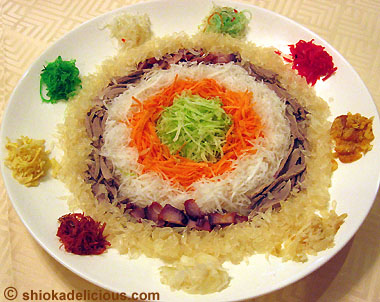
Another dish that makes its final appearance of the year on Yuan Xiao is loh hei. Chap Goh Mei marks the last day when this dish will be eaten, until the next Lunar New Year. A final toss for wishes of good fortune and abundant blessings.
Tonight, we tried my Thai-style loh hei again, with a mixture of char siew and roast duck, and lots more pomelo. Yum! I tried out a new plating design – concentric circles signifying family unity and harmony. Oh, and I also tweaked the dressing again. Please see update on the previous post for the new quantities.
And so from me to all Chinese, Happy Yuan Xiao Jie! May all your wishes of love, harmony and happiness come true this year!
Copyright © 2004 Renee Kho. All rights reserved.
Please contact me for permission to copy, distribute and display any of the images and text contained in this article.
12:00 AM in Festivals: Chinese New Year 2004 | Permalink | Comments (5) | TrackBack
Thursday, February 05, 2026
Welcome!
I would like to warmly welcome the newest member of the food blogging family... Toru. Keep those photos and posts coming! : )
Also in the UK... Italian food enthusiast-turned-food businessman, Carlo Albertoli. For those in South England, do check out his personal cooking services, offering authentic modern Italian home cooking. Sounds absolutely scrumptious!
Copyright © 2004 Renee Kho. All rights reserved.
Please contact me for permission to copy, distribute and display any of the images and text contained in this article.
11:39 PM in Crumbs & Tidbits | Permalink | Comments (4) | TrackBack
Going Thai

Whenever a recipe or dish doesn’t turn out quite the way I had expected or wanted, it bothers me. Don’t get me wrong. I don’t expect everything I cook, bake or make to turn out perfect each and every time. It certainly doesn’t happen that way. And it probably doesn’t even happen to the best of chefs all the time either. It’s just that each time a dish “doesn’t work”, I am troubled by a nagging need to try the dish/recipe again and again, using different ingredients, modifying the methods, adjusting quantities… just trying to figure out how to make it taste good.
So it was with the char siew (bbq pork) loh hei that my mum and I had spontaneously thrown together the other day, and which didn’t work very well at all. Back then, I had pronounced that char siew was unworkable in loh hei. I had categorically stated that BBQ pork should not be used in this New Year salad. However, having had time to think about it, I couldn’t see why it couldn’t and shouldn’t work.
I wanted to try it out again. Surely, char siew could make a tasty addition to a salad, and why not a loh hei salad. I became determined to find the right combination of ingredients that would work. Today I tried it out…
I decided to go Thai-style with this version. Instinctively, I felt the dressing or sauce needed to be different from the standard loh hei plum sauce. It should be lighter and more refreshing on the palate with a spicy punch to counter-balance the denser texture of the meat.
I had a vague idea of the taste sensation I was looking for, but I didn’t make any firm decisions about what to put into the gravy until I was actually putting the dressing together. I thought maybe I would just go with what felt right at that moment. Sometimes, this works marvelously, and produces a sublime result.
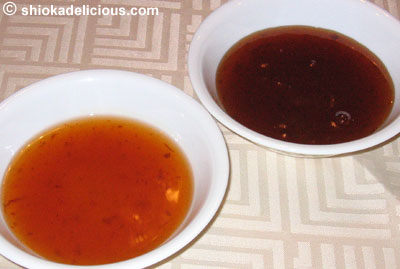
Unfortunately, as usual, I was not jotting down the ingredients and their quantities as I went along (I am trying to change this habit, truly). I added some of this, some of that… then added more of this again… So, regretfully, this is what I can recall from memory… 3 tablespoons Thai sweet chilli sauce, 2 tablespoons vinegar, 1 tablespoon sugar, 3 tablespoons my mum’s plum sauce dressing, pinch of salt. (I used a dinner spoon for the rough measurements).
[Update (6/2/04): I tweaked the dressing a little bit... 3 tbsps Thai sweet chilli sauce, 3 tbsps vinegar, 1 1/2 tbsps sugar, 3 tbsps mum's plum sauce dressing]
I strained out all the chilli seeds from the chilli sauce before adding the chilli sauce to the mixture, as I was rather concerned that the abundant seeds would affect the balance of textures in the salad.
The Thai-style dressing (on left of picture) had a nicely piquant flavor, balanced out by some tanginess and some sweetness, with the plum sauce giving it “body”. It also had a lighter viscosity compared to our regular plum sauce dressing (right of picture). Just a note: the sauce will taste overly spicy/hot and overly sour when tasted on its own, but it will be fine once tossed in with the large quantity of vegetables and condiments.
Other changes that I made:
• Bought char siew from our regular roast pork/duck man, now that his stall has re-opened once again after the Lunar New Year break. His char siew is so much more tender and moist than the one we bought last week. To be fair, the stall we bought from last week was probably using frozen-then-thawed pork to make the char siew, instead of fresh pork, due to the CNY holidays.
• Coated the char siew strips with the Thai-style dressing then strained them before plating them. This gave them an extra layer of moistness and flavor.
• Added sweet pomelo pulp to the salad (not sure if you can make it out from the picture – the ring of off-white pulp around the white radish). Fortunately, I was able to get a fairly sweet and juicy pomelo yesterday. I don’t think a pomelo with bitter overtones would have worked in the salad.
• Included some chopped coriander (at 9 and 3 o’ clock in the top picture).
There was only the five of us at dinner tonight, and we tossed up a fairly large salad – enough for at least 10 people! And the verdict of my “guinea pigs” a.k.a. my family? Well, the entire very large salad was completely devoured. In fact, it was declared that this dressing actually tasted better in some ways than our regular plum sauce dressing. And it was requested that this dressing be used again in our final loh hei of the year tomorrow night at the “yuan xiao” reunion dinner. Wow! *blush* I was pleased as punch, but if truth be told, I think we were just getting a little tired of the regular loh hei, having had it now at least seven times in the last 2 weeks. This dressing simply made for a refreshing change of taste.
I still think this Thai-style version of loh hei can be improved. These are what I would like to experiment with a little further:
• Add more pomelo – didn’t think there was enough of it tonight. I had only used two small wedges of the fruit.
• Use less coriander, and chop it up more finely so that it gets distributed better throughout the salad and gives a more subtle aroma and flavor.
• Maybe substitute Thai-lime juice (or even calamansi juice) for the vinegar.
• Strain the chilli sauce of the chilli seeds, but then add back some of the seeds to give added heat without disrupting the texture balance too much. And maybe add more of the chilli sauce.
• Perhaps add more of the plum sauce mixture too.
I am also contemplating trying this with roast duck breast meat tomorrow night, instead of the char siew… hmmm… I shall dream about it tonight, and see how I feel tomorrow.
Copyright © 2004 Renee Kho. All rights reserved.
Please contact me for permission to copy, distribute and display any of the images and text contained in this article.
03:00 AM in Festivals: Chinese New Year 2004 | Permalink | Comments (3) | TrackBack
Wednesday, February 04, 2026
My First Birthday of the Year

I had my first “birthday” of the year on Wednesday (28 January), as did the rest of Mankind. And so, I’m one year older… five months before I would normally consider myself another year older. *
This is the most commonly known “meaning” of the seventh day of the Lunar New Year or “Ren Ri”. However, behind this special day of the Lunar Calendar also lies a more obscure legend. Yes, as with every Chinese festival, there is a little folklore to explain the reason for the occasion. The legend of Ren Ri has many versions. One story tells of an ancient hero called Pan Gu, who created the world whilst Goddess Nu Wa shaped the six species of livestock from mud during the first six days that Earth was created. On the seventh day, she molded humans out of mud according to her own appearance. And thus, Ren Ri is celebrated - to commemorate the day mankind was created.
Some say that by Buddhist and maybe Hokkien tradition, no animal should be slaughtered for food on Ren Ri. Instead, it is customary for the Hokkiens to cook and eat a dish made up of seven types of vegetables. This practice of the Hokkiens has now filtered through to the general Chinese culture, and many non-Hokkien families also serve up such a dish on the seventh day of the Lunar New Year.
I’m not sure what the exact significance of using seven different vegetables is. In fact, up until a few years ago, it was not a tradition that was practiced in my family. Until, that is, my mum had a conversation with the owner of the vegetable stall we regularly patronize at the wet market. This friendly, very chatty, middle aged lady is very often the dispenser of many a nugget of culinary wisdom. It was she who persuaded my mum that it was an absolute must to fry up a plate of mixed green leafy vegetables for “chor chaat” (7th day of CNY). Why? She did not say. But oh, she was quick to emphasize, this culinary practice was not to be transgressed. But we are not Hokkiens. Doesn’t matter. And so, a new “tradition” was added to our family’s portfolio of CNY practices.
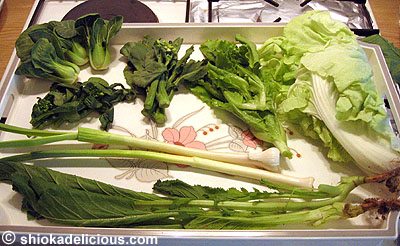
One of course has a large amount of freedom in deciding which seven vegetables to use in your stir-fry. There are only a couple of general parameters to be observed. The vegetables have to be green, and they have to be “leafy”. Therefore, no beans or legumes. And according to our knowledgeable vegetable lady, the only vegetable that is a “must” to include in the dish is the long, leafy one at the bottom of the picture. Neither my mum nor I are quite sure what that vegetable is exactly. It could be Chinese mustard leaf, imported from China. The vegetable lady simply included it in my mum’s vegetable bundle with the kind reminder: “this one, must include one, don’t forget”. It tastes rather “grassy” with bitter overtones. Not quite my cup of tea, frankly speaking. But there you have it… another one of the many Chinese New Year rules which are observed by so many, but the origins and real meaning of which have long been forgotten.
Left to our own devices as to which other six vegetables to include in the dish, my mum and I finally settled on the above. From the uppermost top left hand corner, going clockwise: baby round-head xiao bai cai; kai lan; Chinese lettuce; curly leaf Chinese cabbage; Chinese leeks; and cai xin with small flowers. All one needs is a few stalks of each vegetable, and they sauté up into a large plate of mixed veggie. We kept it simple – just sautéed with garlic and shallots, and seasoned with light soy sauce.
I think this year may be the last year we will be doing this practice. The family does not find it particularly meaningful, as we don’t know the “real” significance behind the custom. And more importantly, no matter how one cooks this dish, it is very, very difficult to get a jumble of seven different tastes, aromas and textures to come together in a way that is close to being elegantly balanced and tasty. It’s very different from cooking a mixed vegetable dish made up of distinctly different vegetables – eg broccoli, cauliflower, baby sweet corn, carrots, shitake mushrooms etc. Mixing various green leafy vegetables together is a whole different ball game. There’s no differentiation of color for one. And the tastes and textures are different, yet not different enough to complement and/or contrast each other. None of the family enjoys this dish. Almost every year most of the dish gets tipped away at the end of the evening. And we find that such a shameful waste. So, that’s it. No more next year.
One Ren Ri custom that my family and almost all Singaporeans have taken to like fish to water is the tossing and eating of yu sheng. This is the original day for loh hei. I wrote about the historical roots of this custom in a previous post. Now, this is one very yummy tradition which I like!
Another food tradition with historical roots is the eating of either mee sua (Hokkien) / mian sian (Mandarin) / rice noodles or any other type of noodles. This is a very common dish which is served up at birthdays, and so also makes it appearance on Ren Ri (Mankind’s birthday). Noodles represent longevity. And noodles cooked for a birthday celebration are never cut or severed in any way. That is considered “bad luck”. Even when serving up the dish, and when eating it, the strands of noodles are never shortened with a fork or chopstick. So, it takes deft hands to neatly serve up bowls of the noodles with the long strands intact and without creating a mess on the table!
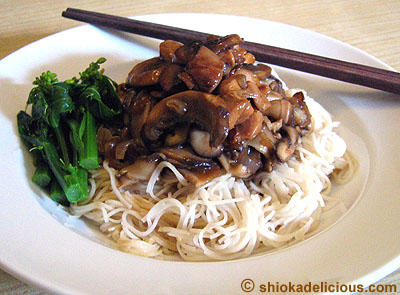
Longevity noodles can be served in many different styles. Very often it is sautéed (fried). Sometimes it is served “dry tossed” or “konlo”, as we did this past Ren Ri. This is the family’s version of konlo mee sua. The recipe will be posted in the next few days.
My mum also made “hao shi fa cai” on Ren Ri. This is another dish that is almost a “must” for Chinese New Year, because of its abundant auspicious symbolism. “Hao shi” (dried oysters) sounds like “good tidings or blessings”. “Fa cai” (black desert moss) sounds like “to prosper or to strike a fortune”. These two ingredients are almost always served with “shen cai” (Chinese lettuce) because the latter sounds like “to grow wealth”.
This dish involves many preparation steps and is pretty time consuming. Normally, my mum makes this on New Year’s Eve for the Reunion Dinner. We didn’t manage to get round to it this year, so it made its appearance on our table on Ren Ri instead.
My mum does a very elegant version of this dish (if I may say so myself), and I will post the preparation and recipe in a couple of days.
Happy belated “birthday” everyone!
* [Here’s a little interesting aside: by the Chinese calendar, a baby is considered one year old at the time of birth, as opposed to zero years old by “Western” traditions, and so, a person’s “Chinese age” is always one year older than his/her age by Gregorian calculations].
Copyright © 2004 Renee Kho. All rights reserved.
Please contact me for permission to copy, distribute and display any of the images and text contained in this article.
11:57 PM in Festivals: Chinese New Year 2004 | Permalink | Comments (2) | TrackBack
Tuesday, February 03, 2026
For Achievement, Prosperity, Progeny and Longevity
Can one ever over-do a good thing? It is already the 13th day of the Lunar New Year, and yet Singaporeans are still feasting away. I had dinner with my family a couple of nights ago at Yunnan Garden, and it was packed to the brim with festive diners. It was a frenzied scene of festive feasting and tossing of loh hei! There is no let up… there can be no slacking now… this is the final dash… the finishing line is in sight… we shall eat and eat and eat until… “yuan xiao” or “chap goh mei” (the last or 15th day of the New Year) this coming Thursday. Only then, will we allow reality to seep in again. In the cold harsh light of the morning of Friday 6 February 2004, we will suddenly see our newly expanded waist-lines, our recently trimmed and slimmed-down wallets and our bullish cholesterol and blood-pressure charts. Until then, heck, what’s the worry? Let’s eat!
I have just realized I have not posted about any of the New Year food I have eaten, except for the loh hei. So, please indulge me if you will, as we take a short trip back in time…
It was the 21 January 2004… and it was the eve of the arrival of the Year of the Monkey. The whole family had gathered for the most important dinner of the year… the New Year’s Eve Reunion Dinner…
*screeching of brakes* *hit the rewind button*
Oops… I completely forgot to take pictures of the Reunion Dinner food. Nope, not even a single picture.  There was just too much excitement going on.
There were the usual suspects at the dinner… loh hei (for prosperity and abundance); fried whole pomfret (for abundance) [why almost always fried (in this family at least)? Because it keeps better, and we always have to ensure that there is leftover fish to be carried over into New Year’s Day. Steamed fish just tastes completely off once kept overnight]; prawns (for happiness); duck; fu jook (dried bean curd sticks – because apparently the sound of its name is auspicious); and veggies of course.
I later found out that there was a nice bit of synchronicity going on as well. We had intended to do chilli crayfish. But we “needed” the requisite prawn dish at the dinner, so we ended up making chilli prawns. Ariel and her family also cooked chilli prawns from the recipe I posted previously for their Reunion Dinner. I like this sort of symbiosis.
There was plenty of food, to ensure there were a lot of leftovers. Usually, no major cooking is done on the first day of the New Year. At most, fresh ingredients will be added to the food from the previous night’s dinner to create new dishes.
New Year’s breakfast, for my family, traditionally includes food symbolizing progeny, prosperity, achievement and longevity… correspondingly represented by (clockwise from top left hand corner) hong zhao gui yen cha (red dates and dried longan “tea”); fa gao (steamed rice flour cake); pan-fried nian gao; shou tao (longevity buns).
According to my mum, the hong zhao gui yen cha is a “tea” that is usually drunk at happy and auspicious celebrations, and therefore, she and my grandmother before her have a tradition of serving up this drink on the morning of the first day of the New Year – to mark a joyous start to the year. When drunk at other celebratory occasions, like weddings, the tea also symbolizes the early arrival (hong zhao/red dates) of offspring, and sons (long yen/longan) in particular.
The tea is made by simply boiling dried red dates and dried longans in water. A few pieces of candied winter melon provide some sweetness. My mum adds a South East Asian touch by throwing in a bundle of pandan leaves for extra fragrance and aroma. After 30-40 minutes of cooking, the tea is strained and served.
Fa gao can probably be considered the original “cake” in Chinese culinary culture. The Chinese do not have a tradition of baked goods. Through history, breads and buns are either steamed (mantou; yun shi juen / “silver thread rolls”; bao) or deep fried (mantou; yun shi juen; you tiao / dough sticks). We also do not have a tradition of using either yeast or baking powder. Eggs were also not used in making “cakes” and pastries. “Cakes” in ancient times were made by steaming a batter of rice flour, water and sugar – fa gao. It was only under Western influence that we had cakes made with eggs and these were called “ji dan gao” or “dan gao” (egg “cake”) to differentiate it from the normal (traditional) Chinese “cakes” (gao). And the traditional Chinese versions of ji dan gao are somewhat different too from the Western cake.
We had originally intended to get the “new age” miniature version of fa gao in pretty pastel shades , but ended up with the traditional large brown-colored one instead.
Nian gao is another traditional Chinese steamed “cake”, made using glutinous rice flour instead of rice flour. A batter of just water, sugar and glutinous rice flour is steamed to a rich caramel-brown perfection. Traditionally, the nian gao is eaten "fresh" on New Year's Day. It is simply sliced and served, with no accompaniments. Only towards the end of the festive period, is the nian gao served fried in various forms. Why? Well, there was no refrigeration in ancient times, and so by the time the two-week New Year festival draws to a close, in all likelihood, the nian gao would have started to go stale or even moldy! So frying them was a way to "refresh" the nian gao and make them edible. Nowadays, people find the taste of "pure" nian gao rather "flat", and so even freshly made nian gao are served up fried.
Pan-fried nian gao with egg is a Foochow tradition, I think. The Hakkas have a savory version, using a different type of nian gao from the traditional brown-colored soft, sticky, sweet version eaten during CNY. The nian gao is sautéed with minced meat. The Hokkiens, if I’m not wrong, serve a battered version during CNY. Very thin slices of nian gao are sandwiched between a very thin slice of sweet potato on one side and a very thin slice of yam on the other. This “sandwich” is then dipped in a sweetish batter, and deep-fried in a lot of oil! Oh so sinful, but so incredibly tasty!
My favorite is still the egg version. Thin slices of the nian gao (the thinner the better) are simply dipped in lightly beaten egg, and pan-fried in minimal oil. If the nian gao slices are thin enough, they will produce soft, very malleable, slightly chewy, slightly sticky pieces of sweetness that are balanced by a little egg and slightly crispy edges. Yum!
The trick to cutting freshly made (and thus very, very soft and sticky) nian gao is to use a long piece of thread (those used in sewing) to cut through the sticky dough. Using a knife will simply result in a sticky, messy pile of goo – much like play-dough! However, once the nian gao has been refrigerated, it hardens, making it very easy to slice with a sharp knife.
The “shou tao” (longevity peach) shaped buns are a must-have at the birthdays of the elderly, to symbolize long life and good health. It is also served at other auspicious and celebratory occasions like New Year. These are fluffy steamed buns with a lian yong (lotus seed paste) filling. Nowadays these buns are all factory-made and come in uniform shapes and color (very bright color!). Homemade ones used to have a more “down-to-earth” feel, as the “peaches” are shaped by hand. However, the colors back then were definitely no less bright!
And so an auspicious start to the year… with wishes for blessings, success, abundance and a long life!
Copyright © 2004 Renee Kho. All rights reserved.
Please contact me for permission to copy, distribute and display any of the images and text contained in this article.
08:02 PM in Festivals: Chinese New Year 2004 | Permalink | Comments (4) | TrackBack
Monday, February 02, 2026
We “Fowled” Up
Speaking of the rain… something has been haunting me for days…
It has been raining almost non-stop since the 2nd day of CNY (save for maybe 1½ days of clear weather). It has been the wettest January in 30 years. A few days ago, while I was standing in the check-out line at the supermarket, an elderly “auntie” who was standing in front of me in the line, suddenly turned around and said to me in Mandarin:
“Auntie": aiyo… everyday raining… not good one. This year sure bad year one. Everytime New Year raining, that year sure bad luck one.
Renee: (smiling, and trying to put a more positive spin on things) People say rain good what. Got water (“you shui”) means got money, so Singapore economy will be good this year.
“Auntie”: ya, last time is like that. But nowadays, like end of the world like that one. Everything tebalek (topsy turvy). Last year also raining every day during CNY, then we got SARS. This year, even more rain, sure jialat (bad/terrible). Now, everywhere got the chicken disease, duck disease, cow disease, pig disease and dunno what disease also. I think ah, soon we have nothing left to eat one…
Just then, her turn came up, and the conversation ended. But it struck a chord within me. The year has not started well for Asia, to say the least. Ten countries are battling the avian flu virus. It has not reached our shores… (yet?). But is it only a matter of time? Only Malaysia, Singapore, Brunei and the Philippines currently stand unaffected. But for how long?
However, what has truly haunted me in the past days are the images, played relentless on the TV, of hundreds and hundreds of chicken hung on huge rotating metal racks as they are slaughtered and processed to be sold to consumers; of thousands upon thousands of baby chicks thrown alive into gunny sacks to be culled; of tens of thousands of chicken carcasses thrown into mass graves. Are we humans so numb to “life” and emotions that we feel nothing as we watch this? Can we really watch such images with total detachment? I see images of the faces of these chickens and my heart breaks. These are living creatures who share our planet. How did we reach this low point?
Yes, I do believe that culling is probably the most effective way right now to deal with the problem. However, I also believe in doing it with as much dignity and grace as possible. This is a human-created problem. We have violated the balance of the natural world, and the natural world is hitting back in its own way. Let us not compound our “crimes” further.
I’m not against eating meat. Neither am I suggesting the whole world go vegetarian. I do however believe in the natural balance of things. The natural world has its own “checks and balances”. Even though Nature is always in flux, it always strives to return to a state of balance (no matter how briefly). As humans, being at the top of the food chain has afforded us certain “privileges”. But we have abused these “privileges”. And the natural order requires balance to be restored.
I am appalled at how this crisis seems to be handled by certain governments. Have we not learnt from SARS? Already eight lives have been lost (officially that is). I believe the unofficial toll is higher. Of these, quite a few are very young children – around 6 years of age. And yet, sick chickens continue to be sold, some fed with herbal folk medicine that purportedly cures the chicken of the virus. These chickens are sold to poor consumers at half the price of normal healthy chicken. Yet, the healthy “live” chickens are sold side-by-side with the sick “live” chickens. So, how does that work? Are the wheels of commerce more important than human lives? Sure, the poultry industry in all the affected countries amounts to a multi-billion dollar business. But how much is a human life worth?
The latest developments are all the more worrying. The WHO now deems it a “possibility” that there has been a case of “human to human” transmission of the virus in Vietnam. Two sisters have died from the virus, possibly having gotten it from nursing their sick brother, who had since died ahead of them. Peter Cordingly of the WHO sounded wearied, dejected and almost defeated yesterday when he announced this. He said: “we are losing more battles than we are winning”. It is not a good prognosis at all.
Another thing that has struck me… the seeming lack of interest in the rest of the world in this outbreak. Hardly any mention on CNN. Does it take the virus to reach across the globe before notice is taken. I assure you, this virus, like the SARS virus, knows no geographical boundary. Why this complacency? The only people currently interested in the issue seems to be the poultry and egg producers of Australia, the EU, US and Brazil, who are looking to cash in on the predicted poultry and egg shortage in Asia. It is still money, not human lives, or poultry lives for that matter, that speaks.
And what of the chickens? I haven’t been able to eat chicken for days. Each time I see chicken meat, images of the faces and eyes of those chickens as they are being culled swim across my mind. Admittedly (and ashamedly), it has taken this crisis to jolt me awake to the horrors of the conditions of commercially farmed chicken. Sure, I’ve “known” about it all along. But it’s easy to appreciate it from an intellectual or even “idealogical” point of view. To see the chickens “face to face” as it were, that is another matter altogether.
I marvel at people still tucking in heartily to chicken meals; at people worrying about getting alternate supplies for chicken so that their consumption will not be disrupted; at people declaring that “I will die if I don’t get to eat meat”. Are we, as a species, so unmoved by what is happening? Is there not a sense of co-responsibility for the state of affairs? Where is our conscience… the one thing that supposedly sets us apart from other animals, and which puts us at the top of the food chain as it were.
While this “crisis” is about battling avian flu, I think it says more about us humans than anything else. And the message is ugly. We have become ugly humans. We don’t deserve our place at the top of the food chain. We have abused our position of privilege. Can we be saved? Do we deserve to be saved?
This could be a year where we humans reassess (and put right) our relationship with the rest of the natural world, or this could be a year where the natural world puts right its relationship with us, and puts us in our places. It is up to us. We can each make a difference. One drop of water can an ocean make.
Copyright © 2004 Renee Kho. All rights reserved.
Please contact me for permission to copy, distribute and display any of the images and text contained in this article.
05:21 PM in Crumbs & Tidbits | Permalink | Comments (6) | TrackBack
Lucky 88?
Some of you may be getting bored of all my CNY postings… but please indulge me for a few more days… I’m still in the holiday mood
It was the annual LNY Chingay parade on Saturday night. We missed it. But from the looks of the pictures in the papers, it was one happy, fun, boisterous and very happenin’ carnival party. (Quite different from the almost regal/formal CNY parade that made its way down the Champs Elysee on the 2nd day of the New Year, and which I found very impressive). I felt prompted to dig up some CNY photos that were still buried in my flash card.
It was the second day of the Lunar New Year, and there were 88 southern belles prancing in the rain. The place? Our beloved twin “durians” – The Esplanade, Theatres on the Bay. The occasion? “Kai nian” (the “year opening” which is marked on the 2nd day of CNY) and the launch of the Hua Yi (Chinese culture) festival.
The star attractions were the 88 lions. It had promised to be a 45-minute long thrill of lion stunts and acrobatics. But no one counted on the arrival of a big party-pooper who made sure her presence was felt. Yep! Mother Nature decided to shower all with abundant blessings. And so what was to have been a 45-minute long party turned into a 15-minute wash out.
The lions were clearly grumpy at being in the rain. They shook their heads and wriggled their backsides half-heartedly before rain-soaked children, some of whom have waited for at least an hour in the rain. They were decidedly un-amused at being hemmed into a small area by large crowds, being drenched, and…
… being made to eat A LOT of mandarin oranges! Someone obviously thought the lions can’t get enough of mandarin oranges. And had laid out what looked like at least 100 mandarin oranges, formed into the two Chinese characters “hua yi”. So the poor lions… they eyed the mandarins warily for the longest time before grudgingly lying down in the rain and tried to “eat” up all those mandarins! In the end, they required a lot of human help to get through all the fruits.  After which, they promptly (all 88 of them) marched off and left a very disappointed crowd in their wake!
Yes, even lions have moods!
Ever since I was a child, I have always loved watching lion dances. I like the big, furry Northern lions for their majesty and regal presence. But I especially love their more energetic, boisterous Southern cousins. Oh! The wonder of watching their antics as they clamber here, there and everywhere, munching on lettuce and mandarin oranges, creating auspicious characters with their food. I love their playfulness and vivacity. Chinese New Year just would not be Chinese New Year without the heart-thumping drum beats, the clanging cymbals and the prancing lions. Oh, and let’s not forget the bright pink-faced, oversized-head figure with the fan… whatzhisname… the mischievous one.
Hey, isn’t there supposed to be an annual lion dance competition, which is always held at Ngee Ann City’s Civic Square? When is it happening this year? Or is it happening this year?
Copyright © 2004 Renee Kho. All rights reserved.
Please contact me for permission to copy, distribute and display any of the images and text contained in this article.
05:10 PM in Festivals: Chinese New Year 2004 | Permalink | Comments (0) | TrackBack
Sunday, February 01, 2026
Happy Chocolate Day!
I just found out that it’s Chocolate Day today. I never knew there was such a day. But hey, I’d be the last to complain! From now on, this date will be marked into my diary every year. So, to all fellow chocolate-lovers (chocoholics?), a very happy chocolate day! May we have a sublime out-of-this-world chocolate experience today…
I love chocolate. Period. In all forms and guises. I melt in the presence of fresh hand-made truffles and pralines. Ooohh… Leonidas’ chocolate truffles!! Now, this is one way to get me to do anything you want! Royce Chocolates work too! Exquisite quality chocolates at non-designer prices. I especially love chocolates with nuts in them. I also love dark chocolate... pure, simple dark chocolate (at least 75%)… Valrhona’s Guanaja 70%, Lindt’s Excellence 85%… Sigh!
But I also have some perennial “chocolate candy” favorites which I grab from the supermarket or petrol kiosk. These are what I call my “comfort chocolates”. I’ve always liked Kit Kat (the UK- or Australia-made versions – hard to find in Singapore where it is usually the Thailand-made version). When I’m feeling lousy, this one always does the trick. Strangely, I’ve never taken to other chocolate-covered wafers like “Take Six” (is that what it’s called? Can’t remember. The one by Cadbury’s).
Once in a while I like Malteses. I like sucking on them until the little balls burst in my mouth, releasing the sweet, melting malt honeycomb centers!  A recent addition to my “I like” chocolate list is Kinder Bueno. And of course, the ubiquitous Ferrero Rocher does it for me too. A combination of wafer crunch, fragrant and aromatic nut, smooth and chocolatey praline center always works well. And oh! Don’t you just love Reese’s Peanut Butter Cups? Oh, oh, oh… am I getting a craving now!
And I haven’t even started on my favorite chocolate cake, brownie, cookie, ice cream, tart, pie, fudge, sauce… Muahahaha… oh, I love chocolate!!
What’s your favorite chocolate? What gives you a tingle all over and puts a smile on your face?
Happy Chocolate Day!
* picture courtesy of Leonidas
Copyright © 2004 Renee Kho. All rights reserved.
Please contact me for permission to copy, distribute and display any of the images and text contained in this article.
02:29 PM in Food and Drink | Permalink | Comments (12) | TrackBack