« November 2003 | Main | January 2004 »
Wednesday, December 31, 2025
This Is Interesting...
I learnt something interesting today… I’ve always known that there are slight differences between UK measurements and US measurements, where cooking and baking are concerned, but I didn’t realize by how much. I had always assumed that the differences were marginal at best, and would not affect the cooking and baking process. So, I was a little surprised to discover the following…
1 teaspoon (US) = 4.93ml (and 1 tsp is usually taken as 5ml)
1 teaspoon (UK) = 4.62ml
Okay, the difference in teaspoon measurement is negligible and insignificant. But take a look at this…
1 tablespoon (US) = 14.78 ml (and is usually taken at a rounded up 15 ml) = 3 (US) teaspoons
1 tablespoon (UK) = 18.5 ml = 4 (UK) teaspoons = 1.25 (US) tablespoons
Now, this could result in important differences when baking (where exact measurements are usually very important to the end result). If I was using a UK recipe that called for 8 tablespoons of butter for example, but I used a US measuring tablespoon to measure out the 8 tablespoons, I would be shortchanging myself of 2 tablespoons of butter. (8 UK tablespoons is equivalent to 10 US tablespoons). Wow! That’s 20% less butter than is required by the recipe. I’m sure that would have an effect on the final baked product. I hadn’t realized the size of the differences could be so significant.
I will have to remember these conversions the next time I bake or cook from a UK recipe.
Here are some more interesting conversions:
1 fl oz (US) = 29.57 ml = 2 (US) tbsps
1 fl oz (UK) = 28.41 ml
1 cup (US) = 236.52 ml (usually taken at the rounded 240ml) = 16 (US) tbsps = 8 fl oz (US) = 8.32 fl oz (UK)
1 cup (UK) = 250 ml
1 pint (US) = 473 ml
1 pint (UK) = 568 ml
So, 1 US quart is 2 US pints but only 1.66 UK pints.
And for those of us living outside the US… we often see US recipes calling for ½ stick of butter or 1 stick of butter and so on. The US stick of butter is actually very different from the sticks of butter we get here (in Asia).
1 US stick of butter is equivalent to 8 (US) tablespoons or approximately 120g or 4 oz. And 1 tablespoon of butter is equivalent to 14.18g or 0.5oz.
The sticks of butter sold in Asian supermarkets are usually 250g or approximately 17 tablespoons of butter. And so a US recipe calling for ½ stick of butter is really just under a quarter of a stick for us!
Ah! The differences that make our world so interesting! 
Copyright © 2003 Renee Kho. All rights reserved.
Please contact me for permission to copy, distribute or display any of the images and text contained in this article.
01:46 AM in Kitchen Tips | Permalink | Comments (0) | TrackBack
Monday, December 29, 2025
Supremely Chewy, Peanut-Buttery and Chocolatey Chippy
There is just something about chocolate chip cookies… something indefinable, that makes people react to them in a certain way, feel about them in a special way and treat them in a different way from other cookies. They are loved by everyone. I have yet to meet a person who hates chocolate chip cookies. It just comes down to having different degrees of “like”. It almost seems like chocolate chip cookies speak to each of us at a primeval level. They are comfort food, even for those of us who did not grow up on milkshakes and chocolate chip cookies!
I made low-fat chocolate chip cookies for Christmas. Yes, I know, they are not very Christmasy at all. But they are so loved by kids and adults alike, and they are a sure fire way to bring smiles to faces. Plus, I really wanted to “make right” my previous somewhat unsuccessful attempt at making chewy reduced fat chocolate chip cookies.
These ones made from this new recipe were a resounding success!  Best of all, no one knew they were low fat (until they were told)! Surely, that must be the defining “test” for a reduced fat cookie, and a chocolate chip one at that. These cookies were really chewy, and really delicious (if I may say so myself
  ). Even I was impressed with how the recipe turned out. I wasn’t quite expecting it. The peanut butter added wonderful aroma and taste to the cookies. The smells that were emanating from the kitchen as the cookies baked… Ahhhh… Pretty close to culinary heaven!
1 ¼ cup plain flour
1 cup quick-cooking rolled oats
½ teaspoon baking soda
½ teaspoon salt
¾ cup packed brown sugar
1/3 cup reduced fat margarine
1/3 cup light peanut butter
¼ cup buttermilk
1/3 cup mini chocolate chips
1. The flour, oats, baking soda and salt were combined together in a bowl.
2. Using a wooden spoon, the sugar, reduced fat margarine and peanut butter were creamed together in a separate bowl. The buttermilk was added, and mixed well.
3. The dry ingredients were added, and stirred in.
4. Finally, the chocolate chips were added and folded in.
5. The batter was dropped by the teaspoon-ful onto baking trays that had already been sprayed with cooking spray. Next, using the back of the teaspoon, sprayed with Pam, the cookies were gently flattened to about ¼” thickness.
6. They were baked in a 350F / 175C oven for about 10 minutes. Be sure NOT to OVERBAKE. Even when done, these cookies felt extremely soft, as if they were completely undone. They were removed from the baking tray immediately and allowed to cool on wire racks. Within 1-2 minutes, they started to firm up, and were beautifully soft and chewy!
Notes:
• I recently read that in reduced fat or low fat baking, the method of measuring out the flour is very important to the success (or not) of the recipe. Apparently, the normally practiced “scoop and sweep” method (i.e. dipping the measuring cup into the bag of flour and sweeping the excess flour off the top) is not suited to low fat baking, and can adversely affect the texture of the final baked product. Instead, a “spoon and sweep” method should be used. This is where the measuring cup is placed on a plate (or some other flat surface that can catch the excess flour), and a spoon is used to stir the flour in the bag (to aerate it slightly, as flour kept in the bag can become compacted) before lightly spooning it into the cup. The measuring cup is filled until it overflows, before the excess is swept off to level the cup. Apparently, the difference in the weight of flour measured by the two different methods can sometimes be as much as 20%! This will definitely make a difference to the texture and crumb of the final product. I agree with the rationale behind this. I think aerated flour is absolutely essential for helping give baked goods a nice, light crumb. Which is why…
• I sieve all my flours whenever I bake, even for cookies (and for cakes, I usually sieve twice). And I think I will, from now on, practice the new “spoon and sweep” method for measuring flour for all my baking, and not just for low fat items.
• I don’t recommend using reduced fat margarine that has less than 50 calories and 5g of fat per tablespoon. I think margarines that are “lighter” than these parameters would probably not produce a tasty end result, and will affect the texture too much.
• I did receive a comment from one person that he would have preferred more chocolate chips in the cookies, so this would be an option to consider. Maybe using ½ or 2/3 cup of chocolate chips instead.
• These cookies do spread a little when baked, so a 2” space should be left between each cookie.
• Low fat or reduced fat baked goods are very sensitive to being overbaked. It is best to check for doneness before the stated time is up.
• I was initially a little surprised by how soft these cookies were even at the end of the stipulated baking time. For my first tray of cookies, I thought they were still uncooked even at the end of the full baking time because they were still so soft, and I returned them to the oven for a couple of minutes more. But they were in actual fact already done. Thank goodness they did not end up overbaked. They came out of the oven very soft, and firmed up immediately upon being removed from the oven. As long as they are lightly browned on the edges and on the underside, they should be done.
• I actually made 2 sizes of these cookies (dropping the batter by the tablespoon-ful and by the teaspoon-ful). The former baked out to about a 3” diameter cookie, and the latter to about a 2” cookie. With this recipe’s batter portion, I could make 11 larger cookies and 16 smaller ones. I think the batter can comfortably produce about 30 2-2½” medium-sized cookies.
• There wasn’t much of a difference in baking time between the smaller and larger cookies, with the smaller ones going in for roughly the same amount of time or maybe just one minute shorter.
• Overnight, these cookies became even chewier. When eating them the next day (assuming there are still any leftover  ), I prefer to warm them up first in the toaster oven for 1-2 minutes.
• Finally, I actually even sat down and tried to calculate the calories/fat content of these cookies! Can you believe it? So, for those who are interested (or care about such things), the larger 3” cookies each have approximately 110 calories and 3.8g of fat, whilst the smaller ones have about 75 calories each with 2.6g of fat. And… if the full batch of batter is divided out to make 30 equal sized cookies, each cookie will have 80 calories and 2.8g fat.
Guilt-free indulgence. How about that?
Copyright © 2003 Renee Kho. All rights reserved.
Please contact me for permission to copy, distribute or display any of the images and text contained in this article.
01:30 PM in Home Baker: Lighten Up! Cookies | Permalink | Comments (0) | TrackBack
Sunday, December 28, 2025
Simple Versatility

Fried beehoon (rice vermicelli) is a firm favorite and a common staple of informal parties and gatherings in this part of the world. It is a very simple yet versatile dish that also travels fairly well. That is why it is very often a dish of choice for picnics. Yes, picnics. Sandwiches and salads are not the “traditional” or preferred picnic food for most South East Asians. I grew up on picnic food like chicken curry eaten with fried beehoon or chunks of crusty bread. 
For one of our Christmas gatherings, we had added a plate of vegetarian fried bee hoon to the rest of the food spread to specially cater for a couple of friends who do not include animal protein in their diets. [This version is not strictly vegetarian (in the Buddhist sense) though, as it uses garlic and onion.]
My style of cooking fried beehoon is rather different from that used in restaurants, which utilizes very high and intense heat (wok-hei) and large amounts of oil to impart a tasty smokiness to the beehoon and to prevent the rice vermicelli from breaking apart. If I was to attempt to fry the beehoon in the same way on a home stove, all I would end up with would be small broken pieces of the vermicelli, instead of nice elegant long and whole strands. The trick is not to stir fry the vermicelli at all…
For the vegetarian version, I used carrots, cabbage, cai xin (green leafy vegetable with small yellow flowers) and Chinese dried mushrooms (rehydrated by boiling them in water with a little oil added), all julienned. Any combination of vegetables can be used. French beans instead of the cai xin, or fresh shitakes instead of Chinese mushrooms for example. I usually just try to include a nice mix of colors (green, red, orange, brown etc) in the vegetables for more eye appeal.
All the vegetables (except the cai xin) are first sautéed in a little hot oil with some minced garlic, and seasoned to taste with light soy sauce, a touch of oyster sauce and pepper. Some hot water (approximately ½ cup) is then added and the pan covered to allow the vegetables to cook through. Once tender, the vegetables are removed from the pan and set aside. Next, the cai xin are sautéed in the same manner, with minced garlic, and seasoned with light soy sauce only. For cai xin, however, I covered the pan only very briefly, as this vegetable (like all other green leafy vegetables) will turn a very unappetizing yellow if covered for too long. This is also set aside.
For the rice vermicelli itself: this needs to be rinsed under running water before being used. I usually use about 2 ½ “slabs” or ½ packet of the vermicelli for a 4-5 person serving.
To cook it: some minced garlic and shallots are sautéed in hot oil, before vegetable stock (approximately 1¾ cups) is added to the wok, along with approximately 1½ to 2 tablespoons light soy sauce, 1½ to 2 tablespoons oyster sauce, ½ to 1 teaspoon sugar, a dash of sesame oil, a little Chinese rice wine and pepper. The stock is allowed to come to a boil, before the beehoon is added. And this is the key: the vermicelli should be tossed continuously, using a pair of chopsticks, until all the stock has been absorbed. Care needs to be taken not to attempt to stir fry or sauté the vermicelli, as this will cause the strands to break into tiny pieces. Stock is continuously added until it is all absorbed and the vermicelli is at the desired tenderness. It’s a bit like cooking risotto I guess. From past experience, I find that about 1¾ cups of stock is generally needed for 2½ slabs of beehoon to achieve the ideal tenderness, and I normally add the full measure of stock right at the start, and do not need to add further amounts after that. However, the quantity of stock required could possibly vary with different makes of vermicelli and possibly even ambient humidity.
After the beehoon has been cooked through, all the cooked vegetables are returned to the wok, and tossed with the beehoon to mix well. At this point, it is possible to add more seasonings if the taste is still not quite there yet.
Very often, fried beehoon is served with the side condiment of sliced vinegared green chilli in light soy sauce. One can also sprinkle some crispy deep fried shallots slices over the top for an added tasty crunch.
Variations:
All types of ingredients, according to personal desires or just whatever is in the fridge/pantry, can be used in cooking fried beehoon. Any of the following, in any combination can be used:
• Strips of char siew (roast pork)
• Cooked fresh prawns
• Egg omelet (lightly beat a few eggs with a fork, season with pepper and light soy sauce, pan-fry into a thin omelet, and cut into strips)
• Strips of chicken (marinade with light soy sauce, a little sugar, a touch of sesame oil, and tiny bit of cornflour, sauté with minced garlic and shallots and set aside)
• Strips of tau kwa (pressed firm tofu) (saute with minced garlic and some seasonings)
• Strips of tau pok (deep fried tofu pockets)
• Hae bee (dried baby shrimps) (saute in a little hot oil with some minced garlic until fragrant - sambal or chilli paste can also be added for sambal hae bee)
• Strips of fresh red chilli
• Chicken stock instead of vegetable stock (I usually prefer using chicken stock actually, if not required to make a non-animal-protein version, as I feel it provides fuller flavors than vegetable stock)
• Pretty much anything that takes your fancy…
Just toss the various cooked ingredients with the cooked vermicelli right at the end, before serving.
Happy Fried Beehoon-ing!
Copyright © 2003 Renee Kho. All rights reserved.
Please contact me for permission to copy, distribute or display any of the images and text contained in this article.
04:54 PM in Home Cook: Rice, Noodles etc | Permalink | Comments (6) | TrackBack
Saturday, December 27, 2025
Mr Cool Cucumber, Ms Sweet Carrots and the Cilantro Patch Potato Kids

I was tasked with coming up with several “veggie” dishes for Christmas Eve dinner. Ah-ha! I thought. What better time then this to start my new quest for health-ful cooking. No, no bland rabbit food, no green salads (how boring), no stir-fried vegetables (we eat that everyday)…
There has been a jar of St Dalfour fig jam sitting, forlorn and lonely, in my fridge for a good many months now. The family obviously doesn’t seem to like it on their toast. And I had a high suspicion that if left there, that jar of jam would just continue sitting in the fridge, untouched, unwanted and rejected until it was ready to leave this world… So, I decided that, this Christmas, I would try to fulfill its life purpose to be used and enjoyed.
How about glazed baby carrots with fig jam? Sure, why not? The Chinese have the famous ribs dish “Pai Kuat Wong” (literally translated as King of Ribs) which many restaurants cook with a combination of different jams (pineapple, marmalade and others I think) to create that signature sweet and sour taste.
These glazed carrots are almost completely fat-free, yet very flavorful, and so easy to make. The baby carrots were steamed for about 15 minutes or until tender. I combined about 6 slightly heaped tablespoons of fig jam (apricot jam, marmalade or even peach jam would work very well too, I would imagine), with just over a 1 teaspoon of grated orange zest, 2 teaspoons of honey mustard (Dijon would probably have been preferable, but I was out of that), and some roughly chopped cilantro (or parsley) leaves. These were cooked over medium heat until bubbly (approximately 2 minutes or less). The steamed baby carrots were added, and tossed to coat evenly with the jam glaze. Voila! Ready to go.
* * * * * *
Some time back, Josh posted about pommes persillade – potatoes with a simple paste of parsley and garlic. I finally got around to trying this recipe out. I used cilantro instead of parsley (my family strangely will eat cilantro but not parsley), and it worked well.
A huge bunch of cilantro was very finely minced, and combined with finely minced garlic, to form an almost paste-like salsa .
I made this dish with both USA Russet Burbank potatoes and the local yellow-fleshed potatoes. The former worked better – their fluffy texture was more conducive to this type of cooking than the firmer fleshed local variety which is more suited for use in cooking curries.
I soaked the cubes of potatoes in some iced water in the refrigerator for about half hour or so before cooking, hoping that this would help the potatoes crisp up with minimal oil being used. A lot of patience was required to get the potatoes to cook and brown when sautéed in so little oil. Having never sautéed potatoes in this manner before, I had begun to worry that the potatoes just were not going to brown nor cook. But brown they did… after maybe a good 15-20 minutes.
Once they were cooked, the cilantro mixture was added, and mixed well to coat the potatoes evenly. After a quick seasoning of salt and pepper to taste, it was ready to be served.
Come to think of it, this persillade would have worked well with the baby carrots too. Hmmm… that’s an idea for the next time around.
* * * * * *

I decided to add this dish at the last minute. This cool, creamy cucumber salad was inspired by the Indian raita, which is usually served with curries to cool the palate. It was creamy yet low in fat, with the creaminess coming from yogurt instead of cream. Instead of having finely diced cucumbers, I decided to have chunkier pieces of the vegetable in my version. The Indian versions (of which there are countless different versions) very often have raw onions and various spices in them. I wanted to keep the flavors of mine somewhat “cleaner”.
I used a combination of plain yogurt, a touch of lemon juice, salt, sugar, some chopped green onions and some chopped cilantro. I think fresh dill would work beautifully too, instead of the cilantro. The yogurt used was a low fat one. I would have preferred maybe a Greek-style or European-style natural set yogurt which has a richer, creamier texture without being significantly much higher in fat. It wasn’t available at the neighborhood grocery shop, and I didn’t have the time to run out to the supermarket. So, we had to make do. Also, I think the next time around, I would probably use a touch of vinegar instead of the lemon juice. The approximate ratio of quantities I used was: 200g carton yogurt, 1 scant tablespoon lemon juice, ½ teaspoon salt, 3-4 tablespoons sugar. After the dressing was made, it was refrigerated for at least ½ hour for it to chill and for the flavors to meld.
I used small Japanese cucumbers, as they are a lot crispier and crunchier in texture. These were cubed and refrigerated to dry and crisp up a little, before being tossed with the yogurt dressing. The salad was then returned to the refrigerator for at least another 1 hour or more before it was ready to be served.
The final touch: a dash of paprika powder (or cayenne pepper) for a splash of color. A nice, cool, creamy treat without the fat and calories.
Just a thought: this would be a great way to make a fruit salad too… mangoes, watermelon, honeydew, rock melon, bananas, apples, maybe even papaya... wow! limitless possibilities...
Happy Salad-ing!
Copyright © 2003 Renee Kho. All rights reserved.
Please contact me for permission to copy, distribute or display any of the images and text contained in this article.
04:59 AM in Home Cook: Vegetables | Permalink | Comments (0) | TrackBack
New Year’s Food Resolution
Something struck me as I chatted with friends and family over the Holidays. So many were complaining about the damage all the festive goodies that they were imbibing were doing or going to do to their waistlines, not to mention to their arteries too. Such comments were not limited to the women either. The men moaned about high cholesterol, too much fat in the diet and on and on. An internal struggle was being battled out. On the one hand, no one could resist the smorgasbord of food laid out at each and every party and get-together. And perhaps, no one wanted to. Afterall, it is the Holidays, and part of the wonderful warmth and joy of such festive seasons is the sharing of great-tasting food and wine with loved ones. Festive occasions would be infinitely unpalatable if filled with nothing but tasteless rabbit food. Yet, I also found it rather ironic that such a happy time was so filled with guilt… we were eating, but not TRULY, 100% enjoying the food. Didn’t that defeat the purpose of it all? The food was not really being enjoyed unconditionally. Surely, an expanded waistline would have been more “worth it” had the food been experienced and enjoyed without reservations.
That set me thinking… is it really so impossible to have good tasting food that is not overloaded with fat, cholesterol and what have you? Why do so many look askance at “low-fat”, “reduced-fat” or “healthy” food. Foodies, gourmets, cooks/chefs and cooking enthusiasts alike turn their noses up at “low fat” food, declaring them as not “real food”. They wouldn’t be caught cooking “low fat” food, heaven forbid! What sacrilege! Use low fat ingredients? Mon dieu! Never! You call that cooking??!
Too many unsavory jokes and ridicule have been thrown at “healthy” food and those who cook them. Yet, surely, does it not require (in many ways) greater imagination, more experimentation and a deeper understanding of the ingredients, their flavors and how they work with, add to and complement other ingredients, in order to be able to produce food that is not only “low fat” or healthy, but also extremely flavorful?
And so, at the risk of upsetting the food blogging world, I decided I was going to try to bake and cook healthier (and lower fat) food for family and friends this Holiday. Asians, and maybe more specifically the Chinese, are prone to “over-feeding” guests. Dinners for 10 would very often have food enough for 20, gatherings for 30 would have food enough for 50… You get the idea. It’s about “face” and the Chinese concept of hospitality. And with Chinese New Year coming hot on the heels of Christmas, for most people this means that their period of constant and severe over-indulgence in food will be spread over a lengthy 1½ month period! It looks like it may be only the cardiologists and other health-care providers who will be the “winners” at the end of all this. 
I guess this is then my New Year’s food resolution and quest. I want to feed my loved ones healthily. My aim (or mission?? Haha, how lofty! ) is to experiment and make healthy adaptations of “conventional” recipes. Actually, a lot of Chinese or Asian cooking, including many of my “standard” family recipes, are already pretty healthy - steaming, braising, simmering, grilling, and stir-frying… In my kitchen, all poultry and meats are religiously trimmed of all excess fat and skin before cooking. Vegetables are sautéed with minimal oil, using broth and seasonings to enhance flavor instead. I think the challenge will lie in experimenting with the much-loved cookie recipes that are such an essential part of Chinese New Year. Admittedly, there are things that can (never?) be made healthier without tasting and looking like crap – pineapple tarts being a case in point. But I think the other perennial favorites like peanut cookies, cashew cookies, cornflake cookies can all be made “low fat”, can’t they? Well, I guess I’ll be finding out over the next few weeks, as Chinese New Year preparations begin in ernest…
Copyright © 2003 Renee Kho. All rights reserved.
Please contact me for permission to copy, distribute or display any of the images and text contained in this article.
04:22 AM in Food and Drink | Permalink | Comments (2) | TrackBack
Not A Lame Lamb Gamble

My mum made braised lamb shanks for Christmas Eve dinner. It tasted pretty impressive. What was even more impressive to me was that she cooked the dish from a recipe she had never tried before, and which she was making up as she went along! For Christmas Eve dinner too! I thought that was taking quite a high risk. I never knew my mum was such a “gambler”. But I should have remembered how good a cook my mum is. The recipe was simple, yet really tasty and everyone loved it.
She blanched 4 pieces of lamb shanks (bone-in) in a large pot of boiling water for about 1-2 minutes. They were drained and then trimmed of all excess/visible fat. It is much easier to remove the fat after blanching the meat, rather than before. The shanks could at this point be either refrigerated for later use or cooked immediately.
Around 4 large onions (more if you prefer) were cut into strips and sautéed in hot oil for just a few minutes – until they were just starting to become tender. They were removed from the wok, making sure to drain the oil back into the wok. These were set aside for later use.
Using the oil that was used to sauté the onions, the lamb shanks were placed in the wok, and seared on all sides on high heat. The seasonings were then added: red wine or Chinese rice wine (I think my mum only used about 6 tablespoons of the latter, but I think if using red wine, more could be added), around 4 tablespoons sweet dark soy sauce, around 4 tablespoons light soy sauce, approximately 2 tablespoons sugar, pepper, 1 tablespoon hoisin sauce and 1 tablespoon zhu hao jiang. This last marinade sauce does not have an English name. I also do not think it has any equivalent substitute. It is very often used by chefs in Chinese restaurants for ribs, stews, braised beef briskets or tendons (as in ngau lam mein / beef brisket noodles) and other meat dishes. It is a very versatile sauce which is rarely used on its own, but combined with other sauces and flavorings to form different marinades. It can be bought from Kwong Cheong Thye at 63, Geylang Lor 27, and is made from their well-guarded proprietary recipe.
Once the seasonings have been added, around 4 cups (I think) of beef stock (or water would be fine too) was added, and allowed to come to a boil. The lamb shanks were left to simmer on low heat, covered, for around 3½ hours or until the meat was very tender (almost falling off the bone).
5-10 minutes before the lamb was ready, the previously sautéed onions were added back into the pot, to allow them to cook down a little together with the lamb, and to allow their flavors to meld with those of the lamb. The short cooking time for the onions prevents them from cooking down too much and dissolving completely into the gravy.
Finally, right at the end, the lamb was brought to a boil again, and a little cornflour solution was added to thicken the gravy. Once the gravy comes to a rolling boil again, the heat was removed.
The onions were nicely soft, with a rich caramelized flavor even though they were only briefly sautéed and cooked for only 10 minutes with the lamb. They had absorbed the full richness of all the flavors of the gravy, and went perfectly with the lamb.
We served this with traditional Chinese steamed mantou and also chunks of crusty French baguette. Both worked really well, and were great for mopping up the delicious gravy.
Kudos to my mum. This was one lamb “gamble” that did not turn out lame! This recipe is definitely going into my personal collection of favorite recipes!
Copyright © 2003 Renee Kho. All rights reserved.
Please contact me for permission to copy, distribute or display any of the images and text contained in this article.
03:44 AM in Home Cook: Poultry & Meats | Permalink | Comments (0) | TrackBack
Friday, December 26, 2025
Boxing Day
It is the day after Christmas… and the house is quiet again. After the mad frenzy of cooking, baking and preparing for Christmas, and the whirlwind of eating and merry-making with family and friends, this is the short lull before the New Year celebrations start to kick in, in a few days time. The Holidays have been filled with lots of good food, great company, plenty of laughter, warmth, joy and happiness.
There has been so much food over the last few days, I’m not even sure where to begin… there were home-cooked food by both my mum and myself, there were contributions by friends and family, and there were store-bought food… some were Asian-styled, others were Western-styled, and yet others were “East-meets-West”… and all were generously topped with abundant love, warmth and well-wishes. That always makes everything all the more delicious, doesn’t it? I think it could be quite a South-East Asian thing, this mixed palate… it feels completely natural to have such a diverse mix of food at one table. East, West, North, South… it all comes together in a delicious alchemy of gastronomic delights. Everyone tucks in happily to rice and potatoes, curry and turkey, chendol on ice cream, even durian log cake and what have you…
Some of the food we had:
• Braised lamb shanks
• Simmered pork ribs
• Chilli lobster
• Salmon quiche
• Bruschettas
• Cucumber salad
• Glazed carrots
• Pommes persillade
• Mince pies
• Fruit cakes
• Yule log cakes
• Mini Swiss rolls
• Christmas cookies
• Fresh-made hazelnut gelato
• Petit Fours
• Chocolate truffles
There are some others that I cannot seem to recall at the present moment. And there are some I never even got to taste! I was so caught up with being with everyone and yakking away that some of the dishes were polished off before I got round to them…  Which also means a lot of the dishes didn’t get their turn in front of the camera. LoL.
It will probably take me a few days to sort out all the food photos from the family photos, and so I’ll be posting the various dishes we cooked in stages.
But… first, I want to talk about desserts. Yes, my favorite topic, and my favorite part of the meal.
I was completely overwhelmed by these…

These were completely and totally sublime! They may look like just ordinary mini Swiss rolls, but believe me, they most definitely did NOT taste like just any ordinary Swiss rolls. In fact, I don’t think I’ve ever eaten such a superlative Swiss roll before! The sponge cake was so cottony soft and smooth – light as feather but not airy. It just melts in the mouth – a sweet and smooth sensation. The fresh cream filling was equally light, and complemented by the lightest touch of strawberry jam. It was completely out of this world!
The only down-side… I only got to eat one. They were gone so quickly! Although I do know of some people who managed to wolf down 4-5 of these! (No names mentioned) 
I really have to find out where these came from. A friend brought them over, and I haven’t had a chance to ask her where she got them from. Somehow I don’t think they can be found in Singapore. I’ve never tasted anything like it here before. But at the same time, I’m hoping they are available in Singapore. I’m already having a craving for them!
There were also mince pies, of course. Christmas wouldn’t quite be fully Christmas without some mince pies, right? These ones were from Marks & Spencer. And they were very good indeed. I really liked the crust – rich, crispy, light and flaky. This year, they also seemed a lot less sweet than previous years. (It would seem that M&S; has tweaked their recipe, perhaps in response to changing customers’ preferences for less sweetness in food).
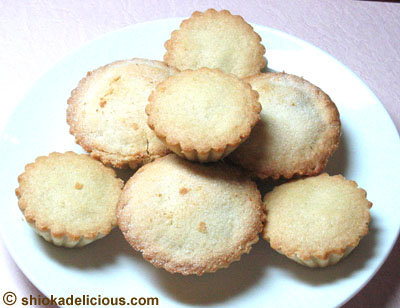
Even the mini mince pies were chock-full of luscious spiced vine fruits… Yum!
We also had some mini chocolate yule log cakes, from another friend. These were very good too. Instead of butter cream, these were filled with a light, yet rich-tasting bitter-sweet chocolate mousse, and topped with dark chocolate. These also did fast-disappearing acts, and were enjoyed by both young and old.
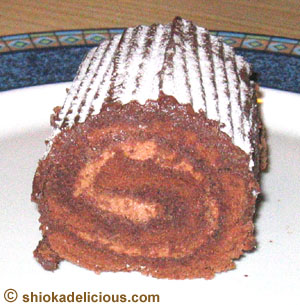
Another personal favorite…
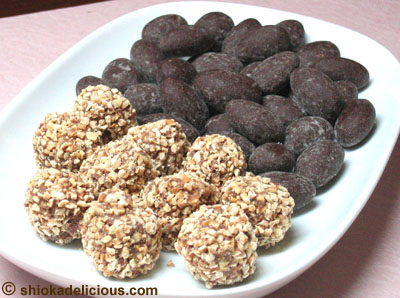
Dark chocolate covered almonds with a light dusting of powdered sugar. Mmmm... Perfect balance of the bitterness of dark chocolate, sweetness of powdered sugar and crunch of roasted almonds. (Sorry, I only remembered to snap the picture after most of them were gone, and they had started to “sweat” even though the air-conditioning was on full-blast, and were looking less than picture-perfect). These were from Royce Chocolates, a Japanese brand with a counter in Takashimaya’s Food Hall. I like their chocolate truffles too. Apparently made from Hokkaido cream, these are extremely smooth tasting. They are not quite shaped like the traditional truffles, and are also less sweet. Just divine!
There was also fresh-made hazelnut gelato from Venezia (Guthrie House or Centrepoint), served with warm chocolate sauce and chopped toasted hazelnuts. No pictures though, sorry. I forgot… I was too busy enjoying the gelato! I also forgot about snapping the myriad of other Christmas baked goodies so kindly brought by friends and relatives. But I assure you they all tasted yummilicious!
Yes, it was a sweet, sweet Christmas indeed!
Next up, lamb shanks and the other entrees and side dishes…
Copyright © 2003 Renee Kho. All rights reserved.
Please contact me for permission to copy, distribute or display any of the images and text contained in this article.
01:45 PM in Festivals: Dong Zhi & Christmas 2003 | Permalink | Comments (4) | TrackBack
Wednesday, December 24, 2025
Seasons Greetings!
Copyright © 2003 Renee Kho. All rights reserved.
Please contact me for permission to copy, distribute or display any of the images and text contained in this article.
04:06 PM in Festivals: Dong Zhi & Christmas 2003 | Permalink | Comments (3) | TrackBack
Tuesday, December 23, 2025
At The Ritz
Given that we will be cooking and cooking, and cooking some more over the next few days, we decided (or at least my mum and I decided) that we would not / did not want to cook for the Dong Zhi family reunion dinner last night and that we wanted to eat out instead. And of course the men didn’t have much of a say in the matter.
We opted to dine at The Greenhouse, Ritz Carlton. I still think this is one of the better buffets in town – with a very wide selection of high quality dishes. There would definitely be something to satisfy all the different tastes/desires of everyone in the family, and we can avoid the discussions and negotiation of where to go, what to eat…
The menu for the Greenhouse buffet changes constantly, day to day. I had been hoping to be able to taste once again a couple of the dishes which I had absolutely loved the last time I was there over 2 months ago – such as the braised “leg of pork” or more commonly known as pork trotters, and the teppanyaki beef tenderloin which were both absolutely sublime! But it was almost all brand new dishes last night. The selection was, as usual, incredibly wide-ranging – there was easily a choice of between 80-100, or maybe even more, dishes!
Needless to say, we never got round to tasting everything. I took only bite-sized pieces of various dishes and still only managed to taste maybe only a quarter to a third of the entire selection that was available!
The pictures are only of the food I did get round to eating  Please excuse some of the slightly messy plates… but that’s what buffet dining is about isn’t it? All flavors and textures sort of intermingling on one plate! Haha…
Appetizers… clockwise from the top…
Smoked salmon on a piece of vinegar marinated daikon (or at least I think it tasted like daikon )... rather vinegary.
One of my perennial favorites: Japanese seaweed salad.
Roasted capsicums and mushrooms… another personal favorite. Nice intense flavors and sweetness. There were also roasted eggplants and zucchini but I usually find these too mushy as they absorb the olive oil all too well.
Yet another personal favorite: marinated octopus salad, done here with jellyfish and cubes of fried tau pok.
Thai-style chicken and pomelo salad… I really liked this. The flavors were a beautifully balanced combination of sweet, sour, tanginess and a little chilli heat. The combination of textures (and tastes) was very good too – with juicy pomelo pulp, tender and moist shreds of chicken breast, crispy raw shallots, a little heat from some chilli padi slices and an aromatic finishing touch from the coriander leaves.
In the center: this tasted like vinegar marinated tamago (Japanese egg omelette) to me, even though the label next to the dish said “fish cake salad”. So not quite sure what I tasted there…
This was an interesting twist to the traditional turkey. Instead of roasting the bird, it was smoked, which meant that it was therefore very nicely moist and tender. It was paired with a herbed curry gravy. Interesting idea, but I just wonder whether a more tangy gravy (maybe Thai-style, Vietnamese-style etc) would have complemented the turkey meat better.
I never even got round to the other two thirds of the appetizer stations… the sashimi, sushi, oysters, mussels, king prawns, dim sum items and much more which I cannot now recall.
I skipped the most of the salad stations with a huge variety of Asian and Western styled salads and the bread station too… and straight onto the entrees…
Clockwise from top…
Vegetable curry… I liked this, especially the pieces of paneer (Indian cottage cheese).
Pan-roasted cod fish… beautifully succulent and juicy!
Fried seabass in spicy sweet sour sauce… pretty good too, but I still preferred the cod.
Braised sea cucumber with Chinese mushrooms… yummy and fairly similar to what my mum cooks!
Baked chicken with wood-ear fungus (or was it kelp?) I liked this too.
Braised lamb with gravy and shallot salsa. Didn’t like this, unfortunately. It was very, very gamey, too underdone and yet very chewy.
Lamb curry. Not bad.
In the center: stir-fried seafood pasta. Nice. It was done with lots of garlic, which I love.
I didn’t actually eat the laksa, but “stole” two quail eggs from the bowl. I love quail eggs! Yum! No idea how the laksa tasted though… And in the end, he left much of it untouched too.
Didn’t get round to tasting the chilli crab, braised duck and quite a few other dishes. I decided I needed to save room (a lot of room) for dessert… my favorite part of any meal.
The dessert selection was… well, shall we say, enough to send a dessert and chocolate lover like me into a fit of ecstasy! 
And I ate all this…
The glutton that I am… No, actually, I didn’t. I shared most of it. I was behaving myself. Truly. This was probably less than one third of the total dessert selection that was on display. I didn’t even get round to the Asian dessert station and one other dessert station (which I cannot now even remember what it had, haha).
Please indulge me now as I just “have” to show some close up shots of the desserts I did manage to try…
Wow! Rum-soaked cherries with rich chocolate mousse (dark and white). *swoon* Enuff said… *swoon again*
I had very fond memories of this from my last visit. An incredibly rich combination of white chocolate and semi-sweet chocolate mousse. It was one of those “died and gone to heaven” type of chocolate dessert. Last night’s tasted slightly different. The semi-sweet chocolate mousse was flavored with hazelnut, which was nice, but not as rich as previously. But hey, who’s complaining?
Clockwise from top left…
Not too sure what this was (there were no labels at all at any of the dessert stations). It could have been a passionfruit mousse tart with apricot marmalade, maybe? Wasn’t too keen on the combination of flavors anyway.
Kaya (coconut and egg custard) cake. Hmmm… the whole table commented on the rather “unnatural green” of this cake. Similarly, can’t say the kaya taste was that natural either. : (
Rich chocolate tart. Need I say more?
Clockwise from top…
Christmas Stollen and two types of Christmas fruit cakes (one with mixed peel and the other with dried cranberries and golden sultanas). I’ve always liked these types of Christmasy sweet goodies.
This, I do not know what it was… hard to even describe what it was like… a very, very sweet, very dense, cakey kind of cookie with mixed dried fruits. It was hard, chewy, dry, cloyingly sweet… Uh… okay, moving on…
Blond honeycomb cake… this looked beautiful. Even my mum commented how well done the honeycomb effect was – every strand of the honeycomb was long, clear and distinct. Unfortunately, looks are no indication of taste… sometimes. Blond and bland, unfortunately.
White chocolate mousse with rich dark chocolate sponge cake. *she goes into another fit of ecstasy*
This looked absolutely seductive. It tasted rich and chocolaty enough, but rather dry. Everyone agreed they preferred my “death by chocolate” version. *awww… they are so sweet*
Sweet almond soup, made from cooking Chinese almonds for a long, long time to form a thick, smooth, creamy, milky white soup. For some reason, I really liked this version, even though it was very slightly grainy, and not as smooth as some other places. I really enjoyed this.
Okay, and now for the really heart-wrenching part of the evening… hankies out, please…
When I last dined at The Greenhouse over two months ago, I was completely bowled over by their cheesecakes. I just loved the strawberry cheesecake that I had. So much better than Hilton’s I thought (which I have always found to be over-rated even though many would declare them the best in Singapore). Ritz's version was rich yet fluffy, sweet but not too sweet, cheesy but not gaggingly dense. I thought it was sensational. And last night, I had made a mental note: I must have the cheesecake. When we arrived at the restaurant, and as we were led past the dessert station on the way to our table, I spied the cheesecake sitting there, and I grinned. Yeah! I was going to have not one, but two pieces of THAT, I thought…
But… I forgot one important thing about The Greenhouse, especially when it comes to their desserts. Very often they don’t repeat the items. That is, when a cake or dessert runs out during the course of the evening, it is usually replenished with something brand new and different. The good thing about that is that one can sit there the whole night and sample a parade of different desserts. The bad thing is, slow movers could miss out on their favorite dessert. And so it was for me…
By the time I got round to dessert, the strawberry cheesecake was gone. I hoped expectantly that another variety of cheesecake would appear. I waited and I waited… a succession of gorgeous mousse cakes, cream cakes and all forms of desserts appeared as previous ones disappeared from the display counters. But no cheesecake. We sat, chatted, ate, chatted some more, ate some more… still no cheesecake.
Then… as fate would have it, as we were leaving, and were walking past the cake counter again… what did I spy with my two eyes? Not one, but TWO cheesecakes, fresh out of the kitchen!! Oh goodness! If there had not been a steady hand on me I would have turned round and gone back to our table! Haha!
This was what I missed…
This looked like a classic baked cheesecake topped with various dried fruits. Yes, I know, the crust looks overly thick. But… this was what (I feel) contributed to making the strawberry cheesecake that I had tasted the previous time so seductively delicious. It’s something about their crust . In this combination, thick layer of rich, flavorful biscuit base with the creamy and fluffy cheese filling, it just tastes heavenly. *sigh*
But the real “killer” was yet to come. I then spied this…
Oh my gosh! I was definitely going to sit down again. I need to have a piece of this. This looked so unbelievably tempting. A layer of chocolate biscuit crust, sponge fingers on the sides, possibly white chocolate cheese filling, dark chocolate ganache topping and curls of white chocolate sprinkled on top. How could anyone resist something like this?!
I can’t believe this… I can’t believe they did this to me… how could they??! This must be some evil conspiracy! They hid the cheesecakes until I was leaving! I think there must have been some kind of glazed (or crazed?!) look in my eyes. The hand on my shoulder tightened. Someone had read my mind. Yes, for one wild second, I was contemplating grabbing the entire chocolate cheesecake and making a dash for the exit! I stood transfixed. I couldn’t leave. I couldn’t leave without eating a piece of this. “Let’s sit down again”. I had voiced my thoughts out loud without realizing it. Then my feet started to propel me forward, as I was led gently, but firmly, towards the exit. One last turn of the head, one last longing glance, one last long sigh…
I came home and had dreams of this chocolate cheesecake. Maybe, one day… one day, we shall meet again…
Copyright © 2003 Renee Kho. All rights reserved.
Please contact me for permission to copy, distribute or display any of the images and text contained in this article.
05:38 PM in Lion City Shiok-Eats: Buffets | Permalink | Comments (2) | TrackBack
Monday, December 22, 2025
Happy Dong Zhi!

It is Dong Zhi today… a time for family togetherness… a time for love, joy, laughter and warmth…
Dong Zhi (Winter Solstice) is one of the most important festivals of the Chinese lunar calendar, and falls almost every year on the 22 December (on rare occasions, it may fall on 21 December). Literally translated it means “arrival of winter”. In ancient times, it marked the end of harvest and the return of family members from far and near to the family ancestral home, to gather, celebrate and prepare for the coming of the Spring Festival or Chinese New Year. I suppose Dong Zhi can be regarded as the Chinese Thanksgiving, and like the American Thanksgiving, food, wine and feasting are integral parts of the celebration.
Tang yuan (glutinous rice balls served in a sweet soup) are a must on Dong Zhi. They are eaten to signify unity and harmony within the family and to celebrate the past good year. “Tang” (meaning soup in Mandarin), sounds like “tuan” (meaning reunion), and “yuan” (meaning round) signifies “yuan man” (completeness, fulfillment).
Although tang yuan can now be eaten throughout the year, at restaurants or hawker centers, or can be bought frozen and ready-prepared in supermarkets, they still take on special significance when eaten on Dong Zhi.
They are usually boiled and served in a sweet soup made with ginger and rock sugar. Our family made two versions today… one is the traditional clear ginger syrup soup, with an added South East Asian twist of pandan leaves as aromatics...

The second is a thick red bean sweet soup (red bean tong shui). I’m not sure what the origins of this version are… but this version is commonly served in restaurants and hawker centers. Apart from red bean soup, they can also be served in (black or white) sesame sweet soup (zhi ma hu) or in peanut sweet soup (hua shen hu).

[Interestingly, when tang yuan are served dry, coated with crushed peanuts, they take on a new name and new meaning. Known as “yuan xiao”, they are eaten on the 15th or last day of the Lunar New Year celebrations. But that is for another time…]
The tang yuan we eat nowadays are so different from the homemade ones I remember as a kid. Hardly anyone makes their own tang yuan anymore. It is just so much more convenient, and tastier too, to buy them frozen and ready-made from the supermarket. And they now come with luscious fillings of peanut (yummy), black sesame (very yummy) and red bean (yummy too).
In the days when there was no ready-made tang yuan to be bought, every family would come together on Dong Zhi morning to make tang yuan. These are made from a very simple dough of rice flour and water, and rolled into tiny marble-sized balls. Very often, they are made into white and pink colors, with the pink color signifying good luck. These had no fillings and were simply boiled in hot water until they floated to the surface, and then served in the sweet syrup soup.
I remember these home-made tang yuan to be rather chewy and bland. Today’s modern versions taste infinitely better, however, I so miss the laughter and joy of sitting around the kitchen table… grandmother, aunts, mum, cousins… all pitching in to mix the dough and roll out these little balls of glutinous rice. I miss the chatter, the teasing and the abundant laughter. Yes, today’s factory-made tang yuan may taste delicious, yet the traditional ones of old tasted sweet, rich and full with love, warmth and joy. Back then, families gathered to make and eat tang yuan together… and that truly must be the real meaning of Dong Zhi…
As I sit with my family to eat tang yuan this festive day, I wish one and all...
Happy Dong Zhi to you and your family!
Copyright © 2003 Renee Kho. All rights reserved.
Please contact me for permission to copy, distribute or display any of the images and text contained in this article.
05:27 PM in Festivals: Dong Zhi & Christmas 2003 | Permalink | Comments (4) | TrackBack
Din Tai Fung
It has been a while since I last posted any of my dining out experiences, simply because all the occasions in the last couple of weeks have felt “inappropriate” for picture snapping. However, tonight, we had dinner with my parents, here…

If you are not a Singaporean, you could possibly be thinking: dinner in a hospital, maybe?? But for Singaporeans, they would probably know this image as part of what is arguably one of the most popular eating places in Singapore at the moment…

This off-shoot of the famous Taiwan-based chain of dumpling restaurants has been open for at least a good 4-5 months now (I think), and yet the lines are still mind-bogglingly long. People are willing to wait, and wait, and wait some more… just to get a table – sometimes for up to 45 minutes or more! This evening, we arrived at around 8pm (just a little after the peak dinner period), and we weren’t shown to our table until almost quarter to nine! When we arrived, there were around 50+ queue numbers ahead of us, and as we were being seated, the latest queue number being given out was about 60 after us!
The front desk staff had very obviously gotten the queuing system down pat - a contrast to the frenzied “(almost) organized chaos” that had ensued when I was last there, shortly after they opened. There is now an electronic queue number display system. A welcome relief for the young ladies manning the front desk – no more shouting out the queue numbers until their voices were raw and hoarse. They can breathe easier now too - no more anxious customers elbowing to crowd in front of the front desk so that they could hear the numbers being called out.

Now, one can relax and sit or stand back, and watch the spectacle of the chefs at work. This must definitely be one of the main attractions of the restaurant, for both locals and tourists alike. A glass “box” right next to the entrance in which over 25 chefs stand, masked and gowned, busily churning out hundreds, if not thousands, of the small steamed meat dumplings that this restaurant is famous for.

Each dumpling is completely hand-made. Each ball of dough is rolled out to the same size and same thickness, the same amount of meat filling is placed in the center of the dough, and the dough is then wrapped around the filling and sealed with PRECISELY 18 folds, to form neat pleated bundles. Yes, apparently, these chefs are trained to put EXACTLY 18 pleats into each dumpling!
It’s quite an amazing sight to watch. So many chefs just standing there, side-by-side around wooden tables, their hands in unceasing movement as they rolled, filled and pleated. Their movements are deft, smooth… almost like a dance. It is almost like watching the well-oiled, smooth mechanisms of a collectors’ watch!
More chefs at work….

(yes, there are a lot of photos tonight… well, we did have 45 minutes of standing around, and so I had volunteer-photographers who went around with my camera snapping away!)
After the dumplings are made, they are steamed and ready to be served. Stacks and stacks of bamboo racks of these dumplings…

Notice the 2 computer screens on the left, which the chef is looking intently at? They are constantly flashing as new orders pile in and the requests for the dumplings grow continuously.
In another section, in the far end of the restaurant, more chefs in another glass “box”… again, in continuous, unceasing activity, as they churned out bowls and bowls of steaming hot soups and noodles…

And so we waited some more… as we watched other diners sitting inside the restaurant tucking into their dinners…

The décor is bright and spacious, with touches of Zen in the wooden furniture, wooden floors, and granite, glass and metal counter tops. Chinese calligraphy paintings hang from the yellow walls. However, the level of activity is probably too frenzied for it to be anywhere near being an oasis of peace and tranquility. Yet, in all its busyness, there isn’t a sense of hurriedness either.
Well, at least, for those of us still on the outside… there are the shallow pebbled ponds of tranquil water and stone sculptures to soothe our minds and enhance our patience!

Finally… we are let in. The service of this place is still incredibly efficient and polite. Everything moves and works with almost clockwork precision – a synchronized dance of food and service. As soon as we are seated, our teacups are filled with piping hot Chinese tea, and within minutes (literally) of our bottoms touching our seats, the food begins to arrive.
This is a dumpling restaurant, and so of course, we ate dumplings, dumplings, and more dumplings : )
Their signature dish: the xiao long bao (steamed meat dumplings with broth) (S$8.50 for 10 pieces) (US$5.00)…

Theirs is a pretty tasty version – almost on par with my all-time favorite in Singapore at Min Jiang Restaurant. The meat filling was lean, moist and juicy with a nice amount of tasty broth. I have to say, the quality is very consistent, with broth in all the dumplings (and therein lies the skill and expertise).

And of course, these xiao long bao dumplings must be eaten dipped in black vinegar and accompanied by raw ginger juliennes.

I also like the vegetable (chives I think) and pork steamed dumplings (S$8.50 for 10 pieces) in this restaurant…

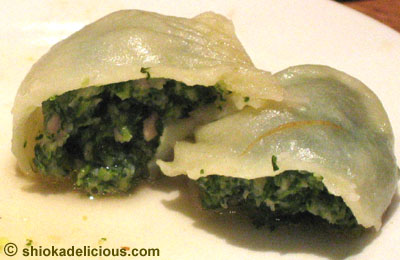
We tried out their vegetable and pork wantan soup (S$6.00 for 8 pieces) (US$3.50) for the first time tonight. Tasty. Actually, these have the same fillings as the above dumplings, only with the thinner and smoother wantan skin and cooked in a tasty pork broth.


The only dumplings I did not really enjoy are the prawn and pork steamed dumplings (S$9.50 for 10 pieces) (US$5.60)…

I found the pork in the filling rather too fatty, and with an almost overwhelming “porky” taste and aftertaste that lingered in the mouth…

All the dumplings have to be eaten whilst hot, as their tops become slightly chewy as they cool.
We also finally managed to try their vegetable and pork steamed bun today. They were sold out the previous time I was here, and according to my brother, they were also sold out as well on each of the various occasions he has dined here in the past.
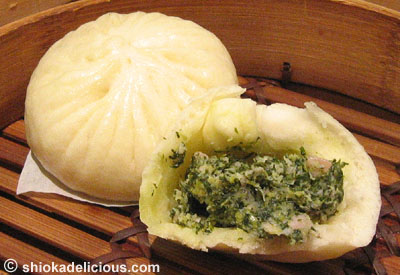
These are ok. The fillings are again the same as the vegetable and pork steamed dumplings and wantans. I’m just not a big fan of paus (steamed buns) with the denser, more chewy dough, like this one. I prefer all my paus with the soft, fluffy dough of the Cantonese-style paus.
I had very good memories of the beef soup noodles from my last visit, and really wanted to have it again. This time though, I ordered it without the pieces of beef (S$6.00 without beef, S$10.00 with beef), as on the previous occasion I had found the beef, whilst very, very tasty, rather chewy and tough.
The first time I had this noodle dish, I was bowled over by the intensely flavorful beef soup. It was thick and rich and oh-so-“beefy”. So shiok! Tonight, it is still good, albeit a tad watered down. But my craving is satiated anyway and I am happy.
We also tried the pork ribs noodle soup (S$8.00). Very tasty broth, and very tender, moist, juicy and flavorful ribs. Nice!

At the end of all that, we felt as stuffed as those dumplings! Haha…
The marketing psychology and positioning of this restaurant and its operational model absolutely fascinates me. I think these are what draw the crowds and the long lines. Couples, teenagers with friends, young families with children and elderly in tow, tourists… a comprehensive cross-section of society is drawn, like moths to a flame, to its large glass windows and their “display” of chefs, and is then seductively enticed into its interiors to experience its unique culinary adventure. The food is pretty good, but not outstanding. But who said memorable dining experiences are about the food alone?
Din Tai Fung
290 Orchard Road
#B1-03/06 Paragon
Singapore 238859
Copyright © 2003 Renee Kho. All rights reserved.
Please contact me for permission to copy, distribute or display any of the images and text contained in this article.
03:31 AM in Lion City Shiok-Eats: Chinese | Permalink | Comments (4) | TrackBack
Saturday, December 20, 2025
It’s Beginning to Taste A Lot Like Christmas
One of the things that make Christmas christmasy for me is the food. Somehow Christmas just doesn’t feel like Christmas without certain epicurean experiences. And it’s not the savory foods that do it for me – no, I do not think about baked ham or roasted turkeys. Christmas for me is defined by all the sweet treats of the season. (Yes, my sweet tooth is quite legendary in this family). Weeks before Christmas I would start dreaming of fruit cakes, mince pies, chocolates, cookies and what have you…
This year, the festivities have had a rather late start for me. I have been too busy to do hardly any Christmas baking. My fruit cake attempt a couple of weeks ago could hardly be called a “resounding success”. But… all is well…
A friend of my brother made us a brandied fruit cake, and it is delicious! It isn’t too sweet (hard to find in commercial ready-made fruit cakes), has a nice, tender crumb and is moist with a balanced taste of brandy. It has a nice homey feel to it – simply decorated, without glazing etc. Our family doesn’t like glazed cherries in or on our fruit cakes, so this suits us to a T.
Apparently, she takes orders for her cakes, which she bakes part-time (over and above her full time job). She does all sorts of cakes from butter cakes to cheesecakes, and is also supposed to have come up with some interesting creations like tequila cakes and vodka cakes. I’m curious and am awaiting a list of her cakes from my brother, so that I can try out some of her other creations. I like her style of baking (and I’m not just saying this because she is known to my brother), and her prices are rather reasonable. I think her fruit cakes go for S$28 for a 6-8” cake, compared to easily $40+ to $50+ from shops.
Anyway, if anyone is interested in contacting her for her cake list or to place an order, please drop me a line, and I’ll pass you her contact number. Okay, yes, this is a mini 30-second plug... but we do like her fruit cake very much. And good things should be shared ; )
Whilst shopping at Cold Storage supermarket the other day, I picked up a box of Tartufo Italian Christmas cake (S$14.90). Each year, I’ve seen these Italian cakes on sale, but have never been tempted to try them, until now. I wasn’t sure what to expect. In fact, I have always associated “tartufo” with Italian gelato for some reason. The fine print on the box said “Italian leavened cake with gianduja hazelnut paste, coated with plain chocolate and decorated with chocolate curls”.
When I opened the box, this was what I found… it looked suspiciously like an extra, extra large muffin!
(Note my first – not very successful – attempt at mood lighting photography. Haha!)
The inside revealed nice, slightly gooey chocolate cream filling, with the lightest hint of the liquor. The texture of the cake had looked rather coarse and dry , but it tasted tender and fairly moist. I actually feel it is more inclined towards being a rich, sweet bread rather than a cake.
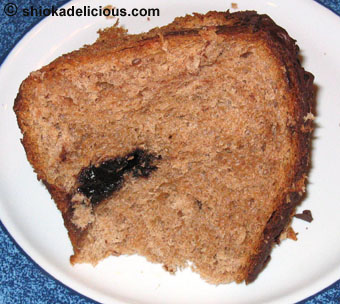
I wonder… is this a traditional Italian Christmas cake? Or is this a modern invention? I’m really curious about the story and tradition behind these sorts of Italian Christmas cakes… I’m presuming it is fairly authentic as it is made in and imported from Italy. Anyone knows? I’m always fascinated by the different foods eaten in different cultures to celebrate the same festivity.
I’m also really curious how this cake/bread can keep for so long. It came non-vacuum sealed in a paper box and the expiry date on the box said May 2004! 
It was nice though. I liked it. I would like to try some of the other varieties next year. I think there must have been at least 5-6 varieties, with different cream fillings or toppings, that I saw on display the other day.
The cake also came with a complimentary cute little mini Panettone – Italian leavened cake with raisins and candied orange peel.
I would guess this is the original Italian Christmas sweet loaf? And the counterpart to the German-originated Stollen. I’m more familiar with this German version of a sweet, rich, brioche-like, fruity, spicy bread/cake with a marzipan center. The tradition of eating Stollen at Christmas apparently arose from the ancient practice of the local bakers’ guild of the city of Dresden’s to present to the Bishop of Narumburg two long white breads, called “Stollen”, on Christ’s birthday and on Michaelmas. I think the characteristic oblong shape of the Stollen with a folded ridge down the center is supposed to represent the Christ Child in swaddling clothes.
The Italian Panettone is quite differently shaped. Is there a significance to this? What’s the tradition behind the Panettone? Strangely, I don’t think the English have a tradition of eating sweet breads at Christmas. I only remember and know of plum puddings with brandy sauce, rich fruit cakes and of course, my favorite, mince pies. One is supposed to eat one mince pie a day on each of the 12 days of Christmas (from 25 December through to 5 January, before the epiphany on the 6th), to ensure one has good luck in each of the coming 12 months of the new year. Interesting, huh?
Ah… fruit cake, Panettone and mince pies… it really is beginning to taste a lot like Christmas!
Copyright © 2003 Renee Kho. All rights reserved.
Please contact me for permission to copy, distribute or display any of the images and text contained in this article.
03:56 AM in Festivals: Dong Zhi & Christmas 2003, Lion City Shiok-Eats: Cakes & Desserts | Permalink | Comments (8) | TrackBack
Meat Balls For Alberto

I like to use these meat balls in a lot of the dishes I cook. They are so convenient. They come fresh, ready-prepared in vacuum sealed packages from the supermarket, and they instantly add taste, texture and “meat” (pun intended) to any dish. I add them to noodle soups, rice vermicelli soups, tau kwa (pressed tofu) dishes, fu jook (bean curd stick) dishes and many, many more. Even instant noodles, with an additional egg. Yum!
I actually prefer these meatballs anytime over the ubiquitous fish balls that are so very common in Asia. They have “more bite” with a “springier” texture than fish balls. And they come in nice ¾” bite-sized pieces, which also make them great for skewering into sort of meat ball satays, then cooked over a BBQ or under a broiler, and either basted with teriyaki sauce, served with salsa or dipped into piquant chilli sauce. There are increasing varieties of them too – beef balls, chicken balls, sotong (squid) balls, beef and mushroom balls, chicken and mushroom balls, sotong and mushroom balls, and even tofu and fish balls.
Here’s a dish that appears regularly on our family’s dinner table – a mixed dish of meat balls, cubes of teriyaki tau kwa (pressed tofu in teriyaki flavor), cubes of fish tofu, different types of mushrooms, carrots, long beans and red chilli. I like this dish a lot!

Copyright © 2003 Renee Kho. All rights reserved.
Please contact me for permission to copy, distribute or display any of the images and text contained in this article.
02:10 AM in Home Cook: Poultry & Meats | Permalink | Comments (2) | TrackBack
Friday, December 19, 2025
Silken Skin

I remember as a young girl, whenever I refused to eat fu jook (bean curd skins) or fu jook pei (dried bean curd stick), my paternal grandma would always tell me that eating fu jook would make my skin as silky smooth and fair as the fu jook. And if old wives’ tales are to be believed, eating lots of fu jook tong shui (bean curd skins sweet soup with gingko and lotus seeds) whilst pregnant would produce a baby with silky smooth skin and complexion!
While I’m not sure such bribery worked on me as a child, I have grown to love eating fu jook and all its variants. Fu jook is made from the “skin” that forms on the surface of heated soy milk. These are scooped up and either sold fresh to be used in making sweet dessert soups like fu jook bak guo tong shui (bean curd skins with gingko sweet soup), or are dried into sticks and used for many types of savory dishes. (Linked pictures are taken from Cook’s Thesaurus).
I love the fu jook dish my mum cooks. It’s chock-full of ingredients, with different tastes, textures and colors. The recipe involves a fair number of ingredients and quite a few different steps to prep all the different ingredients, before actually cooking the dish.
The main ingredients of the dish are: fu jook pei (dried bean curd stick), black wood-ear fungus, carrots, diced chicken meat, tang hoon (mung bean vermicelli), quail eggs, red and green chillis, cilantro or parsley. Occasionally, she may also add mushroom meat balls, fish balls, sotong (squid) balls or cubes of fish tofu. That’s what I like about this dish… the ingredients can be added to, substituted or changed to vary the flavors of the dish.
First, the dried bean curd sticks have to be prepared. They are soaked in water for at least 4 hours. After which, they are quickly sautéed (not deep fried) in hot oil. This is to prevent them from disintegrating when they are cooked in the main dish. They are then rinsed in running water to wash away some of the oil from the sautéing. Next, they are put into boiling water and allowed to “boil” for about 10 minutes. Once drained, they are ready to be used.
Similarly, for the dried black wood-ear fungus, these are also soaked in water then rinsed well to remove all soil and dirt. Again, they need to be boiled for about 10 minutes before being drained and set aside to be used in the main dish.
The quail eggs are hard-boiled and peeled.
The red and green chillis (seeded and de-veined) are sauteed in a little hot oil with a little minced garlic and shallots beforehand.
The diced chicken meat is marinated with a little light soy sauce, sesame oil, sugar and a bit of cornflour. Next, it is sautéed in a little hot oil, until partially cooked through. 1 teaspoon of dark soy sauce is added before it is set aside.
Now for the dish proper… minced garlic and shallots are sautéed in hot oil until softened and fragrant. The carrot slices are added, followed by the wood-ear fungus. Seasonings of around 1 tbsp light soy sauce, 1 tbsp oyster sauce, 3 tbsps rice wine and pepper are added. (Note: these quantities for the seasonings are for a BIG batch of the dish, and should be adjusted accordingly). Next, the chicken stock goes in, along with the dried bean curd sticks. More seasonings are added: 4 tbsps light soy sauce, ½ tsp sugar, 2 tbsps oyster sauce and 1 tbsp dark soy sauce. According to my mum, adding all the seasonings before adding the stock would lead to overly salty carrots and fungus, whilst doing it in two stages leads to a dish with nicely balanced flavors. The quantities for the flavorings may look like a lot, but it doesn’t produce a salty dish at all. My family is almost hyper-sensitive to saltiness. In Chinese restaurants we are constantly requesting for “less salt” in all our dishes. And this dish tastes just fine.
The tang hoon goes in next. The stock is allowed to come to a boil, before letting it simmer for about 15 minutes, uncovered. The last stage is to add the partially cooked chicken, hard-boiled quail eggs, chillis, and any other ingredients (eg mushroom meat balls etc) that are to be added but do not require much cooking time. The last to go in would be the cilantro leaves. The mixture is then brought to a boil, and a little cornstarch solution is added to thicken the gravy. After it comes to a rolling boil again, it is removed from the heat and served.
All that effort is worth it though… it tastes great, and even better the next day! Yum!
Copyright © 2003 Renee Kho. All rights reserved.
Please contact me for permission to copy, distribute or display any of the images and text contained in this article.
03:10 AM in Home Cook: Soy | Permalink | Comments (4) | TrackBack
Split Personality Bread Pudding

The other day, while sorting through a cookie tin full of old recipes that I had copied from various places and scribbled onto scrap pieces of paper, I came across one for bread pudding. I love bread pudding. So does my family. And since we haven’t eaten any for a while, I thought I would try my hand at making one. The weather this past week has also been perfect for bread pudding. There’s nothing quite like eating warm comfort food on a cool rainy day.
I have never made bread pudding before. Yes, another first. Hmmm… it has been a week of kitchen firsts hasn’t it? The recipe looked really simple and it was. It was just a matter of soaking cubes of slightly stale bread into a custard mixture of brown sugar, eggs, evaporated milk and fresh milk.
As usual, I wanted to experiment with different tastes and had a hard time deciding what exactly I was going to do. I wanted to make a bread pudding using raisin cinnamon bread, and I also wanted to try white bread with toasted almond flakes. But I didn’t want to make two bread puddings. So, I made one – with both types of bread. A sort of split personality bread pudding I guess.
For the custard: ½ cup (I think I would prefer slightly less the next time) packed brown sugar was whisked together with 2 eggs. Then, 1 cup of low fat (1.5%) evaporated milk and ½ cup 1.5% fresh milk were added, together with 1½ teaspoons of pure vanilla extract, and whisked to mix. I decided to skip the cinnamon and nutmeg that the recipe called for, as the raisin bread already had cinnamon and I wanted to see what the white bread would taste like without these flavorings and just almond flakes. But of course, I then promptly forgot to add the almond flakes to the white bread mixture!
I divided the custard/pudding mixture into two and added one type of bread cubes to each. (4 cups of bread cubes in total). These were left to sit for about 5 minutes, before going into a 175C oven for 50 minutes, or until the bread has puffed up and turned a deep golden brown. Mine was done in just over 45 minutes - the skewer inserted into the center already came out clean. The bread was a gorgeous golden brown.
I walked away to get my camera to take a picture of the beautifully puffed up pudding. On the way, I stopped to take care of something. I returned to the kitchen 5 minutes later to find that the entire pudding had “sunk” !! Horrors! What happened?! Are bread puddings supposed to do that?? Or maybe I should have left it in the oven to cool slightly first before removing it. Perhaps my impatience caused the “collapse”. Have to find out what happened there…
Regardless, it tasted pretty good. I sprinkled the forgotten almond flakes onto the white bread pudding before serving, and that was very good! Strangely though, the white bread pudding tasted sweeter than the raisin bread pudding. I wasn’t expecting that. If anything, I would have thought the latter would come out sweeter, as the raisin bread is in itself sweeter than the white bread.
Bread pudding on a rain-soaked day… what could be better?
Happy bread pudding-ing!
[Update (23/12/03): It just occurred to me that a possible reason why the bread pudding "sunk" after being removed from the oven is that I didn't place the casserole on a baking tray filled with about 1" deep of water, before putting it into the oven. I think a lot of bread pudding recipes call for such a step. For some reason, the recipe I used did not - or maybe I had scribbled it down wrongly way back when...
I'm thinking also that placing the casserole in a shallow water bath so to speak would create a different (more custardy?) texture, rather than a more kueh-like (cakey) texture.
Not sure if the baking time would need to be adjusted if using the water bath. It should either be the same or maybe just a few minutes longer (?)
I'll have to try the recipe again to find out...]
Copyright © 2003 Renee Kho. All rights reserved.
Please contact me for permission to copy, distribute or display any of the images and text contained in this article.
12:21 AM in Comfort Food | Permalink | Comments (8) | TrackBack
Thursday, December 18, 2025
Lobster, Lobster, Lobster

We had lobsters for dinner tonight. They were done very simply… A LOT of minced garlic, some minced red chillis, some minced spring onions (scallions), salt and pepper, combined with softened butter, and spread over the lobsters. They were popped under the broiler for 8 minutes. That’s it. The flavors were nice without being over-powering, allowing the natural sweetness of the lobsters to come through. The lobster flesh was sweet, juicy and succulent… a sublime mid-week treat!

I’m already brimming with ideas for the other lobsters now in the freezer (all courtesy of my dad!). I can just imagine...
• Lobsters sautéed with wine, ginger and scallions
• Lobsters sautéed with black pepper
• Lobsters sautéed with black bean paste
• Chilli lobsters (a la chilli crabs)
Urgh… choices, choices…
But three cheers for dad! Thanks for the lobsters! 
Copyright © 2003 Renee Kho. All rights reserved.
Please contact me for permission to copy, distribute or display any of the images and text contained in this article.
01:51 AM in Home Cook: Fish & Seafood | Permalink | Comments (2) | TrackBack
Going Potty Over Pot-Pie

On Tuesday, I decided I wanted to try my hand at making a vegetable pot-pie. Now, I’ve never, in all my life, made a pot pie before. On top of that, I’ve never made a savory pie before. Hard to believe, I know, but it is true. Okay, so what could be so difficult about a pot pie right? It’s just a pie baked in a deep casserole dish, with only a top crust, and no dough base. Plus, I’ve made dessert pies before, so the basics are pretty much the same for a savory pie. Should be simple enough. But of course, Renee has to go make life even more interesting (difficult??) for herself… she decided that she was going to try to make a savory pot pie with a biscuit crust. How’s that for jumping in at the deep end?!
I am referring to the American biscuit, not the English… i.e. those scone-like baked items that are sometimes called “Southern Biscuits”. I have never made biscuits before. Not even sure if I have ever eaten one (at least an authentic one). Which means I don’t even know what a biscuit should really be like. And here I was contemplating using that as a crust for my pie!
I have been very tempted to try baking biscuits ever since I read Deb’s post on her attempt at making them. Hers had looked absolutely delectable. Plus, the other day, whilst waiting for someone and flipping through a stray magazine, I had chanced upon a recipe for a pot pie with a biscuit crust, and it looked wonderful. So that did it… I would combine two things that I wanted to make into one. I thought I was being so clever… haha… little did I know of the adventure (or more precisely, misadventure) that awaited me…
The vegetable filling was fine. It turned out really well in fact, with the family giving it the two thumbs up.
I just took whatever vegetables I could find in the fridge and which would give a nice balance of colors, and diced them into equal sized cubes for ease of cooking. I ended up using 1 large onion, ½ large red bell pepper, 1½ yellow-fleshed potatoes (I decided against using Russets, as I wanted something firmer fleshed and not fluffy), 1½ carrots, small flower of broccoli, 1 stalk celery and a medium bunch of cilantro / coriander (interchangeable with parsley).
I sauteed 2 cloves of minced garlic with the diced onions in hot oil until slightly softened, before adding the potatoes, carrots and broccoli. When they were just about to start becoming tender, I added around 2 cups of chicken stock (I wasn’t trying to make the dish vegetarian, so I didn’t bother with vegetable stock), and the seasonings.
Right up to the last moment I was vacillating between making the pie filling Asian or Western. I just couldn’t make my mind up. Finally, when the moment arrived for the seasonings to be added, I opted for Asian. I mixed together Chinese rice wine, hoisin sauce, sesame oil, light soy sauce, sugar and ground black pepper, before adding it to the vegetables. I can’t for the world of me remember the quantities I used of each seasoning. I was just tasting and adjusting as I added. So, these are very approximate, recalled from memory (which is far from reliable!). I think it was around 3 tablespoons of wine, 4 heaped teaspoons of hoisin sauce, ½ tablespoon sesame oil, maybe about 6 (?) teaspoons light soy sauce, 1 teaspoon sugar and a very, very generous shake of ground black pepper.
The vegetables were left to simmer for maybe 5 minutes or so. The bell pepper and the celery were then added, and allowed to continue simmering for only another 2-3 minutes, as I wanted all the vegetables under-cooked so that they could finish cooking in the oven.
After bringing the vegetable mixture to a rolling boil, I added around ½ cup of water dissolved with 2 tablespoons of flour, to thicken the filling. As soon as the vegetables came to a rolling boil again, I removed the heat, and stirred in the cilantro. Placed everything into an 8” casserole dish and put it aside. The filling was done.
Now, for the exciting part… the crust... I had dug out a very old recipe for sweet potato biscuits that I had copied from somewhere yonks ago, but never tried. It looked really simple… I combined together 1½ cups flour, 1 tablespoon baking powder and ½ teaspoon salt. Next, I rubbed in 3 tablespoons of softened butter to form coarse crumbs. So far so good.
Separately, I combined ¾ cup cooked and mashed sweet potato with ¾ cup 1% milk, and gently whisked till smooth. This was added to the flour/butter crumbs mixture. Then, the nightmare began…
The instructions had said to mix the milk mixture with flour/butter mixture to form a soft ball of dough. Ha! What I got was this mushy thing that looked nothing like dough. It was sticky, wet and messy. There was no way I could roll this out. Perhaps the sweet potato had been cooked too long and was too soft. Perhaps I failed to take into account the humidity and moisture in the environment (it had been hot and humid in the early part of the day, then it had rained throughout the afternoon), which probably affected the amount of flour that was necessary. And also most definitely, I had no idea what kind of texture I was really supposed to be looking for in a biscuit dough. But I had to save it somehow… otherwise there would be nothing to eat for dinner!
So I added a bit more flour and tried to get it to resemble something that looked remotely like soft dough. I got there in the end… but it had very obviously been worked too much, and I already knew it wasn’t going to rise. But I was at least hoping it wouldn’t be so hard as to be inedible. Perhaps, just perhaps, fingers crossed, it might hopefully come out something close to a normal pie crust??
Popped the pie into a 425F / 220C oven for their 20 minute bake time and hoped for the best.
Well, the dough rose… ever so slightly. It wasn’t totally flat (thank goodness!). But it was definitely not what I would call a biscuit crust. Still, it tasted good with the pie filling, or so the family said. But family is always supportive, kind and diplomatic! To be honest, I was expecting a lot worse. I had visions of everyone having instant cup noodles for dinner! The filling was yummy, the crust wasn’t too bad – just a little under-salted. And I liked the color of the crust – the orange tinge from the orange fleshed sweet potatoes was just what I had wanted. I chose not to use the yellow fleshed variety of sweet potatoes as I had wanted to see what interesting color the crust would turn out like.
So note to self… lessons I should take away from this whole escapade:
• NEVER try out a new dish for a main meal like dinner, when a failure would mean many hungry stomachs!
• DON’T try to cook more than one new dish at a time, even if it is two new dishes combined into one.
Other notes:
• Add a little more cilantro the next time. I just love how it lifted the flavors of the filling, and the way the flavors melded after being baked for 20 minutes.
• Probably add a little more flour to thicken the filling – 3 tablespoons instead of 2. The family would have preferred the filling more “thickened”.
• Salt the dough more.
Okay, I’m on a mission… I will make nice, risen, flakey, scrumptious biscuits… one day…
Copyright © 2003 Renee Kho. All rights reserved.
Please contact me for permission to copy, distribute or display any of the images and text contained in this article.
01:14 AM in Home Cook: Savory Pies | Permalink | Comments (0) | TrackBack
Tuesday, December 16, 2025
Mango Tango

I have been experimenting with mango salsas over the last couple of days. Yes, we are still (valiantly) trying to eat and use up all the mangoes that came off the two trees in the garden over the last few weeks. I thought I would take up a suggestion Wena gave me and use it with fish.
The idea was to make a Thai-style mango salsa. After all, mangoes are an integral part of Thai cuisine – they are used raw in salads, added to cooked dishes and are a popular ingredient for Thai desserts. The sweet and tangy flavors of mangoes are a sublime match for the sweet, sour, salty, spicy tones of Thai food. I wanted to create the sweet, sour, tangy flavors, maybe with a slight Chinese touch, and match it with a simple steamed or fried fish. It had to be quick, it had to be easy. I also decided I would prefer a salsa with some “gravy” to it, rather than a standard “dry” salsa.
Japanese cucumber (unpeeled), onion or shallots (I tried both, and both work very well, with just a slight difference in sweetness between the two) and carrots were cut into thin strips. These were combined and soaked in a marinade of vinegar, salt and sugar. The vegetables were left to marinade for a good few hours, to allow all the flavors to meld. Just before putting the salsa together, some sweet Thai chilli sauce was added to the vegetables.
The mangoes were also cut into thin strips, and set aside. I didn’t want to add this to the vegetable marinade as I suspected the mangoes might go too mushy from sitting in the vinegar. Also, I wanted to keep the taste of the mangoes very pure.
Separately, some Chinese plum sauce (approximately 6 tbsps?) and a little hot water was put into a frying pan, and seasoned with Thai fish sauce (nam pla) to taste. As the sauces came to a boil, a little cornstarch solution (cornstarch dissolved in a little hot water) was added to thicken the sauce to the desired consistency. Once the sauce came to a boil again, it was removed from the heat and the vinegar-marinated vegetables, together with the mangoes, were added and mixed well .
The colors were beautiful – vibrant yellow mixed with green, white and orange, with specks of red from the chilli sauce. On hindsight, perhaps I should have also added strips of fresh red chilli for even more vibrant colors. I had been wary of making the salsa too spicy, but I think it would have been fine with some chilli strips, adding a different layer of flavors on top of the chilli sauce seasoning. In fact, I should have added more chilli sauce than I did.
I served the salsa on both steamed and pan-fried whole pomfret. I would have preferred using fish fillets, but I didn’t have any in the freezer. I think the salsa probably worked better with the pan-fried fish than the steamed. Either way though, the flavors were great! Very appetizing… tangy, sweet and very slightly spicy. Really shiok!
Another idea occurred to me… this would work great with deep-fried battered fish nuggets or fish fillets (a la fish & chips). I think a beer batter with this might be interesting or a Japanese tempura-inspired batter would be nice too. And instead of a “watery” salsa, I would dice the vegetables, marinade them in the vinegar mixture, add the chilli sauce, plum sauce and fish sauce (but no water), before adding them to plain yogurt, and using it as a dip.
Hmmm… well, there is still half a carton box of mangoes sitting in the pantry… and they do have to be used up before they become over-ripe... hahaha… I think the family could be quite sick of mangoes by the time I’m through! 
Happy mango tango-ing!
Copyright © 2003 Renee Kho. All rights reserved.
Please contact me for permission to copy, distribute or display any of the images and text contained in this article.
02:52 AM in Home Cook: Fish & Seafood, Home Cook: Light Touches | Permalink | Comments (2) | TrackBack
Sunday, December 14, 2025
The One That Started It All
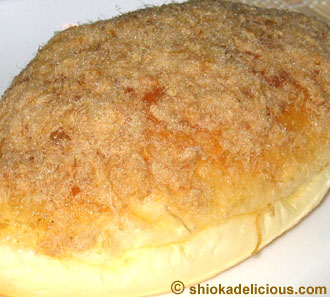
About 3½ years ago, there was a mini-revolution of sorts in the bakery industry in Singapore. The way bread was sold to and eaten by Singaporeans was perhaps forever changed. Aggressive upstart BreadTalk launched their chain of bakeries with modern Zen interiors of steel and glass. They called their bakeries “bread boutiques”, elevating the humble bread bun to designer status. And of course, they also launched the one product that shook not only Singapore’s bread world but also created tsunami waves in the nation’s restaurant industry.
What am I talking about? The Flosss bun (yes, complete with the triple ‘s’ in the name). Doesn’t that one extra letter seem to up the “hip and cool” factor just a touch? The product itself is simply a soft white bun topped with pork floss, with a sweet custard/mayo/cream-like filling. Sounds simple, and yet it was considered completely innovative and exciting when it first appeared. Pork floss has been around for generations. It was our ancestors’ way of preserving meat – shredding it and drying it. It was cheap, it was convenient. As kids, we grew up eating pork floss sprinkled over plain white rice porridge. Yet, no-one, it would seem, thought of selling buns with it as the main attraction. But eating floss with bread was not altogether a new idea… even as a kid, I’ve eaten floss sprinkled on a slice of bread, sometimes over a layer of sweetened condensed milk.
Perhaps it was a reminder of childhood memories or the lure of a classy ambience… whatever it was, Singaporeans ate up these buns by the hundreds of thousands! Seriously. Lines snaked at every BreadTalk outlet. Nobody seemed to mind queuing for up to 20-30 minutes to pay for their precious floss buns. Nor did they seem to mind paying designer prices for a humble bread bun. And before you could say “pork floss” other bakeries were jumping on the bandwagon, all launching their own versions of bread with floss. Some were obvious replicas, others “innovated”… and so we came to be acquainted with chicken floss buns, fish floss buns, floss on the inside of the bun, floss on top, floss rolled in a swirl, floss with bacon, floss with sausage… there was floss everywhere!
Almost all these other bakeries sold their floss buns at prices that were 30% or more lower than the original Flosss, and yet Singaporeans couldn’t resist the allure of the first and the original.
The ripples created by Flosss gathered momentum, crashing like tsunami waves through the rest of the food business in Singapore. Strange things started appearing on the menus of “proper” Chinese restaurants. Chicken with pork floss, pork ribs with pork floss, prawns with pork floss, eggplants with pork floss… Even Pizza Hut, (yes, that icon of American fast food culture) at one stage had pizza with chicken floss!! I was almost half-expecting a floss burger to emerge from under the Golden Arches!  Unsuspecting foreigners would have been forgiven for thinking floss was our national food!
The reason why I’m writing about this is because I have to plead guilty to past momentary “insanity” too. Yes, there was a time when I couldn’t resist the seductive allure of Flosss. I too had fallen under the spell of its tantalizing aromas, fresh from the oven. I had succumbed to its soft and tender crumb. I was spellbound by the oozing sensuality of its cascades of crispy, fragrant pork floss. Ah! The intense anticipation as I stood in line awaiting my turn for a meeting with Flosss. The sexiness of licking every floss crumb from my fingers…
Then just as suddenly, I stopped visiting Flosss. I could pass its window and not blink an eye. I even became oblivious to its smells. The sight of Flosss no longer caused heart palpitations. Yes, like a teenage infatuation, it disappeared as quickly as it appeared. I joined many other Singaporeans in “awakening” once more.
It has been a long while since I’ve had an encounter with Flosss. But it had to happen, right? Our paths had to cross again, and so it did this weekend. What was it like? Well, it is said that our mind plays tricks on us. Sensations and experiences somehow are always enhanced and heightened in memories. And sad to say, Flosss was not how I remembered it to be. Its taste, its fragrance, its appearance… was this the Flosss I had once loved so much? A twinge of sadness crossed my heart as I looked at the rather obvious “bald spots” where once there used to be a heap of, well, floss… The Flosss I encountered this weekend was a shadow of its former self. Perhaps the slow economy of the last couple of years had affected its constitution… it had lost some weight, its sparkle and brazenness was gone. All the same, I salute you Flosss… thanks for the memories…
Copyright © 2003 Renee Kho. All rights reserved.
Please contact me for permission to copy, distribute or display any of the images and text contained in this article.
05:05 AM in Snack Attack! | Permalink | Comments (0) | TrackBack
Saturday, December 13, 2025
You Salmon, Me Hoisin

This is a great alternative to the standard teriyaki salmon. In fact, nowadays, I hardly ever cook teriyaki salmon. Much prefer this version – tasty and extremely easy to cook.
This can be done several ways… Usually, I would dice the salmon and marinade it generously with hoisin sauce, for at least 20-30 minutes. Then, it is simply a matter of sautéing minced garlic and shallots in hot oil (very little oil, as the salmon is a rather “fatty” fish, and its natural oils will be “excreted”… sorry I really can’t think of a more elegant word at the moment… as it is cooked), until softened and browned, before adding the salmon. I always undercook salmon. I just think they taste really horrible when overdone. For diced salmon, I think about 4-7 minutes would be sufficient. If I was using the salmon in fried rice (see previous post), I would probably sauté them for 3-5 minutes only, as they will be cooked further with the rice.
I like this diced salmon version. It can be served as is, and eaten with steamed rice. Or it can be used in fried rice. Or as a sandwich filling. Or to top noodles or pasta…
Sometimes I use salmon steaks or fillets with the same marinade. (I sauté the garlic and shallots and add it to the hoisin sauce to form the marinade). And grill or pan-roast the salmon for about 4-7 minutes, depending on the thickness of the steaks or fillets. It works well too on the BBQ… wrapping the marinated salmon in banana leaves or even lotus leaves.
You salmon, me hoisin… a perfect match, I think.
Copyright © 2003 Renee Kho. All rights reserved.
Please contact me for permission to copy, distribute or display any of the images and text contained in this article.
05:56 AM in Home Cook: Fish & Seafood | Permalink | Comments (0) | TrackBack
Fried Rice Paradise

YAY! IT’S FRIDAY! (or more accurately, the wee hours of Saturday). It’s been a long, long week, and boy! am I glad to see the weekend. When I got home at 9.30pm tonight, tired and starving, I found freshly cooked fried rice waiting for me! Waaw..wow! Plus, I had a choice of not one, but two types of fried rice! Double waaw..wow! Ah! The luxury of choice.
I luurve fried rice. It’s such a versatile dish. I can add almost anything to it. And just by changing one or two, or even all the accompanying ingredients, the taste of the dish changes and evolve. It’s pretty much a “one dish meal”… it has vegetables, meat, egg and rice all in one dish. It’s easy to cook… and uses just one wok/pan, so there’s minimal clean-up (rather important factor for a tired cook) It’s bright, colorful and tasty!
Whilst a simple dish, there are actually many, many different methods of cooking it. I personally don’t think there is one method that is more “correct” than another, or better than another. It’s pretty much down to the chef’s preference and style.
Fried rice connoisseurs will probably say that the dish can only be cooked with leftover, overnight rice, which has less moisture than freshly cooked rice. And on the whole, I would agree with this. After all, the dish itself evolved from cooks wanting a way to utilize leftover rice, and so threw in some fresh meat and vegetables (or even leftover meat and vegetables) to create a brand new, freshly cooked meal. However, we make fried rice using freshly cooked rice all the time (simply because we never have enough leftover rice to use), and the dish still tastes great.
Some people would say that if planning to fry freshly cooked rice, it would be best to add a little salt to the water in which the raw rice is cooked, so that it produces a “dryer”, less soft grain, or, to air the rice after it is cooked and before frying it, to dry it out a little. Again, I understand the basis of these tips, and they probably work well, but I’ve never used them, and I don't think it has affected the taste of our home-cooked fried rice. So, I guess it is all about experimenting until you find the method, tastes and textures you are happiest with.
One thing I do find missing in home-cooked fried rice though is the “wok-hei”, that all important, but rather elusive element. Literally translated from Cantonese, it means “energy of the wok”. It’s that extra fragrance and aroma that the rice has when cooked with extremely high heat and intense flame, which can only be achieved with industrial hobs of restaurants. Then again, not all restaurant-served fried rice has wok-hei. It’s all down to the skill of the chef.
One of my favorite versions of fried rice is the salmon fried rice – using hoisin-marinated salmon, with carrots, cucumber, egg, black olives, and sometimes a tiny bit of lemon zest. I find the olives complement the salmon rather well, and give a sort of Mediterranean feel to the dish. I normally use dried black olives, very, very finely minced. The lemon rind adds a refreshing and tangy counter-balance to the olives and salmon. I prefer Japanese cucumbers for more crunch, but all types work just as well. Or, it can be substituted with diced long beans, green peas or anything that's green!
The way I cook fried rice, is the way my mum cooks fried rice. Each ingredient is sautéed separately, before being brought together with the rice at the end. The salmon is diced and marinated in hoisin sauce, and then sautéed with garlic and shallots (please see next post for recipe). The minced olives are also sautéed with some garlic. The diced carrots are just sautéed in a little oil to soften and cook. I like to leave the cucumbers raw and crunchy. The eggs (2-5, depending on amount of rice and how much egg you like in the rice) are lightly beaten and seasoned with light soy sauce, salt, sugar and pepper.
Finally, to bring all the ingredients together: fry some minced garlic in hot oil, and add the eggs. Just as the eggs begin to solidify, add the cooked rice, and stir-fry. I personally like to see the eggs in my fried rice, so I like the eggs to be in small pieces throughout the rice, which this method will produce. Others prefer the eggs to “disappear” into the rice – i.e. the eggs coat each grain of rice and are not seen. In this case, the rice would have to be mixed with and be evenly coated by the eggs before being added to the garlic.
The rice would probably need to be sautéed for a good 10 minutes or longer, depending on the strength of the flame. I’ve been told that the gauge for doneness of the rice is when the grains of rice start “jumping” and doing a merry dance in the wok.  I’ve never achieved this, probably for a couple of reasons: 1) we normally cook large batches of fried rice (enough to feed probably 10 people), as opposed to the individual portions cooked in restaurants, and with that much rice in the wok, there just ain’t enough space for them rice grains to start doing the jiggle wiggle, you know what I’m saying? 2) it requires intense heat and high flame (the wok-hei again) to achieve this rice dance performance, either that or one has to stand over the rice and fry them for a good ½ hour or more to achieve it. And frankly, I’m too lazy to do that. And hey, I still think (and so does my family) that the fried rice hasn’t suffered too much from the dance deprivation! But I digress…
Once the rice is “ready”, add the seasonings. The standard would be salt and pepper. Or alternatively, fish sauce is tasty too. Finally, add all the other pre-prepared ingredients (fish, vegetables) and sauté to mix. Ta-da… done!

The other version of fried rice that was cooked tonight, and which I haven’t actually had in a looong time, was cooked with luncheon meat, corn kernels, olive, carrots, coriander (or parsley) and eggs. Yum! The diced luncheon meat was sautéed till brown and crispy. The olives and carrots were sautéed as above. And the rice fried in the same way, before adding all the ingredients.
Other versions of fried rice which I really like:
- with prawns
- with salted fish
- with Chinese sausages “lap cheong” (I think Italian Chorizo would work fantastically too)
- with Yunnan ham or any other type of ham and pineapple (yes, pineapple)
- with a sunny-side-up fried egg on top, so that when I break the runny yolk, it cascades over the rice!
- all versions fried with sambal chili
It's all about balancing tastes, colors and textures. Fried rice is just a great dish for letting your taste-desires, creativity and instincts lead you… on a magical mystery taste tour!
Happy rice frying!
Copyright © 2003 Renee Kho. All rights reserved.
Please contact me for permission to copy, distribute or display any of the images and text contained in this article.
05:11 AM in Home Cook: Rice, Noodles etc | Permalink | Comments (2) | TrackBack
Friday, December 12, 2025
The Green, Green Vege of Home
Yes, we are still on the green theme today. More rabbit food, I’m afraid. But hey, I love vegetables, I really do. And sometimes it fascinates me how some people can eat nothing but meat every day, day in, day out, throughout the year. I have a few cousins and some friends who refuse to imbibe even a single stalk of vegetable. I’m pretty much the reverse. A meal just doesn’t seem quite complete to me without some bright-colored plant material
And guess what? Today’s “show and tell” day. (Ha ha! I almost feel like I’m back in grade school.) And of course, the theme of the day is: the different ways vegetables can be stir-fried…
I think the Chinese pretty much stir-fry every type of vegetable that gets served at their table. The most basic would be vegetables stir-fried with minced garlic, and seasoned simply with light soy sauce or oyster sauce and sometimes a little rich flavorful stock. This method works for just about every type of vegetable…
From spinach…

To cai xin (a green leafy vege with small yellow flowers)…
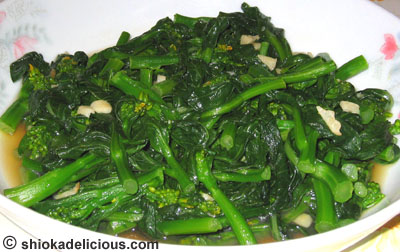
And any other green vegetable one can think of: broccoli, xiao bai cai (baby pak-choy), long beans, French beans, cauliflower, Chinese cabbage (bok-choy) (okay, okay, the last two are not green, but still vegetables)
The only variants would be the length of time the vegetables are sautéed for, depending on their hardness, and also the aromatics and flavorings used in the sauté.
Kailan (Chinese broccoli) usually requires ginger slices or strips to be added as well, to remove the “grassy” taste. And a dash of Chinese rice wine, Japanese mirin (rice) wine or even a fairly dry white wine works wonders with this vegetable. I would add the ginger with the garlic to the hot oil for a quick sauté, before adding the kai lan. And just before it is plated, after all the seasonings have been added, add a dash of the wine. The best would be to flambé the vegetable, but unfortunately, the home gas stove just doesn’t have a large enough flame for this. So, I normally just give a quick sauté to allow some of the alcohol to evaporate, leaving just the taste of the wine on the vegetable.
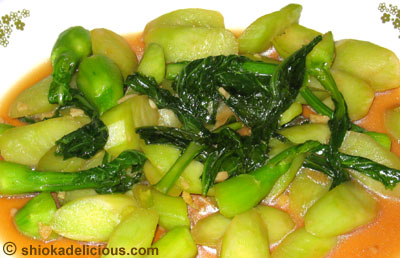
I love kai lan stems – a seasonal vegetable – cooked in this way. Compared to the regular leafy kai lan, these stems are easily 5-8 times thicker, and are usually sold without the leafy part of the vegetable. These are very crunchy and sweet!
I really like fresh shitake mushrooms cooked in this way too…

The tiny juliennes of ginger and the wine really lift the taste of these very aromatic and flavorful mushrooms. Just be sure not to overcook the mushrooms. It takes just 2-3 minutes in the wok, and it’s good to go.
And when we get tired of all that green stuff, we add a dash of red to the stir-fry… Carrots immediately brighten up any vegetable dish, be it cabbage (winter-time cabbages from China are especially sweet and crunchy)…

Or snow peas…
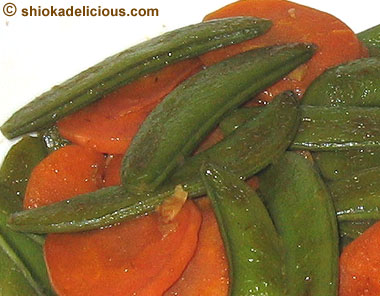
And… the mix and match game continues… on top of the carrots, throw in some fresh shitakes, and hey presto! brand new vegetable dishes…
Asparagus with carrots and shitakes…

Bean sprouts with julienne of ginger, carrots and Chinese dried mushrooms, and some scallions for a touch of green…
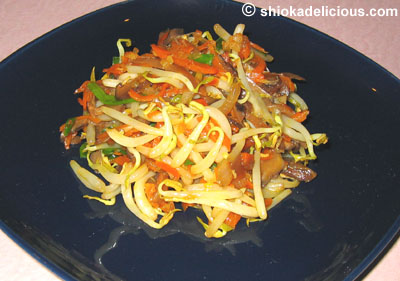
Lettuce with carrots and shitakes…

Then, we start adding different sauces to the same vegetables. Instead of stir frying the lettuce, sometimes I like to quickly blanch them in boiling water (seasoned with a touch of cooking oil, pinch of salt). And top it with various “sauces”.

This one here has three types of fresh mushrooms, carrots, onions and diced chicken. Other “toppings” I regularly use are shallots with oyster sauce; diced chicken with teriyaki or dark soy sauce; shitake mushrooms with ginger and rice wine… I guess the combinations are pretty endless – whatever you fancy, and whatever is in the fridge.
I do baby kai lan (the ones with the rounded ends), kai lan, cai xin, broccoli in these ways too.
Hey, this “match the vegetable to the ingredients” game isn’t so bad now is it? But after all that mixing and matching, it is time to spice things up! It starts getting hot, hot, hot…
Another perennial favorite way to stir fry vegetables is to use sambal belachan or just simple chilli sambal. (This is a very South East Asian way of cooking, although in Sichuan, China incredibly spicy peppercorns are also used in their cooking).
A lot of vegetables can be fried with chilli, from okra or lady fingers and long beans to kang kong or tong xin cai (translated as “hollowed stem vegetable” – very aptly named, as it is the only type of vegetable with a hollow stem!)

At home, we usually do not use sambal belachan (fermented dried shrimp paste with chilli) although it is a must in a large majority of households. We usually make our own chilli paste (grind fresh red chillis and sauté in oil until fragrant), which is more acceptable and palatable than belachan for young and old alike. This chilli paste will keep in the fridge for a couple of weeks, and can be easily added to any type of dish. There is then also the flexibility to add dried shrimps or other ingredients to the vegetable when sautéing it with the chilli paste.
There are many, many more ways to cook vegetables… and you thought vegetables were boring? But I think that’s enough rabbit food for one night The rest will have to wait for another time…
Happy vegetable stir-frying!
Copyright © 2003 Renee Kho. All rights reserved.
Please contact me for permission to copy, distribute or display any of the images and text contained in this article.
01:36 AM in Home Cook: Vegetables | Permalink | Comments (3) | TrackBack
Thursday, December 11, 2025
Bitterness is Good for You

I’m trying to “detox” for a few days before the orgy of feasting, dining and wining begins in 12 days time, and which could potentially continue right up to 5 February next year, when Chinese New Year celebration ends!! My tastebuds leap in anticipation, but my digestive system shudders in horror. 
Well, I did say “trying”, with the emphasis on the word “trying”. I had intended to start today… cut (or at least reduce) the sugar, i.e. less (preferably no) cookies and chocolates, cut the meat, and just more vege, fruits and complex carbs. (Those on Atkins or high protein diets, this is the cue to stop reading) Well, today was a non-starter… had some homemade smores (toasted marshmallows covered with bittersweet chocolate on graham crackers) and some chocolate cookies… Oh well, tomorrow is another day!
However, I’m going to make myself feel slightly better tonight by writing about some vegetable dishes. The Chinese have a saying: “the more bitter it is, the better it is for you”. And the bitter gourd is held by Chinese traditional medicine to have many health-giving and healing properties. It is said to be able to help with high blood pressure, high blood cholesterol and some forms of diabetes. It is also believed to be good for acne, eczema, psoriasis and other skin conditions. Very often, it is made into a tea (by boiling in water) and drunk much like a tincture. I think nowadays it even comes in tea bags for convenience! This is also said to be a great cure for a hangover – flushes out the alcohol from the system!
If I’m not wrong, it is the compound that gives the vegetable its distinctive bitter taste that makes it a very efficient detoxifying food substance. It “cleanses” the blood and digestive system.
This vegetable tastes a lot more palatable than it sounds. And its bitter taste can be easily removed (whilst still retaining its “cleansing” and “detoxifying” properties) by simply soaking it in some salt water for a few minutes after it has been cut. Just rinse well after the soak, and it’s good to go. It’s actually quite a versatile vegetable, and can be cooked in several ways:
- stir-fried with shallots and fish cakes (as in the above picture) or fresh fish slices
- stir-fried with garlic, ginger and fermented black soy beans
- stir-fried with spring onions and miso
- stir-fried with garlic, ginger and diced chicken
- stir-fried with garlic, ginger, thin slices of beef and a black pepper sauce
It is of course also a popular ingredient in “yong tau foo” where it is stuffed with minced fish or pork and either steamed or fried.
I also like it cooked sort of omelet-style…

Saute some shallots in hot oil to soften slightly. Add the bitter gourd slices and give it a good stir-fry. Season with salt and sugar. Cover for a few minutes to allow the gourd to soften somewhat.
In the meantime, lightly beat a few eggs and season with salt and pepper. Add to the gourd, making sure all the gourd is covered with egg. I usually allow the eggs to cook in one of two ways. Sometimes I make a sort of gourd-and-eggs “pancake” (as in the above picture). I allow the eggs to start to solidify into a “pancake” before flipping it to cook the other side. Other times, I like the egg sort of scrambled, so I start stirring the egg as it begins to cook and solidify, so that it forms soft, fluffy clusters of egg and gourd. (A little bit of water has to be added to the egg when it is beaten for the latter version).
Note: whilst preparing the bitter gourd, be sure to remove all the seeds and white “veining” on the inside of the gourd – these don’t taste good, at all. There’s no need to skin the gourd though.
And so a detoxifying we go....
Copyright © 2003 Renee Kho. All rights reserved.
Please contact me for permission to copy, distribute or display any of the images and text contained in this article.
02:31 AM in Home Cook: Vegetables | Permalink | Comments (0) | TrackBack
Wednesday, December 10, 2025
Creamy Mushroom Chicken

Work has been frantic the last two days. It’s the pre-Christmas frenzy – businesses’ busiest time of year. I was certainly in no mood, nor did I have the energy, to cook. Our domestic helper prepared dinner tonight – a very quick, 15-minute chicken dish using Campbell’s cream of mushroom soup. Yes, we cheated. But it doesn’t taste anything like how it might be sounding. It’s actually quite, quite delicious. I learnt the dish from my mum, and it was a god-send during college. In just minutes, there could be a delicious, piping hot dinner on the table.
I would have preferred to use bone-in whole chicken drumsticks and thighs – chicken just looks better, and more like chicken that way . But I don’t like to freeze bone-in chicken. Inevitably, there’ll be some blackening around the bone when thawed chicken is cooked. And I find that rather unsightly. So I only cook with bone-in chicken when it’s fresh from the market. The rest of the time, it’s chicken fillets or de-boned chicken thighs.
The chicken is diced and seasoned with some light soy sauce, sugar, sesame oil and a bit of cornstarch. A diced large onion is sautéed in hot oil, before the chicken is added. Once the chicken is browned and semi-cooked, slices of fresh white button (or brown or field) mushrooms are added, followed by a can of Campbell’s cream of mushroom soup. A touch of hot water is added to adjust the consistency of the gravy. Finally, salt (or light soy sauce) and pepper are added to taste. Our helper added some dark soy sauce today, and so the chicken came out darker than I usually prefer it. I like the natural creamy color better.
Served the chicken with garlic stir-fried xiao bai cai (baby bak choy). I really like these curly leafed variety, which are only available during the winter months (winter in China that is, from where these are imported). They are so much sweeter and crunchier.
We also had soup today. Normally, there would be a soup at dinner everyday but we haven’t cooked any for over a week now. And today we had a nice chunky soup of lotus root, lotus seeds, white wood-ear fungus and boxthorn seeds (which give the soup a nice natural sweetness).
I’ve never bothered to photograph nor post any of the soups we normally cook. I don’t know why. But here’s my first…

In recent days, quite a few people have cooked and posted about soups (Alberto, Deb and Blue). I just love this synchronicity! Soups are so soul-satisfying and heart-warming – that must be the energy that is going around. Nice!
Copyright © 2003 Renee Kho. All rights reserved.
Please contact me for permission to copy, distribute or display any of the images and text contained in this article.
12:10 AM in Home Cook: Poultry & Meats | Permalink | Comments (0) | TrackBack
Tuesday, December 09, 2025
Good-Looking Pilaf
Oh, watched A Cook’s Tour tonight. (Yes, my weekly epicurean TV fix. Can you tell I’m a fan? ) One of the two episodes shown was the Bangkok/Singapore one. And the home-cooked pilaf in the Singapore segment looked so good! And best of all, it was cooked in a rice-cooker – simple, easy and quick. Wow! I would love to know the recipe for that pilaf. It was cooked separate from the meat, and had dried fruits, nuts, veggies etc. Yum! I’ve been looking for a good pilaf / briyani rice recipe for the longest time – one that is fuss-free, quick and easy.
And the dessert served in the Nefertiti Restaurant in Bangkok looked really yummilicious too! Looked like a cross between bread-and-butter pudding, crème caramel and custard. Hmmm… more "soul food". (Today does seem like a day for comfort food doesn't it?) I would love the recipe for that too!
Drool, drool… I think I shall have very tasty dreams tonight!
Copyright © 2003 Renee Kho. All rights reserved.
Please contact me for permission to copy, distribute or display any of the images and text contained in this article.
03:56 AM in Crumbs & Tidbits | Permalink | Comments (0) | TrackBack
It’s a Good Thing

What is that goop??? You ask.  It is warm oatmeal sprinkled with demerara sugar. Yum! The partially melted sugar crystals give a very nice sweet crunch to the otherwise bland oatmeal. There is almost a nutty taste to the sugar.
But why on earth am I blogging about oatmeal of all the food in the world? But why ever not? Okay, granted, glossy, creative, arty-looking photos of elegant recipes have become almost de rigeur in a lot of foodblogs. There’s nothing wrong with that. I absolutely enjoy taking in the glorious, mouth-watering pictures, and thus taste different cuisines and cooking styles vicariously through them – they inspire and whet the appetite of mind, body and soul. But I think there is also room for the everyday food. What you and I eat everyday, which we don’t blog about, maybe because it doesn’t have enough “glam factor”. It’s the comfort food, the easy food that we throw together to feed ourselves and our families, which are simple yet heart-warming. The down-too-earth soul food so to speak.
Alright, many people might dispute that oatmeal can and should be considered as “soul food”. But it’s good wholesome, natural food. And when paired with demerara sugar or sometimes even sweet condensed milk, “it’s a good thing” (as Martha would say).
Where exactly am I going with this oatmeal thing? Nowhere really. Today was a Monday. And Monday mornings are tough. It took all my will-power to get out of bed this morning and drag my sleep-deprived body off to Pilates class. I could feel the weekend indulgence of food and laziness in every muscle fiber as I willed them to move and contort through their paces. And yet the rewards are sweet. By the end of class there was a buzz in my body, a spring in my step and a smile in my heart. I felt energized and happy. Added to that, the simple breakfast of demerara oatmeal just made for a very comforting start to a brand new week…
Alright, alright, enough of this ramble already. I guess it’s painfully clear by now I have nothing much to blog about tonight. Haha… So, I’ll just say g’nite!
Copyright © 2003 Renee Kho. All rights reserved.
Please contact me for permission to copy, distribute or display any of the images and text contained in this article.
03:47 AM in Comfort Food, Home Cook: Light Touches | Permalink | Comments (5) | TrackBack
Monday, December 08, 2025
Old Shanghai

We had dinner in Chinatown again over the weekend. Last Thursday, during our after-dinner stroll, we had passed a restaurant called “Old Shanghai”, and the menu had looked interesting…
Our intention was to have a light meal, but as usual, we ordered a little too much food. We had the Shanghai-style fried noodles and Shanghai-style fried rice, together with several other side dishes.
The noodles were tasty – one of the best dishes of the evening. Hand-pulled fresh noodles stir-fried with strips of lean pork, wood-ear fungus and caixin (green vege). Yummy but oily.

I’m a fried rice person. I can have fried rice every week. Must be remnants from spending my formative teenage years in boarding school and more years in the UK as an undergraduate, where at that time, Chinese food mostly meant fried rice and sweet and sour pork!  Unfortunately, this version of fried rice was rather lacking. It was tasty enough, but rather deficient in wok-hei (hmmm… how do I translate this? It’s that wonderful fragrance that is imparted to the rice when there is sufficient heat in the wok. This wok-hei is next to impossible to get at home, as the flames on our domestic gas burners just do not provide sufficiently intense heat. This is what makes fried rice – good fried rice that is – in restaurants so tasty). I also couldn’t see what made this fried rice typically or specially Shanghainese. It looked rather Singaporean to me! But I was satisfied anyway
  My fried rice fix for the week.

We shared a small bowl of the hot and sour soup. And boy, was it sour! It was almost like drinking vinegar! You know that sensation one gets in the glands at the back of the throat when tasting something really vinegary? Sort of like fingernails running across the blackboard type of sensation? Yeah, that was what it felt like drinking the soup.

The pork and veggie wantan (soup dumplings) were a complete contrast. Ha ha! The dumplings looked and tasted like they were cooked and served in plain water. Sorry, no taste of stock or broth here. The tiny saving grace was probably the dumpling skin. It looked rather thick, but was very soft and smooth.

We of course had to order the signature Shanghainese dish of xiao long bao (small steamed pork dumplings with broth). The two hallmarks of a great xiao long bao? Skin that is thin and translucent yet strong enough to hold the broth in the dumpling without breaking, and broth that is generous and tasty. Both these take a lot of skill and experience on the part of the dumpling maker. These dumplings had slightly thick but okay skin, however, the broth within was rather bland and the meat filling very, very fatty – maybe 70-80% fat with little lean meat.

The biggest disappointment of the evening rounded off our meal. Deep fried carrot pastry. They looked really delicious, with a crispy, flaky crust. But the copious amount of grease oozing from the pastry didn’t settle well in the stomach, and the radish filling was definitely an acquired taste.
Oh well, at least now we know...
It was a beautiful evening out last night, with the night air cooled by the earlier rain. So here’s another night scene… a snapshot of the food street in Chinatown - the al fresco food stalls outside the restaurant. These are the sanitized version (oops, except for the incriminating evidence of Singaporeans who had failed to clean up after themselves!) of the push carts used by the itinerant hawkers of old, who would move through the narrow streets, selling piping hot noodles and porridge to laborers and passers-by. It’s always great to sit under the trees and a canopy of twinkling stars (most of the time) and eat satay (BBQ meat skewers), char kway teow (fried flat rice noodles) and spicy BBQ sambal sting-ray. Food somehow always tastes better this way. Maybe soon…

Copyright © 2003 Renee Kho. All rights reserved.
Please contact me for permission to copy, distribute or display any of the images and text contained in this article.
02:13 PM in Lion City Shiok-Eats: Chinese | Permalink | Comments (4) | TrackBack
Saturday, December 06, 2025
Oh Fudge!

One persistent thought filled my mind yesterday. I needed a chocolate fix. Well, alright, one doesn’t need chocolate, in fact, one doesn’t need many things in life. One needs food for sustenance and shelter for protection maybe, but one doesn’t need chocolate. Okay, so I wanted a chocolate fix… really wanted. The thought wouldn’t go away. So, a quick dig around my collection of un-tried recipes later… voila! This was the result… an incredibly chocolatey, fudgey cake, and best of all… pretty healthy too. Now, does it get any better than this?
Yes, I am still on my continuing quest to find healthy and utterly indulgent food. I’m all for indulgence. I love desserts, I love cakes and cookies… the richer the better. I want to indulge, not once a week or once every couple of weeks, no, I want to be able to indulge everyday as and how my desires strike. But I also enjoy being healthy and (hopefully) vibrant…
Okay, okay, enough of the rambling already. The cake, the cake…
Fudgy Chocolate Cake
1 cup Flour
1/3 cup Cocoa [I prefer European-style Dutch Processed Cocoa for a smoother taste]
1 ½ tsps Baking Powder
1 tsp Baking Soda
¼ tsp Salt
1 ¼ cups Packed Brown Sugar
2 Eggs
3 tbsps Oil
1 tsp Vanilla
1 cup Lite Sour Cream
½ cup Mini Chocolate Chips
Sieve the dry ingredients together. Place brown sugar, eggs and oil into a bowl and beat together with electric mixer on medium speed. Add vanilla and sour cream, and beat on low speed until well blended. Add the flour mixture, using low speed to combine, then beating on medium. Fold in chocolate chips. Pour into a greased 8” square pan. Bake at 175C / 350F for 40-45 minutes. The key is not to overbake the cake. Mine was done in 35 minutes. Cool in pan for about 15 minutes before cutting.
[note: I only had ½ cup of sour cream, so I had to improvise for the remaining ½ cup. I used equal portions of natural low fat yogurt and lite cream cheese, and it seemed to work just fine].
It was quick, it was easy, and… it was good!
Happy chocolate caking!
Copyright © 2003 Renee Kho. All rights reserved.
Please contact me for permission to copy, distribute or display any of the images and text contained in this article.
03:02 AM in Home Baker: Lighten Up! Cakes | Permalink | Comments (3) | TrackBack
Friday, December 05, 2025
Night Scenes
After dinner, we decided to take a leisurely stroll around the food street, and stumbled upon the Winter Solstice Street Market.
Traditionally, the Chinese marked the Winter Solstice (22 December) as the start of New Year preparations. In ancient times, this time of the year meant that the harvest has been completed, and all family members that have left the ancestral home to work in other provinces would travel home to reunite with their families in preparation for the Spring Festival or Chinese New Year celebrations. The Winter Solstice would be celebrated with a family reunion dinner, and the eating of “tang yuen” (literal translation: soup dumplings) – round glutinous rice dumplings boiled in a ginger syrup soup. The modern versions of these dumplings now have fillings of peanut, black sesame or red bean.
Here are some sights (minus the sounds and smells) of the night market…
There was a mini open-air concert going on…
There were food stalls selling fruits, snacks and other traditional tid-bits. I love the smell of the chestnuts being coal-roasted (in the metal drum seen in the right hand corner)…
Fruits painstakingly and neatly arranged and displayed… it is the season for rambutans, persimmons, starfruits and Chinese fragrant pears!
We bought more durians! Yum! The aromas were so strong that they filled the car on the drive home even though the durians were in the boot!
Herbal teas to quench your thirst and to relieve “heatiness” from the body…
Traditional Teochew rice dumplings…
Dried scallops, dried sea cucumbers and dried oysters… all essential ingredients in Chinese New Year celebratory dishes…
Beautiful large (very large, I might add), plump dried oysters or “hou si” (meaning “good tidings”)…
The sky was clear, the weather cool… a beautiful end to a very pleasant evening!
Copyright © 2003 Renee Kho. All rights reserved.
Please contact me for permission to copy, distribute or display any of the images and text contained in this article.
04:40 AM in Festivals: Dong Zhi & Christmas 2003 | Permalink | Comments (2) | TrackBack
HomeTown
Had dinner at a new (2-month old) SzeChuan restaurant in Chinatown tonight. Decorated in a simple, rustic traditional eating-house style, the outlet was small and cosy with a sitting capacity of only about 8 tables. The boss, Jonathan Ren was very friendly, polite, professional and humble. He is himself a professional chef, hailing from Sze Chuan province in China.
The food was good – with all the intense flavors of traditional Sze Chuan cuisine: spiciness or mala (literally translated as “numbness and chilli heat”), sweetness, sourness and saltiness. Certain flavors were a little too intense for our Singaporean palate, but it does show the authenticity of the dishes. The food certainly left our taste buds alive and tingling!
We ordered a lot of dishes! (Most of the dishes did not have English names, so the below are translations or interpretations of the Chinese names).

The first dish to arrive was the famous “zhang cha ya” or tea-smoked duck (S$16 for half duck) (US$9.50). We had been slightly wary of ordering this dish as usually ducks served in restaurants are very fatty. However, Jonathan promised that his ducks, all imported especially from China, have only the thinnest layer of fat under the skin. And true to his word, the duck was very well done, with barely any fat, and yet the meat was tender and moist. And unlike the normal red-colored zhang cha ya usually served in other restaurants, this was a natural color. Very yummy duck, albeit a touch too salty for our palates.
The “yu xiang ji ding” or fish-flavored diced chicken (S$10) (US$6) was also a flavor intense dish. Diced chicken sautéed with vegetables, wood-ear fungus, chillies and mala chilli oil.
The SzeChuan Sweet Sour Fish (S$30 @ S$5 per 100g) (US$18) was another sensory stimulating dish! The Soon Hock fish was not fried but braised with a mala, sweet and sour sauce.

Of course we couldn’t miss out on the signature Sze Chuan vegetable dish of “gan bian si ji dou” or dry-fried four seasons beans (S$8) (US$5). This is a dish of deep fried long beans deep fried sautéed with dried red chillies and garlic. Very spicy but absolutely delicious! This was one of the better versions we have tasted in Singapore. The chef’s skill was evident in the way the beans were cooked. Very often, this dish is served with beans that have been fried so long they have turned limp and blackish. Here, the beans were still a beautiful bright green, with nice texture and bite, and not too oily.

Whilst not a Sze Chuan dish, the “shang tang dou miao” or bean shoots sautéed in broth (S$8) was also beautifully done. The broth was key here and it was nice and flavorful. The dou miao was tender and sweet. Very nice!
We also ordered a bowl of the Sze Chuan beef noodles (S$6) (US$3.50) to share, just to have a taste. It comes in three versions: mala (numbing spiciness), suan-la (sour spiciness) or non-spicy. After all the other spicy and flavor-intense dishes, we opted for the non-spicy version to help cleanse our palate a little. This version was still very flavorful. Fresh Northern-China style handmade noodles were served in a tasty beef broth flavored with five-spice. The beef was also flavorful and tender, with a nice sprinkling of some tendon.

The wonderful meal was rounded off with some deep fried pumpkin pastry, with the compliments of Jonathan. This tasted sort of like a sweet, chewy version of ham chim peng (literally translated as “salty fried dough”). A sweet ending to an enjoyable meal.
Update: sorry, made a mistake... Hometown also has sitting upstairs... for around 60+ as they also do functions, catering etc...
Hometown Restaurant
9 Smith Street
Singapore 058923
Tel: 6372 1602
Food: 4 / 5
Service: 4 / 5
Ambience: 3 / 5
Price: $$
(no GST nor service charge)
S$15 & below : $
S$16-30 : $$
S$31-50 : $$$
S$51-75 : $$$$
> S$75 : $$$$$
Copyright © 2003 Renee Kho. All rights reserved.
Please contact me for permission to copy, distribute or display any of the images and text contained in this article.
04:35 AM in Lion City Shiok-Eats: Chinese | Permalink | Comments (0) | TrackBack
Thursday, December 04, 2025
Dad On The Loose

Two days ago, my dad made a surprising announcement. He was going to cook for the family! Now that is news indeed! My father doesn’t cook. The only time he can be found helping in the kitchen is during Chinese New Year, when he gets “enlisted” by my mum to squeeze out the juices from the radishes, carrots and all the sweet preserved vegetables and dry them out for the “yu shang loh hei”. He declared he was going to cook “dong bo ruo”. I’ve never heard of the dish, at least not by that name. He said it was a pork belly dish...
Ah… I see… I was beginning to understand. I think he’s been craving pork belly – something my mum avoids cooking nowadays, for health reasons – fat, cholesterol etc. Maybe he figured the only way he was going to get to eat some was to cook it himself!
So today was “D-day”. And he asked if I wanted to document the event for my blog. So, I stood with camera in hand as he manned the stove…
It’s actually a very simple dish to cook – all of 5 ingredients only: pork belly meat, lots of ginger, spring onions, dark soy sauce and ShaoXing Hua Tiao Jiu (Chinese wine).
And once you cut through the to-ing and fro-ing of conversation between my mum and dad, the cooking procedure is equally simple...
dad finishes pounding ginger with pestle and is about to place it in the pot with the wine and dark soy sauce...
mum: "I think you should fry the ginger first, without oil, then will be more fragrant..."
dad: gives mum a "I'm the chef here" kind of look, and proceeds to put ginger into pot.
mum: "the pork also, fry it first in the wok without oil, then it will taste better, more fragrant and tasty..."
dad: "ya, there are 2 ways to cook this - one is to deep fry the pork first before braising... then there is this way..."
and proceeds to put pork belly into stock pot.
mum: "no, you should fry the pork first, will taste better..."
dad: "hai-ya, I know what I'm doing..."
and after 35 years of marriage, mum knows better than to say more... she waits patiently to enjoy the dish...
And in plain English... quickly blanch the pork belly in boiling water to rid it of smells and any gaminess. Optional but a good idea: pat the meat dry and place in a “dry” wok (i.e. no oil) and saute briefly to bring out the flavors of the pork. “Smash” the ginger with a pestle. Optional but also a good idea: briefly “dry saute” in a wok (separate from the pork). Next, pour a whole bottle of the Chinese wine into a stock pot. Add enough dark soy sauce to taste. Add the ginger. View image Bring to a light boil, and add the pork belly. Leave to simmer and braise for about 2 ½ hours to 3 hours, or until the meat reaches that “melt-in-your-mouth” texture, yet not losing its shape and bite.
We served it today with braised mui choy (wind-dried chinese cabbage).
I can’t comment on the taste of the pork as I’m very queasy about pork bellies and all fatty meats in general. The mui choy was good though! The family certainly looked as though they thoroughly enjoyed the pork belly – especially my dad.
Copyright © 2003 Renee Kho. All rights reserved.
Please contact me for permission to copy, distribute or display any of the images and text contained in this article.
03:11 AM in Home Cook: Poultry & Meats | Permalink | Comments (2) | TrackBack
Of Drunken Fruits and Pitted “Skin”

I had made up my mind that I would start my Christmas baking today – by hook or by crook. I had even arranged my schedule to try to ensure I could have an afternoon of leisurely indulgence in the kitchen. Alas! It was not to be… murphy’s law proves itself once more… And so, as it is said: “the best laid plans of mice and men…”
As I prepared to make my fruitcake, so it was that 2 clients and a supplier decided that my life was just a little too stress-free today, and thought they would help “spice it up” a little for me! The hazards of working from home! And the stress definitely came through in my poor fruit cake. I think I unconsciously (or was it consciously ) took my frustration out on the eggs!
I was way too vigorous in wielding the whisk and so the cake baked out with dozens of small “pits” on the surface, from the bubbles baking through to the top! Not a pretty sight at all.
I had also probably “over-dosed” the raisins on the brandy! Yesterday, I had searched around in the liquor cabinet and found a bottle of Courvoisier Cognac. Now, I don’t drink hard liquor at all. So, I’m the last person to know the value or quality of such things. I was just thinking: “oh, cognac… that’s brandy, right?… that’ll work…” And proceeded to pour a good half bottle into the raisins to soak them overnight in preparation for the baking today!! That definitely did not make someone too happy! It was like: “hey, that’s my bottle of Courvoisier Cognac!” Uh-oh… And now I know… cognac is pretty expensive stuff… and by the end of today’s baking, I had used up a good ¾ of a bottle of the cognac on just one (rather unsuccessful, I might add) fruitcake… oops!
The near ½ bottle to soak the raisins together with another ½ cup of cognac that I poured into the batter plus more brushed onto the cake, ensured that the final cake result turned out to be fairly heady stuff! Haha… kids could potentially get drunk on this cake! LoL! Might have to put an age 18 warning on the cake!
The results were not what I was looking for – aesthetically at least. Taste-wise, it was pretty good. Yeah, we decided not to let the cake sit and “feed” it anymore (besides, it was already probably way “over-fed” in the alcohol department), and so we had some for dessert at dinner tonight.
Well, it was my first attempt at this recipe… so I can be forgiven right? But I think the next time I try this again, I’ll have to go get some (cheaper?) brandy.
Here’s the original recipe which my mum got off an aunt, with some notations of my observations.
(don’t ask me why it’s called “boiled fruit cake”, I haven’t a clue)
Favorite Boiled Fruit Cake
500g raisins
brandy
½ c. mixed peel
250g butter
1 c. brown sugar, firmly packed
½ c. brandy
5 eggs
1 ¾ c. plain flour
½ tsp bicarbonate of soda
1) Rinse the raisins twice with hot water, and drain well. Soak in brandy for one full day and night. Drain well.
[note: I think one day & night is a little too long – probably 4-6 hours would be sufficient]
2) Melt the butter and sugar together on a low heat. Once melted, add the brandy-soaked raisins and the mixed peel. Stir and heat through. Then add the ½ cup of brandy to the butter mixture and allow to simmer for a short while. Remove from heat and set aside to cool slightly.
3) Line an 8” square cake pan with two layers of greaseproof paper on the bottom and sides of the cake tin. Spray the lining with cooking spray.
4) In a large bowl, lightly beat the eggs.
5) Add the dried fruit and butter mixture to the eggs and mix well.
6) Add the flour and baking soda to the batter and mix well.
7) Pour batter into prepared cake pan and cover with aluminium foil.
8) Bake at 160C for 20 minutes. Reduce heat to 150C and bake for another 1 hour. Remove the foil covering, and bake for another 30 minutes (at 150C). Brush the cake with more brandy, and return to oven and bake another 10 minutes.
9) Switch off the oven, and brush more brandy on to the still hot cake. Leave cake in oven to cool.
10) Once completely cool, remove from cake pan and store. It would be best to brush some brandy on the cake once every 3-4 days for 1-2 weeks before eating. Cake will keep for up to 3 months.
Copyright © 2003 Renee Kho. All rights reserved.
Please contact me for permission to copy, distribute or display any of the images and text contained in this article.
02:03 AM in Home Baker: Cakes | Permalink | Comments (2) | TrackBack
Wednesday, December 03, 2025
Satiated At Last!

About 2 weeks (?) ago, I blogged about my craving for Malaysian-style konlo mee / wantan mee. Well, today I finally got to eat the noodles from the said stall. My mum ta-powed it as lunch for me (isn’t she sweet?). Am satiated now.
Cooked an Indian-style yogurt chicken for dinner tonight, but will post about it some other time… am tired now… it has been a very long day. G’nite! Happy konlo mee-ing!
Update: Just found out from my mum today that the food centre at Redhill Close Market will be closing on Monday (8/12), and moving to temporary premises next to Redhill MRT station (where the old HDB blocks have been torn down). They'll be there for a year whilst existing premises are upgraded. But I think some stall-owners may be choosing to take a break for a year, so won't be around during that time. : (
Copyright © 2003 Renee Kho. All rights reserved.
Please contact me for permission to copy, distribute or display any of the images and text contained in this article.
03:33 AM in Lion City Shiok-Eats: Hawkers | Permalink | Comments (11) | TrackBack
Tuesday, December 02, 2025
What to cook? What to cook?
It’s December! Only 3½ more weeks to Christmas… the Christmas lights are twinkling along Orchard Road, and all the shopping malls and supermarkets are playing Christmas carols ad nauseam… but I still haven’t planned the Christmas menu for all the family and friends gatherings that will be happening. Sigh! I’m out of inspiration. What to cook? What to cook?
I’m not keen on turkey. Actually, I’ve never been keen on turkey. No matter what method is used – brining, roasting, deep frying, tandoori baking etc – I’ve yet to taste a piece of truly moist, juicy, succulent turkey. Have you? In previous years, we’ve done roasted capon, which is near turkey-sized (a small turkey that is) but way tastier (in my opinion). Served it with an Asian/Chinese stuffing of glutinous rice with Yunnan ham, Chinese sausage, Chinese mushrooms, chestnuts etc. Our family’s favorite stuffing. We’ve also done braised duck with this stuffing. Very yummylicious!
We’ve somehow always had a sort of “East meets West” food theme in our family Christmas dinners. Not intentionally. We’ve always just cooked whatever we enjoyed eating, and incorporated “Christmas elements” into the dishes – or tried, at least. So, I’m thinking… how about a braised or simmered leg of lamb rather than the traditional roast leg of lamb. And the gravy from the braised lamb would go rather well, I think, with biscuits (thanks for the inspiration, Deb) – Southern or otherwise. I’ve never baked biscuits before – English scones, yes, but not biscuits. But the ones Deb made looked really good. Or, maybe serve the lamb with candied sweet potatoes?
I’m also thinking… let’s just skip the bird altogether this year. And have a German-style crispy pork trotter, to go with the lamb. The idea of serving ham seems rather stale. When I raised the suggestions of the lamb and pork trotters earlier this evening, the slightly aghast reaction was: what’s the preoccupation with the extremities of animals?! Ha ha ha… I didn’t see it like that until it was pointed out to me! How’s that for a theme for Christmas dinner! LoL!
I’m really curious, what does everyone have for their Christmas dinners?
I'm thinking of skipping the Christmas pudding as dessert. The store- or hotel-bought ones are so tooth-droppingly sweet, it’s not even funny. And I’m not inclined to make my own. Hmmm… I came across a recipe for a cranberry jello-kind of dessert on MSN the other day. But didn’t think to save or print it. And now I can’t find it again. I think that would make a nice, refreshing change for dessert.
Ooh… just thought of something… s’mores for dessert. Ok, we’re in the tropics, so we can’t exactly roast marshmallows at the fireplace. But how about dipping marshmallows into warm melted bittersweet chocolate (sort of fondue style I guess) to get slightly melted, chocolate covered marshmallows, and then sandwiching them between graham crackers like the traditional s’mores. Sounds good! Would it work?
And then there’s the Christmas baking to think about… I really have to start my Christmas baking this week. The fruit cake will need at least 2-3 weeks of “feeding” before it can be eaten. My parents have made a special request for a “not sweet” fruitcake, with just raisins/sultanas, no candied cherries but LOTS of brandy! “None of the cloyingly sweet ready-made ones, please” was the request. My mum even passed me an aunt’s recipe that she had tasted last year and liked. So, I’ll be trying that out.
Don’t think I’ll be making mince pies… will just settle for the ones from Marks and Spencer. They’re actually pretty good – only the classic ones though, which are less sweet. The other versions such as the Deluxe etc are really very sweet – too sweet. I wish the Marks and Spencer in Singapore would carry the full range of Christmas goodies as in the UK, but the range is fairly decent I guess. Where else in Singapore can I get good mince pies? I love mince pies!
Christmas means family, friends, food… joy, love, warmth, happiness! Christmas is coming indeed!
Copyright © 2003 Renee Kho. All rights reserved.
Please contact me for permission to copy, distribute or display any of the images and text contained in this article.
03:55 AM in Food and Drink | Permalink | Comments (2) | TrackBack
Mustard Vegetable with Salted Duck’s Egg

We had another family favorite for dinner tonight – mustard vegetable (“gai choy” in Cantonese) topped with a salted egg sauce. It’s a popular dish in Cantonese restaurants, and it’s real easy to make at home too.
Gai choy generally has a slight bitterness, and I think it is probably an acquired taste. Whilst many people love this vegetable precisely for its slight bitterness and unique flavor, it took me a long, long time before I was even willing to eat it! The gai choy is first boiled in water that has had a little sugar, salt and oil added to it. Once the vegetables are at the crunchiness or softness that is preferred, drain well and place on serving platter.
The sauce: combine in a small bowl 2 tbsps of light soy sauce, ½ tbsp oyster sauce, 1 tbsp Chinese rice wine, pepper and sugar (again, the measurements are only estimates based what it looked like as I poured the ingredients from their bottles!), and set aside.
Dice the hard-boiled salted duck’s egg and set aside.
In hot oil, sauté some minced garlic. Add the above sauce mixture. A quick stir, then add a little cornstarch solution to thicken the gravy. Allow the gravy to thicken before cracking in one fresh egg. Stir the egg so that it forms nice “strands” in the gravy as it cooks. When the gravy is ready, add the diced salted egg, and allow to heat through. Pour sauce over the boiled vegetable and serve.
Happy gai-choying!
Copyright © 2003 Renee Kho. All rights reserved.
Please contact me for permission to copy, distribute or display any of the images and text contained in this article.
02:54 AM in Home Cook: Vegetables | Permalink | Comments (0) | TrackBack
Beef with SzeChuan Vegetable
Received compliments for this dish tonight.  It’s stir-fried tenderloin slices with SzeChuan preserved vegetable (“tzar cai” in Mandarin) – a slightly spicy, salty vegetable.
After trimming all excess fat off the beef tenderloin, cut it into thin slices, and marinade with light soy sauce, sugar and sesame oil.
Take a combination of some young ginger that has been julienned, 1 large onion cut into strips and some red chilli (seeded and de-veined if prefer a less spicy dish), and sauté quickly in hot oil. Once fragrant, add the preserved vegetable (cut into fairly thick slices). Saute for a couple of minutes, before adding the beef slices. These cook real quick. So, as soon as they start to brown, add the seasonings: dark soy sauce, oyster sauce and light soy sauce. A quick sauté, then add a little water to form a little gravy. Next add just a touch of cornstarch water (a little cornstarch dissolved in some water) to thicken the gravy.
Remove from heat. Add some spring onions, and toss to wilt in the residual heat.
Yum!
Copyright © 2003 Renee Kho. All rights reserved.
Please contact me for permission to copy, distribute or display any of the images and text contained in this article.
02:33 AM in Home Cook: Poultry & Meats | Permalink | Comments (0) | TrackBack
A Cook’s Tour in Singapore
Just watched the Singapore episode of A Cook’s Tour on Discovery Travel & Adventure Channel. Really enjoyed it. It was so funny to watch Tony Bourdain’s expressions as he tried our local food. Loved the part when he had the deer penis wine at the Imperial Herbal Restaurant, and he said something about maybe having to walk out of the restaurant with a tablecloth tied around his waist.
And it’s the first time I’ve seen Seetoh (of Makansutra fame) speak proper English! LoL! And I enjoy watching the guy when he’s not trying so hard to ham it up for the camera. He’s quite a humorous and funny guy! I think he should do the Makansutra shows as his “real self”.
Hmmm…. The nasi padang (Malay mixed rice) place that Tony ate at… it looked really good. Missed the name of the restaurant though. I think it’s in Geylang Serai? Not sure. But the beef rendang looks really good!
And is Sin Huat really that good? I’ve never tried the place. But the food looked absolutely sublime in the show. Well, I guess that place is now on my “to try” list. Imagine… learning about my local restaurants from an American eating show! LoL!
Was surprised though that Tony didn’t get round to eating so many of our “great” local dishes – eg char kuay teow, laksa and chicken rice (how could he come to Singapore and not eat Singapore Hainanese Chicken Rice?!)
Anyway, it was an enjoyable show.
Update: Just found out the name of the nasi padang place featured in the show. It's Hjh Maimunah Restaurant (11 & 15 Jln Pisang, Singapore 199078, Tel: 6291 3132). Hope to try it out soon.
Copyright © 2003 Renee Kho. All rights reserved.
Please contact me for permission to copy, distribute or display any of the images and text contained in this article.
02:10 AM in Crumbs & Tidbits | Permalink | Comments (7) | TrackBack
Monday, December 01, 2025
Smile!
Have you noticed my brand new animated smilies? Aren't they great? Thanks Wena! Three cheers for Wena!

Copyright © 2003 Renee Kho. All rights reserved.
Please contact me for permission to copy, distribute or display any of the images and text contained in this article.
07:09 PM in Crumbs & Tidbits | Permalink | Comments (5) | TrackBack
Bacco
We had intended to dine at Da Paolo Il Giardino last night. But we had not made reservations, and after a couple of publicity mentions in the press lately, they were completely full and had no available table for us. So, we ended up having dinner at their next door neighbour, Bacco Italian Restaurant, which was, in contrast, very quiet with only about 5 tables occupied.
Very nice ambience – quiet and elegant. Food was very average.
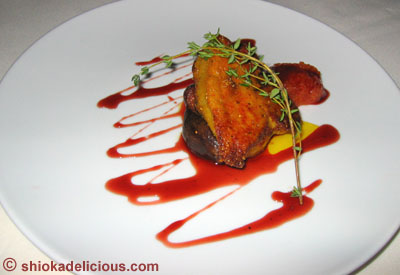
Fegato – Duck Liver (S$22) (US$13). The outside was beautifully crispy, but the insides were a touch too underdone from what one would normally expect – a little too bloody for comfort.  It came with a nice roasted fresh fig though.
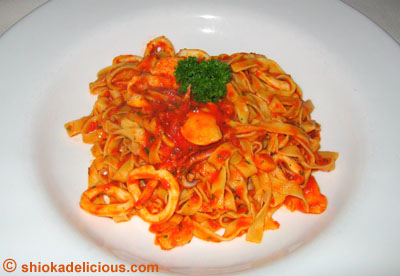
Seafood Tagliatelle (S$20) (US$12). A very red dish! We’re talking bright red!  They must have used extra red tomatoes. Only one small shrimp, half a scallop I think, a couple of small clam-like mollusks and the rest all squid.
Risotto Funghi a.k.a. “baby food” (S$20) (US$12). This looked really yellow and cheesy, but I was told it tasted very bland. It looked mushy on the outside but the center of all the rice were still hard and not cooked through. It was almost all rice with nary a mushroom.

Rack of Lamb (S$30) (US$18). Ok only.
Ossobuco (S$26) (US$15). Very, very fatty. After removing the obvious chunks of fat, only left with maybe ½ to 2/3 of the veal shank. Tasted very gamey.
Service left much to be desired. Most of the staff were fairly professional, however, one member was rather condescending and “uppity” with all the customers (not that there were many of these in the restaurant). I think we now know why.
Prices were high for the dining experience we got – the pricing still pretty much pre-Sars, pre-economic downturn prices. And I had thought that the days of restaurants “coercing” customers to pay S$8.00 for a bottle of mineral water, as the only water being offered, were long gone. Wrong! I had actually forgotten that such a practice existed!
There are many wonderful Italian restaurants in Singapore – a case in point would be the next door neighbor of this restaurant. Enuff said.
Bacco
501 Bukit Timah Road
#01-01 Cluny Court
Singapore 259760
Tel: 6465 5108
Food: 2½ / 5
Service: 1½ / 5
Ambience: 4 / 5
Price: $$$$$
S$15 & below : $
S$16-30 : $$
S$31-50 : $$$
S$51-75 : $$$$
> S$75 : $$$$$
Copyright © 2003 Renee Kho. All rights reserved.
Please contact me for permission to copy, distribute or display any of the images and text contained in this article.
06:56 PM in Lion City Shiok-Eats: Western | Permalink | Comments (2) | TrackBack
Fresh Off the Tree

Over the last 2-3 weeks, we have been getting several bumper crops of mangoes off the mango tree in our garden. There’s nothing like biting into a sweet, juicy, tree-ripened mango, and have all the juices dripping down your chin! LoL. Real shiok! And invariably, organic fruits (without pesticides, fungicides etc) just taste sweeter – the flavors are so much more intense.
Fortunately, this time round, we managed to get quite a big bunch of fruits that were smooth-skinned and blemish free . You see… insects, birds, squirrels and even a parrot or two (yes, wild squirrels and parrots right in the midst of urban Singapore!) just LUUVVE pesticide-free fruits too. So, usually, we end up sharing part of all our fruit crops with them – and more often than not, they are quicker off the draw than we are! Spotting and snaring the ripened fruits before we get to them!
We’ve been trying to find ways to eat up all the mangoes as they become over-ripe very quickly. Hmmm… what recipes are there for ripe mangoes? They’re not really appropriate for Thai mango salads, are they? I think these salads require unripened green mangoes. Perhaps I should try making the Thai glutinous rice and mango dessert, or the Vietnamese broken rice and mango dessert (both fairly similar I think). Have to try and find some recipes for these. Would anyone have a recipe they would like to share?
Copyright © 2003 Renee Kho. All rights reserved.
Please contact me for permission to copy, distribute or display any of the images and text contained in this article.
02:59 AM in Other Shiok-Eats | Permalink | Comments (2) | TrackBack