Wednesday, October 27, 2025
Racy Red Dates
Dates are one of the world’s oldest cultivated fruits. It is believed that they were grown by the Babylonians as long as 8000 years ago, and in those early times, the date palm was regarded as the ‘tree of life’. Every part was used : the buds and fruit were eaten or dried, the sap was drunk, the fibres were woven and the date stones (pits) were used as fuel or fodder for donkeys and camels. Today, centuries on, dates still have a special, even sacred, role in Arabic and Islamic cultures.
The Month of Ramadan or the Muslim Holy Month (of which we are now into the 2nd week of) always coincides with an abundance of dates - - both fresh and dried - - at the market.
I enjoy dates in both their dried and fresh states, but I do have fairly strong preferences as to which varietal I like to eat (what can I say? I can be a picky eater).
For the dried versions, to be eaten as is, I’m more partial to those from the Middle East, with the Medjool (regarded by some as the Rolls Royce of dried dates) and the Maryam (which has a thicker, harder “skin” than the Medjool that I usually peel off before eating) being my favorites ; I love their almost meltingly tender, soft, sticky sweetness. If indeed, like the Muslims, I am fasting and have spent the entire day since before sunrise without any food or water, I can’t think of a nicer (or sweeter) way to prepare my stomach for a large and substantial meal. The dates are supposed to help gently neutralize the acid juices in the stomach, and to aid digestion.
Apart from being eaten on their own, dried dates are of course great for baking with - - whether in moist fruit cakes or hot sticky puddings, or even just simply tossed in juicy fresh fruit salads. They also combine well with nuts, particularly walnuts and almonds. And who can resist a luscious dried date stuffed with a small roll of marzipan and topped with a toasted walnut half? Or a sweet dried date made richer and yet more subtle with a cream cheese filling?
However, when it comes to Chinese dried dates, the fruit is used almost exclusively in cooking only. Dried red dates are used to naturally sweeten both savory and sweet soups. They are also added to herbal concoctions, as they are believed to be very nourishing and restoring for the body.
When it comes to fresh dates though, my preferences are reversed : I much prefer the Chinese red date for eating as is, and am not taken at all with the fresh varieties from the Middle East. I tend to find the latter to be rather lacking in any really distinctive characteristics - - they are sweet but just barely so, they are slightly juicy but really not that juicy at all, and their texture tend towards “hard” crunchiness rather than a juicy crunchy crispness. And oftentimes, they can leave a gummy sappiness in the mouth that I don’t find appealing.
Fresh Chinese red dates on the other hand are a pleasure to sink your teeth into. At an average size of about 3 to 4 cm (1” to 1½”), they almost resemble miniature apples.
But the delight comes when you take that first bite - - they are sweet, very juicy with a rather tender crisp crunchiness. And yes, they taste somewhat similar to a red apple - - sweeter, with slightly less dribble-down-your-chin juiciness, and with a crunchy crisp texture that is just a tad more compact on the bite than an apple. Their fragrance and flavors are very delicate and beautifully refreshing!
I love these fresh Chinese red dates! (And yes, these are the same red dates that are most commonly sold in their dried forms for use in cooking.) They are rather more-ish ; once you start on one, it’s quite hard to stop until you’ve had more than a handful. And they are delightful! Their season is fleeting, so now is the best time to catch them.
Enjoy!
Copyright © 2004 Renee Kho. All Rights Reserved.
Please contact me for permission to copy, publish, distribute or display any of the images or text contained in this article.
01:31 AM in Other Shiok-Eats | Permalink | Comments (12) | TrackBack
Friday, October 22, 2025
The True-Blue Northerner
Remember the Boston Cream Pie that I made with the cake-mix given by my mother’s friend’s mum? The intention was to give half the cake to the elderly lady, but given how it turned out, I was most loathed to do so ; it was terribly embarrassing to give something that tasted like that to someone. But my mum felt it should still be done as it had already been promised to her. As it turned out, she was delighted (or was she just being unfailingly polite??) that her box of cake-mix “came back” as a cake with “bells and whistles” - - she wasn’t expecting it to be filled or frosted. So, in keeping with impeccable Chinese-style courtesy, she, in turn, made for my mum and I some of her own specialty - - dumplings.
These weren’t just any old boiled dumplings, mind you ; these were true-blue Northern Chinese dumplings - - and some of the best my mum and I had ever tasted!
They were really, really good!
The dumplings might not have won any dumpling beauty contests, but I liked their homey, rustic look and feel, and my word! did they taste good! The skin was easily one of the best - - if not, the best - - that we had come across. It had all the markings of an excellent dumpling skin : silky smoothness and softness, with just the right finely balanced amount of springiness and chewiness ; it was thin, delicate and pliable, yet strong and resilient.
My mum, who absolutely loves dumplings and who eats them regularly enough (oh, maybe once or twice a week, at least) to know well the-good-and-the-bad-of-dumplings, adored these, and pronounced them to be pretty close to perfect. As she said, those usually found in restaurants or small noodle / dumpling eateries were very often at one of two extremes - - when the dumplings were made to have enough chewy springiness, they were commonly too thick and “hard”, and when they were made with the right amount of silky smoothness they were usually too soft, with a mushy mouth-feel. I think, eating her friend’s mum’s dumplings, my mum probably felt a little like Goldilocks - - these were just right.
The dumpling filling of lean, moist, juicy minced pork, interspersed with very finely chopped Chinese cabbage, was also very good - - beautifully tasty and richly flavorful with a nice balance between luscious succulence and meaty bite, and between the saltiness of the meat and the natural sweetness of the cabbage.
The beauty of these dumplings is hardly surprising, and maybe even to be expected, given that my mum’s friend’s mum (MMFM from here on - - to save me typing out that mouthful each time) is a first generation Chinese immigrant from Beijing. Even now, into her 80s and after decades of living in Singapore, she has stuck religiously to her practice of eating - - and making - - traditional home-style dumplings almost every day.
Hers is a recipe-less concoction ; everything is made purely from touch, feel and instinct honed by seven decades (she started as a young girl helping her mum and aunts in the kitchen) of making dumplings! Much like how pasta is made in the traditional Italian kitchen, she doesn’t even measure out the flour ; she simply pours until it “feels” right, and then, all the other ingredients are added according to how the dough feels beneath her fingers. Sounds like pure poetry to me.
Well, maybe one of these days, when both MMFM and I have some time, perhaps she will show and teach me how to make the perfect Beijingese boiled meat dumpling. Now, wouldn’t that be something!
Copyright © 2004 Renee Kho. All Rights Reserved.
Please contact me for permission to copy, publish, distribute or display any of the images or text contained in this article.
04:28 PM in Other Shiok-Eats | Permalink | Comments (24) | TrackBack
Thursday, July 08, 2025
‘Tis the Season for Juicy Sweeties
I love fruits. Any kind of fruit – or just about. And I really like this time of the year when it comes to fruits… it’s a bonanza of tastes, flavors, aromas and textures. There is of course the much anticipated and eagerly welcomed mid-year durian season; there are the wondrous summer fruits from the US and Europe: Bing and Rainier cherries, blueberries, strawberries, white nectarines, white peaches… (Speaking of which, have you tried the ones from Israel which recently arrived at Cold Storage? Quite lovely.)
This year, we also seem to have a sudden influx of a lot of fruits from South Africa. Maybe they are not new; perhaps I just never really paid attention in the past… but suddenly I’m noticing that the supermarkets are filled with trays of South African persimmons (or Sharon fruit) and Forelle pears…

These are a new discovery for me. I quite like these pretty red-flushed pears. To me, they seem to taste somewhat similar to the sugar pear – which I adore and whose season is so fleetingly short; although the Forelle’s fragrance and sweetness seem even more delicate and subtle. Their flesh is also crunchier and firmer than the sugar pear’s. I like them well ripened; when they lose their little touch of sappiness. I’m also thinking that, maybe, they may work better as cooking/baking pears rather than eaten fresh. While they may not be quite up there with the sugar pear on my “adore” list, they are certainly a sweet new addition.
But what I’m really excited about at this time of the year are these…

Yes! It’s lychee (or “li chi” in Mandarin) season! It’s a happy sight when the first baskets of Thai lychees start appearing. But I normally wait; I take that as a sign of sweet things to come. For usually, a couple of weeks after the Thai arrivals, we get these – Lo Mai Chi from China. And these lychees are the ones I really like.
They tend to be slightly smaller, but oh, they are sweet, sweet, sweet! And very, very juicy. Bite into one, and immediately you have sweet nectar running down your chin and your fingers. Glorious!

Lo Mai Chis are known for their thick, fleshy pulp and tiny seed. And you know what I really like about them? Their “inner” flesh (the part that touches the seed) does not usually have that layer of thick, sourish husk attached to it. Most importantly, the Lo Mai Chi does not leave that awful sappy, gummy after-taste and feeling in your mouth after you have eaten it. The sweetness, flavors and fragrances are just so pure…
The other day, I came home with a few baskets (okay, maybe too many baskets) of these Lo Mai Chis, and so ended up using some of them to make…

… lychee “kulfi”. Soy milk-based lychee “kulfi”. The flavors worked very well… light, refreshing and summery. And they worked even better when paired with chopped toasted almonds.

It also allowed me to finally inaugurate the flower-shaped silicone moulds that I bought back in April. Quite pretty, no? And the moulds were great for frozen desserts… the kulfis popped right out with little effort, and each were beautifully shaped.
As we hit the peak of lychee season, my thoughts start turning to another sweet, juicy favorite – longans! Their season is always not far behind. Already, just the other day, I spotted some Thai longans in the supermarket. And that can only mean that the Chinese and Taiwanese varietals (which I prefer) will be appearing soon. Yay!

Meanwhile, another Chinese sweetie that I am currently savoring with delight is the Hami Melon.

In appearance, the flesh of this famous Chinese melon has a slight resemblance to the cantaloupe; its taste and texture are however are quite different.

Unlike the soft, yielding flesh of the cantaloupe, the Hami Melon has a slightly crispy texture – a little reminiscent of Asian pears like the Nashi or the Fragrant Pear. Its bouquet is also more delicate than the pronounced sweet notes of the cantaloupe; it has a rather subtle flora fragrance. The Hami’s sweetness is also more toned down and less aggressive, yet in many senses purer than the cantaloupe’s.

I like these for their refreshing crunchy texture and their juiciness. Very nice!
Would you believe that 15-18 years ago, when these imported melons were new to the Singapore market, they cost a whopping S$30.00+ (US$18+) for just one melon! In those days, it was definitely a fruit for the elite only. Thankfully, nowadays, a large, heavy, juicy sweet beauty can be had for just S$4.50!
With so many juicy sweeties tempting and tantalizing my taste-buds at this time of the year, I sometimes feel I want to eat nothing but fruits all day.
Copyright © 2004 Renee Kho. All Rights Reserved.
Please contact me for permission to copy, publish, distribute or display any of the images or text contained in this article.
04:37 PM in Other Shiok-Eats | Permalink | Comments (15) | TrackBack
Tuesday, June 01, 2025
Golden Tropical Thirst Quencher

While we are on the subject of heat-busting foods, here’s a delicious one. This is the loquat fruit, or better known to me by its Chinese name, pipa, so named after the Chinese lute whose shape the fruit is said to resemble.
Some other names that it is known by are biwa in Japanese, nispero or nispero japones in Spanish, nespola giapponese in Italian, bibassier or néflier du Japon in French, wollmispel or japanische mispel in German and Japanese medlar or Japanese plum in English.
Although its name in many of its guises seems to have a Japanese connection, the loquat is actually indigenous to southeastern China. It was introduced to Japan over 1000 years ago, and has been in cultivation there ever since. And as Japan has emerged as a major producer, the fruit has come to be associated with Japan rather than China (in a very similar way that the kiwi fruit, although originally from China, and known in historic times to the Chinese as the “monkey fruit”, has become associated almost exclusively with New Zealand).
Nowadays, loquat trees can be found, in small quantities, all over the world, from India to South America, from Australia and New Zealand to the Middle East, and from Europe to the United States. However, in the “Western” world, namely South America, the US and parts of Europe, the tree is perhaps more commonly grown as an ornamental or garden tree, for its small, attractive and fragrant white flowers, rather than for its fruits.

The loquat is from the pome family – the same family as the plum, apple and pear. Yet, to me, its taste is more akin to that of the kumquat. It is very juicy with a sweetness that is counterbalanced by a sharp, almost tart, tang. Depending on the fruit, I’ve sometimes experienced an initial taste of sweetness followed by a scintillating tanginess, and at other times, it is the soury, slightly acidic notes that hit the palate first, followed by a smooth, gentle sweetness. The fruit is undeniably refreshing. As a family member once put it, it’s a little like eating rather than drinking lemonade, fresh off the fruit – only much sweeter, with rounder, smoother, less edgy zesty flavors compared to the lemon. I think it would be a great candidate for making a cool, uplifting sorbet with!
Apparently there are over 800 varieties of loquats in Asia! And depending on the type, its outer color can range from yellow to orange to apricot or peach, and the inside flesh can be orange, yellow or white.
Most of the loquats available in Singapore are from Taiwan (mainly) or China. The season is very short, lasting at the most 3-4 weeks each year. We usually see the first fruits in the markets and supermarkets probably around mid-April, or sometimes the second week of April, and by the first or second week of May, they are pretty much gone. I had my last loquat about two weeks ago, and I haven’t seen them again in the markets. The fruit also neither travels nor keeps too well, and thus needs to be consumed within a short time of purchase.

Underneath the thin, softly downy skin, is a fairly thin layer of juice-filled flesh. The core makes up the bulk of the fruit, and is filled with several very large, extremely glossy (oh so pretty) brown seeds. Although only four big seeds can be seen in the photo, underneath those there are another 2-3 medium sized seeds.
The texture of the flesh is a little hard to describe. It has the firm yet soft bite of a half-ripe persimmon (Sharon fruit), and yet with the crisp juiciness of a Chinese cantaloupe. Its flavors have the refreshing tanginess of the kumquat, but with plummy overtones, and a layer of floral notes similar to that of apricots. A beautifully complex little fruit.
As with a lot of food, the loquat also has medicinal value in Chinese epicurean traditions. When eaten fresh, or made into a “tea” or even wine, or sometimes included in herbal preparations, it is said to help with coughs, asthma and other respiratory problems. It is also held to be a superb remedy for thirst and dehydration, and a wonderful source of vitamins A and C. This small, juicy fruit is deemed to be able to help cool the body’s systems. And so is a perfect heat quencher during the current hot weather.
Unfortunately, that will have to wait another year…
Even though loquat season has come and gone, a brand new season of one of my most favorite golden, juicy, thirst quenching fruits has just begun. After what seems like a longer than usual break, it is finally back. I’ve seen the first fruits in the markets and supermarkets. And I’ve already begun indulging heartily, much to my taste-buds great satisfaction.

I’m talking about the golden kiwi. I love both types of kiwi fruits – the green and the golden. But I love the golden one more. I like its stronger bouquet and fragrance. Its sweetness doesn’t have a tart edge to it, unlike that of the green variety. It is quite simply a wonderful thirst quencher.
The only down side… this season’s fruits are mighty expensive! S$0.85 (US$0.50) per fruit! That’s more than 20% increase over the previous average price of $0.70! Not good. Especially when it is quite easy for me to down several fruits in one sitting!
Maybe it’s because it is the beginning of the season. Or at least I hope that is the reason.
I do so love golden kiwis…
Copyright © 2004 Renee Kho. All Rights Reserved.
Please contact me for permission to copy, publish, distribute or display any of the images or text contained in this article.
06:17 PM in Other Shiok-Eats | Permalink | Comments (8) | TrackBack
Saturday, May 29, 2025
Home-Grown Honeyed Sweetness

This is such a happy sight. It has been ages since we harvested a fruit off our pineapple plants.
We have several Sarawak pineapple plants in the garden. But since each plant will usually only bear one fruit (at the very most, two fruits) at a time, and the entire plant needs to be transplanted after the fruit has been harvested, it is not often that we get to savor a home-grown pineapple. But when we do, it is well-worth the wait.

The Sarawak pineapple variety is incredibly juicy and sweet. There is so much juice “oozing” from this baby that it is reflecting the camera flash and creating tons of hotspots!
This particular fruit is just a tad over-ripe, as we had left it sitting on the table for a couple of days before cutting it open. Still, it does not have what we call in Chinese a “yellow taste” – a taste that is common in some over-ripe fruits like star-fruits and pineapples.

It is sweet, sweet, sweet. With beautiful smooth honeyed notes, and no sharp edginess or sappiness. Almost like eating nectar. Luscious. Blissfully lush.
Ah! The wonderful gifts of nature.
And soon, there will be another on the way (hopefully)…

Since we're in the garden, let's go see if there are any other fruits that are ready to be picked.
This is one of the two mango trees we have in the backyard…
(One of the simplest and most basic rules of outdoor photography is to never have the subject’s back to the sun. So what does Renee promptly go and do? Take a picture with the subject’s back to the sun. Boy, I’m good.)
Anyway, the two trees produce very different fruits. One produces fruits with yellow flesh that has a firmer, more refined texture. The sweetness is delicate and pure. The fruits from the second tree, on the other hand, have bright orange flesh, with a robust fragrance. The sweetness is more voluptuous and full, the flavors more emphatic. (Oh, there is a picture of the latter fruits in the post I made last year.)

Looks like there are a few fruits that are almost ready for the picking. Ideally, it is always best to leave the fruits to ripen fully on the tree. Unfortunately we can’t do that. As we grow the trees organically, we have lots of little “secret” residents who just love these pesticide-free fruits. Yes, we regularly have to jostle with several squirrels and even a pair of wild parrots for the fruits. And they always seem to know the perfect time to harvest the fruits. So, usually we have to pick them just slightly ahead of that optimum ripeness to ensure we even get to eat any of the fruits of our labor!
See the small tree to the right of the mango tree (in the previous photo)? That is a rambutan tree. It is rather small, I know. Sandwiched as it is between the 15 feet tall mango tree and a slightly shorter star-fruit tree on either side, it has been somewhat deprived of sunshine. It does still fruit though. Unfortunately, the family is not too keen on the type of fruit that it produces. We like rambutans where the husk of the inner seed does not peel off as the flesh is bitten off. And these fruits do that. But, the squirrels seem to like the fruits well enough. So, despite the occasional thought about felling the tree, we’ve kept it. Maybe the squirrels will concentrate on the rambutans and leave the mangoes to us. (One can always hope, right?)

And here are the two star-fruit trees. The fruits are also incredibly sweet (my dad was quite merticulous in searching out good quality sapplings when he planted all the trees so many years ago). Only problem is, we have hardly gotten to eat any. Oh, maybe all of a handful of times in the last 18 years or so! Seriously. The animals beat us to them each and very time. Even when we painstakingly wrap each fruit with paper, they still get to them. So, we have admitted defeat. We nurture the trees lovingly, but it is the squirrels who reap the rewards!

Sorry, no fruits at the moment. Just tiny pink flowers.
Oh, if you are wondering what a pandan (screwpine) plant looks like (since I keep talking about using pandan leaves as flavoring in cooking), here’s one…

Oops. That is a rather messy looking plant. Try this one…

Recently transplanted plant I think.

There are also lots (and I mean lots) of aloe vera plants dotted all around the garden. (My dad loves aloe vera - loves growing them). We have them growing in pots.

And in the ground. Actually, the ones in the pots could be awaiting transplanting. I’m not sure. Can you tell? I’m really not a gardener.
So that was a little impromptu mini-tour around the garden. I wish we still had the durian tree to show you, but that succumbed to illness after never having once flowered or borne fruit in its 16 years of existence. A botanist friend told us it was because there were no durian trees in the surrounding vicinity and thus cross-pollination was not possible. And so it would seem our poor durian tree was stricken with loneliness and unbearable solitude, and eventually gave up.
Copyright © 2004 Renee Kho. All Rights Reserved.
Please contact me for permission to copy, publish, distribute or display any of the images or text contained in this article.
11:30 AM in Other Shiok-Eats | Permalink | Comments (12) | TrackBack
Petite Thai & Robust Vietnamese

I’ve written previously about the chiku fruit (known as the “fruit of life” in Chinese), and about my wondrous first experience of it.
Since then I have been eating and enjoying these fruits on a very regular basis, especially seeing how the current season seems rather extended. I’ve always bought the Vietnamese variety. However, the other day, I decided to give the Thai version a test-run.
While both are chiku fruits, the two varieties are quite different both in appearance and taste. The Vietnamese is a rounded oval shape, with medium brown colored skin that is flecked with yellow and green tones. The Thai, in contrast, is petite, elongated and slender, with a reddish-brown mien that is almost suede-like to the touch.

Inside, the Thai yields a smoother flesh, with a more refined, less grainy texture than the more robust Vietnamese. However, the latter satisfies more with its luscious, voluptuous sweetness and full-bodied, velvety caramel flavors. The Thai seems almost bland in comparison. The sweetness is more subtle and delicate. It is more of an aftertaste of sweetness rather than an emphatic and attention-grabbing lead note. It doesn’t have the assertive caramel aromas of its Vietnamese cousin. I personally think that is one of the biggest appeals of the chiku fruit – that distinctive sweet, nectar-like caramel flavor. Certainly, that is the part I like most about eating the chiku.
While we are on the subject of the Vietnamese chiku, maybe I should elaborate a little on the choosing and eating of this fruit. Since I first wrote about it back in February, I’ve received feedback that some people’s experiences of the fruit have been a lot less than what I had described.
Since that first, almost orgasmic, experience of the chiku, I too have encountered quite a few unsatisfactory experiences with the fruit. I think there are several reasons for this. Most of the fruits sold here in Singapore are picked well before they are ready. This allows the producers time enough to ship them, and gives our local retailers a sizeable storage window, to ensure they can maximize the display life of the fruit. All this just means that the fruits are ripened in storage. Not the best way for any fruit.
However, that doesn’t mean wonderful tasting fruits can’t be found. I think for the greater part, the chiku does manage to ripen well under such less-than-perfect conditions. But there are also quite a few duds in each mound of chiku. These are bland, with a watery, squishy texture that reminds me of a raw potato!
So, what to do? This is by no means scientific or a sure-fire rule, but I’ve found quite often that the less visually appealing fruits tend to ripen a lot better than the “prettier” looking ones! The chikus with the smooth, even coloring and blemish-free skin seem to ripen less readily and successfully than those that may have slight mottling or roughened skin. Certainly gives new meaning to the saying that “it’s not what’s on the outside, but what’s on the inside, that counts”! In this case, the treasure certainly seems to be the beauty within, and not the appearance with-out!
I think it is also important to choose fruits that yield a tiny bit to slight thumb pressure. (But please don’t go pressing every chiku in sight at the supermarket or the wet market, or I’ll have a bunch of irate grocers pounding on my door!  ) Then, when these come home, just let them sit outside for 1-2 days (they don’t ripen so well in the fridge I find). And usually they come to their caramel-y and sweet peak when they are soft to the touch. Not just yielding slightly to pressure, but soft. Yet not mushy. It should be at a softness beyond what would normally be deemed “ripe” in other types of fruit.
One caveat. The fruits have to be watched rather carefully when left out to ripen. My own experience is that they can tip from ripe to over-ripe very quickly. Sometimes within a matter of a half day or so, especially in our very warm and humid climate. So, if need be, I get them into the fridge just before they peak and let them finish ripening in the fridge.
And so far I’ve experienced many lip-smacking encounters with the chiku. I’m still well in love with this fruit!
Copyright © 2004 Renee Kho. All Rights Reserved.
Please contact me for permission to copy, publish, distribute or display any of the images or text contained in this article.
10:49 AM in Other Shiok-Eats | Permalink | Comments (8) | TrackBack
Wednesday, March 31, 2025
A Spicy Nonya Lady Dressed in Green

I bought this Nonya zhong zhi (glutinous rice dumpling) one day last week, with the intention of having it for lunch. Unfortunately, things got so busy that day, I didn’t even have time to stop to eat. And so the dumpling was left sitting in the refrigerator for almost a full week. I finally decided to rescue it before it descended into gastronomic oblivion and crossed over into the next realm. I steamed it for dinner the other night. Fortunately it was still within its natural lifespan, and still tasted very good.*
[*Here's how to tell whether a dumpling is still edible: there should be no cobweb-like glistening strands as the dumpling is cut open with a fork. Thin, transparent strands stretching out from the rice on the inside of the dumpling indicates the dumpling is ready to be dumped.]
To me, the Nonya zhong zhi encapsulates very succinctly in one compact food item the meaning of “Peranakan”.
The Peranakan social group is unique to South East Asia, and more specifically to Singapore and Malaysia. This community evolved some two to three hundred years ago when Chinese traders came South to conduct their trade through and around the geographically strategic Straits of Malacca, and established business ties with the locals in Peninsula Malaya, including Singapore. With time, these Chinese traders settled in the Straits Settlements of Malacca and Singapore and married local Malay women. Out of these cross-cultural relationships and marriages was born a unique culture that was a blend of Chinese and Malay customs, with a dash of the English way of life.
The descendants of these original Chinese-Malay cross-cultural unions, together with their unique culture, came to be called Peranakans. The word “peranakan” in the Malay language meant “locally born”. To the Westerners, they were more commonly known as “Straits-born Chinese” or simply “Straits Chinese”.
Male Peranakans were known as Baba and the females Nonya. The latter was also the term used to describe Peranakan cuisine and fashion.
Everything about the rich heritage of the Peranakans was unique – the way they dress, the language, the food and the cultural traditions and practices.
The traditional Nyonyas and Babas did not speak Chinese, or any other Chinese dialects. They spoke a language of their own, a form of patois Malay, sometimes also called “Baba Malay” – a melodious version of Malay mixed with a good smattering of the Chinese Hokkien dialect and colloquial Malay words.
When the British colonized Malaysia and Singapore, the Peranakans were among the first group of locals to adopt the English language. They began to view themselves as superior to the other Chinese, who couldn't speak English. During the colonial era, many Straits Born Chinese regarded themselves as "Queen's subjects". And it was during this period, that certain elements of English culture and practices were assimilated into the Peranakan culture.
Yet, despite the adoption of various elements from different cultures into their daily life, the Peranakans, at the same time, clung fiercely to their Chinese identity in some aspects. They celebrated festivals like the Chinese New Year and Mooncake Festival on a large scale. The older generations continued to observe Chinese religious beliefs and rituals.
The flow of history also led to a change in the cultural emphasis of the Peranakans. At the turn of the century, as more Chinese immigrants flooded in and rooted themselves in the Malayan Peninsula, the Peranakans began to assimilate into the Chinese culture and thus diluted the rich heritage established by the early Peranakans. Among which were the language and beliefs. Baba Malay rapidly lost out to the Chinese dialects. The Hokkien dialect quickly became the adopted language of the new generations. The Malay component was diluted to such an extent that modern day Peranakans are chiefly Chinese in look and identity.
However, having said this, despite a more dilute Nonya culture in day-to-day living, the modern Peranakans still observe their traditional heritage on special occasions such as Chinese New Year, weddings and birthdays, with many of their practices quite different from traditional Chinese customs.
But perhaps the most profound Peranakan legacy and contribution to South East Asian culture is their food. Nonya cuisine is arguably the original “fusion food”. It is an exotic art of fusing the distinctive traditions, herbs and spices, and culinary skills of the Chinese and Malay. An amalgamation of the best of these two rich and colorful epicurean cultures. Nonya food is a synthesis of all four tastes - a tantalizing blend of spicy, tangy, salty and sweet flavors.
I think South East Asia’s culinary landscape would be decidedly poorer if not for Nonya food. In fact, the culinary culture of the Peranakans has become so accepted and assimilated into mainstream Singaporean and Malaysian food culture, many young Singaporeans and Malaysians do not regard, or even realize that many of their most popular foods are “Nonya” or “Peranakan” in origin. Instead, these beloved dishes are seen simply as being “Malaysian” or “Singaporean” foods. Some examples would be dishes like laksa, mee siam, popiah, otak-otak, sambal hae bee, and the list goes on.
In fact, each time I have written about or described a dish as being Peranakan or Nonya in origin, I would receive emails and comments querying the description. The roots of many of the most well-known South East Asian dishes did originate from Peranakan kitchens, but through the years Chinese, Indian and/or Malay influences have been added to them. Indeed, the cross-influencing has not been one-way. Similarly, some Peranakan recipes have evolved to take on broader South East Asian characteristics, reflecting the wider social fabric of Chinese, Indian, Malay and Eurasian elements. These “evolved” versions exists side-by-side with the original authentic versions, and all are beloved by food-loving Singaporeans and Malaysians, thus sometimes making it rather difficult to distinguish “authentic” from “interpreted” versions of any particular dish.
Which brings me back (after a rather lengthy detour – I do apologize, I get carried away sometimes) to my Nonya zhong zhi. In my humble opinion, I think this food item showcases very simply and eloquently the meaning of Peranakan or Nonya cuisine, which in essence is the fusion of Chinese and Malay culinary traditions.
Here we have the combining of the traditional Chinese glutinous rice dumpling with the Malay sambal hae bee (dried shrimps fried with sambal chilli). It’s simple, it’s tasty, it’s Peranakan.
The Chinese rice dumpling (zhong zhi) is another one of those Chinese food items that is designed to be eaten efficiently and conveniently, without the need for plates or cutlery. The rice and meat are wrapped and cooked together in special bamboo leaves (juk yip in Cantonese).
Once ready, the dumpling is simply unwrapped…

And it is ready to be eaten. It is interesting that the unique wrapping procedure of the dumpling, when done right, always ensures that when the dumpling is unwrapped, the rice pyramid sits conveniently and strategically in the middle, with the long strips of bamboo leaves stretching out almost equally on either side. This is important for the eating of the dumpling.

To eat the dumpling, simply hold onto the bamboo leaves on either side of the rice. It is prudent to position your hands on the leaves as close as possible to the rice. This helps the pyramid of rice maintain its balance on the rather narrow leaves, and not topple over onto the floor as you try to bite into it!
Lift the dumpling to your mouth, and take a nice big mouthful of the dumpling. Slowly savor the beautiful marriage of the soft, smooth glutinous rice with the spicy, slightly sweet sambal hae bee and its nicely contrasting meaty bite and texture. Bliss.

This particular dumpling was chock-full of minced sambal hae bee (dried shrimps in sambal chilli). There was also some finely diced pork in the mixture, for added sweetness and richness of flavor.

When the dumpling has been eaten, simply throw the bamboo leaves away, and you are done. No washing up to do.
Traditionally, rice dumplings were only eaten on Duan Wu Jie (the Dumpling Festival). But nowadays, dumplings are sold and eaten year round. This suits me just fine, especially as this year the Dumpling Festival will be happening rather later in the year than normal – towards the end of June (in fact, just 2 days before my birthday  ). Why? Because we have a “double spring” this year. We are currently in the second “second lunar month” of the year. Yes, the lunar calendar has two “second month” this year. And thus the various festivals that happen from the third lunar month onwards have been pushed back this year.
Just a little bit of interesting trivial there for you.
Happy rice dumpling-ing!
[note: being a non-Peranakan myself, the above information on the Peranakans and the Nonya culture was written based on my outsider’s understanding and appreciation of the people and their culture. If there have been any inadvertent errors, I apologize in advance. Please do drop me a line and let me know.]
Copyright © 2004 Renee Kho. All Rights Reserved.
Please contact me for permission to copy, publish, distribute or display any of the images or text contained in this article.
02:57 PM in Other Shiok-Eats, Tastes of South East Asia | Permalink | Comments (27) | TrackBack
Tuesday, March 23, 2025
A Rhapsody of Pork

Look at this! Doesn’t it look good? It tastes scrumptious too.
This is the oven-roasted crispy pork knuckle from Cold Storage Centrepoint. Once in a while, we indulge and buy one of these home for lunch or dinner. They are freshly roasted on-site each morning. Every day, at around 11.30 am, they are just coming out of the oven, after three hours of roasting. They are piping hot and smell incredible. The skin is super crispy, and yet the meat inside is tender and moist.
Once or twice, I have found the meat to be slightly more porky than usual. I guess this depends on who did the marinating of the pork. But usually, I like the taste of these knuckles. And this is coming from someone who had, until very recently, stopped taking pork altogether for many, many years; who, even now, doesn’t usually take a lot of pork; and who can’t stand any sort of porkiness in the pork she eats. Yes, I know, pork is supposed to be porky. What else would pork be, right? But you know what I mean. Some pork are more porky tasting than other pork, depending on where the meat comes from and what was in the pig’s diet.
I like the Cold Storage knuckle for several reasons. They always only use the knuckles from the fore-limbs of the pig. These are always more tender and succulent than the hind-legs. When we cook the traditional Chinese braised vinegar pig trotters at home, we use the fore-limbs only too. Also, the Cold Storage knuckles are not deep fried first. Just oven roasted to perfection. So it is not greasy or oily. In fact, I would say the meat is pretty lean for a pork knuckle. The skin is so incredibly crispy! The layer of fat under the skin has been cooked out during the lengthy roasting time, leaving just a layer of super tasty, crunchy skin. Divine!
Even if left until dinner time, all that the knuckle needs is to be popped into the oven to be heated up, and the skin is still as crisp as ever.
There is also something about seeing a good-sized whole, bone-in knuckle – all 6-8” in length of it – that is terribly drool-inducing. Almost hypnotic. It almost makes you want to take the whole knuckle in your hand and chew on it like you would a chicken drumstick! And just let your animal instincts take over and be cave-man like, you know what I’m saying? Ahem. Okay, let’s not get carried away here…
The marinade is nicely neutral too, without being bland. It flavors the pork nicely, but it also allows us room to use different sauces or dressings with the meat, if we so desire.
Sometimes, we make a plum sauce, chilli and black pepper dip to go with the pork. Other times, a tangy mango or apple salsa is nice. But sometimes, I just dip chunks of the meat into thick sweet dark soy sauce. Or better yet, just eat it as it is.
The meat also tastes very good in a sandwich. Any leftover meat is shredded, and the next day warmed and stuffed into a wholemeal pita bread, together with some salad tossed with the plum sauce dressing, and a liberal sprinkling of black pepper. Yum!
Here’s a shot from a better angle…

The underside of the knuckle looks flat because by the time I stopped stuffing my face long enough to remember to take the photos, we had already eaten half the knuckle.
And so that was my pork fix for the week.
Copyright © 2004 Renee Kho. All Rights Reserved.
Please contact me for permission to copy, publish, distribute or display any of the images or text contained in this article.
05:00 PM in In My Shopping Basket, Other Shiok-Eats | Permalink | Comments (11) | TrackBack
Monday, February 16, 2025
The Fruit of Life

Happy Monday everyone! Hope it was a wonderful, loving and fulfilling weekend for all.
I shan’t post about my Valentines weekend … however, in keeping with the theme of love – love… the food of the soul, the essence of life… I hereby present “the fruit of life”. This is the sapodilla fruit whose Chinese name “ren shen guo” translates into “the fruit of life”.
This is an exquisite tasting fruit. My only regret is having discovered it only very recently. When I tasted it for the very first time a few weeks back, it sent me into raptures of ecstasy. The explosion of a multitude of flavors and taste sensations on my palate was exhilarating. Oh, indeed! The rather plain and unassuming brown exterior of this “fruit of life” belies an incredibly rich and complex flavor.
It is sublimely sweet… almost like drinking or eating pure nectar. And yet, so complex, with notes of rich dark caramel overlayed with light feathery honeyed tones. It is as if the fruit has been lovingly, gently and slowly cooked down to a rich caramelized flavor. Yet, it is natural, it is fresh, it is refreshing. The flesh is tender yet not mushy, smooth yet with the slightest touch of textured graininess. Every bite offered up mouthfuls of intense juicy nectar. Sublime. Exquisite. Rapturous. Wondrous. Fabulous. The Nectar of the Gods? Close, pretty close.
[Update 29 May 2025: Following some feedback about the experiences some readers have had with this fruit, I've shared a little more about my experiences with choosing and eating this fruit. The new post can be found here.]
Copyright © 2004 Renee Kho. All rights reserved.
Please contact me for permission to copy, distribute and display any of the images and text contained in this article.
03:20 PM in Other Shiok-Eats | Permalink | Comments (6) | TrackBack
Thursday, February 12, 2026
System Re-Boot
Usually after a period of rich foods and just general gluttony, my body feels really sluggish. I feel sluggish. Energy levels dip, patience levels dip, mood levels swing… and I just feel… well, you know… blaaaahhh… And I’ve been feeling like that since Chinese New Year, what with multiple BIG meals each day, every day for two weeks! Plus all those cookies, cakes and sweets. Acck! My poor body!
So this week, I decided it was time for a system reboot!
I really enjoy fruits – almost all kinds of fruits. But, for some reason or another, I seem to have great affinity for orange and yellow colored fruits. (Hmmm… what does that say about me? Anyone know anything about color psychology? ) Whenever my body is in need of a “detox”, suddenly all it wants to eat is fruits, fruits and more fruits. I’m not really into juicing. I feel intense pleasure biting into a succulent, juicy, sweet, luscious piece of fruit, and feeling the sweet nectar explode in my mouth. I love savoring the different textures and the different notes of taste, flavor and sweetness. Ah! Pretty close to heaven!
So, in the good wholesome tradition of the Sound of Music , here are a few of my favorite fruits…

My all time favorite: papaya! But not just any papaya though. I only like the Hawaiian paw paw, or variations thereof. Yes, I know, I’m fussy.
The Hawaiian paw paw is easily the sweetest, juiciest papaya I know of. The flesh is very smooth and refined, and not fibrous as our local papayas (those big elongated ones) tend to be. We can’t get Hawaiian paw paw in Singapore, but the small papayas that we get from Solo, Indonesia (usually) and occasionally from Taiwan are quite similar and are very good too. The slightly mango-shaped one I had this morning for breakfast (above) was soooo sweet and juicy! The Solo papayas are almost a bright orangey red compared to the lighter bright orange of the Hawaiian paw paw. Their flesh is slightly less refined (and occasionally rather fibrous) compared to their Hawaiian cousins. But hey, they make my day. Waking up to a piece of this fruit always brings a smile to my face. My difficulty is in restraining myself, trying not to eat too much and not to eat it everyday… the skin turns yellow from the excess beta-carotene. 
I have only one gripe about buying fruits in Singapore. All our fruits are imported, and a lot of them have to travel literally thousands and thousands of miles to get here. This means we never get tree-ripened fruits. They are all picked while still far from ready, and are allowed to ripen on their long journey over here, or to ripen only a few days after they come home to my kitchen. Sure, some fruits still manage to ripen fairly well under such conditions, but there is still a big difference between these and tree-ripened fruits.
But I’m nit-picking here. I truly think we are so very fortunate living in Singapore. We are so blessed to have a HUGE variety of fruits available to us, from all corners of the globe and almost throughout the entire year. There is almost no seasonal restriction on us. In the middle of the year, we get summer fruits from the Northern Hemisphere… cherries, strawberries and all the other luscious summery fruits from Europe and the US. At the end of the year, we get the same fruits from Australia and New Zealand.
I think a lot of the times, Singaporeans take for granted the variety of foods we have. For mangoes alone, we get to choose from those that come from Mexico, Argentina, Pakistan, India, Philippines, Thailand, Malaysia, Indonesia and Australia. On the supermarket shelves are persimmons from the US, Europe, China, Australia and Israel. We get to enjoy all the tropical fruits that our region has to offer, plus the full range of temperate fruits – year round – imported from Australia/New Zealand, and Europe, US and South America. These fruits are so commonplace in all the supermarkets (even the neighborhood ones) that their presence has become de facto and expected. What should be “exotic and foreign” fruits have become run-of-the-mill for us.
Speaking of persimmons… this is another one of my favorites! Yep, it’s orange too.

I only like the small Sharon persimmons from Israel. The tag line for them, as printed on their boxes, is: “the sweetest persimmon in the world”, and I’m inclined to agree. You will be hard pressed to find a bland, tasteless Sharon persimmon. Every single fruit is super sweet, lusciously succulent and oozing with juiciness, without (and this is important) the sappiness found in almost all Chinese and Australian persimmons. The latter ones, even when very ripe, leave a very uncomfortable gummy after-feel in the mouth that doesn’t go away readily. I’m not sure why this is so. The different growing conditions, maybe? The different soil, climate and growing procedures, maybe?
The Sharon persimmons are much smaller than the other persimmons, but they really pack a tasty and flavorful punch. These are wonderful not only for eating as is, but also in fruit salads and sometimes for baking too. I like to cut them down the cross section rather than down vertically, as this reveals a very pretty star- or flower-shaped pattern on the persimmon slice and makes for a rather nice presentation, I feel. The one I had this morning (please excuse the condensation on the fruit in the picture) had a pattern that looked more like a swaying coconut tree! The first time I had one like that. How nice!

I just bought another two boxes yesterday. Yes, the family likes them that much! I think they have two seasons a year – mid-year and year-end. The current season is probably reaching its tail-end, so we’re enjoying these whilst we can.

Another seasonal fruit that I like a lot. Honey kumquats. Available only during CNY, these honey kumquats are different from the sour ones that hang on the kumquat bushes we display in our homes during CNY. These tiny fruits (seen in picture being compared with the mini mandarin oranges) are sweet, slightly crunchy with a very unique and rather strong fragrance. We simply pop them into the mouth and eat them whole - skin and all. Except the pips of course. Although those are edible too, if you want (and if you are lazy ), just rather bitter.
According to our friendly fruit seller at the wet market, these are really good for helping with digestion and for the larynx. So, if you are wanting honeyed vocals, this is the fruit to get. They taste pretty good when made into a honey kumquat drink. Sooths and cools the throat.
I had been hoping to have some leftover from CNY to maybe bake a kumquat tart or a chocolate kumquat cake. I think that would be interesting. But no such luck. Next year, perhaps…

Of all the banana varieties we get, I like these the best. They are called “mi jiao” in Chinese. Not too sure what their Malay name is. These are tiny bananas – usually no more than 2-2½” (5-6cm) long, and at the very most 3” long. These are so very hard to find in Singapore, but abundant in Malaysia. I have only managed on occasions to get them from some of the fruit stalls that line the streets of Little India at night. They are different from the similar-sized but fatter “pang jiao” which can be easily found here. The texture and sweetness of the “mi jiao” are very unique. When ripe it still has a certain bite to it, and doesn’t become mushy like the pang jiao. Their sweetness is also more complex in tones than the pang jiao.
Come to think of it, we have quite an array of bananas, and I don’t even know the names of many of them. Of course, there are the more common ones like pisang mas (sometimes also called pisang emas i.e. golden banana). So called because of its sweet golden yellow flesh. Then there are the cooking bananas used in making the Asian fast-food “pisang goreng” (banana fritters). The most commonly used one being pisang raja (literally translated as “banana king). Others used in Asian cooking include pisang nangka and pisang nipah, among others. There are also the red bananas from Indonesia (don’t know their Malay name). And of course not forgetting the regular white-fleshed Cavendish bananas. Talk about going bananas over banana names!
Oh! Just remembered a yellow colored (okay, yellow-ish colored) fruit I really like but which is currently not in season… the golden kiwi. This is the one with the pointed, not rounded end. I much prefer this to the regular kiwi fruit. More times than not, the latter tends to be somewhat sour, while the golden kiwi is generally sweet. It’s a personal preference thing… I don’t like sour fruits of any sort.
Okay, enough of the orange and yellow fruits already! Here’s a nice blue colored one I picked up from the supermarket yesterday.

Berries are always rather expensive in Singapore. This small 150g punnet from Australia was S$4.50 (US$2.70) because it was on special offer at NTUC yesterday. Normally, this would be around S$7.00 to S$8.50 a punnet, which works out to a whopping S$56.00 (US$34.00) per kilo! But hey, they had to get on a plane to get here. I usually grab some when they go on offer, as I do like fresh blueberries so. This is probably the only berry I really like. I’m not much of a strawberry person even (shock! horror! but it’s true). Cherries I like, and like a lot. But they aren’t berries, are they?
Oh dear, I seem to have gone on a bit. I'm sure you can tell by now... I really like fruits!  The list of my likes can go on forever... but I won’t.
Ah, fruits… the nectar of Nature that makes life so sweet!
Copyright © 2004 Renee Kho. All rights reserved.
Please contact me for permission to copy, distribute and display any of the images and text contained in this article.
11:46 PM in Other Shiok-Eats | Permalink | Comments (13) | TrackBack
Monday, December 01, 2025
Fresh Off the Tree

Over the last 2-3 weeks, we have been getting several bumper crops of mangoes off the mango tree in our garden. There’s nothing like biting into a sweet, juicy, tree-ripened mango, and have all the juices dripping down your chin! LoL. Real shiok! And invariably, organic fruits (without pesticides, fungicides etc) just taste sweeter – the flavors are so much more intense.
Fortunately, this time round, we managed to get quite a big bunch of fruits that were smooth-skinned and blemish free . You see… insects, birds, squirrels and even a parrot or two (yes, wild squirrels and parrots right in the midst of urban Singapore!) just LUUVVE pesticide-free fruits too. So, usually, we end up sharing part of all our fruit crops with them – and more often than not, they are quicker off the draw than we are! Spotting and snaring the ripened fruits before we get to them!
We’ve been trying to find ways to eat up all the mangoes as they become over-ripe very quickly. Hmmm… what recipes are there for ripe mangoes? They’re not really appropriate for Thai mango salads, are they? I think these salads require unripened green mangoes. Perhaps I should try making the Thai glutinous rice and mango dessert, or the Vietnamese broken rice and mango dessert (both fairly similar I think). Have to try and find some recipes for these. Would anyone have a recipe they would like to share?
Copyright © 2003 Renee Kho. All rights reserved.
Please contact me for permission to copy, distribute or display any of the images and text contained in this article.
02:59 AM in Other Shiok-Eats | Permalink | Comments (2) | TrackBack
Thursday, November 20, 2025
The King of the King of Fruits
It’s November… and that means it’s durian season! Yes, this is the time of the year when this so-dubbed “King of Fruits” is piled high at all the fruit stalls along Sims Avenue / Geylang Road, and at every neighbourhood fruit stall too.
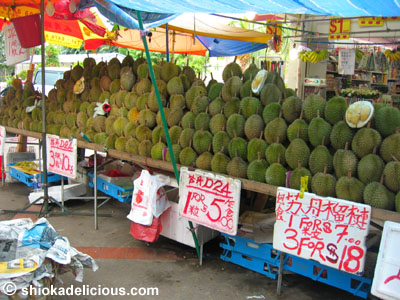
It used to be that we only get to taste the durian twice a year – June/July and November/December, with the major harvest being at the end of the year. However, in recent years, it seems that the fruit has become available all year round. Hmmmm… are the farmers fertilizing the tree a lot or crossbreeding or something to get the trees to flower and bear fruit year round? Isn’t that a rather worrying thought? Seems rather unnatural, I feel. Anyway, the November/December period is still the main harvest – when the fruit is at its tastiest and most abundant.
This year, the harvest has apparently been even more abundant, and prices have fallen dramatically. So, on our way home yesterday from lunch, we couldn’t resist picking up a few Sultan D24 durians. I like to buy the “real fruit”… don’t like those that now come shrink-wrapped and packed in sterile white unimaginative styroform boxes.
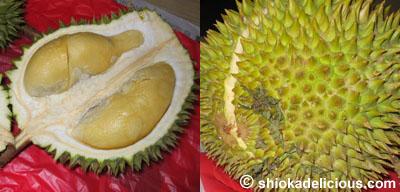
Sultan D24 is considered the King of the King of Fruits. Adored by durian connoisseurs for its perfect balance of sweetness and bitterness, for being beautifully smooth and creamy, and yet not mushy. Its flavors (when one finds a good fruit) are rich, aromatic and absolutely shiokadelicious!
Although recently it would seem that its position as the best in durian breeds is slowly being usurped by the XO durian – which is supposed to be even creamier, even sweeter and more bitter (?)… I don’t know… I’m not a real connoisseur, though I thoroughly enjoy the fruit – in all its guises…
This fruit is so adored that it now appears in just about all possible forms – from durian mousse cake, durian swiss roll, durian pancake, durian cream puffs, to durian ice cream, durian pudding, durian ice kacang and even durian mooncake! I’ve heard that someone somewhere in Singapore is also serving up durian roti prata/roti canai (the crispy, flaky pan-fried Indian pancake, which is normally served savory and eaten by dipping into curry)! Haven’t tried it, and somehow not inclined to either! Some of these permutations work very well, and my family loves them – such as durian cake, durian cream puffs and durian ice cream. However, some just tastes weird, like durian mooncake. But it’s all personal preferences I guess, because there must be people who like them… pastry shops and hotel delis roll them out big-time each year for the mooncake festival.
We like to freeze extra durian. They keep very well in the freezer for months. I also like to remove the flesh from the seeds and mash it into a thick rich, chunky pulp, which can then be mixed into semi-softened vanilla ice cream for a quick-and-easy home-made durian ice cream, or simply scooped over vanilla ice cream as a rich, aromatic topping! Yum, super yum!
And if you’re concerned about assaulting those around you with smelly breathe after indulging in durian, here’s a quick “old wives’ tip” for removing the very strong smell of the durian from your fingers and mouth… Use one of the empty segments of husk, sprinkle around ¼ to ½ tsp of salt into the cavity, dissolve in some water, drink out of the husk and rinse your mouth with the salted water. This also helps prevent sore throats too, which can happen from eating too much of the fruit.
And to remove the smells from your fingers, simply place the empty husk under running tap water, and rinse your hands in the water that has passed through the husk (as my mum is seen doing here View image).
Finally, to balance out the yang or “heatiness” of the durian, it is believed that one should also consume mangosteen after eating durian. This fruit with the deep purple/burgundy hard husk, which hides small segments of sweet white fleshed seeds, is said to have a yin or “cooling effect”, and will prevent the sore throats and hoarseness of voice that says: uh-oh… had too much durian! : D

Happy Durian-ing and Mangosteen-ing!
Copyright © 2003 Renee Kho. All rights reserved.
Please contact me for permission to copy, distribute or display any of the images and text contained in this article.
04:37 PM in Other Shiok-Eats, Tastes of South East Asia | Permalink | Comments (0) | TrackBack