Thursday, September 02, 2025
Refresh!
You know what’s really good for hot, hot days when your body just seems completely zapped of all energy? When every fiber of your being seems infused with lethargy?
On days like those, what I enjoy is lots and lots of barley water. Yep. Barley water. Just barley cooked in lots of water, with a small bunch of knotted pandan (screwpine) leaves thrown in for added fragrance. It can either be sweetened with a piece of rock sugar dissolved into the mixture right at the end of the cooking, or with a side serving of a simple syrup made up of rock sugar and water – this allows everyone to sweeten the drink to their personal liking. I like mine thirst quenchingly unsweetened.
Another thing I enjoy about drinking barley water: right at the end, after the drink is gone… I find an almost child-like delight in using a spoon to dig up all that cooked-down, soft, very tender, somewhat fluffy yet slightly chewy barley sitting at the bottom of the glass. What simple pleasure!
Barley water, served hot or cold, is wondrously light, refreshing and cleansing; and one of the traditional favorite hot weather drinks of South East Asia.
Barley is said to have many health-giving properties; Traditional Chinese Medicine believes it to have great cooling properties for “heaty” bodies, to be a very efficacious detoxifier and cleanser of the intestinal tract, and to be a soothing balm on overworked and stressed digestive systems. Barley is also a natural diuretic.
But all that health and medical mambo-jumbo aside, nothing is quite as delicious - or reviving - as a tall glass of icy cold barley water on a muggy, stiflingly hot and dry summer’s afternoon.
Salut!
Copyright © 2004 Renee Kho. All Rights Reserved.
Please contact me for permission to copy, publish, distribute or display any of the images or text contained in this article.
05:36 PM in Home Cook: Light Touches | Permalink | Comments (16) | TrackBack
Friday, July 16, 2025
Work In Progress
There were several requests for the recipe to the lychee kulfi that I served with my Kerala chicken dinner the other week.
Since it is still very much a “work-in-progress” recipe, and I’m still not completely satisfied with the results, I have decided to post the recipe, as it currently stands, in the comments section of the previous fruit post.
If you do try the recipe, please do come back and let me know how it goes. I would love to find the solution to the still-less-than-ideal texture of the kulfi. Thank you! 
And so, it is Friday! After a really tough (my instructor worked me till I felt like a piece of jello!) but fantabulous Pilates Reformer workout this morning, I’m all abuzz with energy and have a silly smile on my face; never mind that I slept only three hours last night. So, here’s wishing everyone an awesome weekend ahead. Eat well, be happy!  And oh, do come back of course on Sunday for my contribution to IMBB.
Happy Friday! 
01:13 PM in Home Cook: Light Touches | Permalink | Comments (5) | TrackBack
Friday, May 21, 2025
Color My Plate Beautiful

I think sweet potatoes are such wonderful “all-in-one” foods. Wholesome, nutritious (their bright/deep coloring implying an abundance of natural anti-oxidants, vitamins like beta-carotene, as well as minerals) and tasty too. I like them plain, unembellished – in their natural state, or as close thereof as possible. They have a lovely natural sweetness and a nice soft, fluffy texture (the good ones that is), and they warm and fill the tummy in a rather comforting way.

These purple ones are great. No, they are not yams or taro, but sweet potatoes. Isn’t the color gorgeous? I adore the color – deep, luscious purple melding and harmonizing with shades of rich plum, violet, lilac and blue, and sprinkled with tiny flecks of white, almost like sparkling stardust.
We always buy some each time we come across them in the market. I find them more aromatic and fragrant than the more commonly available orange-fleshed ones, with a firmer texture and bite.
Japanese purple sweet potatoes are somewhat different…

(See the little sticker on each sweet potato?  That’s “veggie man”, or so it says on the sticker, and he’s confirming that these are “original Japanese sweet potatoes”. Cute, huh? The sticker even has the Health Authority’s stamp approval, shown by the inclusion of the “eat healthy” pyramid logo on it.
  )
)
Although these Japanese tubers have a gorgeous purple hue with a touch of fuschia overtones, the flesh inside is actually a cheery bright lemony yellow…

After cooking, the skin of the sweet potatoes turns a luxurious, dusky plummy color. Very nice.
These Japanese varieties have a somewhat firmer, denser texture – less fluffy than our purple and orange varieties. When in their prime season, they have a nice, subtle sweetness and softness.
I like the local ones with the orange-colored flesh too…

When really nice ones are available, these are so soft and fluffy, with a very tender texture, and a wonderful, subtle natural sweetness. They truly do not need further accompaniments. They are lovely on their own, or at the most, cooked in the lightest and simplest manner.
More often than not, I usually cook the sweet potatoes in one of two ways. Either in a sweet ginger “soup”, or simply steamed then baked. The local yellow-fleshed sweet potatoes I tend to cook only in the sweet soup; the local purple-fleshed ones* I would steam/bake only; while the orange-fleshed and the Japanese purple ones I would do either depending on how I feel and how good the tubers are when I buy them.
[* These also make gorgeous looking oven-baked chips or crisps. Simply slice very thinly – as thin as possible – with a mandolin, and lightly coat with some cooking spray, a light sprinkle of salt if desired, and into the oven until nicely crisp.]
To make “baked” sweet potatoes, I would steam the tubers for about 25 minutes until nicely tender, then pop them into the toaster oven for 3 minutes on one side, turn them, and toast another 2 minutes or so on the other side, just to “crisp” up the skin a little. And then, I would just munch on them whole, skin and all – like a baked potato, only sweeter, fluffier and more tender. Lovely! There’s no need for butter, sour cream or any other enhancements. Pure, simple and true.
When I want a very simple and light lunch, this is it. Just 2-3 small sweet potatoes, and I’m satiated and happy.
Sweet potatoes. Such a humble, unassuming root vegetable, and yet it can bring an amazing burst of color, texture and subtle sweetness onto our plates and into our diets.
Copyright © 2004 Renee Kho. All Rights Reserved.
Please contact me for permission to copy, publish, distribute or display any of the images or text contained in this article.
03:38 PM in Home Cook: Light Touches | Permalink | Comments (4) | TrackBack
Saturday, March 27, 2025
Skeletons in My Bread Cupboard

Since my recently renewed infatuation with kaya started, I have been imbibing large quantities of bread. Not bread bread, as in crusty loaves and aromatic rolls, but regular sliced bread with various spreads and toppings. Initially I was just looking for an excuse to eat my kaya, but it then evolved into wanting to re-live childhood memories of the different ways I used to eat my bread.
Bread and the eating of bread are such emotional things. Both are so often tied in to memories of the tastes and smells of childhood. During my current bread-consuming spree, I have been re-visiting many of the old, sometimes long forgotten, flavor combinations that were once so loved. A number of these have now re-joined those all-time favorites that never left my life. Some of these bread-eating habits are quirky, others may sound icky and yet others still probably seem downright weird. And yet, each one is tasty, and most bring back a flood of pleasant memories and emotions.
Care for a little tour of my bread “closet” to see what flavorful “skeletons” we can unearth?
Let’s start with my current spread-of-the-month, kaya.
One cannot talk about kaya without talking about the fabled South East Asian (Singaporean and Malaysian, to be exact) institution of kaya toast. We are passionate about kaya toast. Many would pay modern-day exorbitant (some would say extortionate) prices for what amounts to merely two pieces of light fluffy nothingness of bread, sandwiching a slab of butter and a dollop of kaya. It is almost like a collective consciousness. It is not written or set down in any cookbook or culinary rule book, and yet just about everyone knows the exacting criteria that must be fulfilled for a toast to qualify as “good” kaya toast.
Long before McD’s Big Breakfast hit our shores, there was the Oriental fast-food kaya-toast-and-runny-eggs breakfast. In the old days, for just a few cents, one would get a cup of thick, piquant local coffee, a piece of kaya toast and two half-boiled eggs. The coffee was served in a rustic heavy-set porcelain cup which sat atop a porcelain saucer with edges that curved up slightly. This was important. The saucer was key to eating the eggs.
Many of the kopitiams (traditional Chinese coffee shops) had a highly “automated” and synchronized system of cooking these eggs. Timing was of the essence. The eggs could not be overcooked or undercooked. Both whites and yolk should be runny, but the whites should not have transparent bits. It required the cook to find that very fine split-second border-line between transparent and opaque whites.
How was this done? Some kopitiams came up with an ingenious “machine” which pretty much automated the cooking process. This "machine" was simple, easy to operate, and hardly ever broke down. It was simply rows and rows of “hanging tins”. Tin cans which once contained canned food were recycled and given a second life. Small holes were punched in the bottom of the can, and the cans were strung with string and hung along wooden poles. Each morning, during the peak breakfast rush, raw fresh eggs were systematically placed in each can, which was then filled with boiling hot water. As the eggs cooked, the water dripped out of the holes in the bottom of the can. Once the water had run dry (within mere minutes), the eggs were done to perfection – runny yolk and whites, with no transparent bits. The key was in getting the number and size of the holes in the bottom of the cans right. Thereafter, it was on auto-pilot. Ingenious. Efficient. Successful. Fast-food kopitiam style.
As each egg was cooked, removed from the can and served, another egg would be put into the can, and so the process continued. The cook would simply work systematically up and down the row of cans, putting in raw eggs, topping up the boiling water, and removing the cooked eggs. It was akin to a rhythmic culinary dance.
To eat the eggs… first, the cup containing the coffee was removed from its saucer. The half-boiled eggs were cracked and their still very runny insides poured into the now-empty saucer. A dash of light (or dark) soy sauce was added and the eggs stirred with the teaspoon, to create a not-very-visually-appealing brown liquid. The saucer containing the liquid eggs was then carefully brought to the lips and the eggs were “drunk”. That was the way – the only way – that these traditional half-boiled eggs should be eaten! With eggs consumed, it was time to enjoy the kaya toast.
The kaya toast is actually more of a sandwich than a toast – a kaya and butter toasted sandwich. For an authentic, original version of kaya toast, the traditional kopitiam bread has to be used (see top photo). This traditional bread has its roots in the Hainanese kopitiams of old. Tall, slim loaves with a characteristic rounded top, they are cut into ½ inch thick slices. All the crust – top, bottom and sides – are always removed to give narrow, elongated 7” by 3” slices. These are pieces of cloud-like fluffiness and softness, which almost dissolves with each bite.
Two slices of the bread are grilled over smoldering charcoal until nicely golden brown and crispy on the outside, but still cottony soft and fluffy on the inside. Some kopitiams make the kaya sandwich using two full thick slices of toasted bread, others split one piece of toasted bread in half along the cross-section to give two super-thin, very crispy slices of toast. A slab – and I mean a slab, none of that dainty cholesterol-phobic nonsense, but a thick macho slab – of cold butter is sliced and placed on one piece of toast. The other piece of toast is liberally slathered with kaya. The two pieces of bread are then slapped together to form the sandwich.
And there you have it – kaya toast. That is why the Malaysian name for this sandwich is “roti kahwin” (kahwin being either “marriage” or “to marry”). Two slices of toast are “married together” with kaya and butter.
As the sandwich is being brought to the waiting customer, the butter has time to start melting in the heat of the toasted bread. So, as one bites into the sandwich one gets a mouthful of half-melted butter as well as still slightly cold, somewhat hard butter, all complemented by oozing kaya. It is actually quite a symphonic display of textures… cold firm butter, warm melted butter, smooth dripping kaya, crispy crunchy toast, soft fluffy melt-in-the-mouth bread. It may sound messy, icky even, but the varied and contrasting textures, flavors and levels of richness of all the different components come together majestically for a thoroughly enjoyable taste sensation.
The sandwich is so simple, but one only has to watch the enjoyment, joy and utter pleasure on the faces of people eating roti kahwin to realize that this is one food that is almost purely about emotions and nostalgia. Singaporeans nowadays are willing to pay rather exorbitant prices to recapture the spirit and experience of the traditional kopitiam half-boiled eggs and kaya toast breakfast.
I like kaya toast. But on my terms. Which means none of that defiant devil-may-care slab of butter stuff for me. Sorry. I prefer the flavors of the kaya to be the dominant notes in the sandwich, rather than be overwhelmed by the intense richness of biting into a chunk of half-melted butter. So, I like my butter spread onto the toast, followed by a generous layer of kaya. In fact, I like mine as an open sandwich, with only one piece of toast. It increases the kaya to bread ratio. Perfect.
During the initial throes of my infatuation with my new-found Hainanese kaya love, I was looking for all sorts of excuses and ways to eat the kaya. One day I decided to top the kaya with pork floss.
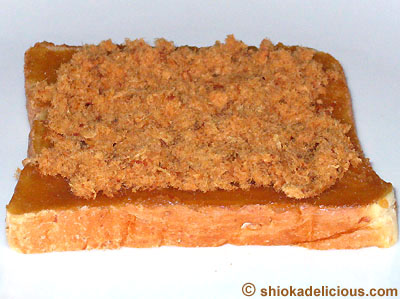
That is hardly ground-breaking, frontier-busting stuff, I know. We have been eating pork floss sandwiches for decades – long before floss buns became hip, happenin’ and yuppie-fied. Personally, I’ve always eaten my pork floss sandwich with butter. This was the first time I tried it with kaya. And I much prefer it with kaya – Hainanese kaya that is. (I think the pandan flavor of Nonya kaya may potentially interfere with the overall taste balance). The sweetness of the kaya is a lovely foil for the saltiness of the floss. The coconut aroma adds an interesting complexity to the overall flavor balance that isn’t there with just butter. And it sure beats the oily, greasy mayo-based commercial floss buns anytime, in my humble opinion. Kaya-floss toast has garnered a permanent seat on my “favorite toasts” list.
How else do I like my kaya and toast? Here’s one from my childhood. Kaya and cheese. It sounds gross. But it doesn’t taste anyway near weird. It actually works very well and tastes good. Again it goes back to the contrast and balancing of sweet with savory. It’s the juxtaposition of the creamy richness of the kaya with the soft gooeyness of the cheese. But, for the authentic taste experience though, it has to be a slice of processed cheese – the type that looks plasticky and comes individually wrapped in what else but more plastic. I’m serious. I think it works best with this type of cheese. None of the gourmet or “real” cheeses for this sandwich. Sorry.
Another long-time love… kaya and peanut butter. I guess one could call this the South East Asian version of peanut butter and jelly sandwich. It is still peanut butter with jam – only it is coconut jam and not fruit jam. Now, this one is really good.
Then again, I’m a peanut butter fiend, so anything with peanut butter in it is really good in my books. This is the gal who, as a teenager, would regularly, for tea, eat peanut butter straight out of the jar, by the spoonfuls! I was particular about my peanut butter. It had to be super chunky – not just chunky, but super chunky – when eating it out of the jar. But it had to be creamy when spread on toast or bread. Hey, a teenager is entitled to her idiosyncrasies, surely.
My all-time favorite peanut butter sandwich combination, to this day, is peanut butter with Nutella. Oh! Bliss! Divine gastronomic bliss! Forget champagne. Forget caviar. I love peanut butter and Nutella sandwiches!
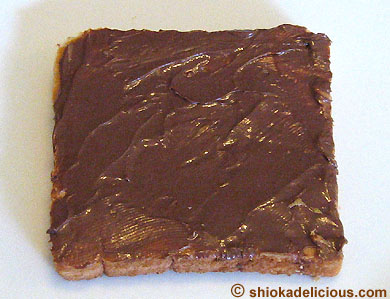
Chocolate with nuts, what could be better? This is a handsome trio – chocolate, hazelnuts and peanuts. The sweetness of the Nutella against the saltiness of the peanut butter. The sticky gooeyness of peanut butter balanced out by the smooth creaminess of the chocolate spread. A marriage made in foodie heaven, in my opinion.
Sometimes I like my peanut butter and Nutella on toast, and sometimes on fresh bread, depending on the kind of texture and mouth-feel I want from my peanut butter. On hot toast, the peanut butter softens and lightens, and feels smoother and creamier on the palate. But when I want that unique peanut butter experience of having goopy stuff getting stuck to the roof of my mouth as I munch on my sandwich, fresh untoasted bread is the way to go.
Another peanut butter combo that I like is this…

Peanut butter with sugar sprinkled over. This was actually taught to me by my cousin’s 8 year old. Sure, many people have grown up eating buttered toast sprinkled with or dipped into sugar. But I personally had not heard of peanut butter with sugar, until about 3-4 years back, when the little one came to stay with us for a short spell while her parents were away. Each afternoon, for tea, she wanted only peanut butter and sugar on toast. Tried as we might, she would not be persuaded to eat anything else for tea. “But this is the best” was the refrain. I have to admit, my initial reaction was one of slight skepticism. Peanut butter with sugar? Why I felt that was so strange compared to say butter with sugar I do not know. But I did.
Yet, the moment I tried it, I was hooked. It truly was good. I had to agree with her. It was way better than butter and sugar. The key, she sagely advised me, was to use creamy peanut butter, never crunchy, as the bits of peanuts would interfere with the feel of the crunchy sugar. She was of course right again. And I remembered thinking: I think we have a budding foodie on our hands. She was only around 4 or 5 at the time.
This aspiring food connoisseur also had a preferred way of eating her peanut butter and sugar toast.

She wanted the toast cut into small bite-sized squares – 16 bite-sized pieces to each piece of toast to be exact, to get her ideal-sized chunks – so that she could pop each piece whole into her mouth. This, as she told me, was to prevent the sugar from falling off the toast as it would if she bit into the full piece of toast. However, when in a pinch, and she had been told to cut the toast herself, she would gingerly cut the toast into four long fingers instead of the cubes. She could then still munch with minimal loss of sugar crystals.
This peanut butter and sugar combination works well as the crunch of the sugar is very subtle. Even the sweetness imparted by the sugar is subtle, against the saltiness of the peanut butter. It is actually less sweet than say putting jam or Nutella on the peanut butter.
One peanut butter sandwich that I used to really like, but which I now seem to have less intense feelings about, as I recently found out when I revisited it again, is peanut butter and bananas. I still like it, just not in a heart-melting, swooning sort of way anymore. The combination still works as well as ever though… sweet, soft ripe bananas thinly sliced and neatly arranged over a layer of peanut butter.
This one I have always felt very ambivalent about – butter and peanut butter. I know it is a favorite of many people. But for some reason my palate finds the taste of butter rather shudder-inducing when it is combined with peanut butter. Maybe I am just weird.
Talking about weird. This may sound way off to some people… Milo as a bread or toast topper. But it is seriously good! Really.
I grew up eating this. It was either buttered toast with Milo generously sprinkled over, or even better still, sweet condensed milk poured over the bread and then Milo generously sprinkled over. As a kid, the latter was the firm favorite. The combination was sweet, sweet, sweet. We are talking serious “blood sugar through the roof” sweetness.
I tried it again the other day, after decades of not having eaten it. Aiks! Way too sweet. Goosebumps inducingly sweet. I must be getting old. I now prefer the butter and Milo version.
What I do remember though are the little imagination games I played as a kid whenever I ate my Milo bread. See, I had two ways of adding the Milo to my bread. One way was to compact down the Milo into a semi-firm crust over the bread.
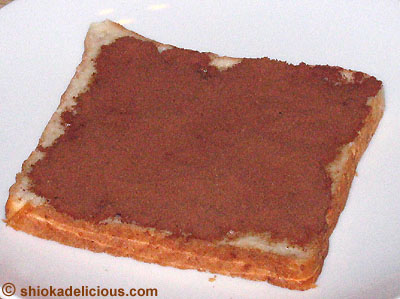
As I bit into the bread, the compacted Milo would give the teeniest crunch, and then dozens of tiny fault lines would appear and spread across the rest of the “crust”. I would watch fascinated. It was like looking at a mini earthquake happening on my bread!
The more fun way however was to sprinkle large amounts of Milo almost haphazardly across the bread.
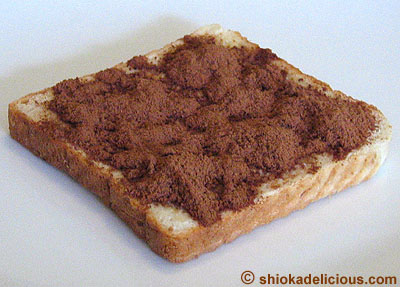
This created an interesting landscape, and the bread became my “Planet Milo”, with its windswept, dry, dusty brown surface of barren mountains, moors and valleys. Each time I had Milo toast, the landscape would change, depending on how I sprinkled the Milo.
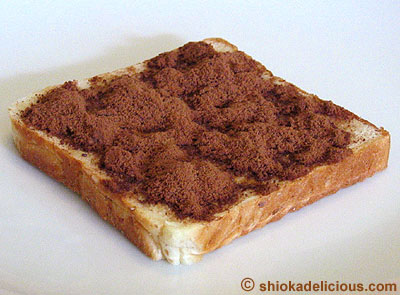
See, this landscape looks different from the previous one. Sometimes I had tall mountain ranges, sometimes it looked more like a craggy shoreline with overhanging cliffs, and yet other times I created flat smooth meadows with low rounded hills. I suspect a large part of my childhood enjoyment in eating Milo bread probably laid more in the opportunities it gave me to play with my food, then in the actual eating! (You can probably also tell how much fun I have been having revisiting these old “habits”. Well, someone has to do the research, right?)
My young mind even imagined and created a little retinue of fairies and elves that lived on my sandy Milo planet. I imagined them scurrying across brown streams and rivers and traversing sandy plains, going about their daily lives.
I also watched, fascinated, as the Milo slowly changed color and texture as the moisture from the underlying sweetened condensed milk (or butter) slowly seeped through, and turned the Milo into a soggy pile of powder.
Boy! Eating Milo bread was always so much fun.
Yes, it is obvious. I had a rather over-active imagination as a kid! Heh. Some would say that has not changed even now!
I think I should stop here before I reveal even more of my weird wacky eating habits, and embarrass myself further.
Oh, one final thing… I have to mention this, because I still enjoy this one to this day. Bread with ice cream. Yes, of course, this is actually the traditional Asian way of eating ice cream. So it’s no big deal. But I like mine with toast, so that the warmth of the toast starts to melt the ice cream as I munch on it. And I think it is even better with chunky ice cream – those with nice chunks of cookie dough, brownie bits or nuts. Yum!
This is the de-stress comfort food for me. If you see me scoffing ice cream toasts, you know I am stressed!
Okay, c’mon. Your turn. What quirky, interesting, wacky, funny or even weird bread/toast-eating habitual “skeletons” do you have hidden in your kitchen cupboard?
Copyright © 2004 Renee Kho. All Rights Reserved.
Please contact me for permission to copy, publish, distribute or display any of the images or text contained in this article.
03:20 AM in Home Cook: Light Touches | Permalink | Comments (18) | TrackBack
Monday, March 22, 2025
Monday Blues

This was my breakfast this morning. A nice bluesy start to the day, and week. Bluesy not in the sense of feeling low and blue, but more as in swingin’ and dancin' to the Blues. What a nice happy feelin’!
It’s organic blue cornflakes by Health Valley. I love the color of blue corn. I also like its sultry nutty taste. While blue cornflakes may not be as crunchy as regular cornflakes, its complex flavors and textures stand head and shoulders over the usually very bland (and nutritionally questionable) regular cornflakes. The cereal is only lightly sweetened by organic cane juice, and the natural lightly savory overtones of the blue corn make for a nice change from the usual sweet breakfast cereals.
This morning I had the cereal with organic hazelnut “milk”, topped with my usual sprinkling of lecithin granules. Ah! Purple and yellow. Rather pretty me thinks. A nice cheerful start to the week.
Happy Monday, everyone!
Copyright © 2004 Renee Kho. All Rights Reserved.
Please contact me for permission to copy, publish, distribute or display any of the images or text contained in this article.
02:03 PM in Home Cook: Light Touches | Permalink | Comments (2) | TrackBack
Saturday, March 13, 2025
First Time Lucky

You know that happy little feeling you have inside when you’re trying to do something you’ve never done before, and you suspect you could well end up falling flat on your face, but then you don’t, and you succeed beyond what you thought you would? Well, I had that little feeling today. And it felt good. A nice way to start the weekend.
Okay, it was no big deal – I made fish cakes… salmon fish cakes to be precise. Still, I felt quite proud of myself. I had never made fish cakes (i.e. those along the lines of crab cakes, and not the regular Chinese fish cakes sold in the markets and supermarkets here) before. I had mentioned in my “ramekin” post that I was thinking of making salmon fish cakes with the leftover breadcrumbs. I have actually been thinking about making salmon fish cakes for months, but have just never gotten around to looking for a recipe from which to make them.
Yesterday a girlfriend had called to say she wanted to stop by and drop off some stuff, so I invited her and her 5 year old little girl over for lunch today. I would make something light I said. As it turned out, events of this morning didn’t give me time to cook. So I needed to make something quick and easy. I decided to make the salmon fish cakes – sans recipe. I was just going to fly by the seat of my pants.
Took out a piece of salmon fillet from the freezer (approximately 350g), and left it to thaw while I busied myself with whatever it was that I had to be busy with. By the time I returned to the kitchen, the salmon was ready to be cut into approximately 1 cm cubes. Can you believe I even vacillated as to what sized cubes to cut the salmon into? I wanted the salmon dice to be bigger, but was afraid they wouldn’t “stick” nicely together to form well-shaped cakes. I didn’t want to cut them too small because they would cook too easily, and I really, really cannot stand over-cooked, dried-out salmon. And so I settled on the in-between size of 1 cm. Ha! So, now I know how some of those cookbooks come up with instructions like “dice celery into 7mm cubes”! Anyway, that is another story.
With the salmon all nicely cut, I was stuck as to how I wanted to flavor it. Time was short, so I fell back on my old perennial favorite... the marinade for my hoisin sauce salmon. I didn’t want the salmon too “wet”, so only 2 heaping teaspoons of hoisin sauce and a generous sprinkling of pepper went into the fish. I left it to sit for a few minutes while I chopped up a sizeable bunch of coriander.
In went the chopped coriander, and the leftover bread (crumbled into coarse crumbs with the fingers). I don’t know how much breadcrumbs there was. I simply emptied the whole zip-lock bag worth of leftover bread. If I was to hazard a guess, I’ll say maybe between ½ and ¾ cup? However, after seeing and tasting the final result, I would say breadcrumbs are not really necessary. I think the cakes will hold together fine without any binder, as long as they have had enough time to sit in the fridge before being pan-fried.
Once the salmon, coriander and breadcrumbs were evenly mixed, I immediately formed them into cakes of approximately 2 to 2½ inches across and around ¾ to 1 inch thick. Each of the five salmon cakes was individually wrapped in cling film and molded into the desired pattie shape. It’s best not to form and wrap them into ball-shaped cakes, as there will be difficulties, when the time comes to cook them, in flattening them out without them breaking apart. The cakes went back into the fridge, to allow the shapes to set and to allow the fish to macerate a little longer in the marinade. I left them in the fridge for around 40 minutes. But if there is time, I think 1-2 hours would be ideal, and then the cakes can do without the breadcrumbs, and still hold their shape nicely.
With the salmon out of the way, I started worrying about a condiment for the fish cakes. It just felt too plain and boring to serve salmon cakes on their own. What to do? What to do? The simplest thing I could think of was a light, refreshing, maybe piquant salsa of some kind, to balance out the rich fattiness of the salmon meat.
I settled on a cucumber chilli salsa…

First, one Japanese cucumber was finely diced. Then, I had to play around with the flavorings, as I did not even have any concrete ideas about what I was trying to achieve. I was just going along, hoping to create something that tasted good.
The quantities are thus, once again, very “agak” (estimations by sight), as I was adding and re-adding as I tasted and mixed. To cut a long story short, at the end of it, I had used approximately 2 tablespoons Thai sweet chilli sauce (for its nice chunky texture with chilli flakes and seeds), 1 tablespoon Lingham’s chilli sauce (to give more body to the sauce and balance out the weak, liquidy body of the Thai chilli sauce), ½ tablespoon of tomato ketchup (for a touch of tangy overtones), ½ tablespoon of white rice vinegar, ¼ to ½ teaspoon of sugar and a pinch of salt. Everything was mixed together with the cucumbers, and popped back into the fridge to chill and macerate. It would have been really nice to have been able to add some finely diced fresh red chillis and fresh pineapple, but I had neither on hand. Still, the salsa worked really well with the salmon cakes.
The cakes were fried up after my friend arrived. And I had the wonderful help of a little 5 year old sous-chef. Each cake was dipped in some lightly beaten eggs, and then coated with panko (Japanese breadcrumbs), before being pan-fried in a non-stick frying pan with very little oil - just a few tablespoonfuls for the whole batch – until it was a rich golden brown on both sides.
My biggest concern while frying the cakes was that maybe I had made the cakes too thick, and that the centers were not going to get cooked through. As it turned out they came out just right. I was really surprised how much so. The salmon was just about cooked through… right on that borderline between being undercooked and overcooked. Ha! What fluke! What luck! But I think it helped that I used a very low flame to fry the cakes, so it gave enough time to cook the fish while the cakes were browning. I also think it was quite important that the cakes were not flipped until one side had reached the desired color. I just feel it would have worked less well if I had kept flipping the cakes.

The cucumber salsa-ish condiment - sweet, tangy, piquant, crunchy - worked really well with the salmon cakes. The fish was nicely moist, juicy and tender.
As for the little one, I made her a salmon burger. I simply split a small wholemeal soft dinner roll, and lightly toasted it in the toaster oven. Added the salmon fish cake and a dash of tomato ketchup. Her verdict? She declared it the “best hamburger she has ever eaten”. So juicy she said. Her only complaint… I didn’t have any fries to offer her. But she was willing to settle for some potato crisps (if you’re English) or chips (if you’re American).
Unfortunately, there are no pictures of the mini salmon burger. The little one had watched with spellbound fascination as I took pictures of the salmon cakes. She too wanted to take her own picture of her salmon burger. Alas, a little too much camera shake and her picture didn’t turn out. She was disappointed, but we promised we would make these “pink hamburgers” (as she called it) again soon. And I do think these salmon cakes would make great “adult burgers” too – maybe with a mango salsa, pineapple salsa or onion marmalade, and with sweet potato fries on the side.
Copyright © 2004 Renee Kho. All Rights Reserved.
Please contact me for permission to copy, publish, distribute or display any of the images or text contained in this article.
03:20 AM in Home Cook: Fish & Seafood, Home Cook: Light Touches | Permalink | Comments (16) | TrackBack
Wednesday, February 11, 2026
A White Breakfast

I had a white-colored breakfast today. It wasn’t planned, it just happened that way. After getting home from Pilates class this morning, I had barely enough time to hop in the shower, change, grab some nosh (and take some pictures ) before having to dash out again to meet a client.
I pulled from the fridge the first things that caught my eye when I opened the refrigerator door. There was half a tub of natural set “European style” yogurt, leftover from cooking last night’s dinner. A quick sprinkle of home-made honey roasted sesame cashew nuts (leftover from CNY) sweetened the yogurt and gave a nice aromatic crunch.

Then, a packet of Unicurd’s almond flavored tofu dessert. I like this a lot actually. It is essentially silken tofu, sweetened with a little syrup and flavored with almonds. It also comes in green tea (which I like), regular (good for adding own flavors) and mango (which I don’t like) flavors. It’s very similar to the traditional Chinese “dao fu hua” soybean curd dessert, only maybe slightly firmer (so that it holds the cube shape very nicely). I think Unicurd’s version is minus the Plaster of Paris that is usually added during the making of the traditional dao fu hua. Forgot to double check the ingredients listing on the package on this. Also forgot to take a picture of the packaging before chucking it away. I find this very convenient. It’s versatile too. One can create many different desserts and snacks with this.
So that was my breakfast. It looks light, but it was actually quite filling, and gave a nice little protein boost too. I like to have a sweet start to the day. Actually, it doesn’t have to be sweet. It just has to be non-savory. For some reason, my body finds it too much of a rude awakening to have to start the day with something like eggs and ham, or even the traditional Chinese breakfast staple of congee with savory condiments. And my stomach churns at the mere thought of having fried bee hoon or noodles for breakfast. Give me cereal or bread any day. Okay, there is one exception… dim sum. But then again, that usually happens at brunch.
What did you have for breakfast today?
Copyright © 2004 Renee Kho. All rights reserved.
Please contact me for permission to copy, distribute and display any of the images and text contained in this article.
11:03 PM in Home Cook: Light Touches | Permalink | Comments (8) | TrackBack
Sunday, January 04, 2026
Easy Delights

This is another laggard posting on Christmas food (or at least Christmas food that we ate).
One of my favorite foods is cheese with fresh crusty bread. There is nothing quite like chomping down on an aromatic hunk of freshly-baked bread generously filled with chunks of rich gooey cheese. (I’m not much of a hard cheese person, unless it comes melted down in a grilled sandwich or something.) I think it’s a perfect combination – crispy bread crust, soft creamy cheese. Mmmm…
I also like bruschettas a lot. I find it to be a very versatile food. And I like versatile food (if you haven’t been able to tell already ) Oh, perhaps I should first clarify that the “definition” of bruschetta that I use is the “globalized” (or some might argue “bastardized”) one. If I’m not wrong, the original Italian bruschetta is nothing like what now gets called “bruschetta” in many, many restaurants across the globe. The traditional Italian bruschetta is simply slices of toasted bread that are rubbed with cloves of garlic, then drizzled with extra-virgin olive oil, and seasoned with salt and pepper.
Then along came what used to be called Pacific Rim cuisine, pan-Asian cuisine or fusion food, with cutting-edge chefs in California, North-West USA and Australia leading the way, forging new frontiers in the “new-age” palate. Bruschettas began to appear on menus in all guises… ranging from simple fares like tomatoes and garlic or spicy tuna, to decadent indulgences of foie gras or Kobe beef cappacio.
Nowadays, it would seem that just about any warm open-faced sandwich would pass as a bruschetta. So with apologies to the Italians and other food purists, my concept of bruschettas lies on the internationalized end of the spectrum.
I had intended to make two types of bruschettas for Christmas Eve, to serve as finger food and to keep tummies from rumbling too much while waiting for the rest of the food to be served. I ended up making three – sort of.
I like bruschettas as party food. They’re so easy and quick with countless possible variations, and everyone likes them.
The first variety was sautéed garlic mushrooms on a walnut and onion loaf (I used the walnut and onion Milano bread from Delifrance).

Next was olive bread (again Delifrance’s Milano olive loaf) topped with fresh tomatoes, garlic and coriander...

These were slightly less successful than the mushroom ones, even though they were all polished off just the same. (I had very hungry guests!  ) I think the tastes of this one were perhaps a touch too strong. I was lazy. I had contemplated giving the tomatoes, coriander and garlic a quick sauté to take the raw edge off them. But I was rushing to complete the other main dishes, I was pressed for time, so I just mixed the blanched, skinned and diced tomatoes, finely chopped garlic and chopped coriander with a dash of sesame oil, a little extra virgin olive oil, salt and pepper, and dumped them on the bread which had been spread with a (very) thin layer of garlic margarine (no mustard). More shredded cheddar cheese sprinkled on top, and into the oven toaster for 2-3 minutes. These tasted great – if you like the taste of raw garlic and raw coriander. They would have tasted better if the ingredients had been quickly sautéed. Oh well.
Now these taught me a great lesson that evening, about food, dining, cooking and making mistakes…

These were a mistake “made right”, so to speak. The “bread” from which these cheese bruschettas were made were the dismal results of my second attempt to make American biscuits. My first hadn’t worked. And I was determined to try again. This time, attempting to make cheese biscuits, with the intention of serving them with the lamb shanks. Maybe I just don’t have the necessary genes to make biscuits! I just couldn’t get them to rise. I can make scones. But I can’t make biscuits. And yet they are fairly similar. Sigh!
My so-called cheese biscuits tasted pretty good – very cheesy with a soft, fluffy bread-like crumb. But they just did not rise! Urrgh! So they sat forlornly in the bread box, destined not to see the light of day at the Christmas Eve table. Until I was suddenly struck by an inspiration. (Yes, the proverbial lightbulb going off in my head). How about turning them into bruschettas? They were highly edible. They just did not have the appearance of biscuits. Well, let them be bread then. Hey, I’m not complaining. As I had not planned on doing this, the only thing I had that I could throw on them was cheese. Which was fine. Cheese on cheese biscuits, why not? Ha, I even managed to do two versions of this! One version was to spread the biscuits with garlic margarine and top them with grated parmesan. The second version had the biscuits being spread with honey mustard (I ran out of garlic margarine and couldn’t be bothered to make anymore) and topped with parmesan and cheddar.
Ha ha, these were eaten up almost as soon as they were taken out of the oven toaster. I didn’t even get a chance to plate them properly. People just sort of wandered into the kitchen and helped themselves! Okay, so they were hungry. Where is the main meal already? But seriously, throughout the evening, people were looking to see if there were still any of these left. For some reason, the combination of cheese “bread”, honey mustard and cheddar seems to work really well. Even I was surprised! The parmesan/cheddar one worked much better than the parmesan/garlic one. Maybe I should have added cheddar to that one too.
But I learnt something important… maybe there just isn’t any “real” failures in the kitchen (unless of course the food is burnt beyond recognition, it’s rotting or in some other way totally inedible, or it's edible but not without serious risk to life and limb). What I had deemed as my second abject failure to make American-style biscuits was actually thoroughly enjoyed by others.
At the end of the day, it really doesn’t matter how or what the food “should” look or taste like, according to some pre-set (by whom?) norms/criteria/standards or according to some recipe. If it tastes good, it is good food!
Here’s to many more adventures in the kitchen!
Copyright © 2004 Renee Kho. All rights reserved.
Please contact me for permission to copy, distribute or display any of the images and text contained in this article.
01:34 AM in Home Cook: Light Touches | Permalink | Comments (6) | TrackBack
Tuesday, December 16, 2025
Mango Tango

I have been experimenting with mango salsas over the last couple of days. Yes, we are still (valiantly) trying to eat and use up all the mangoes that came off the two trees in the garden over the last few weeks. I thought I would take up a suggestion Wena gave me and use it with fish.
The idea was to make a Thai-style mango salsa. After all, mangoes are an integral part of Thai cuisine – they are used raw in salads, added to cooked dishes and are a popular ingredient for Thai desserts. The sweet and tangy flavors of mangoes are a sublime match for the sweet, sour, salty, spicy tones of Thai food. I wanted to create the sweet, sour, tangy flavors, maybe with a slight Chinese touch, and match it with a simple steamed or fried fish. It had to be quick, it had to be easy. I also decided I would prefer a salsa with some “gravy” to it, rather than a standard “dry” salsa.
Japanese cucumber (unpeeled), onion or shallots (I tried both, and both work very well, with just a slight difference in sweetness between the two) and carrots were cut into thin strips. These were combined and soaked in a marinade of vinegar, salt and sugar. The vegetables were left to marinade for a good few hours, to allow all the flavors to meld. Just before putting the salsa together, some sweet Thai chilli sauce was added to the vegetables.
The mangoes were also cut into thin strips, and set aside. I didn’t want to add this to the vegetable marinade as I suspected the mangoes might go too mushy from sitting in the vinegar. Also, I wanted to keep the taste of the mangoes very pure.
Separately, some Chinese plum sauce (approximately 6 tbsps?) and a little hot water was put into a frying pan, and seasoned with Thai fish sauce (nam pla) to taste. As the sauces came to a boil, a little cornstarch solution (cornstarch dissolved in a little hot water) was added to thicken the sauce to the desired consistency. Once the sauce came to a boil again, it was removed from the heat and the vinegar-marinated vegetables, together with the mangoes, were added and mixed well .
The colors were beautiful – vibrant yellow mixed with green, white and orange, with specks of red from the chilli sauce. On hindsight, perhaps I should have also added strips of fresh red chilli for even more vibrant colors. I had been wary of making the salsa too spicy, but I think it would have been fine with some chilli strips, adding a different layer of flavors on top of the chilli sauce seasoning. In fact, I should have added more chilli sauce than I did.
I served the salsa on both steamed and pan-fried whole pomfret. I would have preferred using fish fillets, but I didn’t have any in the freezer. I think the salsa probably worked better with the pan-fried fish than the steamed. Either way though, the flavors were great! Very appetizing… tangy, sweet and very slightly spicy. Really shiok!
Another idea occurred to me… this would work great with deep-fried battered fish nuggets or fish fillets (a la fish & chips). I think a beer batter with this might be interesting or a Japanese tempura-inspired batter would be nice too. And instead of a “watery” salsa, I would dice the vegetables, marinade them in the vinegar mixture, add the chilli sauce, plum sauce and fish sauce (but no water), before adding them to plain yogurt, and using it as a dip.
Hmmm… well, there is still half a carton box of mangoes sitting in the pantry… and they do have to be used up before they become over-ripe... hahaha… I think the family could be quite sick of mangoes by the time I’m through! 
Happy mango tango-ing!
Copyright © 2003 Renee Kho. All rights reserved.
Please contact me for permission to copy, distribute or display any of the images and text contained in this article.
02:52 AM in Home Cook: Fish & Seafood, Home Cook: Light Touches | Permalink | Comments (2) | TrackBack
Tuesday, December 09, 2025
It’s a Good Thing

What is that goop??? You ask.  It is warm oatmeal sprinkled with demerara sugar. Yum! The partially melted sugar crystals give a very nice sweet crunch to the otherwise bland oatmeal. There is almost a nutty taste to the sugar.
But why on earth am I blogging about oatmeal of all the food in the world? But why ever not? Okay, granted, glossy, creative, arty-looking photos of elegant recipes have become almost de rigeur in a lot of foodblogs. There’s nothing wrong with that. I absolutely enjoy taking in the glorious, mouth-watering pictures, and thus taste different cuisines and cooking styles vicariously through them – they inspire and whet the appetite of mind, body and soul. But I think there is also room for the everyday food. What you and I eat everyday, which we don’t blog about, maybe because it doesn’t have enough “glam factor”. It’s the comfort food, the easy food that we throw together to feed ourselves and our families, which are simple yet heart-warming. The down-too-earth soul food so to speak.
Alright, many people might dispute that oatmeal can and should be considered as “soul food”. But it’s good wholesome, natural food. And when paired with demerara sugar or sometimes even sweet condensed milk, “it’s a good thing” (as Martha would say).
Where exactly am I going with this oatmeal thing? Nowhere really. Today was a Monday. And Monday mornings are tough. It took all my will-power to get out of bed this morning and drag my sleep-deprived body off to Pilates class. I could feel the weekend indulgence of food and laziness in every muscle fiber as I willed them to move and contort through their paces. And yet the rewards are sweet. By the end of class there was a buzz in my body, a spring in my step and a smile in my heart. I felt energized and happy. Added to that, the simple breakfast of demerara oatmeal just made for a very comforting start to a brand new week…
Alright, alright, enough of this ramble already. I guess it’s painfully clear by now I have nothing much to blog about tonight. Haha… So, I’ll just say g’nite!
Copyright © 2003 Renee Kho. All rights reserved.
Please contact me for permission to copy, distribute or display any of the images and text contained in this article.
03:47 AM in Comfort Food, Home Cook: Light Touches | Permalink | Comments (7) | TrackBack