Tuesday, June 29, 2025
Min Jiang

My family and I have been dining at Min Jiang since it first opened in the early 80s. In those days, each week without fail – sometimes even a couple of times a week – we would eat at the restaurant. And almost invariably we would order our firm favorites: zhang cha ya (tea-smoked duck), xiao long bao (steamed soup dumplings), guo tie (pan-fried pot-stickers), tian suan yu pian (sweet and sour fish slices), gan bian shi ji dou (dry-fried “four seasons” beans), gui hua chi (shark’s fin scrambled eggs), dou sha wo bing (pan-fried pancake filled with red bean paste) and several others. These were dishes the restaurant did well, and did well consistently (a rare feat in this City).
Throughout the last couple of decades, Min Jiang has remained firmly on our list of reliable options when it comes to good Chinese food in Singapore. It is one of those restaurants you don’t think much about, and yet when you need to come up with a place to eat well-cooked Chinese food, it invariably comes to mind.
I had always thought it had weathered the years well. In a town where restaurants could come and go in a blink of an eye, very often within a matter of months, Min Jiang had stood the test of time. Not once had its standard of food and service fallen. It had been nothing but consistent.
The décor remained unchanged in the 20 plus years, and indeed I think many of the service staff were there from day one and grew with the restaurant. The service was always very efficient, courteous and professional, even when they were at their busiest and bursting at the seams. The food was always good. You never had to worry about having a disappointing meal there. And the prices, while not cheap, were not likely to bust the bank either. We were quite happy for Min Jiang to remain as it was, unchanging, constant and reliable.
But as with all things in life, change inevitably comes. While its business had always been pretty consistent, the management at Min Jiang obviously felt that the restaurant was losing out on the young, urbane consumer base – that sector of society that had high disposable incomes but was attracted only to flashy, modern places, and not “old” classics like Min Jiang. Its regular customers may have remained fiercely loyal, but these were, in the main, of the middle-aged demographic or, the younger generation like me who grew up eating there with our families. The young professionals, however, were giving it a decidedly cold shoulder.
So, it moved – into the main hotel building of Goodwood Park Hotel, from the stand-alone side building it had occupied for over 20 years. The décor changed from a classic, elegant Chinese get-up to a modern, edgy one, replete with spot-lights, halogen down-lights, wooden flooring and paneling, back-lit marble walls, floor to ceiling mirrors and full height glass windows. It even became the very first Chinese restaurant in Singapore to offer al fresco dining, by the pool – another obvious attempt to attract the hip and trendy who favored sitting out in the hot, humid and sweltering weather.
I had not been to Min Jiang since their move, and so I figured my birthday was as good a time as any to give their new set-up a trial run. It also made for a nice change from the usual formal French or Italian dinners I normally got as birthday dinners.
When we arrived at 7.45pm, the place was buzzing. It had obviously been very successful in achieving its goal: almost all the tables were filled with professionals and executive-looking types. The mostly families clientele was gone.
I could not say I particular liked the new layout. The space was extremely narrow and long; with the partitions that segregated the service stations exaggerating this sense of tightness and length; which also resulted in some of the tables being placed in awkward corners. And maybe I’m just old-fashioned or too attached to the old place, but I preferred the spacious Chinese-style ambience more than this in-your-face modernism. The new edginess also seemed strangely at odds with the hotel’s own neo-classical, colonial-style building within which the restaurant now sat.
It also appeared that the large majority of the long-time staff members (the wonderfully knowledgeable and reliable Captains or Maitre ‘Ds and other wait staff) had been replaced by nubile and attractive young things. There was nary a familiar face that I could recognize. I guess, sadly, age and experience just didn’t hold up against youth and beauty in the management’s new bold marketing strategy. But at least the new staff was also very well-trained – on the whole. They were polite and even friendly, but they also pretty much ignored you the whole evening, unless they were bringing food to your table. Our plates were not changed a single time during the entire meal. At one point, one of our party had to do a DIY and went and got clean plates for us from the service station. Oh, how I missed the unobtrusive but ever observant older staff who changed the plates without fail after each course, or at the very least after two courses; who paced the meal just right for you; and who anticipated, a lot of the time, your needs.
As for the food? On the whole, it was still very good.

We started with the vegetarian guo tie (pot-stickers) as appetizers. I had always liked Min Jiang’s guo tie, which I felt were some of the best in town. Their version had all the characteristics of a good guo tie – thin and smooth skin that was soft and succulent at the top of the dumpling, and most importantly, was crispy and crunchy at the bottom. It sounds simple, but you would be surprised at how few places get it right. Sometimes the bottom would be under-cooked, without that incredibly tasty golden-brown crust; while at other places, the tops would be cooked to a crisp golden-brown too, along with the bottoms, making them fully pan-fried dumplings rather than pot-stickers, which in essence are dumplings that have been cooked by a combination of pan-frying and steaming, all in the same pan.

These vegetarian guo tie were good – incredibly tasty, with the most delectable golden, crispy bottom crust. The filling – a mixture of chopped xiao bai cai, Chinese mushrooms and mock ham – was generous, and very well flavored. One thing has to be said about Min Jiang’s food: the flavors are always incredibly well-tuned; no over-salting, no jarring notes, just a harmonious and finely balanced combination of tastes and aromas. I was glad this had remained unchanged. Another thing that had remained unchanged: no MSG! The one thing I wasn’t overly enthusiastic about with these guo tie was their slightly greasy mouth-feel – more oil than normal had been used to cook the dumplings.

Next up were the stir-fried fresh scallops in XO sauce. Another gorgeous tasting dish. The extra large scallops were super fresh – briny, succulent and juicy. Absolutely delectable! The home-made XO sauce (a spicy dried scallop-based sauce) was probably not as spicy as other versions, but again, bursting with intense yet well-balanced flavors. I thoroughly enjoyed this dish.

Even the accompanying steamed broccoli, so often neglected and treated as mere garnish, was beautifully tender with a nice crunch, rather than being hard and undercooked as was often the case. The only let-down of the dish – again the rather generous use of oil.

This was the birthday girl’s special request: stir-fried prawns with cashew nuts. This came plated sort of Western-style; and it was another thing about the new Min Jiang that didn’t sit too comfortably with me – this vague half-hearted attempt at serving up Chinese food Western style, and with only some of the dishes and not all. Anyway, this was another excellent dish on the whole.

The prawns were brimming with briny freshness and were gorgeously succulent and crunchy. I liked that they were naturally crunchy and not made crunchy from being soaked in some solution which turned normal prawns into super crunchy “glass prawns” (buo li xia) but which also leached every ounce of flavor from the crustaceans. These prawns were beautifully tasty and flavorful. And at almost S$3.00 per prawn, they had better be!
The cashews were divine. But then, I absolutely adore cashew nuts. These ones were very fresh and had been deep fried in oil that was also very fresh, so there was none of that rancid after-taste which often happened. These nuts were crunchy on the outside but nicely tender on the inside, and were the perfect foil for the prawns. The snow peas were wonderful too – flash fried to crispy yet tender perfection.
It must have been a new chef at the helm, and one that was consistently rather heavy-handed with the cooking oil. By this time it was starting to sit uncomfortably with us; the greasy mouth-feel of each dish was starting to be a little heavy-going.

The fish course came: steamed snow-fish (or cod fish) with crispy soybean crumbs. This was another well-put together dish, if not for the oiliness. The flavors were wonderful; pristinely fresh fish with a most more-ish and desirable crunchy, crispy deep-fried soybean crumb topping. Taste-wise it was magnificent. The pairing of textures and flavors were most inspired – the moist, juicy, succulent, buttery, melt-in-the-mouth texture of the snow-fish was perfectly complemented by the crisp crunch of the topping; the blandness of the fish provided the perfect canvas for the intense, rich savoriness of the soybeans. Every mouthful was a textural and taste delight.

[Sorry, lousy picture, I know.]
However, yet again, the over-generous use of oil, coupled with the naturally unctuous nature of the snow-fish tipped the balance into over-kill. After only two small pieces of fish each, we were all satiated, no matter how tasty the fish or how more-ish the topping.

And of course, a Chinese-style birthday meal would not be complete without noodles (a symbol of longevity), so we had fried yee fu mein. Instead of the crab-meat version listed on the menu, we requested for the classic vegetarian variant – yee noodles sautéed with jiu huang (yellow chives) and various mushrooms.
Min Jiang’s yee mein had always been a favorite of mine (and my family’s). It had been consistently on my list as one of the best ones in town. And it was still very good. The beautifully rich and intensely flavorful superior stock used to cook the noodles had always been the secret to its scrumptiousness. Yet, this time, it was again that cloying oiliness that let the dish down. When I had slurped up my small bowl of noodles, what was left sitting at the bottom of my (very small) bowl was a pool of at least three quarters of a tablespoon of oil!
Finally, we had my favorite Chinese dessert: wo bing (pan-fried Sichuan pancakes with a red bean paste filling). [Sorry, my camera battery had died on me by then, so pictures will have to wait until my next visit.] I adore wo bing, and Min Jiang’s version has always been one of my favorites; and it was still very good. But again, that oiliness!
Overall, it was a very good meal. Min Jiang had always been excellent in producing beautifully tasty dishes, and this had not changed. It had also remained judicious in the salt department. I was glad too that it had stuck strictly to its “no msg” code of practice. But whereas previously it had also been careful and well-balanced with the oil, it was now loading it on a little too heavily, to the point where it was felt quite obviously in all the dishes served. And that was a little disappointing, for all the dishes were so wonderfully flavorful and tasty otherwise.
The prices, as to be expected with any move or upgrade of premises, had gone up by between 15-25%, depending on the dish. That was not too bad I suppose, but coupled with portion sizes that had shrunk approximately 10-15%, that would make a meal at Min Jiang (unscientifically) about 25-40% dearer!
To be honest, I miss the old Min Jiang. I miss the familiarity and comfort of the old layout, and the seamless efficiency of the previous service and kitchen teams. I miss the consistency and reliability. I think certain things have been lost in the modernization, and it is a pity. No doubt, the firm and strong foundation of the restaurant’s 20 odd years of history is still there, and still sound. But there are also some obvious rough edges to smoothen out. To be fair, it has been opened at the new location for only about three months or so, and perhaps a little more time is needed to break the new teams in. I am still willing to go back and give it another try, but maybe only in several months time. Hopefully things will have settled down by then. For now, this restaurant still remains, albeit a little tentatively, on my list of “regular” good eating places.
Min Jiang Restaurant
Goodwood Park Hotel
22 Scotts Road
Singapore 228221
Tel: 6737 7411
Copyright © 2004 Renee Kho. All Rights Reserved.
Please contact me for permission to copy, publish, distribute or display any of the images or text contained in this article.
06:08 PM in Lion City Shiok-Eats: Chinese | Permalink | Comments (8) | TrackBack
Saturday, May 15, 2025
Crystal Jade La Mian Xiao Long Bao

Last Sunday, sort of by default, we ended up having Mother’s Day dinner at Crystal Jade La Mian Xiao Long Bao. We had left the choice of restaurant to my mum. And since Mum’s favorite cuisine is unquestionably Chinese food, the shortlist came down to her three “more favorite among the favorites” (if you know what I mean) restaurants – Ming Jiang, Peach Garden and Crystal Jade Shanghai. All three were only minutes from home, but Crystal Jade Shanghai was the nearest and a mere stone’s throw away. Since we had not made any reservations, and it was Mother’s Day when the throngs would surely be out in full force, and with the whole family in a casual mood and wanting something easy, simple, fuss-free and close to home, we decided on Crystal Jade Shanghai at Great World City.
The only problem was we had not been to Crystal Jade Shanghai at Great World City in at least 3-4 years. Even though my mum really liked the restaurant and we used to dine there with her on a very regular basis, of late, we had been taking her elsewhere, so she too had not visited the restaurant in a long time. And in our absence, Crystal Jade Shanghai had morphed into Crystal Jade La Mian Xiao Long Bao – technically at least. In reality, they still served the full “formal” Shanghai a la carte menu, but now also offered an additional more casual, mass-market menu of noodles and dumplings.
The change makes good business sense. A casual restaurant will inevitably have a wider-appeal, have a higher table-turnaround rate, do more covers, have more repeat and regular customers and simply be more profitable in every way. It is telling that out of this established restaurant group’s 23 restaurants in Singapore alone (not counting their bakeries and cake shops), 18 are casual eateries under the Crystal Jade Kitchen and Crystal Jade La Mian Xiao Long Bao brand-names.
We surmised that with the opening of the group’s flagship Shanghai restaurant, Hu Cui, in Ngee Ann City, it no longer made sense for them to keep this much smaller outlet as a formal Shanghai restaurant. And thus the renaming and rebranding exercise for the outlet.
Since all of us were dressed too casually (and felt too lazy) to trek down to Hu Cui, and since the Captain (i.e Maitre D) assured us that they were indeed still serving the full Shanghainese menu, we decided to eat there anyway.
I have to say the food there is still very good. For restaurant groups with a chain of outlets, it is never possible to achieve consistent tastes from outlet to outlet, even if the menus are all identical. (Unless of course, you are a hamburger fast food chain.) When it comes to food and cooking, the same recipe cooked by two different individuals will invariably produce two distinct dishes with different nuances of tastes, flavors and style. In this instance it appears that it is still a good team that is helming the kitchen at this outlet.
We ended up ordering a few dishes from the full menu and a few more from the casual menu. As usual, we ordered way too much food.

This was seabass in chilli sauce. It was very good. Lots and lots of diced onions gave the sauce a wonderful sweetness. It wasn’t very spicy, but there was just enough chilli heat to titillate the taste-buds and give the dish nice oomph. It was sort of like a much spicier and yet lighter-in-feel version of a regular sweet and sour sauce. Since we had skipped ordering rice altogether, the chilli level was just right for eating the dish on its own. We liked the gravy, and I think I would even try to recreate it at home to serve with fish and prawns.
The fish was very well done. The pieces of succulent, very fresh seabass seemed like they were very quickly flash deep-fried before being steamed (or perhaps vice versa). And this made them wonderfully moist and juicy with a melt-in-the-mouth texture.

Gong bao ji ding or diced chicken sautéed with dried red chillies and cashew nuts. This used to be one of my favorite chicken dishes. I haven’t had it in ages, so it was nice to revisit the dish. And I really liked this version. Again, the chilli heat was somewhat moderated, but the gravy was what really attracted me. It was slightly sweet, somewhat spicy, and yet savory and very flavorful. I almost single-handedly polished off most of the dish!
The cashew nuts were fresh and not over-cooked. Sometimes there is a tendency to deep fry them for too long, and they come out tasting over-cooked and rather hard. These were just nice. And I simply love cashew nuts!
[Just a little side note, if you want to cook with dried chillies at home, it’s good to blanch them very quickly in very hot oil (like what the restaurants do), and that lifts their color and flavors immensely. They are wonderful to cook with, giving dishes a more complex spicy note than with just fresh chillies alone.]

Yes, we ordered gan bian si ji dou or dried fried “four seasons” beans again. Our family does like this dish a lot. However, we weren’t overly enthusiastic about this version. It was good, just not terribly exciting. We still preferred the Silkroad and Min Jiang versions.

Tianjin cabbage. This was a very nice dish. It’s an incredibly simple dish. But therein lies its beauty. Just some Tianjin cabbage (which is so much sweeter and more tender than local cabbages) sautéed in superior stock with garlic. No embellishments. No strong seasonings. Just the unadulterated natural sweetness of the cabbage. Very nice!

From the noodles menu we ordered another of our family’s favorites – zha jiang mian or noodles with a bean paste minced meat sauce. Almost invariably, if this dish is on the menu in a restaurant we will check it out. 
This was an interesting incarnation of the dish. It was the first time we had seen it served with such a generous helping of gravy. And thick, opaque, dark gravy at that, with a consistency almost reminiscent of the local lor mee! At first glance, it seemed a little like over-kill. Normally, we would baulk at having our la mian drowning in so much sauce. It just didn’t look like authentic zha jiang mian at all. Things didn’t look too promising…

But it tasted very good. The gravy was redolent with intense, well-balanced flavors that coated the noodles well. The meat was nicely lean and tender. As for the noodles themselves, my parents liked them, while I still preferred the texture of Silkroad’s home-made la mian. These noodles seemed like factory-made la mian rather than home-made. But no matter. The meat gravy more than made up for it. And we really didn’t mind that they had been so generous doling out the sauce.

We also tried the onion oil la mian or chong you la mian. In essence this is the China version of the East Malaysian kolo mee kosong. Just hand-pulled noodles tossed with some onion-infused oil and topped with some scallion and caramelized onion strips.
I love kolo mee kosong. And I love chong you mian. But because it is such a simple dish, it really does require excellent noodles to pull the whole thing together. The noodles make or break this dish. So, while this was very tasty, the good but less than top-quality noodles let it down a little bit. Still, we enjoyed the bowl of noodles, and slurped down every last strand.

And of course we couldn’t complete the meal without some dumplings. These were chives and pork dumplings – boiled rather than steamed dumplings. The skin, at first glance, looked a little on the thick side…

Yet, it was nicely soft with a very tender mouth-feel. The additional thickness of the dough was not felt at all in the eating. The meat filling was generous and very flavorful, with each dumpling releasing forth a tasty burst of fragrant broth as it was bitten into. Add the usual ginger and vinegar dip and it was a palate pleaser.
That was a lot of food for a rather small family! By the end of it, we were so full that there simply was no room left for dessert, much as I had wanted to order the fried egg-white balls filled with red bean paste.
It was an enjoyable meal. The food was good and tasty, albeit helped along by a little MSG. But it wasn’t too bad. I had cravings for water and sugar for a few hours after the meal, but I didn’t get a headache (yes, this is my automatic internal MSG gauge), so we weren’t doing too badly on the MSG scale. But then again, I am highly sensitive to MSG, probably a lot more so than most other people.
This was actually my first time eating at a Crystal Jade La Mian Xiao Long Bao outlet. For some reason, I had tended to stay away, preferring instead to stick to the full-fledged restaurants in the Crystal Jade Group. Perhaps the idea of such an extended chain of casual noodle eateries conjured up images of mass-produced, not very good versions of noodles and dumplings. But I have been proven wrong. At least at this outlet, the noodles and dumplings have proven to be well-above average. For a light and quick meal of noodles or for a casual meal of some Shanghai-style dishes, in a homely environment, I would return again.
Crystal Jade La Mian Xiao Long Bao
#03-30 Great World City
Singapore 237994
Tel: 6738 5595
Copyright © 2004 Renee Kho. All Rights Reserved.
Please contact me for permission to copy, publish, distribute or display any of the images or text contained in this article.
02:03 AM in Lion City Shiok-Eats: Chinese | Permalink | Comments (8) | TrackBack
Tuesday, April 27, 2025
The Silkroad Less Traveled

Even though it wasn’t that long ago that I posted a review on Silkroad, here is an update on the restaurant.
I finally got to try their “dao xiao mian” (knife-shaved noodles) about three and a half weeks ago, just before I left for my New York trip. We had happened to be in the Tanjong Pagar area, and decided on the spur of the moment to pop into Silkroad for a quick and simple late-ish dinner. It was a Friday, so I figured I would finally get a chance to sample the knife-shaved noodles (which are only served Mondays through Saturdays) that I have heard so much about. I wanted to see if it lived up to the “strong recommendations”.
Knife-shaved noodles (dao xiao mian) are essentially thin slices of noodle dough – the same dough that is used to make hand-pulled noodles or la mian – that are shaved off the dough block using a knife, rather than being pulled by hand into noodle strands. The key to good knife-shaved noodles is of course the knife-skills of the chef. The slices of noodles should be as thin as possible, almost translucent. This will give the noodles a silky smooth, soft texture. Too thick, and the noodles will be chewy and tough.
There were only two dao xiao mian dishes on the menu. So, we ordered both.

Beef soup dao xiao mian. This was knife-shaved noodles in a mildly (for us at least) spicy beef broth. Very similar to the Sichuan-style beef noodles I wrote about the last time. I didn’t think it was the exact same beef broth that was used in the previous beef noodles, which had been somewhat spicier and punchier. The beef in this version was rather chewy and toothsome. Quite a bit of jaw-work involved there. The broth was decent enough – flavorful and tasty. Rather unfortunate about the beef.
As for the noodles themselves, I was disappointed. Friends had spoken highly of Silkroad’s knife-shaved noodles. So, I could only think of two explanations for my experience. Either my friends “over-sold” the noodles to me, or the chef was having an “off-day”, which happened from time to time even to the best of us. I would like to think it was the latter. But I wouldn’t know unless I tried the noodles again in the future – something I don’t think I will be in a hurry to do.

The weakness was not in the noodle dough itself. Silkroad does a good noodle dough – as evidenced in their la mian. The let down was in the knife-work. There was a great unevenness in the thickness of the noodles. Some of the slices were nicely thin, and thus beautifully soft and silky smooth. But equally, there were many thick, tough and chewy slices too. The thin slices were cooked just right, which meant the thick slices were way undercooked, and just not very palatable. I abandoned the dish half way through.

Fried seafood dao xiao mian. This was the other dao xiao mian offering on the menu. The noodles were fried in the “wet style” – much like a Cantonese ho fun (flat rice noodles). Regrettably, it fared even worse than the beef version. The noodles suffered the same shortcoming as those in the beef soup noodles – lots of too thick, too chewy, undercooked pieces. However, this time, the dish was further compounded by the fact that unlike its beef soup cousin, it didn’t have the benefit of a flavorful broth to make up for the unappetizing noodles. The gravy was unexciting at best, or if brutally honest, characterless and bland. There just wasn’t anything happening there at all.

The only saving grace… the seafood. The scallops were brimming with briny freshness and were meltingly tender, with just the right amount of bite. The prawns were wonderfully crisp and crunchy, and super fresh. They were cooked to a perfect “glass prawn” (buo li xia) texture – a texture that is so crispy and crunchy it has a certain translucent quality to its bite and mouth-feel, almost like biting fine glass I suppose. It is a prawn texture that is often sought after by some foodies. This unfortunately was lost on my dining companion who doesn’t like “buo li xia” at all, preferring instead the more full-bodied texture and denser crunch of “normal” prawns.
We picked off the seafood and vegetables, and left most of the noodles untouched.
Fortunately, we had also ordered my favorite – the dried fried “four seasons beans” or gan bian shi ji dou. (A picture of this dish can be seen on the previous Silkroad post). This was, as usual, done unfailingly well. The beans were flash-fried to perfection. A fine balance of crisp crunchiness with soft tenderness. The accompanying minced meat mixture was as tasty as ever. Intensely flavorful with a finely tuned, richly complex combination of textures and tastes. This time around, I had asked what the finely minced dark-colored dried vegetable in the meat mixture was. I had thought it was wind-dried mei cai in Mandarin or mui choy in Cantonese. I was told it was a unique Sichuan wind-dried vegetable, very different from mei cai. The name completely eludes me now. But the restaurant has it specially flown in from Sichuan. It was delicious, and probably what helped make the meat topping so delectable and addictive.

With tummies still not satiated, we decided to order another noodle dish to share. We settled for “dan dan mian” – la mian (hand-pulled noodles) topped with a spicy minced meat gravy. (I forgot to take a picture of the noodles after it was tossed and covered with the gravy. It looked dry from the above photo, but the tasty sauce was resting underneath the noodles).
This was good. The meat sauce was nicely spicy with characteristic Sichuan mala (numbing and hot) peppercorns. The meat was lean, tender and very flavorful. The noodles fell just a tad on the soft side of al dente, but still good. We enjoyed this dish, with all its punchy and robust spice notes.

We rounded off the meal with my all-time favorite Chinese dessert – Shanghai pancake or “dou sa wo bing”. Thin, crispy pan-fried pancakes filled with red bean paste.

This was my first time trying Silkroad’s version, and I was pleasantly surprised. It was a rather different take on this very popular Chinese dessert. The pastry skin was unique. Instead of the usual thin, smooth batter, this one had a sort of lightly breaded texture, and yet the pancake was not breaded. From what I could tell, the “breadcrumbs effect” was inherent in the batter used, and frying the batter created this effect.
The pastry was gorgeous. Normally, most versions of this pancake (unless they were very well made) would have a very crispy, golden brown outer “skin” with a thin layer of soft dough on the inside. But Silkroad’s pastry was not only incredibly thin and very, very crispy, it also came without any soft dough layer. It was pure crispy crunchiness. Almost like a crispy dough cracker, but with a more tender and flakier crumb. It was lip-smackingly good!
The red bean paste was also interesting. I think it was homemade. A rather unique blend of two bean paste styles - the Japanese-style reddish colored whole bean paste and the more traditional Chinese-style almost-black smooth paste. More importantly, the bean paste was not overly sweet and was not oozing copious amounts of oil. In fact, the pancake as a whole was wonderfully free of greasiness. Very nicely done.
On balance, the meal was pretty good, even if not spectacular. Yes, the knife-shaved noodles were disappointments, but the other dishes more than made up for it.
I would still say the basic noodle dough and the hand-pulled noodles at Silkroad are consistently well-made. The potential weak link lies in the noodle kitchen, and its handling of the noodles. It would seem that consistent cooking is a little hit-and-miss when the restaurant is busier, thus sometimes resulting in la mian that are a tad overdone. Not catastrophically so, but still noticeable. The noodle kitchen manages well enough on quieter evenings, as evidenced from my previous visits.
Looking around at the other diners that night, most of whom had chosen to dine on “proper meals”, the main kitchen didn’t seem to have the same difficulty coping. A lot of the main dishes looked positively delectable – like the zhang cha ya (tea-smoked duck), gong bao ji ding (diced chicken sautéed with dried chillies) and several more. While in the past I have generally gone to Silkroad mainly for their noodles, I think I should try more of their main a la carte menu on my future visits.
Of note, the service that evening was excellent. Probably the best I’ve experienced at Silkroad. The servers were polite, friendly, helpful and very attentive. An experience that was common to all the diners at the restaurant that evening.
Overall, this is still a very good noodle place. So long as you stick with the hand-pulled noodles. And those selections with the “chef’s hat” icon next to them on the menu, indicating they are the chef’s specialties, tend to be safe bets for an enjoyable meal. It would also appear that this restaurant doesn’t do badly on their main cuisine dishes either. I now also have one further reason to keep going back to Silkroad… the newly discovered dou sa wo bing Shanghainese pancake.
Silkroad
Amara Hotel Singapore, Level 2
165 Tanjong Pagar Road
Singapore 088539
Tel: 6227 3848
Opens daily.
Lunch: 11.30am to 3.00pm
Dinner: 6.00pm to 10.30pm
Copyright © 2004 Renee Kho. All Rights Reserved.
Please contact me for permission to copy, publish, distribute or display any of the images or text contained in this article.
04:01 PM in Lion City Shiok-Eats: Chinese | Permalink | Comments (14) | TrackBack
Monday, March 29, 2025
Summer Pavilion

I took my mum out for lunch on Saturday. It had been a while since we last had a mother-daughter “date”, so it was nice. We decided on a light dim sum lunch at Summer Pavilion in the Ritz Carlton.
If you are looking for classy, elegant and refined Cantonese cooking, and budget is no objective, Summer Pavilion is among the top choices in town. Over the years, its food has remained consistently good and its service is always impeccable.
The restaurant is well-appointed. Housed in a glass pavilion that is offset from the main hotel building, it looks out on one side into a lovely cobbled courtyard fringed with flowering shrubs and bamboo plants, and on the other side it overlooks a tranquil feature pond with gently flowing waters. On this visit, we were seated next to the courtyard. It was very pleasant to be able to enjoy the bright sunshine and watch the rustling leaves, while staying in air-conditioned comfort, away from the stifling heat and humidity.
The ambience inside the restaurant is equally lovely – spacious, elegant and mellow, it is very different from the usual noisy hustle and bustle of a Chinese restaurant. It speaks of quiet yet casual refinement. A perfect place for intimate conversation, while tucking into sumptuous culinary creations.
I suppose the food at Summer Pavilion can best be described as modern Cantonese. Modern in the sense that the Chef is not afraid to use ingredients that are unconventional to Chinese cuisine, such as goose liver. Yet, the cooking style is most definitely Cantonese. Flavors are light, with the emphasis on using the freshest and best ingredients available, and letting the natural flavors and textures of the ingredients take center stage. The food is restrained, elegant and refined.
The dim sum menu offers a decent selection. And on weekends and public holidays, the regular dim sum menu is supplemented by an adjunct menu of more involved dishes, served in small dim sum sized portions.
At Summer Pavilion, one will not find the usual dim sum items like har kow (steamed prawn dumplings), siew mai (steamed meat and prawn dumplings) or wu kok (deep fried yam dumplings). No, it doesn’t serve any of the ubiquitous dim sum offerings that are rolled out at every other Chinese restaurant. It sets itself apart with its distinct offerings.
Given that there were only the two of us, and both of us wanting to eat light, it was a hard task to narrow down the choices. There were so many options which tempted us. As we perused the menu, and mulled over what we wanted to eat, our palates were nicely occupied with sipping Tie Guan Yin (literally translated as “Iron Goddess of Mercy”) tea and munching on the amuse bouche of deep fried yam crisps.

These were wafer-thin, translucent shavings of yam that have been deep fried. It was crispy with no greasy feel on either the fingers or the palate. I really liked the very pretty effect of the root vegetable’s natural purple patterning.
We finally settled on just six options, out of the many whose descriptions tantalized our imagination.
The first was “steamed scallop dumplings with asparagus and Lin Zhi Mushrooms in XO sauce”.

This was exquisite. The skin was so thin and translucent we could see the ingredients inside with their different colors and textures. And yet it was supple enough that it didn’t break when the dumpling was lifted with the chopsticks. It was satiny smooth with a beautiful glossy sheen. The texture was gorgeous – soft yet not mushy, meltingly tender with just enough bite. I was bowled over by the skin. The skin of this dumpling alone spoke volumes about the skills and talent of the Chef.
Each dumpling came prettily served on a scallop shell.

Inside, it was chock-full of ingredients. Small cubes of well-marinated, super fresh, very tasty scallops mixed with diced fresh vegetables. The woody earthy flavors of the mushrooms melded nicely with the light fresh taste of the scallops, while some chopped coriander added the right amount of aroma. It was a very finely tuned balance of flavors, with the XO sauce providing just enough piquancy to the dumpling. This was a perfect start to the meal.
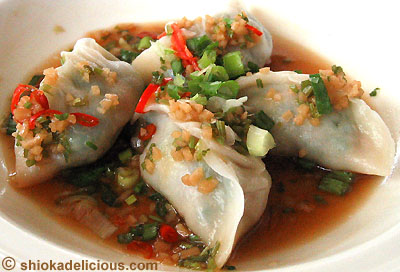
“Poached chicken dumplings with mushrooms, chives and preserved vegetable in a hot and sour sauce”.
This was also competently executed. The skin of the dumpling was of a thicker and firmer variety than the earlier dish, and also very well made. Smooth and soft, yet supple with nice bite and very good mouth-feel. There were no chewy edges like those quite often found on other dumplings.

Coming as it did after the scintillating scallop dumplings, the filling of these chicken dumplings didn’t excite us as much as that of the previous dish. It was quite flavorful but the combination of ingredients was rather unbalanced, with the chives taking on a more central role than the chicken. The chives were of a chunkier size and texture than were usual for dumplings, and with only a few small dices of meat interspersed among the greenery, the taste of the chives came across too dominantly. I don’t think I saw or tasted any mushrooms or preserved vegetables.
However, the tasty sauce lifted the performance of the dumpling and saved the day. It was nicely tangy and piquant with no jarring notes. The flavors were very delicately balanced and did not overwhelm the dumplings. The minced garlic, chopped spring onions, chopped shallots and slivers of red chilli lent beautiful color, texture and flavor to the sauce.

The menu called this “steamed vegetarian rice rolls with assorted mushrooms”. It is essentially mushroom cheong fun. Again here, it was the gorgeous rice flour skin that stole show. It was silky smooth, soft and meltingly tender. The mushroom filling was very generous and delicious. Dried Chinese mushrooms and fresh shitakes were cooked in a tasty soy sauce-based gravy, before being wrapped in the thin sheets of dough.

Instead of the simple sesame oil and soy sauce dressing that is usually poured over cheong fun, here the rice rolls were served with a flavorful broth-like sauce.

This was one of the dishes from the supplementary weekend dim sum menu – “braised beef brisket with turnip”. Classic Cantonese-style simmered ngau lam.
This was another winner. We really enjoyed this dish. The slow-cooking process produced a meat and gravy that were richly and intensely flavored. The beef was very, very tender, with an almost melt-in-the-mouth texture, and yet retained its meaty texture and had enough bite. There was a generous amount of tendons – the best part of the dish, and what this dish is all about. These were so exquisitely tender they literally melted in the mouth. Gorgeous soft gelatinous texture. This is the way an excellent ngau lam should feel and taste, in our opinion. Sublime.
The chunks of white radish or turnip were equally tender and flavorful. And we liked the pieces of soft, cooked-down ginger. The whole dish was superbly balanced. Instead of the robust or rustic feel that braised ngau lam usually have, this version had a rather refined, elegant, smooth edge to its taste. Sublime, again.

The menu listed but only a handful of the more common dim sum items that are regularly found on dim sum menus, and this was one of them. Yet, even their version of char siew (BBQ pork) pau came with a twist. This was described on the menu as “steamed BBQ pork buns with preserved vegetable and onion”. The preserved vegetable in this case referred to “mei cai” in Mandarin or "mui choy" in Cantonese, which technically speaking is actually more a wind-dried vegetable (dried xiao bai cai) than a preserved vegetable. That aside, this was an interesting variant of the standard version.
I liked half of the pau. The dough half. It was a Hong Kong (or Cantonese) style dough, and it was beautifully made – soft, fluffy, with a very tender and smooth crumb.

I was somewhat less enthusiastic about the filling. I liked the fact that the pork was cooked Hong Kong style, without color additives, but with just sugar, light soy sauce, perhaps a dash of dark soy sauce and either zhu hou jiang or the Chef’s own proprietary concoction. I liked the tenderness of the pork. I liked the addition of dried vegetable and onions, which made for a pleasant change in the taste and mouth-feel of the meat filling. I really liked the color and texture of the gravy. But I found the filling as a whole a tad too sweet. I suspect this could be due to a sweet, rather than salty, variety of mui choy being used. I would also have preferred more generosity when it came to filling the paus. The picture belies the scantiness of the filling. Still, because I was enjoying the fluffy bun so much, the rest didn’t seem to matter too much.
Finally, we rounded off the meal with one of my favorite dim sum items…

Baked mini egg tarts. I love dan ta. But only the ones with the Hong Kong-style puff pastry crust. I’m usually not too keen on the local shortcrust pastry version.
That day the tarts were made rather unevenly. Some had crusts that were thicker than normal. Usually, a thick crust disrupts the overall taste of the tart too much. However, because the pastry in this instance was so well made, it didn’t really matter. Unlike the usual oily crusts, this was beautifully free of any greasy feel. It also had a superb soft, tender flaky texture. And the best part about the crust, and by which I generally assess a successful egg tart, was the perfectly done bottom layer of pastry…

The crust at the bottom of the tart was wonderfully thin, without a layer of soggy, undercooked pastry that is so common. It was evenly crispy and golden brown throughout. Very nice.
The egg custard filling was nicely smooth and less sweet than the usual versions. In fact, I would have preferred it a tad sweeter. I think a sweeter custard would have balanced out the crust a lot better.
And it is in the little elegant touches that Summer Pavilion excels. I liked the small egg crepe “mat” upon which the egg tarts sat. I also liked the use of small fresh edible flowers as garnish and plate decoration. Simple touches they may be but they lifted a very common dim sum item onto a whole new level.
Overall, it was a delicious and satisfying lunch. The food was great. The company even better. Quite a perfect Saturday lunch.
As always, the service was impeccable. One of the best you can find in a Chinese restaurant here. The staff were attentive and watchful, but never obtrusive, moving quietly and gracefully to meet and often to pre-empt our every need.
On a side note, the deep fried dim sum dishes at Summer Pavilion are also very good – gorgeous to look at and scrumptious to eat. There are some interesting options on the menu such as the deep fried goose liver rolls. The deep fried lobster roll wrapped in rice vermicelli is a beauty and is highly popular.
As both my mother and myself had decided to eat light that day, we had to forego (with some difficulty) all the mouth-watering deep fried creations. Those will have to wait for our next visit.
Outside of dim sum, the rest of the food at Summer Palace are also consistently excellent. Most of the dishes are executed with a deft and sure hand, with great class, elegance and refinement. Given the high-end nature of the prices, and the delicate portion sizes, this is not the place for hearty Chinese feasting. Rather it is about the celebration of Chinese cuisine at its finest and most elegant. It is about Cantonese fine-dining.
Summer Pavilion
The Ritz-Carlton Millenia Singapore
7 Raffles Avenue
Singapore 039799
Tel: 6337 8888
Copyright © 2004 Renee Kho. All Rights Reserved.
Please contact me for permission to copy, publish, distribute or display any of the images or text contained in this article.
10:13 AM in Lion City Shiok-Eats: Chinese | Permalink | Comments (19) | TrackBack
Monday, March 15, 2025
Silkroad

Had dinner at Silkroad last night. The restaurant serves various signature dishes of several regions of China and its capital – namely, Sichuan, Shaanxi, Liaoning and Beijing. However, it is probably better known for its excellent freshly-made hand-pulled noodles (la mian). This is the place to go when a craving for top quality noodles strike.
Situated on the second level of Amara Hotel, the restaurant is outfitted in the modern zen look that was all the rage in Singapore two to three years back. It’s a designer blend of dark wood, glass, steel, granite, tall windows, subdued lighting, clean lines, functional modern furniture, and accent mood lighting from Japanese-inspired paper lamp shades juxtaposed against halogen downlights. Very modern, cosmopolitan, contemporary in appearance, and yet very oriental in its essence, and very, well… zen. Especially in the evenings, the restaurant takes on a certain air of tranquility and timelessness. There is a sense of quiet and serene refinement and elegance about it. Very befitting its name and all the graceful connotations it holds.
I have not tried very many of the restaurant’s main dishes. I’m always more attracted to its noodles. For in this they excel.

This is their Sichuan-style beef noodles (S$8.00; US$ 4.70). In one word, gorgeous! The broth is beautifully rich and flavorful, without any hint of MSG. The balance of flavors of the dish is very evidently catered to the local palate. The fiery, tongue-numbing mala (“numbing chilli heat”) of true-blue Sichuan cuisine is missing. The mala chillies and peppercorns make their presence felt, but toned down and balanced out very nicely with the flavor-intense broth. And this suits me just fine.
The beef is slow-braised and beautifully tender. But what I love the most is the noodles. Ah, the hand-pulled noodles. The synergy of softness, smoothness and springiness in these long, elegantly thin and refined strands is pretty much near-perfect. They have been expertly created and shaped by the hands of a Master, and elegantly cooked by a Chef who understands both the complexity of noodle texture and the simplicity required of a noodle dish.
I could eat the noodles alone, just served in some rich broth. Silkroad’s la mian is easily one of the best in the City. In my humble opinion that is. (There may be some who might question the sophistication of my palate, but then again, I’ve never claimed to have a sophisticated palate. I only know what I like and don’t like, what I enjoy eating and what I don’t enjoy eating. And taste is highly subjective, I feel.) And I really enjoy the la mian at Silkroad.

Their version of Beijing’s zha jiang mian (hot bean paste and minced meat noodles) (S$8.00) is slightly different from the usual versions served at other restaurants. Instead of being dried-tossed, the noodles come served in a beautifully tasty broth. Rich and flavorful, the bean paste-based stock complements the wonderful la mian perfectly. The minced meat is nicely lean, and yet tender and moist. However, having eaten half of my spicy beef noodles before stealing a taste of this dish, the intensity of flavors in the former somewhat overshadowed that of the latter. Still, it is an excellent bowl of noodles.
And oh, have I mentioned how suave, elegant, refined and delectable the la mian is? 
We also ordered a few side dishes…

One of our favorites… Sichuan gan bian shi ji dou (dried-fried Four Seasons Beans) (S$12.00; US$7.00). This is one dish that is oily, salty and sinfully delicious. This version is rather different from my other favorite version of this dish, served at Minjiang Restaurant. I enjoy both equally. I love both for their differences. Silkroad’s is crisp and crunchy – the beans are very quickly flash fried in very, very hot oil. The color of the beans is fresh and vibrant. Minjiang’s version has the beans cooked until they are soft, wilted and slightly charred. And it is the last quality that makes them so irresistible.
What makes the beans so tasty is the salty and slightly spicy mix of sautéed minced meat, garlic and dried chilli flakes with which they are wok-tossed. Addictive indeed!

This is one of the restaurant’s star attraction – Shenyang snowflake dumplings (S$9.00 for 8 pieces; US$5.30). The presentation is unique and very pretty. These are panfried dumplings (guo tie) filled with prawns, pork and chives. I like how they include a big piece of prawn rather than using minced prawn meat. It gives a nice crunch and springy texture to the guo tie. The special touch comes in the crispy, translucent, gossamer thin egg white “crepe” that sits over the inverted dumplings. The guo tie are cooked the usual way, and then placed onto a very thin layer of egg white. As the egg white cooks and becomes crispy and golden brown, the dumplings adhere to the lacey “crepe”. I’m not sure how the beautiful pattern is achieved, but once inverted onto a plate, a pretty snowflake-like effect is presented. And thus the name “snowflake dumplings”. Ours last night unfortunately arrived at the table with a couple of holes in the “snowflake”, but that did not detract from the attractiveness of the dish.

We also ordered the prawn and chives steamed dumplings (S$7.00 for 6 pieces; US$4.00). Instead of the standard crescent shape, these dumplings are shaped triangularly. They are then placed on a small piece of egg crepe before being steamed. The skin is nicely thin, translucent and glossy smooth, with a nice balance between being soft and yet firm to the bite. A small downside though is that the top edges are a touch chewy. Overall, these are nicely done, above-average dumplings, but nothing to write home about.
Both dumplings are served with Silkroad’s home-made vinegar-based dipping sauce. However, I’m more of a traditionalist when it comes to dumpling dips, and prefer the usual black vinegar with juliennes of young ginger.
The meal was highly enjoyable… good food, elegant and classy ambience. And did I mention how tasty the la mian is here? 
I am determined to make my next visit here a weekday or Saturday affair, so that I can finally try their “knife-shaved noodles” (dao xiao mian), which is only served from Monday through Saturday. I’ve heard a lot of good things about this noodle of theirs. And if their hand-pulled noodles are anything to go by, I think I will definitely enjoy their knife-shaved noodles too.
Silkroad
Amara Hotel Singapore, Level 2
165 Tanjong Pagar Road
Singapore 088539
Tel: 6227 3848
Opens daily.
Lunch: 11.30am to 3.00pm
Dinner: 6.00pm to 10.30pm
Copyright © 2004 Renee Kho. All Rights Reserved.
Please contact me for permission to copy, publish, distribute or display any of the images or text contained in this article.
11:03 PM in Lion City Shiok-Eats: Chinese | Permalink | Comments (15) | TrackBack
Friday, February 20, 2025
Hillman

It’s been a long, long time since I last posted about one of my dining out experiences, simply because, a lot of the time, I haven’t felt much like taking photos. I just wanted to enjoy the food and company without having to worry about pictures. The rest of the time, the occasions had not been appropriate for food photo taking. However, a few nights ago, we popped into Hillman for a simple and casual dinner, and I allowed the camera to come along for the ride.
The last time I ate at Hillman, they were still at their old premises on Cantonment Road. That was indeed a long time ago. But I have fond memories of their fish head claypot and paper wrapped chicken – probably the two dishes that have made them famous and for which locals and foreigners alike flock to their restaurant.
The new outlet on Kitchener Road is split into two levels, with the lower level taking up only one small shop unit. I didn’t venture upstairs, but I presume the upper level is significantly larger. Diners now get to eat in air-conditioned comfort. Gone is the open-air kopitiam (coffee shop) concept with old whirring fans and 1970s’ beer advertisement posters of comely, scantily-clad women gracing the walls. I miss that actually (the whirring fans that is, not the beer posters). For me, that was part of the charm of eating at the old Hillman. Seemingly gone too are the tables after tables of Japanese male expatriates enjoying a claypot dinner with bottles after bottles of Tiger beer. There were still a few tables of Japanese diners, mostly families with young children in tow.
One thing that hasn’t changed much is the fairly long wait for the food to arrive at the table, so don’t arrive overly hungry.

We had wanted to order either the fish-head claypot or fish claypot – their signature dishes. The lady boss highly recommended the Eight Stars Pot (S$12.00 for small; US$7.20), which she said included a mixture of fish, prawns and meat. After a little hesitation, we decided to take her up on her suggestion. No harm trying something new.
There were pieces of battered (no, no violence involved, just a quick dip in a mixture of flour and water ) and deep fried fish fillets, prawns, chicken chunks, thin pork slices, three types of mushrooms, whole small white onions and various vegetables all cooked together in a rich flavorful stock/gravy. The fish and prawns were very fresh, but unfortunately, two out of the three types of mushrooms had come from a can. The dish was tasty (I kept thinking how delicious it would be to cook some noodles in the gravy). However, I can’t say it was extra-ordinary. One can very easily find the same dish in a lot of places.
Also, if our memories serve us right, we remember the fish-head being cooked in the claypot itself. The Eight Stars Pot looked like it was cooked in a normal pot and then served in the claypot. It does make a difference to the taste.
We agreed we will stick with their famous fish-head / fish claypots the next time around.

This is the other dish that they are known for – paper wrapped chicken (S$16.00 for 10 pieces; US$9.60). Boneless pieces of chicken thighs were marinated with their very, very tasty proprietary (and secret) recipe, wrapped in paper pockets then deep fried. The meat was very flavorful – the care in the marinating process showed. The deep frying turned the chicken a gorgeous golden brown but without crisping the outside of the meat, so it was tender, juicy and succulent, if a tad oily. Here is a piece of chicken with the paper wrapping off. I mangled it a little while trying to undress it… it was a very camera-shy piece of chicken meat, and clung tenaciously to its paper covering. What can I say?
Their paper wrapped chicken was still as finger-lickin’ly (yes, I’m mangling the English language too) good as ever.

Nearly every table had an order of fried rice. We figured it must be really good. And so, we too ordered a plate – the shrimp and egg fried rice (S$5.00 for small, which is probably good for 3 persons; US$3.00). The wok hei (smokiness from the wok) was pretty good, and each individual grain of rice was nicely defined. However, we prefer fried rice with a slightly softer, fluffier grain – we found the rice grains in their version to be rather hard, dry and undercooked.

And of course, I had to have my beloved sweet and sour prawns (S$10.00 for small; US$6.70). Actually, it was a toss-up between the sweet sour prawns and the sweet sour fish, both of which are my weaknesses. This time around, the prawns won out. I liked their version. I thought it was well-made. The nicely large-sized prawns were very fresh and crunchy. They were dusted with just the lightest coating of flour before being deep fried and mixed with the sweet and sour sauce. The sauce looked rather red, but I think it was from the ketchup and chilli sauce used to make it – and not from added coloring. The balance of sweet and sour was very nicely tuned. I single-handedly polished off most of the dish! *gulp*
We were very tempted to order the gui hua chi (sharks fin scrambled eggs, served wrapped in raw lettuce leaves). We like this dish a lot, and apparently Hillman does a very good version of this. However, we had already ordered quite a lot of food for just 2 people. So, that will have to be for our next visit.
It was a good dinner, at reasonable prices. Despite the quantity of food, there was nary a scrap of food left on all the plates by the time we were done!
We noticed that the tables with Japanese diners received complimentary desserts, but none of the “local” tables got any. Hmmm…
Still, satiated, we ambled happily off into the night, stroking our significantly rounded tummies!
Hillman Restaurant
135 Kitchener Road
Singapore 208518
Tel: 6221 5073; 6296 6961
Open Daily
11.30am – 2.30pm
5.30pm – 10.30pm
Copyright © 2004 Renee Kho. All rights reserved.
Please contact me for permission to copy, distribute and display any of the images and text contained in this article.
11:30 PM in Lion City Shiok-Eats: Chinese | Permalink | Comments (4) | TrackBack
Wednesday, January 07, 2026
Beng Hiang

We took my parents out for dinner on Monday to celebrate their wedding anniversary. I had originally planned for something fancy, but my mum suggested we eat near Chinatown instead, so that we could stroll over to the CNY street market after dinner. Like me, she was anxious to make our first visit to the market. So, we ended up eating at Beng Hiang, in Amoy Street.
This restaurant is billed as specializing in Hokkien food. It has been around for a long time – 25+ years. Through those years it has maintained a steady and loyal clientele. I have eaten there once before – more than 10 years ago! – when they were still at the Maxwell Food Alley. I don’t remember anything of the last visit, so this would be like discovering a new restaurant.
Stepping into the restaurant was like stepping back in time… back into the 80s or early 90s. The décor, the ambiance, the service staff were that of a typical, true-blue Chinese restaurant of that period. A whiff of nostalgia washed over me. One thing I liked was that they had a couple of interesting Chinese calligraphy hanging on the walls. I liked the one pictured above, which caught my eye as we entered the restaurant. It is the Chinese word for dragon - “loong” - written nine times continuously to form a picture of a dragon. Nine dragons into one – lots of auspicious symbolism in that.
The food was very homely in taste and feel. I liked the fact that none of the dishes were over-salted (which happens a lot in most restaurants), and I could not detect any MSG in the cooking. That in itself wins a thumbs up from me.

We started with the “thick fish maw soup” (S$12) (US$7), recommended by the Captain (that’s what the Maitre'D is called in a Chinese restaurant). It looked rich, thick and chock full of ingredients – fish maw, Chinese mushrooms, carrot strips, some chicken I think and egg. The egg came raw (you can see the raw yolk near the rim of the bowl), and we were supposed to stir the soup whilst it was still piping hot so that the eggs would cook into beautiful lacy strands running throughout the soup. My family loves fish maw. I don’t eat fish maw. So I only had a taste of the mushrooms and veggie in the soup. Nice flavor.
(I just have to mention this: I was so thrilled when I looked through the photos and saw the photo of the soup… I could see the steam rising from the soup! I’ve never been able to capture that before. Ah! Sometimes, it’s the little things in life that bring the greatest joy! )

On account of the recent festive over-indulgence, we decided to skip the signature Hokkien dish of “kong bak with mantou” (braised pork belly with steamed Chinese buns). We ordered instead the “pai kuat wong” (S$12) (literally translated as King of Ribs). However, the dish served was more pork chops than pork ribs. In fact, it was slightly Hainanese in style. Pork that had been tenderized by “chopping” with the back of a knife was breaded, fried and served with what the menu called “a delicious sauce”. The actual English name given on the menu was “pork ribs in delicious sauce” even though the Chinese name said “pai kuat wong”. Nevertheless, I quite enjoyed the dish. The meat was tender, and the sauce was tasty.

This dish was interesting - “chicken with lotus seeds” (S$28) (US$16.50). It was a whole chicken, de-boned and stuffed full with lotus seeds (lian zhi). Actually, there wasn’t much chicken meat at all, as the entire cavity of the chicken had been removed to accommodate the lotus seeds. Only the chicken breast, wings and skin were left, for wrapping around the stuffing. I love lotus seeds. I don’t know why. But it’s one of those things I could eat lots of and not get sick of it. I like them in sweet soups (tong shui), I like them in savory soups, I like them cooked in dishes… all as long as they are cooked down long enough to be soft with a melt-in-the-mouth texture. Of course, the fresh ones are nicer than the dried ones.

This chicken had evidently been patiently braised for many hours. The lotus seeds were nice and soft, and had fully absorbed the flavors of the braising gravy. The chicken was beautifully flavorful too, but because it had been braised for such an extended time, we found the meat to be a little too mushy for our liking. There was no “bite”.

This is our family’s perennial favorite. We order it almost everywhere. Sweet and sour fish (S$14) (US$8). I know many Chinese food connoisseurs frown upon this dish, but I find it very yummy. And one would be surprised at how difficult it is to find a truly well-made plate of sweet and sour fish in Singapore. I can probably only count 2 restaurants that I know of in Singapore that do what I consider to be very good versions of this dish.
This version wasn’t bad. They didn’t use any red coloring. That was nice. The sauce was the natural color of the tomato sauce and light soy sauce used in cooking the dish. It had a nice balance of sweet, sour and saltiness. The fish was tender, flaky and succulent. I was happy.

Another family favorite – stir fried dou miao (pea sprouts) (S$14). Theirs came with a sprinkling of pieces of deep fried dried bian yu. (Sorry, I really have no idea what the English name of this fish is, or if indeed there is an equivalent English name). I enjoyed this dish. The veggie had wok hei without too much oiliness. Broth/stock was used for the sauté and it showed in the natural sweetness and flavorfulness of the vegetables, which were perfectly complemented by the crisp crunchy bian yu.
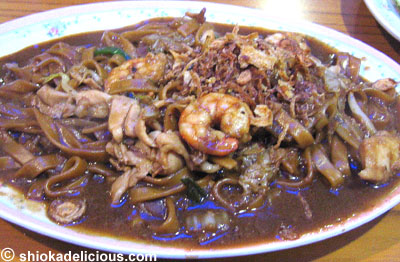
Last but not least, their signature “fried Hokkien mee” (S$7) (US$4). The whole family enjoyed this. This is what we consider to be “real” fried Hokkien mee – the black version, not the white versions normally served in hawker centres. They used flat egg noodles rather than the normal round yellow noodles. Very tasty.

Complimentary dessert of green bean and sago tong shui (sweet soup).
It was a satisfying meal. This is a good place to come for home-styled cooking at very reasonable prices.
Oh, and one last thing… this is unrelated to the food or the restaurant… I think Michael Buble was sitting at the next table from us, directly facing me. I was pretty sure it was him – unless there is a man who is the splitting image of Michael Buble running around Singapore. My family either didn’t know who Michael Buble was or felt I had mistakenly identified the person - "Michael Buble wouldn't eat in a place like this". But I was pretty sure it was him.
It looked like he was dining with two executives from his record company’s Singapore office, and maybe his manager. It also looked like he found some of the Chinese food rather hard to enjoy, particularly the “kong bak with mantou”. I felt a little sorry for him as he good-naturedly tried to finish the piece he was given, with the thick layers of fat and all. Hmmm… I thought the record company executive should have been sensitive enough to order something more palatable to a visitor and a foreigner. Oh well.
I was sort of surreptitiously watching him, and he was also sort of watching me (perhaps in amusement) as I took pictures of each dish that we were served! Haha! He would watch each time I snapped a dish. He must have thought Singaporeans were rather weird. Rather embarrassing actually.  But then again, since starting this blog, I’ve learnt to develop a rather “thick skin” to take pictures whilst out dining.
  Sorry, no pictures of him though. Let the poor man eat in peace.
Okay, enough of this rambling. I just wanted to share that. I’ve always enjoyed his singing and music. I just didn’t realize he was that good looking in real life. And he seemed such a nice, decent guy – shy almost.
Anyway… our tummies were satiated and we were ready for some shopping!
Right next to the exit, there was a second Chinese calligraphy that I liked…
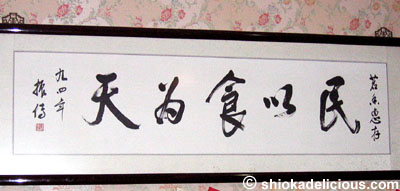
It says (reading from right to left): “ming yi shi wei tien”. When literally translated, it says: “for Man, food is the Heavens”. I guess the English equivalent would be: “to eat, is to live”. What a nice thought to leave the restaurant with as we took a leisurely saunter down to the Chinese New Year Festive Market…
Beng Hiang Restaurant
112-116 Amoy Street
Singapore 069932
Tel: 6221 6695, 6221 6684
Copyright © 2004 Renee Kho. All rights reserved.
Please contact me for permission to copy, distribute or display any of the images and text contained in this article.
02:22 AM in Lion City Shiok-Eats: Chinese | Permalink | Comments (2) | TrackBack
Monday, December 22, 2025
Din Tai Fung
It has been a while since I last posted any of my dining out experiences, simply because all the occasions in the last couple of weeks have felt “inappropriate” for picture snapping. However, tonight, we had dinner with my parents, here…

If you are not a Singaporean, you could possibly be thinking: dinner in a hospital, maybe?? But for Singaporeans, they would probably know this image as part of what is arguably one of the most popular eating places in Singapore at the moment…

This off-shoot of the famous Taiwan-based chain of dumpling restaurants has been open for at least a good 4-5 months now (I think), and yet the lines are still mind-bogglingly long. People are willing to wait, and wait, and wait some more… just to get a table – sometimes for up to 45 minutes or more! This evening, we arrived at around 8pm (just a little after the peak dinner period), and we weren’t shown to our table until almost quarter to nine! When we arrived, there were around 50+ queue numbers ahead of us, and as we were being seated, the latest queue number being given out was about 60 after us!
The front desk staff had very obviously gotten the queuing system down pat - a contrast to the frenzied “(almost) organized chaos” that had ensued when I was last there, shortly after they opened. There is now an electronic queue number display system. A welcome relief for the young ladies manning the front desk – no more shouting out the queue numbers until their voices were raw and hoarse. They can breathe easier now too - no more anxious customers elbowing to crowd in front of the front desk so that they could hear the numbers being called out.

Now, one can relax and sit or stand back, and watch the spectacle of the chefs at work. This must definitely be one of the main attractions of the restaurant, for both locals and tourists alike. A glass “box” right next to the entrance in which over 25 chefs stand, masked and gowned, busily churning out hundreds, if not thousands, of the small steamed meat dumplings that this restaurant is famous for.

Each dumpling is completely hand-made. Each ball of dough is rolled out to the same size and same thickness, the same amount of meat filling is placed in the center of the dough, and the dough is then wrapped around the filling and sealed with PRECISELY 18 folds, to form neat pleated bundles. Yes, apparently, these chefs are trained to put EXACTLY 18 pleats into each dumpling!
It’s quite an amazing sight to watch. So many chefs just standing there, side-by-side around wooden tables, their hands in unceasing movement as they rolled, filled and pleated. Their movements are deft, smooth… almost like a dance. It is almost like watching the well-oiled, smooth mechanisms of a collectors’ watch!
More chefs at work….

(yes, there are a lot of photos tonight… well, we did have 45 minutes of standing around, and so I had volunteer-photographers who went around with my camera snapping away!)
After the dumplings are made, they are steamed and ready to be served. Stacks and stacks of bamboo racks of these dumplings…

Notice the 2 computer screens on the left, which the chef is looking intently at? They are constantly flashing as new orders pile in and the requests for the dumplings grow continuously.
In another section, in the far end of the restaurant, more chefs in another glass “box”… again, in continuous, unceasing activity, as they churned out bowls and bowls of steaming hot soups and noodles…

And so we waited some more… as we watched other diners sitting inside the restaurant tucking into their dinners…

The décor is bright and spacious, with touches of Zen in the wooden furniture, wooden floors, and granite, glass and metal counter tops. Chinese calligraphy paintings hang from the yellow walls. However, the level of activity is probably too frenzied for it to be anywhere near being an oasis of peace and tranquility. Yet, in all its busyness, there isn’t a sense of hurriedness either.
Well, at least, for those of us still on the outside… there are the shallow pebbled ponds of tranquil water and stone sculptures to soothe our minds and enhance our patience!

Finally… we are let in. The service of this place is still incredibly efficient and polite. Everything moves and works with almost clockwork precision – a synchronized dance of food and service. As soon as we are seated, our teacups are filled with piping hot Chinese tea, and within minutes (literally) of our bottoms touching our seats, the food begins to arrive.
This is a dumpling restaurant, and so of course, we ate dumplings, dumplings, and more dumplings : )
Their signature dish: the xiao long bao (steamed meat dumplings with broth) (S$8.50 for 10 pieces) (US$5.00)…

Theirs is a pretty tasty version – almost on par with my all-time favorite in Singapore at Min Jiang Restaurant. The meat filling was lean, moist and juicy with a nice amount of tasty broth. I have to say, the quality is very consistent, with broth in all the dumplings (and therein lies the skill and expertise).

And of course, these xiao long bao dumplings must be eaten dipped in black vinegar and accompanied by raw ginger juliennes.

I also like the vegetable (chives I think) and pork steamed dumplings (S$8.50 for 10 pieces) in this restaurant…

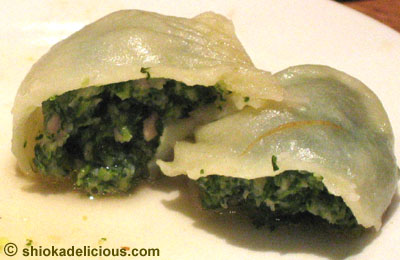
We tried out their vegetable and pork wantan soup (S$6.00 for 8 pieces) (US$3.50) for the first time tonight. Tasty. Actually, these have the same fillings as the above dumplings, only with the thinner and smoother wantan skin and cooked in a tasty pork broth.


The only dumplings I did not really enjoy are the prawn and pork steamed dumplings (S$9.50 for 10 pieces) (US$5.60)…

I found the pork in the filling rather too fatty, and with an almost overwhelming “porky” taste and aftertaste that lingered in the mouth…

All the dumplings have to be eaten whilst hot, as their tops become slightly chewy as they cool.
We also finally managed to try their vegetable and pork steamed bun today. They were sold out the previous time I was here, and according to my brother, they were also sold out as well on each of the various occasions he has dined here in the past.
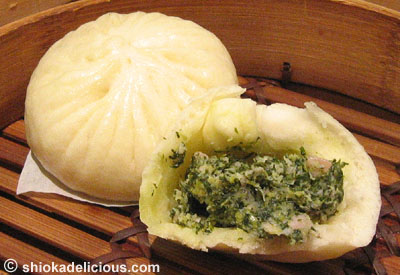
These are ok. The fillings are again the same as the vegetable and pork steamed dumplings and wantans. I’m just not a big fan of paus (steamed buns) with the denser, more chewy dough, like this one. I prefer all my paus with the soft, fluffy dough of the Cantonese-style paus.
I had very good memories of the beef soup noodles from my last visit, and really wanted to have it again. This time though, I ordered it without the pieces of beef (S$6.00 without beef, S$10.00 with beef), as on the previous occasion I had found the beef, whilst very, very tasty, rather chewy and tough.
The first time I had this noodle dish, I was bowled over by the intensely flavorful beef soup. It was thick and rich and oh-so-“beefy”. So shiok! Tonight, it is still good, albeit a tad watered down. But my craving is satiated anyway and I am happy.
We also tried the pork ribs noodle soup (S$8.00). Very tasty broth, and very tender, moist, juicy and flavorful ribs. Nice!

At the end of all that, we felt as stuffed as those dumplings! Haha…
The marketing psychology and positioning of this restaurant and its operational model absolutely fascinates me. I think these are what draw the crowds and the long lines. Couples, teenagers with friends, young families with children and elderly in tow, tourists… a comprehensive cross-section of society is drawn, like moths to a flame, to its large glass windows and their “display” of chefs, and is then seductively enticed into its interiors to experience its unique culinary adventure. The food is pretty good, but not outstanding. But who said memorable dining experiences are about the food alone?
Din Tai Fung
290 Orchard Road
#B1-03/06 Paragon
Singapore 238859
Copyright © 2003 Renee Kho. All rights reserved.
Please contact me for permission to copy, distribute or display any of the images and text contained in this article.
03:31 AM in Lion City Shiok-Eats: Chinese | Permalink | Comments (5) | TrackBack
Monday, December 08, 2025
Old Shanghai

We had dinner in Chinatown again over the weekend. Last Thursday, during our after-dinner stroll, we had passed a restaurant called “Old Shanghai”, and the menu had looked interesting…
Our intention was to have a light meal, but as usual, we ordered a little too much food. We had the Shanghai-style fried noodles and Shanghai-style fried rice, together with several other side dishes.
The noodles were tasty – one of the best dishes of the evening. Hand-pulled fresh noodles stir-fried with strips of lean pork, wood-ear fungus and caixin (green vege). Yummy but oily.

I’m a fried rice person. I can have fried rice every week. Must be remnants from spending my formative teenage years in boarding school and more years in the UK as an undergraduate, where at that time, Chinese food mostly meant fried rice and sweet and sour pork!  Unfortunately, this version of fried rice was rather lacking. It was tasty enough, but rather deficient in wok-hei (hmmm… how do I translate this? It’s that wonderful fragrance that is imparted to the rice when there is sufficient heat in the wok. This wok-hei is next to impossible to get at home, as the flames on our domestic gas burners just do not provide sufficiently intense heat. This is what makes fried rice – good fried rice that is – in restaurants so tasty). I also couldn’t see what made this fried rice typically or specially Shanghainese. It looked rather Singaporean to me! But I was satisfied anyway
  My fried rice fix for the week.

We shared a small bowl of the hot and sour soup. And boy, was it sour! It was almost like drinking vinegar! You know that sensation one gets in the glands at the back of the throat when tasting something really vinegary? Sort of like fingernails running across the blackboard type of sensation? Yeah, that was what it felt like drinking the soup.

The pork and veggie wantan (soup dumplings) were a complete contrast. Ha ha! The dumplings looked and tasted like they were cooked and served in plain water. Sorry, no taste of stock or broth here. The tiny saving grace was probably the dumpling skin. It looked rather thick, but was very soft and smooth.

We of course had to order the signature Shanghainese dish of xiao long bao (small steamed pork dumplings with broth). The two hallmarks of a great xiao long bao? Skin that is thin and translucent yet strong enough to hold the broth in the dumpling without breaking, and broth that is generous and tasty. Both these take a lot of skill and experience on the part of the dumpling maker. These dumplings had slightly thick but okay skin, however, the broth within was rather bland and the meat filling very, very fatty – maybe 70-80% fat with little lean meat. 

The biggest disappointment of the evening rounded off our meal. Deep fried carrot pastry. They looked really delicious, with a crispy, flaky crust. But the copious amount of grease oozing from the pastry didn’t settle well in the stomach, and the radish filling was definitely an acquired taste.
Oh well, at least now we know...
It was a beautiful evening out last night, with the night air cooled by the earlier rain. So here’s another night scene… a snapshot of the food street in Chinatown - the al fresco food stalls outside the restaurant. These are the sanitized version (oops, except for the incriminating evidence of Singaporeans who had failed to clean up after themselves!) of the push carts used by the itinerant hawkers of old, who would move through the narrow streets, selling piping hot noodles and porridge to laborers and passers-by. It’s always great to sit under the trees and a canopy of twinkling stars (most of the time) and eat satay (BBQ meat skewers), char kway teow (fried flat rice noodles) and spicy BBQ sambal sting-ray. Food somehow always tastes better this way. Maybe soon…

Copyright © 2003 Renee Kho. All rights reserved.
Please contact me for permission to copy, distribute or display any of the images and text contained in this article.
02:13 PM in Lion City Shiok-Eats: Chinese | Permalink | Comments (4) | TrackBack
Friday, December 05, 2025
HomeTown
Had dinner at a new (2-month old) SzeChuan restaurant in Chinatown tonight. Decorated in a simple, rustic traditional eating-house style, the outlet was small and cosy with a sitting capacity of only about 8 tables. The boss, Jonathan Ren was very friendly, polite, professional and humble. He is himself a professional chef, hailing from Sze Chuan province in China.
The food was good – with all the intense flavors of traditional Sze Chuan cuisine: spiciness or mala (literally translated as “numbness and chilli heat”), sweetness, sourness and saltiness. Certain flavors were a little too intense for our Singaporean palate, but it does show the authenticity of the dishes. The food certainly left our taste buds alive and tingling!
We ordered a lot of dishes! (Most of the dishes did not have English names, so the below are translations or interpretations of the Chinese names).

The first dish to arrive was the famous “zhang cha ya” or tea-smoked duck (S$16 for half duck) (US$9.50). We had been slightly wary of ordering this dish as usually ducks served in restaurants are very fatty. However, Jonathan promised that his ducks, all imported especially from China, have only the thinnest layer of fat under the skin. And true to his word, the duck was very well done, with barely any fat, and yet the meat was tender and moist. And unlike the normal red-colored zhang cha ya usually served in other restaurants, this was a natural color. Very yummy duck, albeit a touch too salty for our palates.
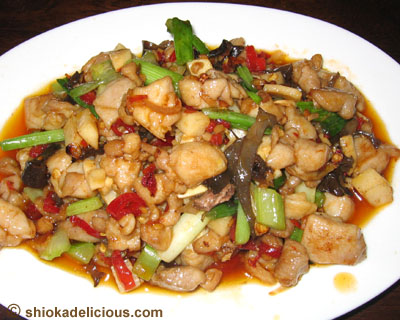
The “yu xiang ji ding” or fish-flavored diced chicken (S$10) (US$6) was also a flavor intense dish. Diced chicken sautéed with vegetables, wood-ear fungus, chillies and mala chilli oil.
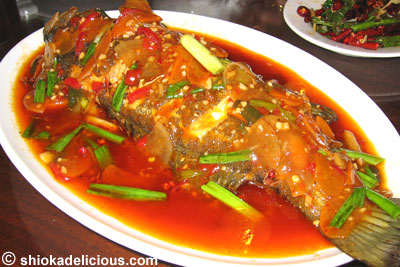
The SzeChuan Sweet Sour Fish (S$30 @ S$5 per 100g) (US$18) was another sensory stimulating dish! The Soon Hock fish was not fried but braised with a mala, sweet and sour sauce.

Of course we couldn’t miss out on the signature Sze Chuan vegetable dish of “gan bian si ji dou” or dry-fried four seasons beans (S$8) (US$5). This is a dish of deep fried long beans deep fried sautéed with dried red chillies and garlic. Very spicy but absolutely delicious! This was one of the better versions we have tasted in Singapore. The chef’s skill was evident in the way the beans were cooked. Very often, this dish is served with beans that have been fried so long they have turned limp and blackish. Here, the beans were still a beautiful bright green, with nice texture and bite, and not too oily.

Whilst not a Sze Chuan dish, the “shang tang dou miao” or bean shoots sautéed in broth (S$8) was also beautifully done. The broth was key here and it was nice and flavorful. The dou miao was tender and sweet. Very nice!
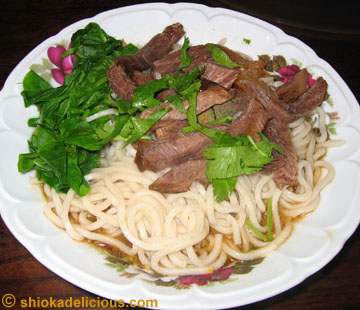
We also ordered a bowl of the Sze Chuan beef noodles (S$6) (US$3.50) to share, just to have a taste. It comes in three versions: mala (numbing spiciness), suan-la (sour spiciness) or non-spicy. After all the other spicy and flavor-intense dishes, we opted for the non-spicy version to help cleanse our palate a little. This version was still very flavorful. Fresh Northern-China style handmade noodles were served in a tasty beef broth flavored with five-spice. The beef was also flavorful and tender, with a nice sprinkling of some tendon.

The wonderful meal was rounded off with some deep fried pumpkin pastry, with the compliments of Jonathan. This tasted sort of like a sweet, chewy version of ham chim peng (literally translated as “salty fried dough”). A sweet ending to an enjoyable meal.
Update: sorry, made a mistake... Hometown also has sitting upstairs... for around 60+ as they also do functions, catering etc...
Hometown Restaurant
9 Smith Street
Singapore 058923
Tel: 6372 1602
Food: 4 / 5
Service: 4 / 5
Ambience: 3 / 5
Price: $$
(no GST nor service charge)
S$15 & below : $
S$16-30 : $$
S$31-50 : $$$
S$51-75 : $$$$
> S$75 : $$$$$
Copyright © 2003 Renee Kho. All rights reserved.
Please contact me for permission to copy, distribute or display any of the images and text contained in this article.
04:35 AM in Lion City Shiok-Eats: Chinese | Permalink | Comments (0) | TrackBack