« December 1, 2025 - December 7, 2025 | Main | December 15, 2025 - December 21, 2025 »
Sunday, December 14, 2025
The One That Started It All
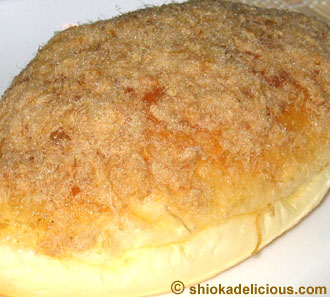
About 3½ years ago, there was a mini-revolution of sorts in the bakery industry in Singapore. The way bread was sold to and eaten by Singaporeans was perhaps forever changed. Aggressive upstart BreadTalk launched their chain of bakeries with modern Zen interiors of steel and glass. They called their bakeries “bread boutiques”, elevating the humble bread bun to designer status. And of course, they also launched the one product that shook not only Singapore’s bread world but also created tsunami waves in the nation’s restaurant industry.
What am I talking about? The Flosss bun (yes, complete with the triple ‘s’ in the name). Doesn’t that one extra letter seem to up the “hip and cool” factor just a touch? The product itself is simply a soft white bun topped with pork floss, with a sweet custard/mayo/cream-like filling. Sounds simple, and yet it was considered completely innovative and exciting when it first appeared. Pork floss has been around for generations. It was our ancestors’ way of preserving meat – shredding it and drying it. It was cheap, it was convenient. As kids, we grew up eating pork floss sprinkled over plain white rice porridge. Yet, no-one, it would seem, thought of selling buns with it as the main attraction. But eating floss with bread was not altogether a new idea… even as a kid, I’ve eaten floss sprinkled on a slice of bread, sometimes over a layer of sweetened condensed milk.
Perhaps it was a reminder of childhood memories or the lure of a classy ambience… whatever it was, Singaporeans ate up these buns by the hundreds of thousands! Seriously. Lines snaked at every BreadTalk outlet. Nobody seemed to mind queuing for up to 20-30 minutes to pay for their precious floss buns. Nor did they seem to mind paying designer prices for a humble bread bun. And before you could say “pork floss” other bakeries were jumping on the bandwagon, all launching their own versions of bread with floss. Some were obvious replicas, others “innovated”… and so we came to be acquainted with chicken floss buns, fish floss buns, floss on the inside of the bun, floss on top, floss rolled in a swirl, floss with bacon, floss with sausage… there was floss everywhere!
Almost all these other bakeries sold their floss buns at prices that were 30% or more lower than the original Flosss, and yet Singaporeans couldn’t resist the allure of the first and the original.
The ripples created by Flosss gathered momentum, crashing like tsunami waves through the rest of the food business in Singapore. Strange things started appearing on the menus of “proper” Chinese restaurants. Chicken with pork floss, pork ribs with pork floss, prawns with pork floss, eggplants with pork floss… Even Pizza Hut, (yes, that icon of American fast food culture) at one stage had pizza with chicken floss!! I was almost half-expecting a floss burger to emerge from under the Golden Arches!  Unsuspecting foreigners would have been forgiven for thinking floss was our national food!
The reason why I’m writing about this is because I have to plead guilty to past momentary “insanity” too. Yes, there was a time when I couldn’t resist the seductive allure of Flosss. I too had fallen under the spell of its tantalizing aromas, fresh from the oven. I had succumbed to its soft and tender crumb. I was spellbound by the oozing sensuality of its cascades of crispy, fragrant pork floss. Ah! The intense anticipation as I stood in line awaiting my turn for a meeting with Flosss. The sexiness of licking every floss crumb from my fingers…
Then just as suddenly, I stopped visiting Flosss. I could pass its window and not blink an eye. I even became oblivious to its smells. The sight of Flosss no longer caused heart palpitations. Yes, like a teenage infatuation, it disappeared as quickly as it appeared. I joined many other Singaporeans in “awakening” once more.
It has been a long while since I’ve had an encounter with Flosss. But it had to happen, right? Our paths had to cross again, and so it did this weekend. What was it like? Well, it is said that our mind plays tricks on us. Sensations and experiences somehow are always enhanced and heightened in memories. And sad to say, Flosss was not how I remembered it to be. Its taste, its fragrance, its appearance… was this the Flosss I had once loved so much? A twinge of sadness crossed my heart as I looked at the rather obvious “bald spots” where once there used to be a heap of, well, floss… The Flosss I encountered this weekend was a shadow of its former self. Perhaps the slow economy of the last couple of years had affected its constitution… it had lost some weight, its sparkle and brazenness was gone. All the same, I salute you Flosss… thanks for the memories…
05:05 AM in Snack Attack! | Permalink | Comments (0) | TrackBack
Saturday, December 13, 2025
You Salmon, Me Hoisin

This is a great alternative to the standard teriyaki salmon. In fact, nowadays, I hardly ever cook teriyaki salmon. Much prefer this version – tasty and extremely easy to cook.
This can be done several ways… Usually, I would dice the salmon and marinade it generously with hoisin sauce, for at least 20-30 minutes. Then, it is simply a matter of sautéing minced garlic and shallots in hot oil (very little oil, as the salmon is a rather “fatty” fish, and its natural oils will be “excreted”… sorry I really can’t think of a more elegant word at the moment… as it is cooked), until softened and browned, before adding the salmon. I always undercook salmon. I just think they taste really horrible when overdone. For diced salmon, I think about 4-7 minutes would be sufficient. If I was using the salmon in fried rice (see previous post), I would probably sauté them for 3-5 minutes only, as they will be cooked further with the rice.
I like this diced salmon version. It can be served as is, and eaten with steamed rice. Or it can be used in fried rice. Or as a sandwich filling. Or to top noodles or pasta…
Sometimes I use salmon steaks or fillets with the same marinade. (I sauté the garlic and shallots and add it to the hoisin sauce to form the marinade). And grill or pan-roast the salmon for about 4-7 minutes, depending on the thickness of the steaks or fillets. It works well too on the BBQ… wrapping the marinated salmon in banana leaves or even lotus leaves.
You salmon, me hoisin… a perfect match, I think. 
05:56 AM in Home Cook: Fish & Seafood | Permalink | Comments (0) | TrackBack
Fried Rice Paradise

YAY! IT’S FRIDAY!  (or more accurately, the wee hours of Saturday). It’s been a long, long week, and boy! am I glad to see the weekend. When I got home at 9.30pm tonight, tired and starving, I found freshly cooked fried rice waiting for me! Waaw..wow! Plus, I had a choice of not one, but two types of fried rice! Double waaw..wow! Ah! The luxury of choice.
I luurve fried rice. It’s such a versatile dish. I can add almost anything to it. And just by changing one or two, or even all the accompanying ingredients, the taste of the dish changes and evolve. It’s pretty much a “one dish meal”… it has vegetables, meat, egg and rice all in one dish. It’s easy to cook… and uses just one wok/pan, so there’s minimal clean-up (rather important factor for a tired cook)  It’s bright, colorful and tasty!
Whilst a simple dish, there are actually many, many different methods of cooking it. I personally don’t think there is one method that is more “correct” than another, or better than another. It’s pretty much down to the chef’s preference and style.
Fried rice connoisseurs will probably say that the dish can only be cooked with leftover, overnight rice, which has less moisture than freshly cooked rice. And on the whole, I would agree with this. After all, the dish itself evolved from cooks wanting a way to utilize leftover rice, and so threw in some fresh meat and vegetables (or even leftover meat and vegetables) to create a brand new, freshly cooked meal. However, we make fried rice using freshly cooked rice all the time (simply because we never have enough leftover rice to use), and the dish still tastes great.
Some people would say that if planning to fry freshly cooked rice, it would be best to add a little salt to the water in which the raw rice is cooked, so that it produces a “dryer”, less soft grain, or, to air the rice after it is cooked and before frying it, to dry it out a little. Again, I understand the basis of these tips, and they probably work well, but I’ve never used them, and I don't think it has affected the taste of our home-cooked fried rice. So, I guess it is all about experimenting until you find the method, tastes and textures you are happiest with.
One thing I do find missing in home-cooked fried rice though is the “wok-hei”, that all important, but rather elusive element. Literally translated from Cantonese, it means “energy of the wok”. It’s that extra fragrance and aroma that the rice has when cooked with extremely high heat and intense flame, which can only be achieved with industrial hobs of restaurants. Then again, not all restaurant-served fried rice has wok-hei. It’s all down to the skill of the chef.
One of my favorite versions of fried rice is the salmon fried rice – using hoisin-marinated salmon, with carrots, cucumber, egg, black olives, and sometimes a tiny bit of lemon zest. I find the olives complement the salmon rather well, and give a sort of Mediterranean feel to the dish. I normally use dried black olives, very, very finely minced. The lemon rind adds a refreshing and tangy counter-balance to the olives and salmon. I prefer Japanese cucumbers for more crunch, but all types work just as well. Or, it can be substituted with diced long beans, green peas or anything that's green!
The way I cook fried rice, is the way my mum cooks fried rice. Each ingredient is sautéed separately, before being brought together with the rice at the end. The salmon is diced and marinated in hoisin sauce, and then sautéed with garlic and shallots (please see next post for recipe). The minced olives are also sautéed with some garlic. The diced carrots are just sautéed in a little oil to soften and cook. I like to leave the cucumbers raw and crunchy. The eggs (2-5, depending on amount of rice and how much egg you like in the rice) are lightly beaten and seasoned with light soy sauce, salt, sugar and pepper.
Finally, to bring all the ingredients together: fry some minced garlic in hot oil, and add the eggs. Just as the eggs begin to solidify, add the cooked rice, and stir-fry. I personally like to see the eggs in my fried rice, so I like the eggs to be in small pieces throughout the rice, which this method will produce. Others prefer the eggs to “disappear” into the rice – i.e. the eggs coat each grain of rice and are not seen. In this case, the rice would have to be mixed with and be evenly coated by the eggs before being added to the garlic.
The rice would probably need to be sautéed for a good 10 minutes or longer, depending on the strength of the flame. I’ve been told that the gauge for doneness of the rice is when the grains of rice start “jumping” and doing a merry dance in the wok.  I’ve never achieved this, probably for a couple of reasons: 1) we normally cook large batches of fried rice (enough to feed probably 10 people), as opposed to the individual portions cooked in restaurants, and with that much rice in the wok, there just ain’t enough space for them rice grains to start doing the jiggle wiggle, you know what I’m saying? 2) it requires intense heat and high flame (the wok-hei again) to achieve this rice dance performance, either that or one has to stand over the rice and fry them for a good ½ hour or more to achieve it. And frankly, I’m too lazy to do that. And hey, I still think (and so does my family) that the fried rice hasn’t suffered too much from the dance deprivation! But I digress…
Once the rice is “ready”, add the seasonings. The standard would be salt and pepper. Or alternatively, fish sauce is tasty too. Finally, add all the other pre-prepared ingredients (fish, vegetables) and sauté to mix. Ta-da… done!

The other version of fried rice that was cooked tonight, and which I haven’t actually had in a looong time, was cooked with luncheon meat, corn kernels, olive, carrots, coriander (or parsley) and eggs. Yum! The diced luncheon meat was sautéed till brown and crispy. The olives and carrots were sautéed as above. And the rice fried in the same way, before adding all the ingredients.
Other versions of fried rice which I really like:
- with prawns
- with salted fish
- with Chinese sausages “lap cheong” (I think Italian Chorizo would work fantastically too)
- with Yunnan ham or any other type of ham and pineapple (yes, pineapple)
- with a sunny-side-up fried egg on top, so that when I break the runny yolk, it cascades over the rice!
- all versions fried with sambal chili
It's all about balancing tastes, colors and textures. Fried rice is just a great dish for letting your taste-desires, creativity and instincts lead you… on a magical mystery taste tour!
Happy rice frying!
05:11 AM in Home Cook: Rice, Noodles etc | Permalink | Comments (2) | TrackBack
Friday, December 12, 2025
The Green, Green Vege of Home
Yes, we are still on the green theme today. More rabbit food, I’m afraid. But hey, I love vegetables, I really do. And sometimes it fascinates me how some people can eat nothing but meat every day, day in, day out, throughout the year. I have a few cousins and some friends who refuse to imbibe even a single stalk of vegetable. I’m pretty much the reverse. A meal just doesn’t seem quite complete to me without some bright-colored plant material 
And guess what? Today’s “show and tell” day. (Ha ha! I almost feel like I’m back in grade school.) And of course, the theme of the day is: the different ways vegetables can be stir-fried…
I think the Chinese pretty much stir-fry every type of vegetable that gets served at their table. The most basic would be vegetables stir-fried with minced garlic, and seasoned simply with light soy sauce or oyster sauce and sometimes a little rich flavorful stock. This method works for just about every type of vegetable…
From spinach…

To cai xin (a green leafy vege with small yellow flowers)…
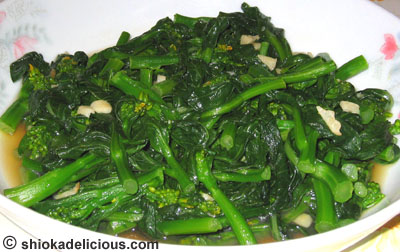
And any other green vegetable one can think of: broccoli, xiao bai cai (baby pak-choy), long beans, French beans, cauliflower, Chinese cabbage (bok-choy) (okay, okay, the last two are not green, but still vegetables) 
The only variants would be the length of time the vegetables are sautéed for, depending on their hardness, and also the aromatics and flavorings used in the sauté.
Kailan (Chinese broccoli) usually requires ginger slices or strips to be added as well, to remove the “grassy” taste. And a dash of Chinese rice wine, Japanese mirin (rice) wine or even a fairly dry white wine works wonders with this vegetable. I would add the ginger with the garlic to the hot oil for a quick sauté, before adding the kai lan. And just before it is plated, after all the seasonings have been added, add a dash of the wine. The best would be to flambé the vegetable, but unfortunately, the home gas stove just doesn’t have a large enough flame for this. So, I normally just give a quick sauté to allow some of the alcohol to evaporate, leaving just the taste of the wine on the vegetable.
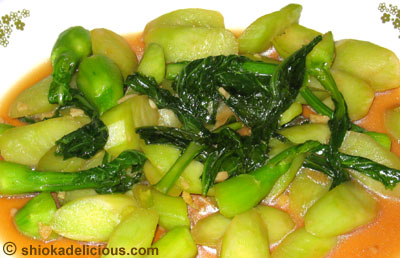
I love kai lan stems – a seasonal vegetable – cooked in this way. Compared to the regular leafy kai lan, these stems are easily 5-8 times thicker, and are usually sold without the leafy part of the vegetable. These are very crunchy and sweet!
I really like fresh shitake mushrooms cooked in this way too…

The tiny juliennes of ginger and the wine really lift the taste of these very aromatic and flavorful mushrooms. Just be sure not to overcook the mushrooms. It takes just 2-3 minutes in the wok, and it’s good to go.
And when we get tired of all that green stuff, we add a dash of red to the stir-fry… Carrots immediately brighten up any vegetable dish, be it cabbage (winter-time cabbages from China are especially sweet and crunchy)…

Or snow peas…
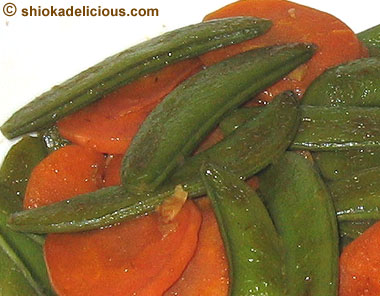
And… the mix and match game continues… on top of the carrots, throw in some fresh shitakes, and hey presto! brand new vegetable dishes…
Asparagus with carrots and shitakes…

Bean sprouts with julienne of ginger, carrots and Chinese dried mushrooms, and some scallions for a touch of green…
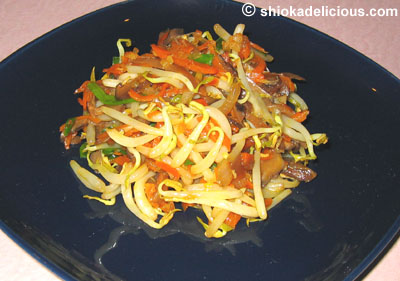
Lettuce with carrots and shitakes…

Then, we start adding different sauces to the same vegetables. Instead of stir frying the lettuce, sometimes I like to quickly blanch them in boiling water (seasoned with a touch of cooking oil, pinch of salt). And top it with various “sauces”.

This one here has three types of fresh mushrooms, carrots, onions and diced chicken. Other “toppings” I regularly use are shallots with oyster sauce; diced chicken with teriyaki or dark soy sauce; shitake mushrooms with ginger and rice wine… I guess the combinations are pretty endless – whatever you fancy, and whatever is in the fridge.
I do baby kai lan (the ones with the rounded ends), kai lan, cai xin, broccoli in these ways too.
Hey, this “match the vegetable to the ingredients” game isn’t so bad now is it? But after all that mixing and matching, it is time to spice things up! It starts getting hot, hot, hot…
Another perennial favorite way to stir fry vegetables is to use sambal belachan or just simple chilli sambal. (This is a very South East Asian way of cooking, although in Sichuan, China incredibly spicy peppercorns are also used in their cooking).
A lot of vegetables can be fried with chilli, from okra or lady fingers and long beans to kang kong or tong xin cai (translated as “hollowed stem vegetable” – very aptly named, as it is the only type of vegetable with a hollow stem!)

At home, we usually do not use sambal belachan (fermented dried shrimp paste with chilli) although it is a must in a large majority of households. We usually make our own chilli paste (grind fresh red chillis and sauté in oil until fragrant), which is more acceptable and palatable than belachan for young and old alike. This chilli paste will keep in the fridge for a couple of weeks, and can be easily added to any type of dish. There is then also the flexibility to add dried shrimps or other ingredients to the vegetable when sautéing it with the chilli paste.
There are many, many more ways to cook vegetables… and you thought vegetables were boring? But I think that’s enough rabbit food for one night The rest will have to wait for another time…
Happy vegetable stir-frying!
01:36 AM in Home Cook: Vegetables | Permalink | Comments (3) | TrackBack
Thursday, December 11, 2025
Bitterness is Good for You

I’m trying to “detox” for a few days before the orgy of feasting, dining and wining begins in 12 days time, and which could potentially continue right up to 5 February next year, when Chinese New Year celebration ends!! My tastebuds leap in anticipation, but my digestive system shudders in horror. 
Well, I did say “trying”, with the emphasis on the word “trying”. I had intended to start today… cut (or at least reduce) the sugar, i.e. less (preferably no) cookies and chocolates, cut the meat, and just more vege, fruits and complex carbs. (Those on Atkins or high protein diets, this is the cue to stop reading) Well, today was a non-starter… had some homemade smores (toasted marshmallows covered with bittersweet chocolate on graham crackers) and some chocolate cookies… Oh well, tomorrow is another day!
However, I’m going to make myself feel slightly better tonight by writing about some vegetable dishes. The Chinese have a saying: “the more bitter it is, the better it is for you”. And the bitter gourd is held by Chinese traditional medicine to have many health-giving and healing properties. It is said to be able to help with high blood pressure, high blood cholesterol and some forms of diabetes. It is also believed to be good for acne, eczema, psoriasis and other skin conditions. Very often, it is made into a tea (by boiling in water) and drunk much like a tincture. I think nowadays it even comes in tea bags for convenience! This is also said to be a great cure for a hangover – flushes out the alcohol from the system!
If I’m not wrong, it is the compound that gives the vegetable its distinctive bitter taste that makes it a very efficient detoxifying food substance. It “cleanses” the blood and digestive system.
This vegetable tastes a lot more palatable than it sounds. And its bitter taste can be easily removed (whilst still retaining its “cleansing” and “detoxifying” properties) by simply soaking it in some salt water for a few minutes after it has been cut. Just rinse well after the soak, and it’s good to go. It’s actually quite a versatile vegetable, and can be cooked in several ways:
- stir-fried with shallots and fish cakes (as in the above picture) or fresh fish slices
- stir-fried with garlic, ginger and fermented black soy beans
- stir-fried with spring onions and miso
- stir-fried with garlic, ginger and diced chicken
- stir-fried with garlic, ginger, thin slices of beef and a black pepper sauce
It is of course also a popular ingredient in “yong tau foo” where it is stuffed with minced fish or pork and either steamed or fried.
I also like it cooked sort of omelet-style…

Saute some shallots in hot oil to soften slightly. Add the bitter gourd slices and give it a good stir-fry. Season with salt and sugar. Cover for a few minutes to allow the gourd to soften somewhat.
In the meantime, lightly beat a few eggs and season with salt and pepper. Add to the gourd, making sure all the gourd is covered with egg. I usually allow the eggs to cook in one of two ways. Sometimes I make a sort of gourd-and-eggs “pancake” (as in the above picture). I allow the eggs to start to solidify into a “pancake” before flipping it to cook the other side. Other times, I like the egg sort of scrambled, so I start stirring the egg as it begins to cook and solidify, so that it forms soft, fluffy clusters of egg and gourd. (A little bit of water has to be added to the egg when it is beaten for the latter version).
Note: whilst preparing the bitter gourd, be sure to remove all the seeds and white “veining” on the inside of the gourd – these don’t taste good, at all. There’s no need to skin the gourd though.
And so a detoxifying we go....
02:31 AM in Home Cook: Vegetables | Permalink | Comments (0) | TrackBack
Wednesday, December 10, 2025
Creamy Mushroom Chicken

Work has been frantic the last two days. It’s the pre-Christmas frenzy – businesses’ busiest time of year. I was certainly in no mood, nor did I have the energy, to cook. Our domestic helper prepared dinner tonight – a very quick, 15-minute chicken dish using Campbell’s cream of mushroom soup. Yes, we cheated. But it doesn’t taste anything like how it might be sounding. It’s actually quite, quite delicious. I learnt the dish from my mum, and it was a god-send during college. In just minutes, there could be a delicious, piping hot dinner on the table.
I would have preferred to use bone-in whole chicken drumsticks and thighs – chicken just looks better, and more like chicken that way . But I don’t like to freeze bone-in chicken. Inevitably, there’ll be some blackening around the bone when thawed chicken is cooked. And I find that rather unsightly. So I only cook with bone-in chicken when it’s fresh from the market. The rest of the time, it’s chicken fillets or de-boned chicken thighs.
The chicken is diced and seasoned with some light soy sauce, sugar, sesame oil and a bit of cornstarch. A diced large onion is sautéed in hot oil, before the chicken is added. Once the chicken is browned and semi-cooked, slices of fresh white button (or brown or field) mushrooms are added, followed by a can of Campbell’s cream of mushroom soup. A touch of hot water is added to adjust the consistency of the gravy. Finally, salt (or light soy sauce) and pepper are added to taste. Our helper added some dark soy sauce today, and so the chicken came out darker than I usually prefer it. I like the natural creamy color better.
Served the chicken with garlic stir-fried xiao bai cai (baby bak choy). I really like these curly leafed variety, which are only available during the winter months (winter in China that is, from where these are imported). They are so much sweeter and crunchier.
We also had soup today. Normally, there would be a soup at dinner everyday but we haven’t cooked any for over a week now. And today we had a nice chunky soup of lotus root, lotus seeds, white wood-ear fungus and boxthorn seeds (which give the soup a nice natural sweetness).
I’ve never bothered to photograph nor post any of the soups we normally cook. I don’t know why. But here’s my first…

In recent days, quite a few people have cooked and posted about soups (Alberto, Deb and Blue). I just love this synchronicity! Soups are so soul-satisfying and heart-warming – that must be the energy that is going around. Nice!
12:10 AM in Home Cook: Poultry & Meats | Permalink | Comments (0) | TrackBack
Tuesday, December 09, 2025
Good-Looking Pilaf
Oh, watched A Cook’s Tour tonight. (Yes, my weekly epicurean TV fix. Can you tell I’m a fan? ) One of the two episodes shown was the Bangkok/Singapore one. And the home-cooked pilaf in the Singapore segment looked so good! And best of all, it was cooked in a rice-cooker – simple, easy and quick. Wow! I would love to know the recipe for that pilaf. It was cooked separate from the meat, and had dried fruits, nuts, veggies etc. Yum! I’ve been looking for a good pilaf / briyani rice recipe for the longest time – one that is fuss-free, quick and easy.
And the dessert served in the Nefertiti Restaurant in Bangkok looked really yummilicious too! Looked like a cross between bread-and-butter pudding, crème caramel and custard. Hmmm… more "soul food". (Today does seem like a day for comfort food doesn't it?) I would love the recipe for that too!
Drool, drool… I think I shall have very tasty dreams tonight!
03:56 AM in Crumbs & Tidbits | Permalink | Comments (0) | TrackBack
It’s a Good Thing

What is that goop??? You ask.  It is warm oatmeal sprinkled with demerara sugar. Yum! The partially melted sugar crystals give a very nice sweet crunch to the otherwise bland oatmeal. There is almost a nutty taste to the sugar.
But why on earth am I blogging about oatmeal of all the food in the world? But why ever not? Okay, granted, glossy, creative, arty-looking photos of elegant recipes have become almost de rigeur in a lot of foodblogs. There’s nothing wrong with that. I absolutely enjoy taking in the glorious, mouth-watering pictures, and thus taste different cuisines and cooking styles vicariously through them – they inspire and whet the appetite of mind, body and soul. But I think there is also room for the everyday food. What you and I eat everyday, which we don’t blog about, maybe because it doesn’t have enough “glam factor”. It’s the comfort food, the easy food that we throw together to feed ourselves and our families, which are simple yet heart-warming. The down-too-earth soul food so to speak.
Alright, many people might dispute that oatmeal can and should be considered as “soul food”. But it’s good wholesome, natural food. And when paired with demerara sugar or sometimes even sweet condensed milk, “it’s a good thing” (as Martha would say).
Where exactly am I going with this oatmeal thing? Nowhere really. Today was a Monday. And Monday mornings are tough. It took all my will-power to get out of bed this morning and drag my sleep-deprived body off to Pilates class. I could feel the weekend indulgence of food and laziness in every muscle fiber as I willed them to move and contort through their paces. And yet the rewards are sweet. By the end of class there was a buzz in my body, a spring in my step and a smile in my heart. I felt energized and happy. Added to that, the simple breakfast of demerara oatmeal just made for a very comforting start to a brand new week…
Alright, alright, enough of this ramble already. I guess it’s painfully clear by now I have nothing much to blog about tonight. Haha… So, I’ll just say g’nite!
03:47 AM in Comfort Food, Home Cook: Light Touches | Permalink | Comments (3) | TrackBack
Monday, December 08, 2025
Old Shanghai

We had dinner in Chinatown again over the weekend. Last Thursday, during our after-dinner stroll, we had passed a restaurant called “Old Shanghai”, and the menu had looked interesting…
Our intention was to have a light meal, but as usual, we ordered a little too much food. We had the Shanghai-style fried noodles and Shanghai-style fried rice, together with several other side dishes.
The noodles were tasty – one of the best dishes of the evening. Hand-pulled fresh noodles stir-fried with strips of lean pork, wood-ear fungus and caixin (green vege). Yummy but oily.

I’m a fried rice person. I can have fried rice every week. Must be remnants from spending my formative teenage years in boarding school and more years in the UK as an undergraduate, where at that time, Chinese food mostly meant fried rice and sweet and sour pork!  Unfortunately, this version of fried rice was rather lacking. It was tasty enough, but rather deficient in wok-hei (hmmm… how do I translate this? It’s that wonderful fragrance that is imparted to the rice when there is sufficient heat in the wok. This wok-hei is next to impossible to get at home, as the flames on our domestic gas burners just do not provide sufficiently intense heat. This is what makes fried rice – good fried rice that is – in restaurants so tasty). I also couldn’t see what made this fried rice typically or specially Shanghainese. It looked rather Singaporean to me! But I was satisfied anyway
  My fried rice fix for the week.

We shared a small bowl of the hot and sour soup. And boy, was it sour! It was almost like drinking vinegar! You know that sensation one gets in the glands at the back of the throat when tasting something really vinegary? Sort of like fingernails running across the blackboard type of sensation? Yeah, that was what it felt like drinking the soup.

The pork and veggie wantan (soup dumplings) were a complete contrast. Ha ha! The dumplings looked and tasted like they were cooked and served in plain water. Sorry, no taste of stock or broth here. The tiny saving grace was probably the dumpling skin. It looked rather thick, but was very soft and smooth.

We of course had to order the signature Shanghainese dish of xiao long bao (small steamed pork dumplings with broth). The two hallmarks of a great xiao long bao? Skin that is thin and translucent yet strong enough to hold the broth in the dumpling without breaking, and broth that is generous and tasty. Both these take a lot of skill and experience on the part of the dumpling maker. These dumplings had slightly thick but okay skin, however, the broth within was rather bland and the meat filling very, very fatty – maybe 70-80% fat with little lean meat.

The biggest disappointment of the evening rounded off our meal. Deep fried carrot pastry. They looked really delicious, with a crispy, flaky crust. But the copious amount of grease oozing from the pastry didn’t settle well in the stomach, and the radish filling was definitely an acquired taste.
Oh well, at least now we know...
It was a beautiful evening out last night, with the night air cooled by the earlier rain. So here’s another night scene… a snapshot of the food street in Chinatown - the al fresco food stalls outside the restaurant. These are the sanitized version (oops, except for the incriminating evidence of Singaporeans who had failed to clean up after themselves!) of the push carts used by the itinerant hawkers of old, who would move through the narrow streets, selling piping hot noodles and porridge to laborers and passers-by. It’s always great to sit under the trees and a canopy of twinkling stars (most of the time) and eat satay (BBQ meat skewers), char kway teow (fried flat rice noodles) and spicy BBQ sambal sting-ray. Food somehow always tastes better this way. Maybe soon…

02:13 PM in Lion City Shiok-Eats: Chinese | Permalink | Comments (4) | TrackBack