« January 5, 2026 - January 11, 2026 | Main | January 19, 2026 - January 25, 2026 »
Sunday, January 18, 2026
New Year Goodies Galore!!
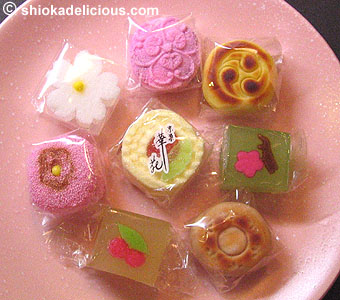
Woo hoo!! Look what I got! Received these today… these are the exquisitely made, very dainty Japanese confectionery that I posted about the other day. Kawaii! (Cute!) (As the Japanese would say  ) Actually, I made a mistake. The other day, I said they were made from Konnyaku jelly, but after eating them today, I realized they are not Konnyaku. They are various Japanese confectionery – some are made from jelly (the 2 square pieces and the white flower), some have a white bean paste filling with a mooncake-like pastry (the 2 round yellow-brown ones), some are mochi-like with red bean paste filling (round pink one), some have hard, very sweet sugar centers (pink flower), and some are just very, very sweet (center yellow round one).
Each of the designs is so exquisitely rendered. Almost too pretty to eat. I say almost… Quite a few other designs had already landed in our stomachs before I even remembered about taking pictures.  I really wanted the tiny tangerine designs that I spotted the other day, but apparently they have long been sold out. Oh well! Still…
What a nice, sweet start to the weekend. I was planning to go down early next week to grab some for the New Year, but I guess my raves about them didn’t go unnoticed  . How sweet! (figuratively and literally).
This weekend has turned out to be one filled with several pleasant surprises… It is always such a warm feeling when one thinks about/wishes for something, then forgets about it, thinking it not that important, when out of the blue, without you expecting it, the wish is fulfilled.

I had been slightly disappointed about how my cornflake cookies had turned out, and was discussing with my mum how I could go about modifying the recipe again. Apparently, my mum had mentioned to my aunt (who makes these cookies by the thousands - and I mean thousands – each year), and not only did my aunt promise to forward me her recipe (which should be coming soon), but she also sent me a big jar of the cornflake cookies she made! All the way from Brunei too! Yep! Delivered by plane. Isn’t she just the sweetest?
Every year she spends hours and hours, days and days, weeks and weeks before CNY baking cookies. She started out making them for family, then friends started placing orders with her… and now she has a full fledged CNY cottage industry going, with a repertoire of some 10-15 different types of cookies! Her cornflake ones are still one of my favorites. She painstakingly forms little rosettes with the cornflakes on each cookie (as opposed to the usual more rough-and-ready method of rolling the balls of dough in crushed cornflakes). This takes HOURS! Everything is still completely made by hand. And the cookies are in nice small one-bite sized pieces. Yum!
She also sent me these…

I love these! Kueh mur (sp?). This is actually a Malay cookie. I have not seen it in Singapore, not even during Hari Raya. Perhaps it is an East Malaysia/Brunei thing?
These are basically icing sugar-coated cookies with a very tender, crumbly, melt-in-your-mouth texture. The recipe is simple enough, but the key to the success of making this cookie lies in the “frying” of the flour before making the dough. The flour has to be “stir-fried” (without oil) in a wok until it is extremely light and “loose”. This is a time-consuming process (perhaps 45mins to 1 hour? Depending on how much flour you have), and requires a great deal of bicep/arm strength! If the flour is not sufficiently “light”, the resulting cookie will be very dense and when eaten, will be this sticky, thick powdery goo in the mouth. Not pleasant! When done right, the entire cookie simply melts away in the mouth, leaving a wonderful sweet taste. Shiok! It is not easy to find a well-made kueh mur.
By the way, these kueh mur cookies are made into small bite-sized balls, which can be popped whole into the mouth. I just realized that from the picture, these things look like humungous golf-ball sized giants! LoL.

This was also part of the gift package that came from Brunei. This is a yearly fixture in our annual “CNY goodies” box sent from Brunei. Kueh Kapit (literal translation from Malay: Cupid cookie), otherwise known as love letters or egg rolls. The roots of this CNY staple are found in the Malay and Peranakan cultures. This is a fragile thin, crepe-like, but very crispy cookie, rolled into a cigar-shape.
The Malay/Peranakan version differs from the Chinese rendition in that the former has a touch of coconut milk/cream added to the batter, which gives the cookie incredible aroma, fragrance and a richer, more complex taste.
This is another very time-consuming, labor-intensive festive cookie to make. It takes hours of sitting in front of hot iron griddles, cooking each individual piece of cookie dough. Clock watching is of the essence. It takes mere minutes for the thin cookie to cook. If you remove the cookie several seconds too early, it may result in a too light-colored cookie. A few seconds too long, and the cookie will be too dark. It takes a lot of practice and experience to get each cookie looking very similar in color to each other.
One also sacrifices the skin on the tips of your fingers when making this cookie. When the batter comes off the griddle, it is still soft. But it hardens very quickly, and so before it does, when it is still piping hot, the cookie has to be very quickly rolled into the cigar shape – by hand!
What makes a good kueh kapit? The biscuit must be as thin as possible yet still strong enough not to break too easily. It must be tender but not too fragile. It must be light and crispy without being hard. It must be golden brown – not burnt but not too pale. It must be just right. Tall order, no? It is a labor of love, and oh so delicious! Great on its own, even better with ice cream! 
Every year, we get ours from an elderly Malay woman who has been making these for decades!
All of a sudden, the New Year gifts have been pouring in over the last couple of days.

More pineapple tarts. These are hand-made by a friend. Another labor of love.
Hmmm… I think we have a little too many pineapple tarts now… 5 types! Oh boy! My poor waistline!
Oh, and would you believe, we received 4 big nian gaos from various friends. If you add the two we had already bought, that makes for a lot of nian gaos this New Year! Haha! I can see us having nian gao pan-fried with egg for breakfast for quite some time to come!
We also received these…

They look like pork bak kwa, they feel like pork bak kwa, but they taste quite different from the regular pork bak kwa. These are chicken bak kwa, a supposedly slightly healthier version of the pork bak kwa (BBQ sweet meats), but I doubt so, given the amount of grease and oil this version also comes swimming in. And personally, calorie for calorie, fat gram for fat gram, I would go for the one and the original… the pork bak kwa. But this version is great to have to serve to Muslim friends.
When eating bak kwa, I always pick the pieces that have more of the chao tar (burnt, crispy) edges. Ooh! I love those crispy bits! Yummy!!!
My mum also bought more New Year goodies today.

These are the true traditional Chinese almond cookies. They are very dense, dry, powdery cookies – quite hard, not crunchy nor crispy. When placed in the mouth, they sort of melt into a powdery, thick mixture. Not my cup of tea unfortunately. I always feel like I’m imbibing mouthfuls of powder!  Come to think of it, I haven’t come across someone who actually likes eating these, and yet a lot of households buy them every year. I'm not even sure what the tradition is behind these almond biscuits. Nowadays of course they come neatly packaged in individual packs, displayed in an elegant gift box, as opposed to the traditional tin can of old, into which dozens of the cookies are stacked, one on top of the other.

Fa gao (steamed cakes). They are basically light, fluffy, airy steamed cakes made from flour, sugar and water. During CNY, they symbolize prosperity and wealth, as “fa” sounds like the Chinese word “to prosper”. My mum would normally buy a large one that is shared by the family during breakfast on the first day of the New Year. Today, she came home from the market with these – mini fa gao in pretty pastel shades, as opposed to the usual brown or white. She wanted to try them out before the New Year to see how they tasted before deciding what to get for New Year’s Day. I think they look rather pretty and elegant. I like!

We will be making keropok (deep fried prawn crackers) over the next few days. These are dried crackers made from minced prawns. When deep fried, they expand around 4-5 times in size, and become a white, crispy and light cracker. These keropok are still sometimes served with roast chicken in some Chinese restaurants.
Our family remains partial to the famous Brunei keropok – thin, very crispy with a full-bodied prawn flavor. When the keropok is made too thick, the deep-fried cracker will be hard and dense, instead of being light and crispy.
While we are on the subject of famous Brunei food products, there was also a HUGE block of belacan (fermented shrimp paste) included in the “gift pack” we received today. I’m not well-versed in the subtleties of different belacans, and cannot tell the difference between run-of-the-mill and out-of-this-world belacans, but so many people have waxed lyrical about the Brunei-made belacan. I know that two former Presidents of Singapore as well as many Singaporean cabinet ministers order this stuff in bulk. Only recently, the family of a minister visited Brunei, and carted back tens of kilos of this stuff!
Belacan is truly pungent. Neighbors many doors away will always be able to tell which family is having belacan in the next meal!  But it is so very delicious when added to a variety of dishes. The shrimp paste is usually combined with chilli paste to form sambal belacan, which can then be used in vegetable stir-fries, fish or meat dishes and so on.
Wow! A food-filled weekend indeed!
04:19 AM in Festivals: Chinese New Year 2004 | Permalink | Comments (12) | TrackBack
Saturday, January 17, 2026
Heralding the Stork!
10:22 AM in Crumbs & Tidbits | Permalink | Comments (0) | TrackBack
Making a List and Checking It Twice
The list of things to buy for CNY seems endless. Every now and then we would remember something we have missed and add it to the list, which just seems to grow longer, never shorter. Well, slowly but surely, we are making our way down the list.
Let’s see... how are we doing so far?
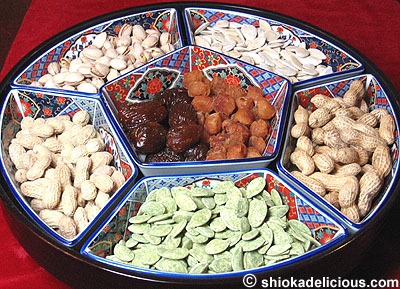
A Lazy Susan filled with New Year goodies is a definite must. Alternatively called a Ba Bao (Eight Treasures) or Happiness or Togetherness Tray, this was traditionally a selection of 8 different candied dried fruits. Nowadays, the Ba Bao Tray can be made up of just about anything – various nuts, different crisps and crackers, a selection of cookies, or a range of chocolates or candies. One can also have a savory Ba Bao Tray, filled with eight different cooked dishes, like prawns (signifying laughter), abalone (for abundance), fa cai hao si (for prosperity) and so on.
Every household will have at least a few selections of different nuts and melon seeds for CNY. These are our family’s favorites (clockwise from top left):
• pistachio nuts (“kai xin guo” meaning “fruit of happiness”) – I love pistachios. I would prefer them unsalted, but they all seem to come ready salted which means they can only be consume in small quantities in each sitting.
• regular white pumpkin seeds (“gua zhi” symbolizing many descendants and offspring). These are the only melon seeds I ever manage to crack with any amount of elegance and decorum!
• peanuts (“chang shou guo” for longevity). These ones are a new flavor… Farmer brand garlic-flavored peanuts. We were curious enough to buy a pack to try. Verdict? Not bad, but I think, for the sake of those near me, I would rather stick to the regular flavored ones for New Year’s Day.
• green tea-flavored pumpkin seeds
• regular Shandong groundnuts. Shandong in China is famous for producing supposedly some of the best peanuts in the world – crunchy and fragrant. Shandong groundnuts also tend to be larger in size than regular peanuts. As far back as I can remember, we always buy the Hand Brand of groundnuts – you know, the one that, as children we called the “very good” brand because of it’s iconic logo of a “thumbs up”. We broke with tradition this year, and tried out the Camel brand of Shandong groundnuts.
As mentioned before in a previous post, candied fruits are also highly significant during CNY. The center of the tray shows honeyed red dates and dried longans. These two are always placed together and are termed “hong zhao gui yen”, expressing a wish for the early arrival (represented by the red dates) of many sons (represented by the longans).
For some families, perhaps particularly the Cantonese, a tea, brewed from dried red dates and dried longans, is drunk on the first day of the New Year. However, the dried red dates and dried longans used for brewing the tea are slightly different from the ones shown above. These regular dried red dates can also be used in cooking soups. Our family quite often use these dried red dates to sweeten soups when we do not want to use meat to make the soup base. Instead of using the more expensive golden dried longan (as in the picture above), regular chopped dried longans can be used to brew the tea.
This tea is also drunk by newly weds on the day of their wedding, to symbolize fertility and many descendants.
These are absolute musts in our home during CNY. I simply LOVE these. Candied lotus roots and candied lotus seeds. It’s still 5 days to New Year, and we are already munching through our second batch of these! Lotus roots are supposed to symbolize family harmony, togetherness and unity. Lotus seeds again symbolize a long line of descendants. But I just love the taste of these. I don’t know why.

Oh yeah, I have also made some honey roasted cashew nuts. I usually prefer to do them at home if I have the time, as the store-bought ones are almost inevitably deep fried. I would dry-roast them in the oven – much healthier that way, and they still come up crunchy and fragrant.
As cashews take anywhere between 20-30 minutes to cook (depending on your oven), I usually pop the raw cashews into the oven for approximately 7-10 minutes before coating them with the honey and returning them to the oven, so that the honey doesn’t have time to burn. For every 500g of raw cashews, I normally use approximately ½ cup of honey mixed with a scant 2 tablespoons of water (to lighten the consistency of the honey). I try to get a thick liquid that is not so sticky that it is hard to mix into the nuts and yet not too watery.
Once the cashews have had a brief spell in the oven, I toss them with the honey and return them to the foil-lined baking sheet, making sure to spread the nuts out so that they don’t stick together too much as they bake. Sometimes I also toss them with some raw sesame seeds together with the honey, or I will add pre-toasted sesame seeds a few minutes before the nuts are ready.
I like making honeyed walnuts this way too. I love the commercially available ones, another favorite for CNY, but they are deep fried in a lot of oil. The home-made ones are just healthier and just as tasty.

These are always at the very top of our shopping list for every Lunar New Year. Ingredients for the loh hei yu shang! The whole family loves loh hei yu shang, and during the course of the 15 days of CNY, we might have this dish oh maybe 7-8 times even. This dish is a definite must at any New Year gathering or party. It is also “traditional” to have this dish on New Year’s Eve, the first day of New Year, the 7th day of New Year and usually on the last day too. Business people will toss up this dish with business partners or associates at business lunches and/or dinners during the New Year period.
Loh hei is basically a very large salad made up of shredded green radish, white radish and red carrots, accompanied by 9 different types of syrup-soaked or candied vegetables and dried fruits, such as candied ginger and candied kumquat peel. (The 7 tubs and 4 smaller packs in the picture). The star of the salad is raw fish, smoked salmon or abalone. Ground roasted peanuts and roasted sesame seeds (top left hand corner) are also added, together with a liberal sprinkling of deep fried crispy dough pieces (top right hand corner). A plum-sauce based dressing is poured on, some lime juice is added and the salad is tossed by all present. The higher the salad is tossed, the better it is.
The name “Loh Hei Yu Shang” means to generate opportunities, openings, great wealth and prosperity. “Loh” in Cantonese means to “churn” or create (business) opportunities. “Hei” means to “rise”. “Yu” (the fish or abalone) signifies abundance. “Shang” is to grow.
As the salad is being tossed, auspicious sayings are said aloud – such as “loh, loh, loh dou fung shang shui hei” i.e. toss, toss, toss till the wind grows and the water rises, meaning good luck and fortune will grow and increase. The higher the salad is tossed the more the prosperity will grow.
Every year we would buy the ingredients (minus the radishes and fish) from Kwong Cheong Thye (63, Geylang Lor 27). For the last 10 years or more, we have been making this dish at home to share with family and friends, as previously we had found the versions served at restaurants to be overly-sweet, and overly-priced too. I don’t know what the current market price is for this dish – maybe ranging between S$38-88? Depending on the size of the serving and the type of fish/seafood used. We buy the ingredients in bulk (good for around 7-8 large servings, as pictured above) and it comes to under S$60. We also then get a choice as to what we would like to use in the loh hei… smoked salmon, raw fish, or even roast duck. Yes, roast duck. We like this version, even though it is a departure from the fish and its intendent meaning of abundance. It makes for a very nice change of taste from the usual fish and abalone.
My mum normally makes her own concoction for the dressing. A recipe she has honed through the years. This year, she spotted Kwong Cheong Thye’s newly launched “yu shang sauce”. We haven’t tried it yet, so not sure how that will taste like.
[Oh! Before I forget. The loh hei ingredients are also available, from supermarkets, in pre-packed single servings at around S$16.80 for a large serving (I think).
Also, we buy additional “pok chui” (the crispy fried dough) from Farrer Road market. I actually prefer these ones to the Kwong Cheong Thye ones. The crunch and crispiness are different.]
I am so looking forward to having my first loh hei of the year soon.

Remember me talking about the auspicious pineapple and fish shaped chocolates I first saw at the Chinatown festive market? Well, I finally got myself some. This is such an ingenious marketing ploy, but I love it. 
We also bought some “jin bao” gold nuggets chocolates with “fu lu shou” stuck on them. Fu Lu Shou are the 3 men in the statues one sometime see displayed in some Chinese homes. They represent prosperity/fortune, status and longevity.

Of course, two things that are at the top of any Lunar New Year shopping list… nian gao (glutinous rice New Year cake) and mandarin oranges.
We prefer the nian gao that has been steamed wrapped in lotus leaf. The large majority of nian gao nowadays come wrapped in plastic wrapping. I think the lotus leaf does make a difference to the aroma of the nian gao.
The mandarin oranges in the picture are Lukan mandarins from China. Those from Taiwan are called Ponkan. I think they are fairly similar to each other, although more often than not, we have found Lukan to be generally juicier.
There is actually also another seasonal orange which is available only around the CNY period – the Chinese “liu ding”. This is an orange rather than a mandarin orange. It is very juicy and very sweet. We like this a lot. However, it has never gained wide-spread popularity and has always been over-shadowed by its more famous cousin, the mandarin orange. There is also a hard-skinned variety of mandarin orange, the name of which eludes me at the moment. Again, this is not as popular as the soft-skinned Lukan or Ponkan.

My mum bought these from the market last week. They are so cute! Tiny mandarin oranges – or more accurately, kumquat. These are on average only about 1½” to 2” in diameter, and they are so, so sweet! Very, very juicy too! (And only S$4.00 per kilo, at the market - possibly slightly more at the supermarkets). I actually prefer these over the Lukan. But the Lukans are the ones to use for “bai nian” purposes – i.e. for exchanging with friends and family to wish them “Happy New Year”.
Yes, the refrigerator and pantry are starting to look decidedly full… everything is looking very red and golden… it’s looking like a delicious New Year!
04:16 AM in Festivals: Chinese New Year 2004 | Permalink | Comments (2) | TrackBack
Wheezing and Sneezing
I am up to my elbows in dust and clutter. The annual spring clean is now underway in earnest. Each year, I never fail to be amazed at the amount of “unseen” dust that lies hidden in obscure corners of rooms, cupboards and shelves. I am always stunned by the amount of “junk” one manages to accumulate in the space of 12 short months.
The countless “unique” jam jars and empty bottles, stacks of “pretty” biscuit tins that I “just have to keep”… the many “must-buys” that are picked up during various saunters through the kitchen gadgets department of different departmental stores… all squished, crammed, shoved, hidden into every available nook and cranny of every kitchen drawer, cupboard and shelf. At the time, I was so sure I would have fabulous uses for these things. And yet, for 12 months they have lain “hidden” and forgotten in the dark recesses of a kitchen cabinet. So, every year, a big sweep is done. Jars, bottles, tins, gadgets… they get found new homes either with a new family or in the big wide world of the rubbish dump.
The fridge is a shocker. Bottles of curry spice mix, ground spices, half-used packets of nuts… all having outlived their natural life span in this dimension. Ackk! I’ll spare everyone the gory details.
It’s not just in the kitchen either. Magazines, clippings, paperwork… a zillion other things. How do humans manage to accumulate so much stuff?! I marvel at my own optimism each and every year. Magazines and cuttings of interesting articles are set aside… “I’ll read those when I have more time”. But “more time” never comes, and the magazines sit collecting dust. One would think I would have learnt by now…
Clearing my wardrobe always reveal interesting finds too. Clothes that I don’t even know I have - some still with the price tags on them! [Note to self: do NOT impulse buy clothes again]. Well, I guess some lucky people will be getting brand new clothes for New Year – free.
And so, the annual wheeze and sneeze session is in full swing. We started really late this year. The New Year is only 5 days away! A weekend of scrubbing and mopping lies ahead…
On a different note, I just need to whine about this… I’VE PUT ON WEIGHT in the past 12 months. This is not good news. I had not noticed the weight gain. I don’t usually weigh myself, so it was a little upsetting (shocking?) yesterday when I tried on my cheongsam (qi pao) from last year. I was intending to wear it to a New Year function next week. But hey, guess what? It no longer fits! This is so depressing! Unfortunately, the cheongsam is such an unforgiving dress to wear. Just put on an extra ½ inch around the waist, and one ends up looking like a bak zhang (wrapped rice dumpling). Sigh! Maybe by some miracle I can still find someone to do alterations for me at this late stage…
Anyway, female whinging over… back to more food talk… : )
03:04 AM in Crumbs & Tidbits | Permalink | Comments (0) | TrackBack
Thursday, January 15, 2026
You Say Cookies, I Say Biscuits
The one time in the year that I completely over-indulge in cookies (or biscuits as they are called in this part of the world) is during the Lunar New Year. It used to be that all the CNY cookies were (or had to be) hand-made at home. And there-in lie a lot of the magic and appeal of CNY cookies - memories of weeks and weeks of baking by my mum and aunts in the run-up to the New Year. In those days, the biscuits had a down-to-earth, almost rustic appeal to them… cornflake cookies, rice crispy cookies, even milo cookies. My love for CNY cookies (for some reason, these cookies are not made nor sold outside of CNY) is very much colored by my recollections of the colors and images of nut-grinding with a mortar and pestle, mixing the batter, rolling the dough into tiny balls… the smells of the baking cookies… and that moment when we, the kids, are finally allowed to taste the fresh-out-of-the-oven cookies. Heaven!
Each family would have their own recipes, or variations of a popular recipe, each with its own unique taste. The fun was in trying all the different varieties as we went from home to home, visiting family and friends over the 2 weeks of CNY.
Nowadays, most families buy their cookies ready-made. The choices available are mind-boggling, and there are some really tasty options out there. We usually aim for a combination of both ready-made and home-made.
“Chinese cookies” are rather different in texture and taste-balance from “Western cookies”. I find that the Americans tend to prefer their cookies with a soft, chewy texture, whilst the English/Europeans prefer a crispier/crunchier texture. Chinese cookies tend to be “soong” in texture. I have thought for hours on an accurate translation for this word, and have come up with nothing. There doesn’t seem to be an English equivalent of this word. The closest I can come is that it is a crispy yet soft, tender and melt-in-your-mouth texture, and still this would not really approximate to the real meaning of “soong”. (Anyone knows a better translation of this word? Please help!)
Unlike “Western” cookies, Chinese biscuits, even sweet biscuits, all tend to have a slight savory overtone – it’s a finely balanced combination of saltiness and sweetness. So one can actually eat tons of the stuff without feeling “jelak” (getting sick of it).
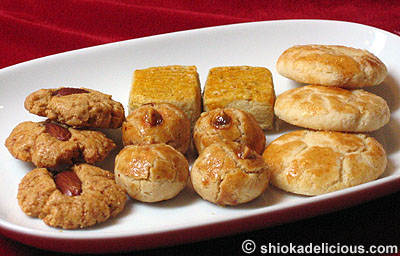
Every year we usually have a range of at least 12-14 types. This year, we made a very late start on the Lunar New Year shopping (ban nian huo). So, what is in our biscuit collection so far this year?
(Above picture, from left):
Almond Nut Crunchy (by Bengawan Solo, Singapore). Very fragrant, crispy and “soong”. I like the addition of Nestum in the cookie batter. I think it adds a little extra to the texture and aroma of the cookies.
Peanut Cookies (by Glory, Singapore). A firm favorite of my mum every year. I personally find it a just a tiny tad too much on the salty side. However, it has great texture, and a beautiful smell of peanuts.
Pistachio Pumpkin Cookies (by Johor-based Lavender Confectionery). This is one of their new flavors this year, and makes a nice change. I can’t really taste the pumpkin, but the tiny bits of chopped pistachio makes for a very nice crunch. [On a side note: I also like Lavender’s Vegetarian Almond Cookies (no eggs). I am tempted to buy this…]
Walnut Cookies (by Tarts n Pastries, Singapore). I like this. Very tender, melt-in-the-mouth, “soong” texture.
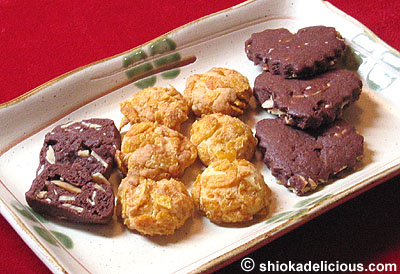
I had grand ambitions of baking most of the cookies for CNY this year. However, as always, things pile up (work, social commitments, spring cleaning, family obligations and on and on), and time slips by… and nothing gets done. I’ve only managed two varieties (one of which I made into two sizes and shapes).
The cornflake cookie is a “must” in this family. It is hardly available commercially. The only bakery offering it, that I’ve seen, is Bengawan Solo, and I don’t particularly fancy that version. Previously, my mum would bake them. For the past few years, an aunt has been making them and giving them to us for CNY. This year, yours truly was supposed to make them. And boy! has that been a journey!
As I was about to make the cookies, I discovered I had misplaced the recipe my mum had given me many years ago, and which I had since then tweaked and adjusted to my satisfaction. The recipe just couldn’t be found, and it was too late to be asking my mum for the recipe. So, I ended up surfing the Internet, but cornflake cookie recipes were few and far between. I finally settled on this one. For some reason, the cookies came out American-style: chewy. That was not what I was looking for. Feeling very frustrated that I had “wasted” an entire evening (it was close to 2am by then), I gave up, and decided to start afresh the next day.
I got the original recipe off my mum again, but I just could not remember what I had adjusted and how. It has been a good 6-7 years since I last made this recipe! Well, to cut a long story short, the cookies are very crunchy and crispy, but they are not “soong”, and that is what I really want. They taste great, just not the perfect texture I am looking for.
I also made some choco-almond cookies based on a recipe from cooks.com. I substituted the shortening with butter, and added toasted almond flakes to the batter. Half the dough was shaped into a fairly slim roll, and cut into bite-sized pieces. The other half was rolled out and cut with a cookie-cutter to form heart-shaped cookies. These are also slightly soft/chewy – perhaps because of the butter/shortening substitution? They pass the taste-test, but not quite what I was looking for texture-wise.
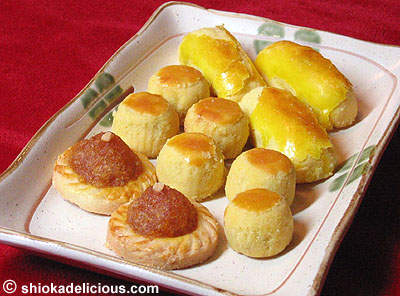
Pineapple tarts. The GREAT love of Singaporeans and Malaysians for CNY. There have been so many Google and Yahoo searches for “pineapple tarts” to my site! I can’t tell you.
There are basically two types of pineapple tarts – the open-faced one and the “closed” variety. The latter being an innovation on the former. The pastry used in both types is very different from each other. The open-faced tart has a crispier/crunchier, flakey pastry dough, whilst the enclosed tart is made with a very soft, buttery, melt-in-your-mouth pastry. The taste and “bite” of the two variations are completely different. The latter usually has the addition of cream and milk powder in the pastry batter.
The taste-test for the open-faced pastry is that it should be crispy without being hard. It has to have a tender crumb. For the “closed” tart, the challenge is to produce a pastry that is very, very soft and crumbly almost, and yet will hold together and keep its shape.
The filling of both types of tarts is the same – a sweet, very slightly spiced, pineapple paste made by cooking down fresh pineapple with sugar and a touch of cloves. This is an extremely time-consuming and tedious part of the preparation. It takes more than 1 hour of continuous stirring at the stove before the pineapple paste is ready. Only for those who want an intense bicep workout!
When the “closed” pineapple tarts first made their appearance over a decade (?) ago, they were made elaborately into the shape of pineapples. Nowadays, most confectionaries/bakeries make them into simple log or round shapes.
Our favorite for this type of pineapple tart is the version made by Smiling Orchid. Each tart is still hand-made, and the crust is deliciously soft and melt-in-your-mouth, with a nice buttery and creamy taste. The filling is also neither too tart nor too sweet. However, this year, we were too late in placing orders, and the order list has closed. So we are doing without Smiling Orchid pineapple tarts this year.  We have bought several other versions, and nothing quite compares. The ones from Indonesia (center in picture) are not too bad. Not much to look at, but pretty good taste wise. The ones on the right were given by a friend. If I’m not wrong, they are from Ho Kee Pau in Geylang. The filling is on the tart side, which some people prefer. The crust is not particularly soft nor crumbly.
We have also ordered some of these pineapple tarts from a friend of a friend, and will be picking those up this weekend.
I personally have a slight preference for the open-faced tart over the closed version. I find them less rich. We normally buy the ones by Glory (above left). After trying many, many versions, I still like theirs.
Well, the “treasure trove” of cookies is slowly but surely growing! With just one more week to go, I’m sure more will be added before New Year Day rolls around. I’m not done with my Lunar New Year shopping yet! We have also placed orders for some cashew nut cookies and more peanut cookies from another friend of a friend. Yes, more and more people seem to be baking cookies at home for sale. It must be a lucrative venture. And inevitably, there will be more and more requests from friends to buy from friends of friends of friends… It will become harder and harder to turn down such requests. Sigh! But hey, I love CNY cookies!
Happy cookie-ing!
06:25 PM in Festivals: Chinese New Year 2004 | Permalink | Comments (10) | TrackBack
Tuesday, January 13, 2026
Who Needs an Excuse for a Food Bazaar Anyway?
Definitely not the Singaporeans. But hey, the Lunar New Year is as good a reason as any.
The Takashimaya Food Hall is, in my opinion, one of the best departmental store food halls in Singapore – somewhat reminiscent of the Harrods Food Hall of London, and the Saks Food Hall of New York. And each time there is an upcoming festival (which in multi-racial and multi-cultural Singapore, is a very regular occurrence), Takashimaya holds a bazaar in the basement atrium of Ngee Ann City. Each bazaar will have dozens and dozens of food stalls offering food that is related to the upcoming festival, as well as other well-loved Singaporean favorites.
On Sunday night, we decided we would be courageous and brave the weekend hoards in Orchard Road and head on down to the Takashimaya CNY bazaar.
I had finally admitted to myself that the likelihood of me getting much CNY baking done was now very slim. Oh sure, I had ambitious plans to bake at least 8-10 different types of cookies. I had it all worked out (or so I thought)… a batch of 150-200 cookies of each recipe would probably take me maybe 3-4 hours, so 8-10 recipes spread over 8-10 evenings wasn’t going to be difficult. Ah, but you see, I forgot some important elements to the equation… like, running my business (ah yes, work? what’s that? ), family and social obligations, and the zillion other things that need to be done before CNY.
By last weekend, I had only managed two batches of cookies, and only after much distress at that (but that’s another story for another post). Looking at my schedule for the next week and a half, it didn’t look like much baking was going to get done. So, if we were going to have any CNY cookies at all for the celebrations, they were going to have to be bought ready-made. And that’s fine. There are a lot of great tasting cookies out there. It’s just that home-made cookies are just that much more special, and they don’t taste as “homogenous” as store-bought ones.

The Takashimaya CNY bazaar is always a great place to shop for CNY cookies. It brings together, under one roof, a large number of the top quality bakeries in Singapore. I would estimate that of the perhaps 65-75 stalls there, easily over 80% were selling CNY cookies and other CNY food. With each booth offering samplings of their products, we could taste the full range of options before deciding which to buy. And hey, for foodies, this is pretty close to food ecstasy – just wandering from stall to stall, munching on a whole hoard of food samples which every outlet thrusts very eagerly at you. Each stall has probably at least 12-15 different types of items on sale, with many stalls offering a lot more than that. Multiply that by 60+ stalls, and the numbers are staggering!
There were quite a few new flavors and innovations this year, which was exciting. I also spotted a number of new operators/bakeries that I have not seen before. We ended up buying 6-7 different varieties – some new, others old favorites. Pictures and descriptions coming up shortly.
Apart from the cookies, there were of course the usual CNY “musts”, such as bak kwa (BBQ sweet meats).

These are thin slices of pork with a sweet marinade that are grilled over a charcoal fire. Very delicious, but also very unhealthy. Not only do they have high levels of preservatives, nitrites and what have you, but they are also not very artery-friendly. These are available all year round, at yet, during CNY, Singaporeans seem to go into a frenzy for this meaty snack. We are prepared to literally stand in line for 1 - 1½ hours (and even longer as New Year’s Day draws closer) at the really popular and famous stores, just to get our hands on a pack of these delectables. This despite festive prices being at least 30-50% above normal prices.

The really good bak kwas are those that are thinly sliced with tender, moist meat and crispy slightly burnt edges. Shiok!
These also come in beef or chicken varieties. And the other day, I saw an ad in the papers for crocodile meat bak kwa! Uh… okay…

This I enjoyed… crispy bak kwa pastry (on the left). This could have been around before, but this was my first encounter with it, and it tasted really good! A piece of bak kwa sandwiched between 2 pieces of very crispy, flaky and incredibly fragrant pastry, topped liberally with sesame seeds. Sinful, but oh so good!
(The pastry on the right is the normal BBQ pork pastry or char siew sou).

These are the modern versions of the traditional glutinous rice New Year cake I mentioned in my previous posting. They are still made from steamed glutinous rice, but are shaped into the highly auspicious symbols of Koi fish, and colored in red, orange or white, rather than the traditional brown.

They are very pretty indeed, and make great gifts. However, personally, I still prefer the taste and texture of the traditional nian gao. The latter is softer, and has a richer caramel flavor.
This year there seems to be a whole range of new flavors and new textures for the nian gao. I spotted water chestnut nian gao, yam, pumpkin and many more new and fancy flavors. Some of them are not even made from glutinous rice anymore. Some were more pudding-like – lighter in texture than the traditional rice cakes. I liked a couple of them. A very refreshing change, but I wouldn’t really consider them nian gao (although of course the PR machines of all these bakeries are working overtime marketing these as great new nian gao options). To me, nian gao has to be nian gao (if you know what I mean), which means it has to be made from glutinous rice and steamed. All other variations are well, just interpretations, and are new desserts or new CNY goodies, and can’t really be called “nian gao”.

This is one of the new variety of “nian gao” that has been around for a couple of years. It is made from the Japanese Konnyaku jelly.
Each year, I am so tempted to buy this. I like eating Konnyaku. And I think these New Year Konnyaku Koi fishes are so pretty. Each year, I end up not buying them. Why? They require refrigeration. I would spot them in advance of New Year, make a mental note to come back just before New Year to get them so that they would be “fresh”. And each year, as New Year draws close, our fridges inevitably bulge to bursting point with all the other foodstuffs required for preparing the Reunion Dinner and the subsequent New Year parties. I would then think: I really can’t find space to store the Konnyaku Koi. Every year, the same mental process, every year, the same end-result: no Konnyaku Koi.  Heh! Maybe this year will be different… I’m going to have my Konnyaku Koi.
Still on the subject of Konnyaku… I spotted these at another stall. Oh, oh, oh… they are exquisite!

Konnyaku jelly made into the daintiest and prettiest designs I’ve seen. Almost too pretty to eat. They were incredibly refined, and looked absolutely scrumptious. The designs ranged from delicate flowers to cute white bunnies.

From auspicious tangerines to cute little birds.

Some came beautifully arranged in gift boxes. Now, these I am definitely getting some of these for the New Year!

At yet another Japanese booth, these caught our eyes. The stall featured a full range of different nuts and crackers brought in directly from Japan. Lots of new and interesting flavors to try out. However, this one, the “Bamboo Charcoal Peanuts” had us chuckling away as we read the accompanying info sheet . Yes, I tried some (not that I needed them, mind you ), and they tasted pretty good. Nothing like what their name suggests they may taste like. Crunchy, slightly salty and with none of the bitterness I was expecting from the charcoal. Looks aside (you have to admit, don’t they look a little like the opposite of the problem they are touted to relief? ), these would make a great snack with beer and wine actually.
I enjoyed these… steamed rice flour puddings with a molten gula melaka (palm sugar) center. Yum! The preparation process is fascinating to watch, and a crowd pleaser, judging from the small huddle that is constantly gathered around the booth.

Small bamboo cylinders (with a small metal plate at the bottom – bottom right hand corner of picture) are filled with what looked like rice flour crumbs (very light, soft, flakey, almost powdery). A “tunnel” is created in the center, and filled with gula melaka.

These are placed on a steamer and cooked for maybe 3-4 minutes. The small holes in the metal plate of the bamboo cylinder facilitate the cooking of the “cake”. The tubular plugs you see are for closing off the steam outlets when there are no “cakes” being cooked, to prevent the loss of steam and the reduction in cooking temperature.

After just a few minutes, the cooked rice cakes are removed from the bamboo cylinders, and served with shredded coconut.
The molten sugar center is fabulous! It’s tongue-burningly hot (yes, I learnt the hard way, at the expense of hundreds of thousands of tongue cells!). The flavors and textures are interesting… the rather bland, soft, fluffy rice cake, with the rich, sweet and delicious molten gula melaka center (gula melaka has a very unique flavor, completely different from any other brown sugars or cane sugars), and accompanied by fragrant, slightly crunchy shredded coconut. It works really well!

Oh! Here’s another close up pic of the “bing tang hulu” or candied hawthorn fruits I mentioned in my previous post. Hawthorn fruits are actually used in Chinese medicine to aid digestion, relieve gastric and heartburn, and to help alleviate high cholesterol.
These traditional Chinese pastries are not very CNY-ish at all, but are my (and my family’s) perennial favorites.

(Top row, from left): Savory Five Spice Century Egg Pastry; Sweet Lotus Seed (lian yong) Pastry; Sweet Red Bean Paste Pastry (tau sar piah); (sorry, can’t remember the last one, and unable to read the signage from the photo).
Traditionally, the pastry is made from lard. However, in health-conscious times, these pastries are now almost always made with vegetable oil. They are still very crispy and flakey, and very yummy!
The traditional fillings of these Chinese pastries are either sweet or savory green bean paste, followed by sweet red bean paste and lotus seed paste fillings. Very recent (last few years) innovations are flavors like Five Spice etc. I personally find the newest “interpretations” rather odd tasting, and still prefer the traditional tastes.

(Top row, from left): Curry Puffs; Traditional Chinese Cakes with or without Red Bean Paste filling.
My parents remember very fondly and always have a soft spot for these traditional “egg cakes”. In the old days, when the migrant community of South East Asia was still very poor, and eggs were a very rare and luxurious indulgence, these cakes were a real treat. Although the egg content was not very high in these cakes, it was considered “high class” food (according to my dad). Back then, they would cost maybe $0.05 - $0.10 cents each, which, in those days, was a large sum of money and it was only on very special occasions that my grandparents would allow these cakes to be bought!

(Top row, from left): Egg Tarts; Curry Puffs again.
(Bottom row, from left): Char Siew Sou (BBQ pork pastry), Baked Char Siew Bun (similar to the char siew sou, just differently shaped).
Egg tarts normally come in two varieties of pastries – crispy shortcrust pastry (pictured above) or flakey puff pastry (also known as Hong Kong-style egg tart).
Curry puffs are deep fried pastry “pockets” which are usually filled with spicy meat and/or potato mixture. The most common filling would be minced beef with potatoes and sometimes carrots and other vegetables. I’m not too partial to these deep fried dumplings, however curry puffs aficionados tell me that the best of curry puffs must have a long list of qualities like a super crispy crust that does not go soft and soggy after a couple of hours and that is not overly greasy; a crust that is both crispy yet flakey at the same time; a filling that has a nice balance of spices and is generous with ingredients… and on and on…
It was a definitely a night for stuffing myself with food. So, what else did I have?
A couple (oh, okay, a few… quite a few) pieces of otak otak.
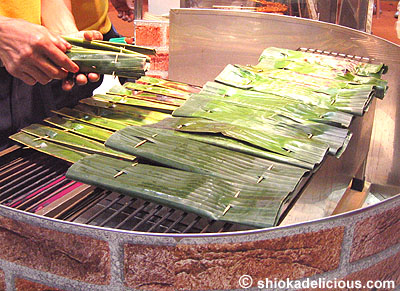
Spicy fish paste wrapped in banana leaves and grilled. These ones were grilled on a smoke-free electric grill, so the taste was rather different from the usual charcoal-grilled ones. But I can never resist an otak when I see one… Highly addictive!
Apart from the traditional fish paste, they now come made from squid, prawns and other seafood.
These otak otak are great when used as a sandwich filling too!
What a night! Yes, I was a glutton! Yes, we were packed like sardines at the bazaar, with human traffic slowed to almost an inch-by-inch crawl. But it was fun, and it was delicious!
07:15 PM in Festivals: Chinese New Year 2004 | Permalink | Comments (9) | TrackBack