« Oh Sweet Valentine | Main | A White Breakfast »
Tuesday, February 10, 2026
Konlo Mee

I like noodles. Probably more than I like rice. Noodles can be stir-fried or deep-fried. They also come served in flavorful broths. But my favorite way of eating noodles is kon lo (or literally, “dry tossed” in Cantonese). This is Chinese comfort food. A plate of noodles that have been boiled in water, tossed with some light seasonings and topped with various toppings ranging from minced meat and fish balls to bbq pork or raw vegetables. Konlo noodles nourish not only the body but the soul.
First though, perhaps a word about the general genre of Chinese “dry tossed” noodles and the specific name “konlo mee”.
There are numerous variations of “dry tossed” noodles, not only from one region and dialect of China to another, but also from one overseas Chinese community to another. The differences come in the toppings or ingredients used to make up the dish; in the seasonings used; and in the types of noodles used. Northern Chinese noodle dishes tend to use wheat noodles whereas the Southern Chinese favor rice noodles. Hong Kongers prefer egg wheat noodles, while the Taiwanese, like the Northern Chinese use more hand-pulled wheat noodles. In South East Asia, just about anything goes! Further variations come in the shape and textures of the noodles – flat, round, thin, thick, soft and smooth or springy and chewy. Different noodles are used for different dishes.
The two most famous, or at least best known “dry tossed” noodles from China would be Sichuan’s Dan Dan Mian (noodles topped with spicy minced meat) and Beijing’s Zha Jiang Mian (noodles topped with minced meat in fried soy bean paste). Hong Kong has her Wantan Mein, while Taiwan has her cold noodle dish of hand-pulled noodles topped with shredded raw vegetables and either sesame or peanut paste.
Singapore, being the culinary melting pot that it is, has versions of all the above. Perhaps what could be considered more uniquely South East Asian would be konlo (dry tossed) noodles with minced meat or fish balls and fish cakes. Now, just to make things a little more complicated, konlo noodles are not called “konlo” in Singapore. One would be hard-pressed to find the term “konlo mee” listed on the menu boards in the hawker centers and food courts of Singapore. Minced meat “dry tossed” noodles go by the name “bak chor mee”. And fish ball noodles are called, well, fish ball noodles. Naturally. 
The term “konlo mee” is (correct me if I’m wrong) pretty much an East Malaysian/Borneo thing. Taken from the Cantonese words for “dry tossed” (kon lo), it evolved into the English spelling “kolo” mee. It is mainly a dish of wheat noodles topped with minced meat (pork or chicken).
What then is the difference between Singaporean bak chor mee and Malaysian kolo mee? Quite a lot. It’s all in the seasonings used and the texture of the noodles. I am a HUGE fan of Sarawakian and Bruneian konlo mee, and I have not really been able to find a close enough version in Singapore. (I’ve written about my ongoing quest previously). The latter has chewier noodles, or what we call a “Q-Q” texture, and very often uses a seasoning sauce that includes tomato sauce (ketchup) and chilli sauce.
So, the terms “kolo mee” and “konlo mee” are, to me anyways, interchangeable. And I use the latter term to refer to “dry tossed” noodles in general as well as Malaysian “kolo mee”. Complicated I know.
Anyway, here are my home versions (one can come up with countless versions) of konlo or dry tossed noodles…
First off, preparing the toppings…
There are really no limitations as to what can go on top of the noodles. Whatever appeals to your palate at that moment in time would be a good guide.
It could be as simple as minced pork or minced chicken stir-fried with a little minced garlic, and seasoned with light soy sauce. It could be slices of store-bought bbq pork (char siew), or a few fish balls and fish cake slices. It could be leftovers from the previous night’s dinner!

When making konlo noodles at home, a lot of the time I like to make a dark soy sauce diced chicken “gravy” (above picture, top) for my noodles. If I’m wanting a vegetarian version, I cook an oyster sauce-rice wine mushroom topping. I prefer using Chinese dried mushrooms (above picture, bottom right), although sometimes I may use a mixture of mushrooms such as Japanese enoki and shitake mushrooms, together with round field mushrooms and so on. Occasionally, carrots add a dash of color (below picture, top right hand corner).

Diced Chicken in Dark Soy Sauce
I normally use de-boned chicken thighs, simply because I find brown meat more flavorful and I prefer the texture. However, breast meat is an easy substitution. After being diced, the chicken meat is marinated with 2 tablespoons light soy sauce, ¼ to ½ teaspoon sugar, ½ teaspoon sesame oil and around ½ tablespoon cornflour (this would be good for 4 pieces of thigh meat), and left to sit for 20-30 minutes.
In a little hot oil, quickly sauté some minced garlic and finely chopped shallots. Add the chicken, and give it a quick stir-fry. Once the meat has changed color, add 2 tablespoons of dark soy sauce, and a dash of pepper. When the mixture comes to a boil, add a little cornflour/water mixture to thicken the gravy. Bring the sauce to a boil again, and remove from the heat.
*Mushrooms or other vegetables may be added to the chicken for added interest, flavors and textures.
Oyster Sauce – Rice Wine Mushrooms
Most of the time I use dried Chinese mushrooms simply because we always have a bunch of them pre-prepped sitting in the freezer, and all I have to do is defrost a few, slice and I’m ready to cook.
Sauté some chopped shallots in hot oil, and add the thinly sliced mushrooms. Just a quick stir, and the seasonings go in: some light soy sauce, dark soy sauce (only a tiny bit, enough to give the gravy some color), oyster sauce, sugar, salt and pepper. All the flavorings are added according to personal taste preferences and can be readily adjusted or substituted. I find mushrooms cook really fast – at most 4-5 minutes, depending on the type of mushroom used. Any longer and they will become too mushy. Add a little cornflour/water mixture to thicken the gravy. Once the sauce returns to a boil, add some Chinese rice wine or white wine. Return it to a boil to burn off some of the alcohol. Ideally, it would be great to flambé the mushrooms upon adding the wine. That really adds to the flavor of the mushrooms. But I don’t know how to flambé, have never managed to do it properly and am generally wary of having flames leap into my frying pan!
Vegetable Accompaniment
I usually also have some green veggies to place on the side of the noodles, simply for the color. I like cai xin with small yellow flowers (see above pictures) a lot. But any green vegetable would do – regular cai xin (a.k.a. chai sim), kai lan or even spinach.
Bring a pot of water, seasoned with a little cooking oil, sugar and salt, to a boil, and add the vegetables. Remove from the heat once the desired tenderness is reached, drain and they’re good to go.
Alternatively, (if you are less lazy than me!), the vegetables can also be stir-fried with chopped garlic and seasoned with a little light soy sauce and pepper.
Crossing the Cold River
Next, the noodles. Any type of noodle can be used – flat rice noodles (kuay teow or ho fun), thin round rice noodles (mee sua or mian sian), flat wheat noodles (mee pok), round egg noodles, spinach noodles, carrot noodles, rice vermicelli (bee hoon) and even macaroni and other pastas.
The ideal way of cooking noodles is what I call the “three dip” method. Actually, I think there is a more eloquent name for it… something about crossing a cold river… but the poetic term eludes me for the moment.

Three pots of water are required. Two pots of boiling water, and one pot of cold (not iced) water. The noodles are first cooked in the first pot of boiling water (furthest left in picture). Once cooked, they are quickly plunged into the pot of cold water (furthest right). Finally, they are dipped into the second pot of boiling water (middle) to heat them through again, and then drained.
Why the need for this 3-step procedure? It enhances the texture of the cooked noodles, and also, quite importantly, prevents the cooked noodles from clumping together into a sticky mess. The first pot of boiling water cooks the noodles. It also “rids” the noodles of some of their alkalinity (from the alkaline water with which some wheat noodles are made) as well as the flour that sometimes coats certain types of noodles. The cold “bath” gives the noodles nice “bite” – a “Q-Q” texture. The final pot of boiling water simply heats the cooled noodles through again. We don’t want to put the noodles back in the first pot of boiling water with all the dissolved flour and alkaline water.
This method is used by all hawkers and restaurant chefs to cook all types of noodles. Even noodles that will be served in a soup are first cooked this way, and then added to the broth and heated through to allow the flavors to meld. This keeps the flavors of the broth “pure”.
Saucing It Up
Once cooked, the noodles are immediately tossed with the seasonings. This can be done on an individual serving basis or the entire batch all at once. I do the latter when I’m lazy and not inclined to offer diners any options.  Otherwise, I’m quite happy to do it on a plate-by-plate basis, and one can thus actually vary the seasoning sauce according to the preference of each diner.
Again, the options are limitless. Here are just some of the combinations I use frequently:

For the mee sua (rice noodles) we had on the 7th Day of CNY, it was just some light soy sauce, some garlic oil (minced garlic sautéed in vegetable oil), a little bit sugar and a dash of sesame oil. This is “neutral” dressing for the noodles, and suits most people, unless they really dislike garlic in any amount.
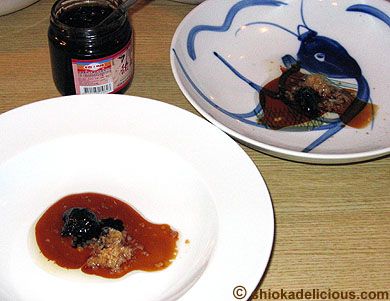
When I am tossing the noodles by individual servings, I use various sauce recipes according to the preferences of the diner. I just place the seasonings in each individual plate, and have them ready and waiting. The noodles are cooked in individual portions too, and as soon as they are drained, they go straight onto the plate, and I just toss them in the plate that they will be served in.
The picture above shows a sauce made up of some sweetened soybean paste (the little jar in the photo), light soy sauce, garlic oil and a dash of sesame oil.
Other sauce combinations I like using:
• Sweet dark soy sauce, light soy sauce, chilli paste (either home-made or store bought), garlic oil, and a dash of sesame oil.
• Sweet dark soy sauce, fish sauce and garlic oil.
• Sweet dark soy sauce, light soy sauce, garlic oil, dash of sesame oil and pepper.
• Ketchup, oyster sauce, dash of sesame oil and pepper.
• Ketchup, chilli sauce or chilli paste, oyster sauce, light soy sauce (tiny bit), garlic oil and a dash of sesame oil.
• Ketchup, chilli sauce, oyster sauce, fish sauce, sugar (tiny bit) and a dash of sesame oil.
• Hoisin sauce, oyster sauce, light soy sauce, garlic oil, dash of sesame oil and pepper to taste.
All sorts of combinations will work really. The possibilities are pretty much endless. Whatever takes your fancy… swap the seasonings around, add some, remove some, substitute some. It’s fun!
Looking East, Looking West
Finally, the plating.
The “eastern” way…
For informal occasions, once the noodles have been tossed in the serving plates, I simply top them with the meat sauces and vegetables, or the diners help themselves to the sauces. (The above is the mee sua from the seventh day of CNY again).
Or the “western” way…

Same mee sua (rice noodles), different style.
Any which way they come, I simply love “konlo” noodles!
Copyright © 2004 Renee Kho. All rights reserved.
Please contact me for permission to copy, distribute and display any of the images and text contained in this article.
11:30 PM in Home Cook: Rice, Noodles etc | Permalink
TrackBack
TrackBack URL for this entry:
http://www.typepad.com/t/trackback/457171
Listed below are links to weblogs that reference Konlo Mee:
Comments
wow even ur noodles look like a gourmet dish...by the way did u manage to try the kl version recommended by one of your readers koon kee wanton noodles
the link is here
http://www.journeymalaysia.com/foodkl.htm#21
Posted by: toru | February 11, 2026 03:08 AM
*slurps noodles from plate* [making delicious slurping sounds]
*chew chew - due to chewy texture*
ooh....hi! ;o) was just having my lunch of sarawak mee (called konlo mee too i think!) minus the meat garnishing. *slurps*
such wonderful timing to be able to read this and enjoy something of the same sort at the same time. *winx*
but i like ur versions much much better!! they look scrumptious enough to eat from the pictures!
*reaches for the pc screen*
aiks.....what i got is static! hmmph~
Posted by: moyzie | February 11, 2026 11:35 AM
as usual great post! It's always a pleasure to read them. Also thanks for describing the "three pots procedure": now I understand the problem I sometimes have with my konlo mee "experiments".
Posted by: Alberto | February 11, 2026 03:55 PM
psssst! secret to sarawak and bruneian kolo mee : onion oil. fry some shallots in oil until onions are cooked but not brown. remove shallots. mix oil with noodle. that's the secret. ;)
Posted by: Wena | February 11, 2026 06:50 PM
hi toru,
thanks for the link.
no, unfortunately I've not been up to KL in quite a while.
but will definitely be checking the place out when I do next get up there.
Posted by: Renee | February 12, 2026 01:12 AM
hi moyzie,
you never fail to bring a huge smile to my face : ) thank you.
*sounding jealous* can I swap with you? my home-made konlo mee for your sarawak kolo mee kosong? *longing, longing* *dream, dream* pretty please?
Posted by: Renee | February 12, 2026 01:16 AM
hi Alberto,
*blush* thanks so much for the kind words.
you've cooked Asian konlo mee before? how about sharing some photos? would love to see them *nudge, nudge* ; )
Posted by: Renee | February 12, 2026 01:19 AM
hi Wena,
hey, thanks for the tip : )
so that's what they put in sarawakian konlo mee.
I guess that makes it slightly different from bruneian konlo mee (no shallot oil I think, as far as I know).
will definitely be trying out the shallot oil the next time around.
hmmm... now, if only I can get my hands on some of the seria noodles (so unique that bruneians living in Canada and US still hanker for it after years and years, and find all sorts of ways to get their hands on the noodles!)
Posted by: Renee | February 12, 2026 01:25 AM
Renee, I've made Dan Dan Mian a few times, with varying results, but after reading this post I'll try some of your recipes. If I don't completely ruin them ;-) I'll post about it.
Posted by: Alberto | February 12, 2026 03:32 PM
In my hometown of Taiping, we like our konlo mee with "chee yau char" (lard - or literally, pork fat crisps). We use the oil and the crisps make up the garnish! Sinfully delicious. ;)
Posted by: james | February 12, 2026 06:23 PM
Alberto, I'm looking forward to reading about your next "mee" escapade ; )
James, wow! pork crisps and oil! yikes! so sinful! but you're right... nothing beats the smell and taste of pork crisps!
I've heard Taiping has some really good food... hope to visit one day.
Posted by: Renee | February 13, 2025 12:03 AM
Renee,
what a find! For a guy, from a completely different culinary background, on the other side of the Pacific :), the explanations are a godsend.
Posted by: Alistair | March 15, 2025 05:10 PM
hi Alistair,
it's always a nice feeling to know that someone enjoys the postings and find the info useful.
thank you! : )
Posted by: Renee | March 16, 2025 05:11 AM
you write the most detailed posts :) thanks for sharing your various sauces for kon lo mee.
Posted by: stef | March 17, 2025 09:07 AM
hi stef,
thank you!
it feels very nice to know that you are enjoying my humble home-style recipes : )
Posted by: Renee | March 18, 2025 12:46 AM