« For Achievement, Prosperity, Progeny and Longevity | Main | Going Thai »
Wednesday, February 04, 2026
My First Birthday of the Year

I had my first “birthday” of the year on Wednesday (28 January), as did the rest of Mankind. And so, I’m one year older… five months before I would normally consider myself another year older. *
This is the most commonly known “meaning” of the seventh day of the Lunar New Year or “Ren Ri”. However, behind this special day of the Lunar Calendar also lies a more obscure legend. Yes, as with every Chinese festival, there is a little folklore to explain the reason for the occasion. The legend of Ren Ri has many versions. One story tells of an ancient hero called Pan Gu, who created the world whilst Goddess Nu Wa shaped the six species of livestock from mud during the first six days that Earth was created. On the seventh day, she molded humans out of mud according to her own appearance. And thus, Ren Ri is celebrated - to commemorate the day mankind was created.
Some say that by Buddhist and maybe Hokkien tradition, no animal should be slaughtered for food on Ren Ri. Instead, it is customary for the Hokkiens to cook and eat a dish made up of seven types of vegetables. This practice of the Hokkiens has now filtered through to the general Chinese culture, and many non-Hokkien families also serve up such a dish on the seventh day of the Lunar New Year.
I’m not sure what the exact significance of using seven different vegetables is. In fact, up until a few years ago, it was not a tradition that was practiced in my family. Until, that is, my mum had a conversation with the owner of the vegetable stall we regularly patronize at the wet market. This friendly, very chatty, middle aged lady is very often the dispenser of many a nugget of culinary wisdom. It was she who persuaded my mum that it was an absolute must to fry up a plate of mixed green leafy vegetables for “chor chaat” (7th day of CNY). Why? She did not say. But oh, she was quick to emphasize, this culinary practice was not to be transgressed. But we are not Hokkiens. Doesn’t matter. And so, a new “tradition” was added to our family’s portfolio of CNY practices.
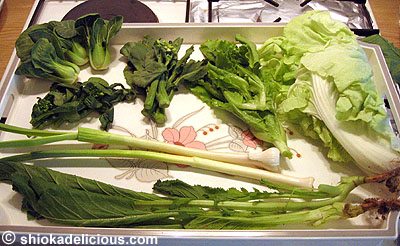
One of course has a large amount of freedom in deciding which seven vegetables to use in your stir-fry. There are only a couple of general parameters to be observed. The vegetables have to be green, and they have to be “leafy”. Therefore, no beans or legumes. And according to our knowledgeable vegetable lady, the only vegetable that is a “must” to include in the dish is the long, leafy one at the bottom of the picture. Neither my mum nor I are quite sure what that vegetable is exactly. It could be Chinese mustard leaf, imported from China. The vegetable lady simply included it in my mum’s vegetable bundle with the kind reminder: “this one, must include one, don’t forget”. It tastes rather “grassy” with bitter overtones. Not quite my cup of tea, frankly speaking. But there you have it… another one of the many Chinese New Year rules which are observed by so many, but the origins and real meaning of which have long been forgotten.
Left to our own devices as to which other six vegetables to include in the dish, my mum and I finally settled on the above. From the uppermost top left hand corner, going clockwise: baby round-head xiao bai cai; kai lan; Chinese lettuce; curly leaf Chinese cabbage; Chinese leeks; and cai xin with small flowers. All one needs is a few stalks of each vegetable, and they sauté up into a large plate of mixed veggie. We kept it simple – just sautéed with garlic and shallots, and seasoned with light soy sauce.
I think this year may be the last year we will be doing this practice. The family does not find it particularly meaningful, as we don’t know the “real” significance behind the custom. And more importantly, no matter how one cooks this dish, it is very, very difficult to get a jumble of seven different tastes, aromas and textures to come together in a way that is close to being elegantly balanced and tasty. It’s very different from cooking a mixed vegetable dish made up of distinctly different vegetables – eg broccoli, cauliflower, baby sweet corn, carrots, shitake mushrooms etc. Mixing various green leafy vegetables together is a whole different ball game. There’s no differentiation of color for one. And the tastes and textures are different, yet not different enough to complement and/or contrast each other. None of the family enjoys this dish. Almost every year most of the dish gets tipped away at the end of the evening. And we find that such a shameful waste. So, that’s it. No more next year.
One Ren Ri custom that my family and almost all Singaporeans have taken to like fish to water is the tossing and eating of yu sheng. This is the original day for loh hei. I wrote about the historical roots of this custom in a previous post. Now, this is one very yummy tradition which I like!
Another food tradition with historical roots is the eating of either mee sua (Hokkien) / mian sian (Mandarin) / rice noodles or any other type of noodles. This is a very common dish which is served up at birthdays, and so also makes it appearance on Ren Ri (Mankind’s birthday). Noodles represent longevity. And noodles cooked for a birthday celebration are never cut or severed in any way. That is considered “bad luck”. Even when serving up the dish, and when eating it, the strands of noodles are never shortened with a fork or chopstick. So, it takes deft hands to neatly serve up bowls of the noodles with the long strands intact and without creating a mess on the table!
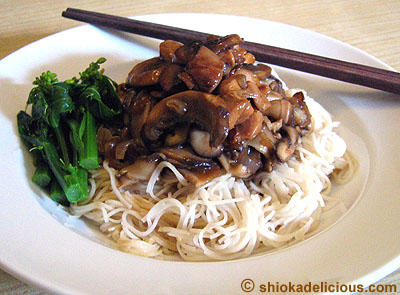
Longevity noodles can be served in many different styles. Very often it is sautéed (fried). Sometimes it is served “dry tossed” or “konlo”, as we did this past Ren Ri. This is the family’s version of konlo mee sua. The recipe will be posted in the next few days.
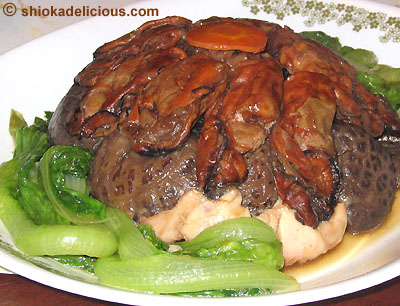
My mum also made “hao shi fa cai” on Ren Ri. This is another dish that is almost a “must” for Chinese New Year, because of its abundant auspicious symbolism. “Hao shi” (dried oysters) sounds like “good tidings or blessings”. “Fa cai” (black desert moss) sounds like “to prosper or to strike a fortune”. These two ingredients are almost always served with “shen cai” (Chinese lettuce) because the latter sounds like “to grow wealth”.
This dish involves many preparation steps and is pretty time consuming. Normally, my mum makes this on New Year’s Eve for the Reunion Dinner. We didn’t manage to get round to it this year, so it made its appearance on our table on Ren Ri instead.
My mum does a very elegant version of this dish (if I may say so myself), and I will post the preparation and recipe in a couple of days.
Happy belated “birthday” everyone!
* [Here’s a little interesting aside: by the Chinese calendar, a baby is considered one year old at the time of birth, as opposed to zero years old by “Western” traditions, and so, a person’s “Chinese age” is always one year older than his/her age by Gregorian calculations].
Copyright © 2004 Renee Kho. All rights reserved.
Please contact me for permission to copy, distribute and display any of the images and text contained in this article.
11:57 PM in Festivals: Chinese New Year 2004 | Permalink
TrackBack
TrackBack URL for this entry:
http://www.typepad.com/t/trackback/434056
Listed below are links to weblogs that reference My First Birthday of the Year:
Comments
hello
was so inspired by your website - I started my own humble food blog
www.xanga.com/kitchenslave
Posted by: toru | February 5, 2026 02:39 AM
hi Toru,
welcome to the food-blogging family! hope you really enjoy yourself blogging.
nice pics!
looking forward to more photos and postings from you.
: )
Posted by: Renee | February 6, 2026 12:10 AM