« December 29, 2025 - January 4, 2026 | Main | January 12, 2026 - January 18, 2026 »
Sunday, January 11, 2026
Waxing Lyrical Over the Lunar New Year

Every year, I never fail to be completely transfixed and amazed by this sight – rows and rows of waxed meats (“lap mei” in Cantonese or “la wei” in Mandarin) as far as the eye can see. An entire wall of all sorts of waxed meats – all glossy, shiny, almost plasticky.
I’ve seen this perhaps hundreds of times, and yet, every year when I visit the CNY bazaar, I inevitably stop and stare, transfixed. A part of me is almost repulsed at the thought of eating something that looks so “fake”, and yet I am, at the same time, so irresistibly drawn, unable to look away nor walk away. The meats look so perfect…
Such waxed meats are another food item that many families must include in their Reunion Dinner on New Year’s Eve or sometime during the Lunar New Year period. This is especially true for the Cantonese.
As mentioned in my previous post, the tradition of eating such waxed meats arose from pure necessity. However, nowadays, people are still drawn nostalgically to the tastes and smells of these preserved, wind-dried meats. Admittedly, these meats impart incredible flavors and aromas to the dishes that they are cooked in.
Perhaps the most famous of these dishes is the Cantonese “lap mei fun” – a must for most families in Hongkong, Guangzhou and Southern China. This is rice cooked with various waxed meats like waxed duck (lap yup), waxed sausages (lap cheong), waxed pork (lap yuk), together with Chinese mushrooms, garlic, ginger, and flavored with sesame oil, soy sauce and either Chinese huatiao wine or rice wine. Different families will have their own preferred combination of ingredients. The waxed meats are steamed separately first, usually with additional ginger and wine, before being cooked with the rice. A final sprinkling of crispy deep fried shallots is often added before serving, to give a very aromatic and delicious crunch. This is a very rich dish, with intense flavors and a beautiful mix of different textures and taste sensations. The fat content and strong flavors of the preserved meats adds a smoothness and richness to the fluffy but bland white rice. For most people, this has become a “once-a-year” dish, and so while it is not the healthiest of dishes, it is relished with glee and full enjoyment.
Another version would be “sar po lap mei fun” or claypot waxed meat rice. I personally prefer the waxed meats cooked with steamed glutinous rice which is wrapped in lotus leaf. The sticky, chewy texture of the glutinous rice adds a different dimension, and the lotus leaf imparts a wonderful aroma to the rice. Different ingredients can be added to create different tasting versions of the rice – Chinese chestnuts can be added, or even fresh chicken pieces for example.
These waxed meats can also be steamed with ginger and wine and served on their own, or steamed with Chinese leeks (“suan”). They can also be added as a component ingredient in other dishes too. As a child, I was completely addicted to lap cheong (Chinese sausages). I remember I would refuse to eat dinner unless there was lap cheong on the table. As long as there was lap cheong in a dish, I would devour it! And I’m talking everyday, seven days a week, for quite a number of years! So, it would be lap cheong fried with egg (sort of a cross between lap cheong omelette and lap cheong scrambled eggs), lap cheong with vegetables, lap cheong with just about anything. Then, just as suddenly, one day, I just completely stopped eating it. I refused to touch it. Then as a young adult, for many years, I even refused to eat any form of pork! Thankfully, I’m now back to eating everything in moderation. 

The original traditional preserved meats were made by wind-drying the meats before applying a layer of wax over the meats to prolong their shelf life even further. The “best wind” for this is considered to be the Northern wind (bei feng) in the North-East regions of China. It is said to dry the meats thoroughly without causing them to ferment, and the dry, cold wind also imparts the unique flavors that is associated with wind-dried meats. Of course, in modern times, to meet commercial demand, the large majority of these meats are in all likelihood dried in industrial ovens in large food factories.
These meats come in dozens of different varieties and flavors. For example, the Chinese sausages can be made from pork, duck, goose, duck liver, goose liver and so on, and in recent times, to cater to the more health-conscious consumer, they are now also made from chicken. There is a range of flavors to choose from – depending on the type of wine and seasonings used to marinade the meats. The prices range accordingly too, with the priciest being those that have been soaked in XO Cognac.
Here are some the different types of waxed, dried, preserved meats that are on offer at the CNY festive market:

Waxed duck (lap yup) and waxed pork (lap yuk).

Waxed pork belly (lap yuk) and preserved minced pork slices (these are similar to the ones used to make “bak gwa” or BBQ sweet meats).

Check this out… a waxed whole leg of ham!

And yes, even waxed fish!
Don’t they just look incredible? And they are indeed all actual, real, edible food! 
On a lighter and more refreshing taste note, there are also mountains of pomelos on offer during this time of year…

They are piled up high, and even hung from the scaffolding. (And yes, that’s the stall-owner tucking into a late dinner of noodles )

These are the green variety from Malaysia. The ones from Ipoh are especially sweet and juicy, and very much loved by my family. When we can get hold of them, we usually buy half a dozen of them! They go really quickly in this household! I love pomelos either on their own or made into a Thai-style salad, with chicken, beef or just vegetables. Yum!

We also spotted these yellow pomelos from China that night. They are “Shatian pomelos” – a region of China that is supposed to be famous for producing very sweet and juicy pomelos. We had never seen this variety before – it has bright lemon-yellow skin, with a rather exaggerated “bump” at its head. The fragrance of this fruit is a lot more intense than the normal green Malaysian variety. Hard to describe… almost citrusy yet with very sweet overtones.
The stall owner, a lady from mainland China did a very good job of selling the pomelos to the men. She insisted that these fruits were as sweet as honey and dripping with juiciness. So, we ended up buying one, for S$6 (bargained down from S$7) for a small fruit. We opened it as soon as we got home…

Sad to say, it was a disappointment. Yes, the fragrance was nice and intense. Yes, it was fairly sweet (but no way near honey-sweetness). However, it was completely devoid of juice!  Oh well, at least we tried something new.

These mini pumpkins are also a favorite to have in the home during CNY, for its auspicious connotations. Pumpkin is known as “jin gua” in Mandarin, and “jin” means gold.

Another supposedly auspicious fruit. Actually it is more of a vegetable. This is the “hulu” gourd. In ancient times, for want of a better or easier alternative, these gourds were dried and used as containers for wine. Ancient texts and drawings very often refer to this “hulu” shaped wine vessel. I presume the “good luck” symbolism comes from its use as a container for wine, as in those days only the wealthy could afford wine and thus have a need for such vessels. These gourds are not edible and are used for display purposes only.
There are also various other interesting food items on sale at the bazaar that are not necessarily strictly associated with the Lunar New Year…

These are hawthorn fruits soaked in heavy syrup – “bing tang hu lu”. The hawthorn fruit is seasonal, making its appearance round about the time of the Spring Festival, and is only available from China. It is a rather tangy/sour fruit, and so is soaked in heavy syrup to balance out the flavors. This is very much eaten as a sort of candy. For the kungfu or Chinese martial arts movie buffs out there, these sticks of fruit are the exact ones that are very often seen in these period Chinese dramas. A favored ancient candy snack.

This is totally unrelated to CNY, but I am including it because I like these a lot. These are eggs hard boiled in a rich herbal soup made up of various Chinese herbal medicines, which help to boost your immune system, fortify your blood and make you “strong”. Personally, I do not believe that the small amounts of herbs infused into the egg would make much of a difference. Chinese medicine usually has to be consumed by the bitter bowl-fuls over an extended period for it to have any significant effect. However, these eggs are yummy. A very unique taste experience!
That night, I couldn’t resist having one of these eggs, even on a very full stomach following dinner. 
We never got around the whole market that evening. Our visit was prematurely terminated by rain. I’m hoping to make it back down there again sometime this week. We didn’t manage to get our bak gwa (roasted sweet meats) – a definite must during CNY – that evening. The line was seriously looong… and we didn’t relish a one hour wait (minimum). I am also hankering after some of those rather cute pineapple and fish chocolates.
We’ve also almost eaten up some of the CNY food that we bought that night! Heh! Time to re-stock again before the actual New Year
Ah… the CNY shopping picks up pace now… only 10 more days to go! Urrgh! And still so much to do. The spring cleaning… the decorating of the home… the shopping for CNY goodies… the baking…
10 more days to go…
03:13 PM in Festivals: Chinese New Year 2004 | Permalink | Comments (6) | TrackBack
Friday, January 09, 2026
Whispering Sweet Nothings in Heaven’s Ear

As a young girl, I was fascinated by this story… the legend of the Kitchen God.
The traditional Chinese believe that a Kitchen God watches over the kitchen of every home. Now, this deity does not judge one’s culinary skills, but rather he oversees the moral conduct of the household. Throughout the year, the Kitchen God surveys and monitors the family's virtues and vices from his position on a kitchen wall or mantle. Usually, the Kitchen God is not an actual statue but rather a paper depiction of a lavishly bedecked figure.
According to the legend, one week before the Spring Festival begins (New Year’s Day), the Kitchen God returns to Heaven to report on the family's behavior during the previous year. It is believed that a negative report means that the family will suffer from bad luck during the year to come. Therefore, it became a tradition for families to bring to the Kitchen God, prior to his departure, an offering of a sticky, sweet cake, in the hope that only sweet words about the family in his charge will be spoken at his audience with the Jade Emperor (in Chinese mythology the Jade Emperor is the ruler of heaven). Another variation to the story has it that the sweet cakes offered to the Kitchen God will “seal” his mouth, as it would be so full of the sticky cake that he would be unable to say anything at all!
After the offering has been made, the image of the Kitchen God is burnt as a symbolic act of departure, to send it on its way back to Heaven. And so from the 23rd of the last lunar month, the Kitchen God is absent from his “throne” in the kitchen. During this time, the kitchen is thoroughly cleaned in preparation for his return on New Year’s Eve, when a new image of the Kitchen God is “enshrined” for the New Year.
This is the legend behind the eating of the New Year Cake or “nian gao” – a very sweet, sticky steamed rice cake made from glutinous rice flour, water and sugar. The tradition of eating these cakes naturally emerged from the tradition of making the offering to the Kitchen God. After the offering has been made, the cakes are eaten by the family so as not to let them go to waste.
In modern times, the “nian gao” has come to symbolize “nian nian gao sheng” or growth and advancement every year. It is now believed that eating the rice cakes symbolize a year of progress ahead. For children or those still in education, a year of good grades and academic success. For working adults, a year of professional or business success and achievement. For each individual, a year of personal growth and expansion.
Although our family, being a Christian family, has never had a Kitchen God “altar” in our kitchen and I never saw an image of the Kitchen God, I was nevertheless fascinated by this story as a young child. To this day, each time I eat “nian gao” I inevitably think of this legend, and the purpose of these sweet cakes. Actually, as a young child, my parents provided a new twist to the story. I was told that after I eat the sweet nian gao, I have to say only nice things to and about other people!
So it is customary for just about every family to buy at least one nian gao for CNY. At the festive market, trays and trays of these sweet rice cakes are on display. (They of course can also be easily bought from every wet market, hyper-market and neighborhood provision shop). They come in all kinds of sizes. I spotted the huge one at the festive night market the other night (above picture). It must have been between 18-24” in diameter. The cardboard signage next to it says it weighs a hefty 20 kilos, and it comes with an equally hefty price tag!
The nian gao in the above picture are the traditionally shaped and colored ones (the color being from the caramelisation of the sugar). In recent years, restaurants and hotels have “reinvented” the nian gao, and they now come in auspicious shapes (such as Koi fish) and colors (orange, gold) to better signify prosperity, wealth and abundance in the coming year. Some of these “modern” nian gao even come with pure gold leaf adornments.
To the left of the large nian gao in the picture, you can also see a small “fa gao”. This is also sometimes called “ma lai gao” or Malay cake. It is also a steam caked made from just wheatflour, sugar and water – no oil or eggs. It can come in different colors, like brown, white, pink or yellow. The eating of this cake during CNY is a recent tradition, and originates from South East Asia. The auspicious symbolism of this cake is derived from the sound of its name. Its name “fa gao” describes the fluffy texture of the cake, and at the same time the word “fa” sounds like the word “to prosper”.

During CNY, one avoids serving and eating sour and bitter foods, as this is taken to have the meaning of encountering unpleasant or bitter experiences in the new year. Thus, sour fruits and drinks like grapefruits and soursop, lemonade and lime juices respectively are never served to guests, nor are ingredients like bitter gourd used in CNY cooking. Instead, the house is filled with all things sweet and pleasant, to augur well for the year ahead. It is a tradition to have an octagonal tray of various “sweets” in the home during CNY. This is the “ba bao pen” or Eight Treasures Tray. This selection of sweets can consist of just about any variety of sweets the family prefers. There are sweets galore at the festive market. All types of candied fruits and vegetables are on offer.

Clockwise from top left: candied green papaya, candied ginger, candied papaya, candied coconut strips (this is taken to signify abundant progeny and descendants – the significance is taken from the sound of the words for “coconut”, “ye zhi”, with the word “zhi” sounding like the word for sons or offspring – this is very much a South East Asian tradition, as coconuts are abundant in this part of the world), candied sweet potato, candied winter melon.

Clockwise from top left: candied sweet lime (favored for its golden color and sound of its name, both of which resemble gold, wealth and abundance), candied carrot (auspicious color), candied lotus seeds (“lian zhi” – again, the name sounds like “lots of descendants and offsprings), candied lotus roots (these signify family unity and harmony), candied water chestnut, candied coconut pieces (for long line of descendants). My personal favorites are the lotus roots and seeds. I like the chewiness of the roots and the soft crunch of the seeds, balanced with the sugar. I have to admit to indulging heavily in these each year during CNY! I like the water chestnut too, but it is SERIOUSLY sweet, and can only be taken in very small doses!
Dried fruits are also favored during CNY…

Top left: dried red dates (“hong zhao” – the second word in its name signifies “all things come early”, i.e. the early realization of goals, wishes and desires). Bottom left: dried tangerines (again, the name “kum” and color signify wealth and prosperity).

A favorite with many people… dried persimmons. The dried fruits are given a dusting of flour to help keep it fresh and prolong the shelf life. These dried fruits are quite different from the Western versions of dried fruits – these are almost like soft, chewy sweets even though they are fruits that have been dried whole.
All these candied goodies only make their appearance during CNY, and so for many people, this is an excuse to indulge heartily in them! (I speak from experience! Heh!)

Next to these sweet offerings are another definite “must-have” for each family - melon seeds. These “gua zhi” symbolize “gua di mian mian” or to have many descendants and offsprings.

Traditionally, these came only in black melon seeds (hei gua zhi), red melon seeds (hong gua zhi) or white pumpkin seeds (bai gua zhi).

In the last couple of years, new and fancy “new-age” flavors and colors have emerged.

Bright pink rose-flavored pumpkin seeds.

Lavender (zhi luo lan) -flavored and green-tea flavored pumpkin seeds.
A favored activity during CNY is to sit with family and friends and munch on these melon seeds. They are addictive! Once one gets into a rhythm of cracking the seeds, peeling back the husk and removing the fragrant inner seed, it is hard to stop! One just keeps going and going, sometimes for hours on end, as one chats away with family and friends! The entire cracking, peeling and removing of the inner seed is done entirely with the two front teeth and the lips only. No hands required! The pointed end of the melon seed is cracked open with the front tooth. The same tooth is used to delicately peel back the two sides of the opened up husk, to reveal the white inner seed. The front teeth are then used to gently secure the inner seed and ease it from the husk. All this is done very elegantly and discretely, leaving only a pile of perfectly opened up “v-shaped” empty husks on the table! It takes skill and a lot of practice!

Nowadays, to accompany the traditional candied fruits and sweets, many homes also have on offer various chocolates and candies in auspicious shapes and designs. This is quite obviously an incredibly lucrative brain-child of retailers. This stall really packs them in. The crowd (when I was there) was several persons deep. I could barely get a nose in on the action (and thus the very blurred picture as I tried to squeeze my camera through! Haha!)

What’s being offered is chocolates shaped into “lucky” designs (not sure if you can make it out from the picture) like Koi fish, gold fish, pineapples (“wang lai” in Chinese sounding like “wealth arrives”) and so on. These are not cheap… they are going for around S$1 per piece of chocolate, and these are just low-grade commercial quality chocolates, which without the fancy CNY designs would sell for only maybe S$0.10 - 0.20 per piece! More often than not, these chocolates do not get eaten. Very few people like their taste, but people snap them up anyway, and display them in their homes for the symbolism behind their designs.

This is from another stall, also selling “lucky chocolates”. The designs in this stall are a little smaller, and thus the crowd around this stall was correspondingly smaller too! These smaller pineapples and gold ingots are priced at S$0.60 per piece.
Again, more of the “new-age” flavored pumpkin seeds next to the chocolates.

This stall-owner is selling the more traditional or some might say “old-fashioned” candies and chocolates, which unfortunately, nobody seems to be interested in anymore.
Ah… the sweet traditions of CNY, both ancient and modern…
And so this is my wish for the New Year of the Monkey: may every mind think sweet and kind thoughts, every mouth speak sweet and kind words, every heart be filled with the sweetness of love, compassion and peace, every life be filled with sweet success, achievement and fulfillment, and every home be filled with sweet warmth and togetherness!
11:09 PM in Festivals: Chinese New Year 2004 | Permalink | Comments (14) | TrackBack
Thursday, January 08, 2026
A Sea of Red and Gold
After dinner on Monday, the whole family took a 10-minute leisurely stroll from Amoy Street down to the Chinese New Year Festive Market at Smith Street and the 5 streets around it. This annual CNY market is THE place to go to get into the spirit of the “Spring Festival”. People come from across the island – grandparents, young families, couples, professionals still in their work clothes, toddlers, babes in arms – they all come to shop, to browse, to eat, and to simply soak up the festive air.
During the run-up to Chinese New Year, this small pocket of Singapore is like no place else in the country. While the rest of the nation continues to hum to its usual clock-work efficiency, this place is sizzling with chaotic excitement. Festive goodies pile up in every direction… smells of sweet meats being roasted waft into the air… stall-owners shout out to the waves of passer-bys, enticing them to stop and savor the goodies they have on offer… a crush of human bodies, many laden with bundles and bags of precious CNY treasures, surges through the narrow streets. This is a side of Singapore not normally seen. This is the side of Singapore I love!
Even on a week-night, the market was bustling and the atmosphere electrifying…
First though, a disclaimer… the photos in this post and the next 2 posts are very much “rough-and-ready”. In the surging crowds, all I could do was point and shoot. Framing shots? Forget it. Camera angles? I wish. Adjust exposure? Get real. The goal was to shoot before I was pushed along again by the crowds or to snap the picture before 5 other human bodies crashed into me! So, it means that you will, unfortunately, see some blurred shots, the backs of heads, and maybe even a couple of rear-ends  . My apologies in advance. I’ve kept these shots as I hope they can still capture and convey at least some of the excitement, energy and “buzz” of the festive market.
It is not just the Chinese who throng the market. Indians, Malays and Caucasians flock to share in the festive mood...
This year’s market is supposed to be the largest to date, with almost 500 different stalls plying all manner of festive goodies. It runs through 5-6 streets in the heart of Chinatown. In the narrow streets, between the rows of restored traditional shop-houses, make-shift stalls have been set up.
Decorating the home is a very important part of preparing for CNY. For the Chinese, red is the most auspicious of colors. Red symbolizes joy, happiness, prosperity, abundance, blessings and all manner of celebratory good tidings. Gold also holds a premium position. It was, in ancient times, the Imperial color, worn only by the Emperor, and no one else. And so naturally, in anticipation of the Spring Festival, the most important celebration in the Chinese calendar, homes are filled with all things red and gold.
Many stalls in the market are selling different decorations for the home, ranging from auspicious couplets to be hung on the walls, little red and gold decorations to be hung on pussy willows or other plants, to small decorative table displays with auspicious symbolisms, and red and gold cushion covers for the sofas.
It is a sea of red and gold…
Decorations in all shapes and sizes are piled high on display tables, hung on the walls and hung from the ceiling. Each bright red item screaming out for attention around me, above me. It is dizzying to be in the presence of so much red!
These decorations range from cardboard “plaques” of auspicious words (such as the most right round “plaque” with the black rim, which has the word “fu”, meaning blessings/prosperity), to decorative paper dragons (top right hand corner), and bright red lanterns (uppermost right hand corner).
Some decorations are for displaying on tables or cabinets. Each stall owner has dozens and dozens, some have hundreds, of different designs to choose from. (This stall owner is almost completely obscured by a screen of dangling decorations!)
These can be hung on walls, doors or plants.
And yet more red and gold decorations! Notice all the auspicious symbols used in all the designs. The fish (second from left) signifies abundance. Note too that single numbers are not used. The symbol is of a pair of fish. The golden ears of corn (third from left) and the huge “jin bao” (gold nuggets) of course symbolize riches, wealth and prosperity.
Hanging matching couplets is also very important for most homes, and these are usually hung on either side of a doorway. They may of course also be hung by themselves on a wall. These auspicious sayings always come in pairs (never on their own), and for some (the Hokkiens I think), they may add a third saying which runs across the top of the paired couplet. A good knowlege of Chinese couplets is needed to be able to select the appropriate pairings!
More wall hangings! (There was so much gold that they were reflecting off my flash like crazy!) Again, all the pictures are of happy, fortunate symbols.
Here’s a close-up (albeit not a very clear one)…
On the right, a sea of swimming Koi fish are depicted. Kois are a very popular symbol of wealth and prosperity, water ("shui") is another symbol of wealth, and swimming/movement signifies progress and advancement. On the left, young celestial children are seen playing with a huge pot of gold.
Another very important thing to have in the home in large quantities is fresh flowers or green plants. They are the perfect symbol of the arrival of Spring, of life and vitality.
These flowers are especially popular in Singapore. I have no idea what they are called, even though I see them every year. I asked the lady minding the stall, and she didn’t know too! But these flowers come in vibrant red or yellow, and are rather fragile and vulnerable to Singapore’s hot and humid weather. They require quite a lot of loving tender care, and very often, don’t last very long after the 15 days of New Year.
[Update (28/01/04): Just found out today that these blooms are called Celosia. Erm... that's the botanical name I would imagine. Still no idea what they are called informally. And I'm sure there must be some auspicious sounding name that makes them appropriate for CNY.]
This is one of the most recognized and most popular symbols of CNY. The kumquat bush (it’s not quite big enough to be called a tree). “Kum” (Mandarin orange) sounds like the word for “gold” in Cantonese. The bright orange coloring also evokes auspicious connotations. This is a “must” in a lot of homes. They are placed at the door to symbolize the arriving of wealth at your doorstep.
Pots and pots of kumquat awaiting new homes. It’s a beautiful sight… this field of bright orange.
These are the smaller variety of kumquats, where each fruit is about maybe 3-3.5 cm in diameter. There are some varieties where the fruit are the size of a human fist. The latter normally cost a lot more than the former.
These are again temperate plants, imported from China and Taiwan, and require a lot of care to survive our much warmer climes.
This is another “must-have” for many people…
This is a fairly recent custom adopted by Singaporeans (and now Malaysians too) from the Taiwanese. It is probably only in the last 7-8 years that this “tradition” has been practiced. These are very poetically called “fu gui zhu” or “prosperity bamboo”. These are evergreen bamboos, and are very different from the common bamboo that is associated with making chopsticks and furniture! Outside of CNY, these same green bamboos are known as “guan yin zhu” (Goddess of Mercy bamboo).
These pots are essentially many, many small stalks of “fu gui zhu” bound together into several tiers. They come in many sizes, with different number of tiers of bamboo. There is always an odd number of tiers, never even. The above picture shows one of the larger ones – 9 tiers and probably about 12-14 inches in diameter. The larger and taller the assembly, the more expensive it is.
When this tradition first started, these “fu gui zhu” were eye-poppingly expensive, especially in the run-up to CNY. Outside of CNY, they may sell for only S$2-3 a pot (for a very small one). The same pot, just prior to CNY, will easily sell for S$18 or S$28. The larger pots will fetch prices in the hundreds, and previously, in the thousands! This year, the prices seem a lot lower than in previous years. One can get a very good-sized one for less than S$100.
You will find that during CNY, prices are awash with “8s”. Everything is priced with an eight! $8, $28, $88, $388, $888, $1888… You get the picture  . And sometimes “3s” and “2s” will be thrown in for good measure – three in Chinese sounds like “to live”, “to grow” or “life”, and two sounds like “easy” or “smooth”.
Yet another “must-have”… the pussy willow. (Yes, I know… all the shots are out of focus. It was crowded at these stalls! I’ll post clearer pictures once the pussy willow in my home is up and ready.) These stalls are always one of the more popular ones. Almost everyone, regardless of whether they buy anything else in the market, will more often than not, be seen toting a bundle of pussy willows.
Why pussy willows? I’m not sure. It’s a seasonal plant – only seen at the end of Winter/beginning of Spring. Once the brown husk covering each “blossom” is removed, a soft, fluffy, cottony white bud is revealed. With each bud uncovered, it becomes a tree of shiny white “blossoms”. Very pretty. And usually, each family will hang many small red and gold decorations and tie red ribbons onto the branches. This is very much the Chinese version of a Christmas tree!
And so that was a quick tour of just some of the more important items for the decoration of the home in anticipation of CNY.
Despite giving many stalls a cursory “look-see” only, we were only maybe about two thirds through the market before it started to drizzle fairly heavily, and we had to make a quick scurry back to our car at Amoy Street.
It was a magical night. I was dizzy with trying to do half a dozen things all at once. My senses were wild with trying to absorb all the sights, smells and tastes. I was browsing and discussing with my mum what to buy, and which stall to buy it from. I was busy tasting all the tasty morsels offered to me by the stall-owners. At the same time, I was trying to remember to take pictures, to find a clear opening without human bodies to get my shot, and to hold a steady hand and not get pushed or shoved whilst trying to take the picture. What a night! But it was so much fun! I was on a high from the festive sizzle. I LOVE Chinese New Year!
There’s more to come… after we’ve made sure the home is well-decorated, what’s next? Food, glorious food… of course…
[The market is on everyday until New Year’s Eve, 21 January 2004. It is open until 12 midnight on week-nights and 1am on weekends]
03:21 AM in Festivals: Chinese New Year 2004 | Permalink | Comments (3) | TrackBack
Wednesday, January 07, 2026
Beng Hiang

We took my parents out for dinner on Monday to celebrate their wedding anniversary. I had originally planned for something fancy, but my mum suggested we eat near Chinatown instead, so that we could stroll over to the CNY street market after dinner. Like me, she was anxious to make our first visit to the market. So, we ended up eating at Beng Hiang, in Amoy Street.
This restaurant is billed as specializing in Hokkien food. It has been around for a long time – 25+ years. Through those years it has maintained a steady and loyal clientele. I have eaten there once before – more than 10 years ago! – when they were still at the Maxwell Food Alley. I don’t remember anything of the last visit, so this would be like discovering a new restaurant.
Stepping into the restaurant was like stepping back in time… back into the 80s or early 90s. The décor, the ambiance, the service staff were that of a typical, true-blue Chinese restaurant of that period. A whiff of nostalgia washed over me. One thing I liked was that they had a couple of interesting Chinese calligraphy hanging on the walls. I liked the one pictured above, which caught my eye as we entered the restaurant. It is the Chinese word for dragon - “loong” - written nine times continuously to form a picture of a dragon. Nine dragons into one – lots of auspicious symbolism in that.
The food was very homely in taste and feel. I liked the fact that none of the dishes were over-salted (which happens a lot in most restaurants), and I could not detect any MSG in the cooking. That in itself wins a thumbs up from me.

We started with the “thick fish maw soup” (S$12) (US$7), recommended by the Captain (that’s what the Maitre'D is called in a Chinese restaurant). It looked rich, thick and chock full of ingredients – fish maw, Chinese mushrooms, carrot strips, some chicken I think and egg. The egg came raw (you can see the raw yolk near the rim of the bowl), and we were supposed to stir the soup whilst it was still piping hot so that the eggs would cook into beautiful lacy strands running throughout the soup. My family loves fish maw. I don’t eat fish maw. So I only had a taste of the mushrooms and veggie in the soup. Nice flavor.
(I just have to mention this: I was so thrilled when I looked through the photos and saw the photo of the soup… I could see the steam rising from the soup! I’ve never been able to capture that before. Ah! Sometimes, it’s the little things in life that bring the greatest joy! )

On account of the recent festive over-indulgence, we decided to skip the signature Hokkien dish of “kong bak with mantou” (braised pork belly with steamed Chinese buns). We ordered instead the “pai kuat wong” (S$12) (literally translated as King of Ribs). However, the dish served was more pork chops than pork ribs. In fact, it was slightly Hainanese in style. Pork that had been tenderized by “chopping” with the back of a knife was breaded, fried and served with what the menu called “a delicious sauce”. The actual English name given on the menu was “pork ribs in delicious sauce” even though the Chinese name said “pai kuat wong”. Nevertheless, I quite enjoyed the dish. The meat was tender, and the sauce was tasty.

This dish was interesting - “chicken with lotus seeds” (S$28) (US$16.50). It was a whole chicken, de-boned and stuffed full with lotus seeds (lian zhi). Actually, there wasn’t much chicken meat at all, as the entire cavity of the chicken had been removed to accommodate the lotus seeds. Only the chicken breast, wings and skin were left, for wrapping around the stuffing. I love lotus seeds. I don’t know why. But it’s one of those things I could eat lots of and not get sick of it. I like them in sweet soups (tong shui), I like them in savory soups, I like them cooked in dishes… all as long as they are cooked down long enough to be soft with a melt-in-the-mouth texture. Of course, the fresh ones are nicer than the dried ones.

This chicken had evidently been patiently braised for many hours. The lotus seeds were nice and soft, and had fully absorbed the flavors of the braising gravy. The chicken was beautifully flavorful too, but because it had been braised for such an extended time, we found the meat to be a little too mushy for our liking. There was no “bite”.

This is our family’s perennial favorite. We order it almost everywhere. Sweet and sour fish (S$14) (US$8). I know many Chinese food connoisseurs frown upon this dish, but I find it very yummy. And one would be surprised at how difficult it is to find a truly well-made plate of sweet and sour fish in Singapore. I can probably only count 2 restaurants that I know of in Singapore that do what I consider to be very good versions of this dish.
This version wasn’t bad. They didn’t use any red coloring. That was nice. The sauce was the natural color of the tomato sauce and light soy sauce used in cooking the dish. It had a nice balance of sweet, sour and saltiness. The fish was tender, flaky and succulent. I was happy.

Another family favorite – stir fried dou miao (pea sprouts) (S$14). Theirs came with a sprinkling of pieces of deep fried dried bian yu. (Sorry, I really have no idea what the English name of this fish is, or if indeed there is an equivalent English name). I enjoyed this dish. The veggie had wok hei without too much oiliness. Broth/stock was used for the sauté and it showed in the natural sweetness and flavorfulness of the vegetables, which were perfectly complemented by the crisp crunchy bian yu.
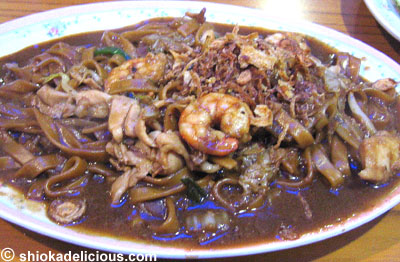
Last but not least, their signature “fried Hokkien mee” (S$7) (US$4). The whole family enjoyed this. This is what we consider to be “real” fried Hokkien mee – the black version, not the white versions normally served in hawker centres. They used flat egg noodles rather than the normal round yellow noodles. Very tasty.

Complimentary dessert of green bean and sago tong shui (sweet soup).
It was a satisfying meal. This is a good place to come for home-styled cooking at very reasonable prices.
Oh, and one last thing… this is unrelated to the food or the restaurant… I think Michael Buble was sitting at the next table from us, directly facing me. I was pretty sure it was him – unless there is a man who is the splitting image of Michael Buble running around Singapore. My family either didn’t know who Michael Buble was or felt I had mistakenly identified the person - "Michael Buble wouldn't eat in a place like this". But I was pretty sure it was him.
It looked like he was dining with two executives from his record company’s Singapore office, and maybe his manager. It also looked like he found some of the Chinese food rather hard to enjoy, particularly the “kong bak with mantou”. I felt a little sorry for him as he good-naturedly tried to finish the piece he was given, with the thick layers of fat and all. Hmmm… I thought the record company executive should have been sensitive enough to order something more palatable to a visitor and a foreigner. Oh well.
I was sort of surreptitiously watching him, and he was also sort of watching me (perhaps in amusement) as I took pictures of each dish that we were served! Haha! He would watch each time I snapped a dish. He must have thought Singaporeans were rather weird. Rather embarrassing actually.  But then again, since starting this blog, I’ve learnt to develop a rather “thick skin” to take pictures whilst out dining.
  Sorry, no pictures of him though. Let the poor man eat in peace.
Okay, enough of this rambling. I just wanted to share that. I’ve always enjoyed his singing and music. I just didn’t realize he was that good looking in real life. And he seemed such a nice, decent guy – shy almost.
Anyway… our tummies were satiated and we were ready for some shopping!
Right next to the exit, there was a second Chinese calligraphy that I liked…
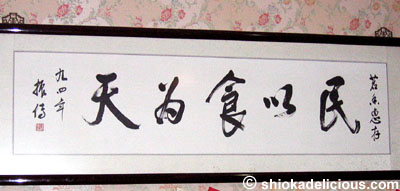
It says (reading from right to left): “ming yi shi wei tien”. When literally translated, it says: “for Man, food is the Heavens”. I guess the English equivalent would be: “to eat, is to live”. What a nice thought to leave the restaurant with as we took a leisurely saunter down to the Chinese New Year Festive Market…
Beng Hiang Restaurant
112-116 Amoy Street
Singapore 069932
Tel: 6221 6695, 6221 6684
02:22 AM in Lion City Shiok-Eats: Chinese | Permalink | Comments (2) | TrackBack
Tuesday, January 06, 2026
Even More Monkeying Around
I forgot about these…
When cooking CNY dishes, the Chinese usually make sure to include certain ingredients in the festive fare. Again, a lot of the significance and auspicious connotations of these ingredients come usually from the sound of their names.
• Soon (young bamboo shoots) signifies “shi shi soon li” (or “all things flow smoothly) – a wish that the path ahead for the coming year will be a smooth one, free of major obstacles. Young bamboo shoots are also prized as they are a seasonal delicacy – available only at the end of Winter/beginning of Spring.
• Prawns always make an appearance in at least one of the dishes at any CNY meal. The word for prawns in Chinese (“har” in Cantonese, “xia” in Mandarin) sounds like the noise of laughter and the word for “to laugh” (“xiao”) respectively. They symbolize the wish to "xiao xi xi" all year round - for the year to be filled with joy and happiness.
• And when serving chicken during CNY, the whole bird is served, in the same way a whole fish (with head and tail intact) must be served (as mentioned in the earlier post). The poultry can be served cut into manageable pieces, but the head should be present. And for the truly traditional Chinese, it is even better if the rear-end is present on the plate too! This may sound horrifying to the Western mind, but it is a representation that there will be no half measures nor “bits and pieces” during CNY, or as the Cantonese would say “mg sum mg sei” (neither here nor there). For the fish especially, the presence of the tail is important, signifying smooth and successful completion and fruition of all endeavors (especially those of the monetary kind).
Earlier this afternoon, I was chatting with a girlfriend and we were discussing the quirky little modern customs that we seem to have come up with in association with CNY. And we recalled something that made us both chuckle. I’m not sure if this is a Singaporean thing or not… but each year a lot of Singaporean women would buy a brand new set of bright hong bao red underwear to be worn on the first day of the CNY, believing this will help raise their personal levels of good luck and good fortune in the coming year. But ironically, many would wear these brightly- and auspiciously-colored undergarments under dark, somber, sometimes even black, outer wear! Go figure. Well, regardless of the efficacy of this practice in affecting personal fortune, I’m sure it will raise the temperature by several notches in the bedroom!
10:29 PM in Festivals: Chinese New Year 2004 | Permalink | Comments (6) | TrackBack
More Monkey Business
Since my previous posting on CNY traditions, I’ve had a number of email queries as to why I left out certain CNY foods.
No, I have not forgotten about them. Just that when I was typing that post, I couldn’t for the world of me remember the reasons why we ate those foods. I just knew we always had them at CNY. But why?? Well, since then, I’ve managed to clarify a couple of them with my mum. Others are still a blank. So maybe someone can help out?
Here are a few more CNY food “must-haves”…
• La wei (waxed meats). These originated from ancient times when there was no refrigeration or other easy means of preserving meats. CNY or Spring Festival would be celebrated at the end of winter, a season where fresh meats was scarce. And for the Chinese, no celebration or festivity is ever complete without dishes and dishes of meat and fish. As the saying goes, there must be “da yu da rou” at a celebratory meal – literally translated as “big fish, big meat”. So, it was customary, back then, to wax and preserve meats in the summer months, when fresh meat was abundant, and then to serve them during the CNY celebrations. This tradition of eating these preserved meats has continued despite the advent of refrigeration, and the year-round supply of fresh produce. Why? Well, these waxed meats taste really good when cooked with rice in a claypot (in Cantonese: lap mei fun). However, a word of caution… these waxed meats come with copious amounts of preservatives, nitrites and other potentially carcinogenic stuff. So, moderation is the key. Plus, check the country of manufacture. Fortunately, those sold in Singapore are tested by the Agricultural Ministry and certified safe.
• Bak kwa (Hokkien for BBQ sweet pork slices). Hard to describe what these are without pictures. I guess they can be considered as the Chinese version of beef jerky? Only less chewy, and sweeter. These are so, so loved by young and old alike. Great with beer too! People are willing to stand in line, for hours (seriously) just to buy a packet of these from the famous shops. Nowadays, bak kwa is available throughout the year. Yet, there is something special about eating them during CNY. So, never mind the long lines and the highly inflated prices (sometimes up to 100% more expensive than normal times), these are a “must” for CNY. The history of these sweet meats is probably the same as for the waxed meats above, with the latter being of North Asian origins and the former of South East Asian roots. The same cautionary note also applies.
• Kueh sapit (love letters or egg rolls). Paper thin wafer-like cookies made into cigar-shaped rolls. These originated in South East Asia, and were imported from the Malay culture. They were served by our Malay counterparts during Hari Raya (Malay New Year), and we Chinese loved the taste so much, we adopted them into our own food culture! Egg rolls can now be found in North Asia too (China, Hongkong, Taiwan), but they taste different (and look slightly different too). The South East Asian variety, more often than not, has a touch of coconut milk added to the batter, for added aroma, fragrance and taste. How to judge a really well-made kueh sapit? The biscuit must be as thin as possible yet still strong enough not to break too easily. It must be crispy without being hard. It must be golden brown – not burnt but not too pale. It must be just right. These are great on their own, but super dupa with ice cream! : )
There are tons more food items… I’ll never be able to cover them all…
Perhaps pictures will tell the story best… We visited the Chinatown CNY street market last night. (Yes, we did! And it was oh so fun!) I have yet to have a chance to go through the 100+ photos I ended up snapping, so these will be coming up in batches over the next few days. So please bear with me…
Oooh… I’m feeling it… I am beginning to feel all festive and happy! Chinese New Year is coming! 
03:09 PM in Festivals: Chinese New Year 2004 | Permalink | Comments (2) | TrackBack
From Lobster To Fish

There was still some tau cheong (soy bean paste) mix left over from making the chilli lobsters. The mix was spice-free – just ginger, garlic and bean paste blended in the food processor – and so was perfect for use in steaming fish.
Used it on Sunday evening with the above fish. I’m not even sure what fish it was. The fishmonger called it “wu” fish. Never heard of it before. He insisted it was a really tasty fish, with flesh of very smooth and refined texture. Well, it was worth a try. And he was right. Very smooth and succulent flesh. Nice! I liked it.
Bought the tail section, and had it cut into about ¾” thick slices. Placed stalks of spring onions on dish (I usually do this when steaming fish, to “raise” the fish a little off the plate, so that it cooks more evenly), and placed the fish on top. Combined the bean paste mix with a little bit of sugar, a dash of light soy sauce (yes, the tau cheong is already salty in itself, but adding the light soy sauce gives a different dimension of saltiness, not so "flat"), and 3-4 sui suan mei (sweet & sour plums), and liberally spread over the fish pieces. Next, topped each piece of fish with slices of ginger and red chillis. (I love bright colors in food. Makes the dish look so much more appetizing). That’s it. Into the steamer for just 8 minutes (I always steam my fish in the wok, on a gas stove, so I’m not sure what the timing would be on an electric stove). Then, with a liberal sprinkle of green onion and a quick cover of the wok (maybe 30 seconds or so, just to wilt the spring onions a little), it’s ready to be served.
A nice homely Sunday dinner to end a nice weekend.
05:19 AM in Home Cook: Fish & Seafood | Permalink | Comments (2) | TrackBack
A Toasty Sunday Brunch

It was one of those lazy Sundays. Woke up late, perused the Sunday papers… then contemplated what we should/wanted to have for brunch. I remembered Wena’s post on having French toast in KL. I love French toast, especially the type that Wena had. They looked like the Taiwanese-style version – more deep fried rather than pan-fried. These have the crispiest outside with soft fluffy insides, but they also come swimming in a deep pool of oil! So sinful, but oh so delicious! So, guess what? Yep, that’s right. We had French toast for brunch.
As usual, I wanted to try something different. I decided to stuff the French toast instead of doing the normal dipping in egg and pan-frying. Sunday brunch should be exciting! I tried several versions of the stuffing. I also tried to get a crispy outside without the deep frying and the oil.
This is what I tried…
Fillings:
• Peanut butter and banana [I remember reading somewhere, a long time ago, that the King himself, Elvis, loved peanut butter and banana deep fried sandwiches. Just a little bit of trivia. )
• Peanut butter, Nutella and banana
• Nutella and banana
Dip/Batter:
• Lightly beaten egg only
• Egg then corn flour
• Cornflour then egg
I used thick sliced white bread – ½” or more thick (Gardenia’s Classic Loaf), and instead of using a knife to try to split the bread, I used the kitchen scissors to cut a pocket into the bread . So much easier and quicker with the scissors. I could cut evenly into the bread without one side being thinner than the other. This helped ensure the fillings didn’t break through or leak out through the bread.
The fillings were all very good actually. They may sound weird to some of you. But to me, peanut butter and bananas are a natural partnership. Needless to say, chocolate (in this case, Nutella) and banana works beautifully. All three together though I felt was a bit too confused. Too many flavors going on in a small piece of sandwich.
It wasn’t possible (nor advisable) to stuff too much into each piece of bread. I didn’t want the fillings oozing out and creating a mess in the frying pan.
I didn’t manage to get a crispy outside. The egg version (eggs plus 1 tablespoon of milk and ¼ to ½ teaspoon of sugar to each egg used, lightly beaten together with a fork) was like your standard French toast. Dipping the bread into cornflour after dipping it into the egg didn’t produce a very noticeable difference, although there was a very light “crust”. Dipping the bread into the flour first, before the egg just didn’t work. The toast tasted of raw flour. Yuk!
I didn’t even use oil for the frying – just cooking spray, and that worked fine. (Of course, using oil would have probably given me the crispiness I was looking for. And the more oil, the crispier. But I wanted to see if I could get the crispiness without the oil. Stubborn, I know)
Well, it produced a pretty tasty sandwich…

These could have been served with a dusting of powdered sugar on top, or with the usual honey or maple syrup. But I liked them as they were.
My mind was racing… the possible variations seemed endless. I was thinking: maybe if I used a crepe-like batter, using both plain flour and rice flour (maybe in a ratio of 4:1 or 5:1). That might produce a crispy outside with very little oil. (Rice flour when mixed into a plain flour batter can usually produce a crispier effect).
As for the fillings, there were countless possibilities, both sweet and savory.
Savory:
• Cream cheese, chives and smoked salmon
• Ham and cheese
• Cheese, cheese and more cheese
• Sardines
• Tuna
Sweet:
• Cream cheese with raisins or nuts
• Sweetened condensed milk with Milo (yes, Milo straight from the tin! I used to eat this alot as a kid. Sweetened condensed milk spread onto a piece of bread, and Milo sprinkled over it. I know it sounds incredibly, cloyingly sweet. It sounds that way to me too nowadays. But I adored it as a kid! I haven’t had it in decades! Maybe it is time to revisit some of these quirky childhood eating habits!)
I didn’t get round to trying any of the other ideas this time. I was trying to make the toast, cook them, plate them and take photos – all at the same time. And everyone was getting hungry and impatient. They threatened to throw my camera away.  So, we ate instead…
Note:
The dipping (be it egg or batter) can be adjusted for making either sweet or savory sandwiches by adding either sugar or salt.
We also had these for brunch…

An early bird, who had already been up for hours, gone out and had dim sum breakfast, came home with an assortment of dim sum items from Crystal Jade in Ngee Ann City. I only took a picture of three… (from left) char siew sou (baked roast pork pastry), dan ta (egg tart) and chicken pie. I love char siew sou. And this was a nice version. Flaky pastry, lean pork filling. Mmmm… I enjoyed the egg tart too. I always prefer the Hongkong pastry version, with the flaky, puff pastry crust (like this one), over the short crust pastry version. Crystal Jade’s is always well made. I didn’t get to eat the chicken pie, so I have no idea how it tasted. But the wu kok (deep fried yam paste and minced pork dumpling) (not in picture) was a taste disaster. Enuff said!
It was a nice satisfying Sunday brunch, eaten whilst still in my jammies! Wah! The ultimate luxury!
03:21 AM in Home Cook: Light Touches | Permalink | Comments (4) | TrackBack
Monday, January 05, 2026
The Monkey Is Already At The Door!!
I went into a mild panic after reading Wena’s post on CNY (that’s Chinese New Year, in case you are wondering) preparations. It suddenly hit me that CNY is only a mere 17 days away!! Ai-yai-yai yai-yai!! We haven’t even begun preparations yet. And there is always so much to do before CNY.
Yes, I of course I already knew CNY was around the corner. (I just didn’t realize how close around the corner it was.) The retailers made sure we didn’t forget that there is another festival coming up. Within days of Christmas, stores were already telling us to quit jingling bells and rocking around the Christmas tree. Their tunes changed and the relentless messages now sung from their speakers were: “gong xi, ah, gong xi, da jia fa da cai” (wishes to you, wishes to you, everyone will prosper – literal translation) and “guo xin nian, zhu xin nian, xin nian dao, nian nian nian, zhu da jia guo ge da fei nian”. Christmas carols have been replaced by CNY songs – in every shop, shopping mall, supermarket…
Walking through Cold Storage the other day, I was struck by the irony of it all. Unsold Christmas goodies (candies, chocolates, Christmas baking and cooking ingredients, even fruit cakes and stollen) jostled for space on the supermarket shelf with freshly delivered CNY cookies, waxed meats etc. The Christmas goodies looked forlorn and dejected. Their shine and appeal have faded. The harried shopper gave them nary a glance. Instead their next door neighbor, the sweet, fragrant pineapple tart was now the star of the show. Yet, undaunted, the Christmas goods cried out for attention as loud as they could, trying to draw attention to their severely marked down, incredibly attractive prices. Oh yes, they were determined indeed to find a new home for themselves before their expiry dates loomed. Alas! To no avail. Their time had come and gone. It was now the turn of the strings of lap cheongs (dried Chinese sausages), the cans of abalone, the trays of peanut cookies, the crates of Chinese mandarins to shine, to regal in all the attention…
I am just so amazed at the shopping capacities of Singaporeans. I would have thought everyone would be all shopped out by now, after weeks and weeks of Christmas shopping. But no, the queues are still there… long, long lines to get into the carpark, longer lines still to pay for the purchases… the jostling continues… ai-yai-yai!
Yet, what is CNY really about? I mean, the “real” traditions that make CNY, well, CNY. Okay folks, make yourself a cuppa, sit back, relax… this could be a long read. And sorry, no pictures to break the monotony – not yet, anyways. Those will follow as and when the events happen. In the meantime, here are just a few (and I mean a few) of the dozens and dozens of traditions that make up CNY. Practices may vary from family to family, from dialect group to dialect group, and sometimes from country to country (eg there are sometimes significant differences between the practices of the Chinese in mainland China and in North Asia, and those of the so-called “overseas Chinese” of South East Asia).
Before New Year
Home
• Let’s start with the home. Spring cleaning starts weeks before CNY. Literally everything is cleaned. The curtains are taken down and brought to the cleaners. Professional cleaners are called in to clean the carpets. Cupboards are cleared of unwanted clutter. Refrigerators are cleaned out and tidied up. Everything in the household gets a clean, sparkling, shiny start to the brand new year! : )
• Even the cars are washed and waxed either the day before New Year’s Eve or on New Year’s Eve itself.
• For some families, it is important to start the new year with new things – new curtains, new bedsheets etc.
• CNY decorations go up. Red is the over-riding theme. Red symbolizes celebration, vitality, happiness, joy, prosperity and abundance. And so red ribbons are tied onto plants, hong baos (red packets) are hung or made into auspicious symbols like dragons, fish and lanterns.
• Dui lians (pairs of auspicious sayings) are hung at the door. I guess this is similar to the Western equivalent of hanging a Christmas wreath on the door. These always appear in pairs, never alone.
• Lots and lots of fresh potted plants and flowers are bought and placed in the house, to signify the arrival of spring and new life.
• Ying niu (pussy willows) are a firm favorite, and are usually decorated with gold and red decorations, much like a Chinese version of the Christmas tree.
• Tao hua (plum blossoms) also herald spring, and have the added significance of bringing love and romance (for those in the family that are yet unmarried).
• Ju zhi (kumquat plants) are also a “must”. They signify gold, prosperity and abundance.
• A recent tradition, imported from the Taiwanese I believe, is the displaying of “fu gui zhu” (prosperity bamboo) in the home. These are sold as pots of tiered green bamboos. There is always only an odd number of tiers – 3, 5 and so on – never an even number. The more tiers there is, it is believed, the greater the prosperity, or so the superstition goes. It is best to buy these plants early if you are keen. The closer it gets to New Year, the higher the prices go. More prosperity for the shop owners! Haha!
• One tradition my mum practices is to tie a bunch of 9 stalks of Chinese leeks with a red ribbon and hang it in the kitchen until after the 15 days of New Year. It means “chang chang jiu jiu you de suan”. Chinese leeks are called “suan” which sounds the same as the word “to count”. So it signifies, monetary prudence, and also that there will be plenty of money to count throughout the year!
• I’m sure there are many more traditions related to the home, but they elude me for the moment…
Personal
• For the person, there too are many preparations to be done.
• It used to be that new clothes are a must. I remember as a kid, we had new everything… new pyjamas, new shoes, new socks, all the way down to new underwear! And everything was in auspicious colors of red, pink or maroon! Nowadays of course, one sees people in black and dark somber colors when visiting relatives. This is still much frowned upon by the elders, but the younger generation feels “fashion” or trends are more important. Personally? Well, I believe that colors do give off “energies” and affect moods. Oranges and yellows stimulate appetite, blues calm etc. So, I think it would be of no harm, and would certainly lift spirits to be dressed in bright cheerful hues for New Year.
• Like the home, the person should start the New Year “tidied up”, fresh and sparkling. So, haircuts should be had before the New Year. Many women will visit their hairdressers on New Year’s Eve to have their hair styled before ushering in the New Year.
Food
There are many foods that are “musts” during Chinese New Year, as they are deemed to convey auspicious significance. Usually these auspicious meanings come from the sound of their names. These appear in no particular order… or rather in the order that my brain is remembering them : D
• Pineapple tarts are a definite favorite. Pineapple or “wang lai” in Hokkien sounds like “prosperity arrives”. So, not only are these little pastry morsels incredibly delicious (and addictive), they also supposedly symbolize the arrival of great wealth in the New Year.
• “Nian gao” or New Year cake. These steamed cakes are made from glutinous rice flour, sugar and water. They signify “nian nian gao shen” or progress and growth every year. They are eaten on the first day of the New Year to symbolize advancement in your career, be it in your educational career if you are a student, or in your professional career or business. By the way, here’s something interesting. These sticky, sweet cakes are so soft and sticky that they cannot be cut with a knife, and are usually cut with a piece of string. More on this later…
• Pomelo or “you zhi”. Sounds like and means “wishes come true” and that one has everything one wishes for.
• Mandarin oranges or “kum” in Cantonese, literally sounds like the word “gold”, and is therefore self-explanatory. In fact, I know of one of my mum’s Cantonese friends who would, every year, on New Year’s Eve, after everyone has gone to bed, scatter mandarins all over the living room floor, so that upon waking on New Year’s day, the whole family would go into the living room and “zhap kum” or "pick up gold". : D Great symbolism for the New Year don’t you think?
• “Suan” or Chinese leeks. As described above. These are seasonal vegetables, and are only available around Chinese New Year every year.
• Abalone or “bao yu”. Another firm favorite, especially with businessmen. The sound of its name carries the symbolism of “guaranteed abundance”.
• Dried oysters or “hao si”. The name sounds like the saying: good tidings and blessings, or good business in the coming year.
• “Fa cai”. This is a black, hair-like desert moss. “Fa” in Chinese means to prosper or to grow rich. This moss is usually cooked with the dried oysters above to form the dish called “hao si fa choy”, signifying an abundant and blessed year ahead.
• “Shen cai” or Chinese lettuce (not the rounded lettuce of the West, but the elongated ones… the ones we always feed the lions of lion dances : ) ) are also a “must” ingredient in New Year dishes. “Shen” means to grow or advance.
• Fish is another dish that is bound to make its appearance at tables in many families. The word for fish, “yu” sounds like the word for “abundance”. And a whole fish (with head and tail) is always served. No fillets or half fishes! This is to ensure that things are seen through to full completion and fruition in the New Year. No half measures!
• Pistachio nuts are called “kai xin guo” in Chinese, meaning “fruit of happiness”.
• Ground nuts (peanuts with shells) are also called “chang shou guo” or “longevity fruits” in Chinese.
• “Gua zhi” or melon seeds. Their meaning: “gua di nian nian” or “to have a long line of descendants”. There are many varieties. Originally there were only the black, red and white ones. But they now come in all kinds of spandangled new-age flavors like green tea, sambal, rose and what have you. Can you believe, to this day, I have never succeeded in cracking open one of these (the white varieties excepted) with my teeth without breaking the inside edible seed? Mine always end up coming out in tiny little bits and pieces. Hahaha!
• Kueh lapis. This is a South East Asian tradition, with Indonesian (I think) origins. A rich spiced butter cake made up of thin layers of cake. Very delicious but extremely time-consuming to make. My mum used to bake this every year, then she gave up. Making just one cake involves up to 1 ½ - 2 1/2 hours of sitting in front of the hot oven. One cannot even get up to go to the bathroom in that time, or you risk coming back to a burnt layer of cake, and have to start all over again. Each thin (approximately 1.5mm thick) layer of cake is painstakingly layered on and baked individually. That’s why purchasing ready-made versions of this cake is very expensive. Oh, almost forgot… the significance of the cake is “bu bu gao shen” or steady advancement/progress, on account of the many layers of the cake.
• “Ba bao pen” or Eight Treasures Tray (or sometimes called the Togetherness Tray) is a common sight in most homes. Traditionally, this is an octagonal tray of eight types of sweets and candies, signifying a sweet year ahead. Nowadays, there are Eight Treasures Tray of all types of foods, from nuts, to crisps and crackers.
• Oh, oh, oh… how can I forget… the most popular dish of all… “Loh Hei Yu Shang” (meaning to generate opportunities, openings, great wealth and prosperity). “Loh” in Cantonese means to “churn” or create (business) opportunities. Sorry, that’s the closest I can get. There just aren’t literal translations or even vaguely close equivalents in English. “Hei” means to “rise”. “Yu” as said before, means abundance. “Shang” is to grow. This is a salad of raw fish slices, grated white radish, grated green radish, grated red carrots, various sweet and vinegared condiments like ginger etc, sesame seeds, chopped peanuts, deep fried dough crackers and a plum sauce dressing. This dish originated from West Malaysia and Singapore, with roots in Southern China. But has now been fervently adopted by the Hongkongers, Taiwanese and just about all Chinese communities around the world. I love the version my mum makes. In fact that is the only version I usually eat. Maybe I’m so used to the balance of flavors in her version, that I don’t particularly enjoy the ones that are served in restaurants. For many people, “loh hei” is a must throughout the 15 days of Chinese New Year. More on this dish when we make our first one of the year ; )
There are many, many more food items… but it will take me the whole night and more…
The New Year Celebrations
The actual New Year celebrations are also filled with traditional “practices”.
New Year’s Eve:
• All cleaning and washing must be done before midnight. No sweeping of floors, washing of clothes etc are allowed on the first day of New Year. This is to avoid sweeping away all the new luck.
• Extra food is cooked on New Year’s Eve to ensure that there are some leftovers for the next day – to symbolize that that will be abundant food going from one year into the next.
• Young children are encouraged to stay up as late as possible on the Eve, to signify that their parents and elders will have a long life.
• On the stroke of midnight, parents will present their unmarried children with hong baos (red packets) containing money. The Cantonese call these packets “lai see” or blessings.
1st Day Of New Year
• In my family, after greeting our parents, we sit down to a breakfast of “nian gao” and “hong zhao gui yen cha”. We usually cut the “nian gao” or glutinous rice New Year cake into very thin slices and pan-fry them with egg. Not sure which dialect this tradition of frying the nian gao with eggs comes from. Foochow maybe? The true tradition would be to eat the nian gao fresh, on its own on the first day of New Year. This cake is then kept for the 15 days of the New Year. Given that there were no refrigeration in the olden days, by the time the 15th day rolled around, the cake would have gone moldy, and so it would be fried to make it edible again. Nowadays, we fry them on the first day, simply because they taste much nicer when fried with eggs! : )
• “Hong zhao gui yen cha” is a “tea” made from boiling red dates, dried longans and sugared winter melons (tang dong gua). It signifies good fortune and abundant blessings for the whole year.
• For a lot of families, I think especially the Hokkien ones, no fresh meat is cooked on the first day of New Year. This came from the tradition of not killing of animals on the first day of the year. This is another reason why a lot of meat and fish are cooked on New Year’s Eve, and the leftovers are eaten on the first day.
2nd Day
• This is traditionally known as “kai nian” or in literal translation “year opening”. This is when the stoves of the home are fired up (for the first time in the new year), and the women cook up a storm. After the quiet celebrations with family on the 1st day, the home is now opened up to all friends and relatives who come and visit and partake of food.
• We used to have an “open house” on the 2nd day of New Year, every year. And my mum and our domestic helper would cook for 100+ people! Just the two of them! Cooking everything from scratch! Imagine that!! (This was in the days before I could cook). They had to cook something like 15-20 different dishes! It was an industrial sized operation to be sure! We haven’t done this in many, many years. My mum, as she moved on in years, found it too tiring, and I, to this day, find it absolutely too daunting. So, now it is just small gatherings of close friends and family. In those days in Singapore, it was almost impossible to find a Chinese caterer who was prepared to cater on the 2nd day of New Year. And if you could find one, the prices would be sky-high with the quality of food correspondingly a faint shadow of their normal standards. We tried it one year, and most of the food was left untouched by our guests. They wanted my mum’s cooking. But we were no longer prepared to spend 18 hours straight in the kitchen cutting, dicing, cooking, washing etc. Imagine us decked out in our new clothes, hair carefully coiffed but staying in the kitchen all day without a moment’s rest. We didn’t even get to mingle with the guests. They came, they ate and they left. In the end we decided it was a rather meaningless way to spend New Year.
7th Day
• This is also known as “humanity’s birthday”. Everyone turns a year older on this day.
• The Hokkiens have a tradition of cooking a dish made up of 7 different types of vegetables on this day.
9th Day
• I think this is the day the Hokkiens make offerings and pray to the “Sky God” or “Tien Gong”. Oh dear, I could be wrong on this. Have to check with Hokkien friends on this one.
15th Day
• Last day of the “official” New Year celebratory period. The family gathers for another family reunion dinner before everyone departs again back to their jobs etc…
• We eat dry tang yuan (known as “yuan xiao”) on this day.
• This is also known as Chinese Valentines day. In ancient times, this was the only day of the year that males and females were allowed to meet freely and select a prospective spouse. Another name for this day would be the “lantern festival” as in the olden days men and women would meet and play “solve the riddles” games with lanterns, and that’s how they pair up. Anyone know the real tradition of the lantern games?
Other general traditions:
• When visiting relatives and friends, one always bring and offer to the host a pair of Mandarin oranges. This symbolizes the giving of good fortune and blessings to your friends and relatives. Never offer odd numbers, and avoid offering four (which sounds like “to die” or “death”) oranges too.
• Married people are expected to give hong baos or lai sees to unmarried singles and to all children. (Haha… that’s why traditionally, couples would “rush” to have their first child soon after getting married so that when CNY rolls around, they won’t only be doing all the giving, but will also be “receiving” through their child).
• All inauspicious sayings, words and arguments are to be avoided. And if indeed something “inauspicious” happens, for example, like a plate or cup is dropped and broken, an auspicious saying is immediately uttered – eg “luo di kai hua”, meaning “fall to the ground and bloom as flowers”, and so the shattered plate and cup is used to symbolize a beautiful thing rather than an inauspicious event.
Oh boy! This has been a mega long post. I could go on and on, but I won’t. (Yes, I heard that sigh of relief) : ) After typing out all that, I'm all in the mood for CNY already! : D
I’m hoping to go down to the Chinatown Chinese New Year street market (which started on Saturday night) soon, to do some new year shopping… hopefully I will have some pictures to show too. It’s supposed to be one of the biggest markets yet – with almost 500 stalls. Yippee! I always really start feeling the CNY spirit when I head on down to this street market.
Yes, I complain about CNY being so close to Christmas and the Gregorian New Year this year. But hey, the goat wasn’t a very nice visitor this year. Created a right upheaval nation-wide and across the globe did he. (Actually, if truth be told, the goat has been good to me this year, no complaints from me). But I guess a lot of people are ready to welcome in the monkey. And yes, he is at the door already! Let’s roll out the red carpet…
01:46 AM in Festivals: Chinese New Year 2004 | Permalink | Comments (15) | TrackBack