« Welcome! | Main | Growing Blessings and Fortune »
Friday, February 06, 2026
The First Full Moon
The 15th day of the first lunar month (today), which is also the first full moon of the lunar year, marks the last day of the Lunar New Year festivities. Known as “Yuan Xiao” in Mandarin, it is so named because the first lunar month is called the “yuan-month” and the ancient term for “night” is “xiao”. Additionally, “yuan” also symbolizes “fulfillment” or “completion”, coming from the term “yuan man”. It’s Hokkien name “Chap Goh Mei” literally translates as “the 15th night”. On this day, the family gathers for another reunion dinner as a sign of unity and harmony, and to celebrate the closing of a fulfilling New Year celebration. At this dinner, the glutinous rice balls that were eaten on Dong Zhi (winter solstice festival) are eaten again. This time, however, they are served “dry”, coated with ground peanuts, rather than in soup. They are now called “yuan xiao” rather than “tang yuan” (the name used only when they are served in soup). More on this later.
The 15th day of the first lunar month is also known as the Lantern Festival. While this tradition has almost entirely died out in Chinese communities outside of China, it is still a major celebration on the mainland itself, and in Hong Kong and Taiwan. A main part of the festivities is the display of thousands of large, very intricate and colorful lanterns and the gathering together of the entire community to view and appreciate the lanterns, and to try and solve the riddles that are written on them. In a festive carnival atmosphere and against a backdrop of fireworks, concerts and other stage shows are also held, and games and food stalls set up. It continues the theme of the (extended) family united in a joyful celebration.
There is yet another name associated with the 15th day of the first lunar month. An association which seems to have sprung up from the ancient celebrations of the Lantern Festival. Chinese Valentines Day.
One simple day on the lunar calendar, and yet so much significance is attached to it.
The Legends
There are many different beliefs about the origins of the Lantern Festival.
One legend describes it as a time to worship Tai Yi, the God of Heaven in ancient times. The belief was that the God of Heaven controlled the destiny of the human world. He had sixteen dragons at his beck and call and he decided when to inflict drought, storms, famine and pestilence upon human beings. And so, beginning with Qin Shi Huang, the first emperor to unite China, all subsequent emperors ordered splendid ceremonies each year. The emperor would ask Tai Yi to bring favorable weather and good health to him and his people.
Another legend associates the Lantern Festival with Taoism. Tian Guan is the Taoist god responsible for good fortune. His birthday falls on the 15th day of the first lunar month. It is said that Tian Guan likes all types of entertainment. So followers prepare various kinds of activities during which they pray for good fortune.
In yet another legend, it is said that the Jade Emperor in Heaven was so angered at a town for killing his favorite goose, he decided to destroy it with a storm of fire. However, a good-hearted fairy heard of this act of vengeance, and warned the people of the town to light lanterns throughout the town on the appointed day. The townsfolk did as they were told, and from the Heavens, it looked as if the village was ablaze. Satisfied that his goose had already been avenged, the Jade Emperor decided not to destroy the town. From that day on, people celebrated the anniversary of their deliverance by carrying lanterns of different shapes and colors through the streets on the first full moon of the year, providing a spectacular backdrop for lion dances, dragon dances and fireworks.
In modern times, the Lantern Festival is celebrated with the display of giant sized lanterns, concerts, carnivals and fireworks. As people go round to admire and appreciate the beautifully made and decorated lanterns, they also attempt to solve the riddles (cai mi yu) which are written on each lantern.
Matchmaking
Through the ages, the celebration of the Lantern Festival evolved and took on another purpose and meaning. In the olden days, young men and women were forbidden from mingling freely. There was of course no such thing as “dating”. It was only during the Lantern Festival, as families in the entire community came out to admire and enjoy the lanterns that the young people had a chance to mingle and to try to find a suitable partner. There were many tales of eyes meeting across lanterns, an “accidentally” dropped handkerchief that was picked up “coincidentally” by the equally smitten young man. And so, many a match was made on the night of the lanterns!
And so it is that Yuan Xiao Jie also came to be known as Chinese Valentines Day.
Regional Variations
I read an interesting nugget in the papers the other day. Apparently, in Penang, Malaysia, they have a rather unique way of celebrating Yuan Xiao Jie. There, it is not lanterns but mandarin oranges that play the match-maker. On Chap Goh Mei, unmarried Chinese girls throw oranges into the sea of river, in the hope of snaring good husbands. I understand that this practice is still carried out to this day.
Many regions of China also seem to have their own interesting and unique local twists to the celebration of Yuan Xiao and the Lantern Festival. Apparently, in Quan Zhou, China, lanterns are used to predict offspring. It is customary for newly married couples to return to the woman’s parental home on the second day of the New Year, bearing gifts. [By Chinese custom, a married woman is not allowed to visit her parents on the first day of the New Year. It is only on the second day “kai nian” that a woman returns to her parental home with her husband and children to visit her parents.] When the couple takes leave from the woman’s parents’ home, they are presented with two lotus lanterns, one white and one red. On the night of the Lantern Festival, the young couple hangs the lanterns beside their bed, and light a candle in each. The first candle to burn out will indicate the gender of their first child. Should the candle in the white lantern burn out first, the baby will be a boy. If it is the red lantern that extinguishes first, they will be blessed with a baby girl.
Yuan Xiao
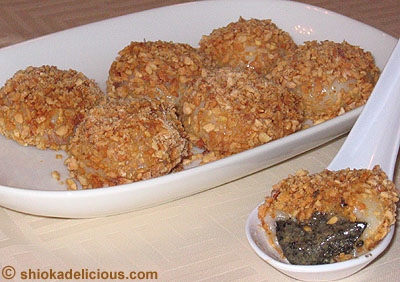
Besides beautiful lanterns, love and romance, another important part of the Lantern Festival or Yuan Xiao Jie is the eating of small dumpling balls made of glutinous rice flour. As I mentioned before, these glutinous rice balls symbolize unity and harmony within the family.
It is interesting how the same food takes on a new name and a slightly different meaning depending on when it is eaten. On winter solstice (dong zhi), these rice balls are called “tang yuan” and are served up in a sweet ginger soup. “Tang” (meaning soup in Mandarin), sounds like “tuan” (meaning reunion), and “yuan” (meaning round) signifies “yuan man” (completeness, fulfillment). This is very appropriate, as in the olden days, Dong Zhi marked the gathering of all family members from near and far under one roof, after perhaps a year apart. These dumplings symbolized a family reunited once more.
Come Yuan Xiao Jie or the 15th and last day of the Lunar New Year celebrations, these glutinous rice balls take on the name “yuan xiao”, which sounds like “a fulfilled completion and a bringing to a close”. After eating the “dry” dumplings, coated with ground peanuts (yes, that is what the little packet of ground peanuts included in each pack of frozen tang yuan is meant for), family members once again depart for faraway towns, cities or countries to work and live. It marks the closing of New Year celebrations and is a send-off of sorts, with wishes of abundant blessings in the coming year. It may be another year hence, on the next Dong Zhi, that family members will have the opportunity to get together again.
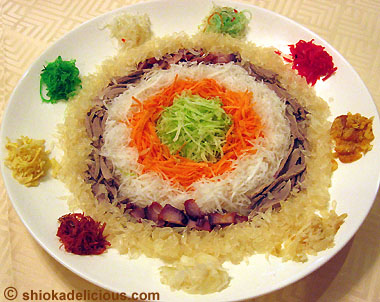
Another dish that makes its final appearance of the year on Yuan Xiao is loh hei. Chap Goh Mei marks the last day when this dish will be eaten, until the next Lunar New Year. A final toss for wishes of good fortune and abundant blessings.
Tonight, we tried my Thai-style loh hei again, with a mixture of char siew and roast duck, and lots more pomelo. Yum! I tried out a new plating design – concentric circles signifying family unity and harmony. Oh, and I also tweaked the dressing again. Please see update on the previous post for the new quantities.
And so from me to all Chinese, Happy Yuan Xiao Jie! May all your wishes of love, harmony and happiness come true this year!
Copyright © 2004 Renee Kho. All rights reserved.
Please contact me for permission to copy, distribute and display any of the images and text contained in this article.
12:00 AM in Festivals: Chinese New Year 2004 | Permalink
TrackBack
TrackBack URL for this entry:
http://www.typepad.com/t/trackback/436616
Listed below are links to weblogs that reference The First Full Moon:
Comments
hi renee!
i loved ur yee sang concoction. but right now, my thoughts are tempting my tastebuds with visions of ur yuan xiao, the images playing peekaboo in my mind tantalising my tastebuds and cravings. sigh~
can u teach me how to make those? i usually make the plain ones with soya milk only. ;o)
Posted by: moyzie | February 6, 2026 12:13 PM
hi moyzie,
: D I can just picture your tastebuds doing a little jiggle and dance : D hehe
we use the frozen tang yuan from the supermarket - see picture here... http://www.shiokadelicious.com/photos/products/frozen_tang_yuan_2.html
we happen to like this brand, but there are several brands on the market.
(you should be able to get them in M'sia?)
comes with different fillings, and a small packet of the ground peanuts is also included.
so, we just pop them (frozen) into boiling water, wait for them to float up, and roll in the ground peanuts.
really, really yummy!
and now, you have tantalized my tastebuds too... and having them do a jiggle wiggle right now : D
tang yuan with soy milk... wow, I've never had them like that before... sounds so good!
do you use cold or hot soy milk?
ack! I want tang yuan in soy milk! now!
Posted by: Renee | February 7, 2026 03:18 AM
hi renee,
i usually make my own soy milk, so it is warm. after i 'cook' them in boiling water (short while only as not to overcook the texture) then i transfer them to the soy milk pot and boil a lil while for flavour. i use pandan leaves in the soy milk when boiling the 2nd time. ;o) u can always opt to put the cooked tong yuen into the soy milk right after its done, no need for reboil. if u're buying the soy milk from outside then u can serve chilled! this yr i added sago. LOL turned it into dessert!
Posted by: moyzie | February 7, 2026 09:35 PM
oh ok....thanks! will ransack the supermarts soon! LOL
i like the black sesame paste version, i once had them in a friend's house. mmm.....yummy!
the peanut filling version will probably taste like 'mua chi'. ;o) yay!! my fav. snack too!
Posted by: moyzie | February 7, 2026 09:38 PM
hi moyzie,
wow! you make your own soy milk? that's so great! do you use one of those soymilk making machines or do it the old-fashioned way?
yeah, home-made soymilk always taste so much better and richer. but I'm lazy... so I just use store-bought.
woo hoo! cold soy milk and sago and pandan and tang yuan... wah! what more can I say... that would be close to dessert heaven!
hehe! still have one packet of the frozen tang yuan in the freezer... I think I'll make some of this dessert... yum yum!
me too, I like the black sesame filling the best... so fragrant and yummy! I like the peanut ones too (over the red bean ones).
actually, I love tang yuan. period.
: D
Posted by: Renee | February 8, 2026 03:32 AM