« Wheezing and Sneezing | Main | Heralding the Stork! »
Saturday, January 17, 2026
Making a List and Checking It Twice
The list of things to buy for CNY seems endless. Every now and then we would remember something we have missed and add it to the list, which just seems to grow longer, never shorter. Well, slowly but surely, we are making our way down the list.
Let’s see... how are we doing so far?
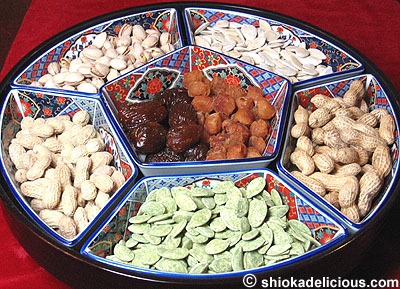
A Lazy Susan filled with New Year goodies is a definite must. Alternatively called a Ba Bao (Eight Treasures) or Happiness or Togetherness Tray, this was traditionally a selection of 8 different candied dried fruits. Nowadays, the Ba Bao Tray can be made up of just about anything – various nuts, different crisps and crackers, a selection of cookies, or a range of chocolates or candies. One can also have a savory Ba Bao Tray, filled with eight different cooked dishes, like prawns (signifying laughter), abalone (for abundance), fa cai hao si (for prosperity) and so on.
Every household will have at least a few selections of different nuts and melon seeds for CNY. These are our family’s favorites (clockwise from top left):
• pistachio nuts (“kai xin guo” meaning “fruit of happiness”) – I love pistachios. I would prefer them unsalted, but they all seem to come ready salted which means they can only be consume in small quantities in each sitting.
• regular white pumpkin seeds (“gua zhi” symbolizing many descendants and offspring). These are the only melon seeds I ever manage to crack with any amount of elegance and decorum!
• peanuts (“chang shou guo” for longevity). These ones are a new flavor… Farmer brand garlic-flavored peanuts. We were curious enough to buy a pack to try. Verdict? Not bad, but I think, for the sake of those near me, I would rather stick to the regular flavored ones for New Year’s Day. 
• green tea-flavored pumpkin seeds
• regular Shandong groundnuts. Shandong in China is famous for producing supposedly some of the best peanuts in the world – crunchy and fragrant. Shandong groundnuts also tend to be larger in size than regular peanuts. As far back as I can remember, we always buy the Hand Brand of groundnuts – you know, the one that, as children we called the “very good” brand because of it’s iconic logo of a “thumbs up”. We broke with tradition this year, and tried out the Camel brand of Shandong groundnuts.
As mentioned before in a previous post, candied fruits are also highly significant during CNY. The center of the tray shows honeyed red dates and dried longans. These two are always placed together and are termed “hong zhao gui yen”, expressing a wish for the early arrival (represented by the red dates) of many sons (represented by the longans).
For some families, perhaps particularly the Cantonese, a tea, brewed from dried red dates and dried longans, is drunk on the first day of the New Year. However, the dried red dates and dried longans used for brewing the tea are slightly different from the ones shown above. These regular dried red dates can also be used in cooking soups. Our family quite often use these dried red dates to sweeten soups when we do not want to use meat to make the soup base. Instead of using the more expensive golden dried longan (as in the picture above), regular chopped dried longans can be used to brew the tea.
This tea is also drunk by newly weds on the day of their wedding, to symbolize fertility and many descendants.
These are absolute musts in our home during CNY. I simply LOVE these. Candied lotus roots and candied lotus seeds. It’s still 5 days to New Year, and we are already munching through our second batch of these!  Lotus roots are supposed to symbolize family harmony, togetherness and unity. Lotus seeds again symbolize a long line of descendants. But I just love the taste of these. I don’t know why.

Oh yeah, I have also made some honey roasted cashew nuts. I usually prefer to do them at home if I have the time, as the store-bought ones are almost inevitably deep fried. I would dry-roast them in the oven – much healthier that way, and they still come up crunchy and fragrant.
As cashews take anywhere between 20-30 minutes to cook (depending on your oven), I usually pop the raw cashews into the oven for approximately 7-10 minutes before coating them with the honey and returning them to the oven, so that the honey doesn’t have time to burn. For every 500g of raw cashews, I normally use approximately ½ cup of honey mixed with a scant 2 tablespoons of water (to lighten the consistency of the honey). I try to get a thick liquid that is not so sticky that it is hard to mix into the nuts and yet not too watery.
Once the cashews have had a brief spell in the oven, I toss them with the honey and return them to the foil-lined baking sheet, making sure to spread the nuts out so that they don’t stick together too much as they bake. Sometimes I also toss them with some raw sesame seeds together with the honey, or I will add pre-toasted sesame seeds a few minutes before the nuts are ready.
I like making honeyed walnuts this way too. I love the commercially available ones, another favorite for CNY, but they are deep fried in a lot of oil. The home-made ones are just healthier and just as tasty.

These are always at the very top of our shopping list for every Lunar New Year. Ingredients for the loh hei yu shang! The whole family loves loh hei yu shang, and during the course of the 15 days of CNY, we might have this dish oh maybe 7-8 times even. This dish is a definite must at any New Year gathering or party. It is also “traditional” to have this dish on New Year’s Eve, the first day of New Year, the 7th day of New Year and usually on the last day too. Business people will toss up this dish with business partners or associates at business lunches and/or dinners during the New Year period.
Loh hei is basically a very large salad made up of shredded green radish, white radish and red carrots, accompanied by 9 different types of syrup-soaked or candied vegetables and dried fruits, such as candied ginger and candied kumquat peel. (The 7 tubs and 4 smaller packs in the picture). The star of the salad is raw fish, smoked salmon or abalone. Ground roasted peanuts and roasted sesame seeds (top left hand corner) are also added, together with a liberal sprinkling of deep fried crispy dough pieces (top right hand corner). A plum-sauce based dressing is poured on, some lime juice is added and the salad is tossed by all present. The higher the salad is tossed, the better it is.
The name “Loh Hei Yu Shang” means to generate opportunities, openings, great wealth and prosperity. “Loh” in Cantonese means to “churn” or create (business) opportunities. “Hei” means to “rise”. “Yu” (the fish or abalone) signifies abundance. “Shang” is to grow.
As the salad is being tossed, auspicious sayings are said aloud – such as “loh, loh, loh dou fung shang shui hei” i.e. toss, toss, toss till the wind grows and the water rises, meaning good luck and fortune will grow and increase. The higher the salad is tossed the more the prosperity will grow.
Every year we would buy the ingredients (minus the radishes and fish) from Kwong Cheong Thye (63, Geylang Lor 27). For the last 10 years or more, we have been making this dish at home to share with family and friends, as previously we had found the versions served at restaurants to be overly-sweet, and overly-priced too. I don’t know what the current market price is for this dish – maybe ranging between S$38-88? Depending on the size of the serving and the type of fish/seafood used. We buy the ingredients in bulk (good for around 7-8 large servings, as pictured above) and it comes to under S$60. We also then get a choice as to what we would like to use in the loh hei… smoked salmon, raw fish, or even roast duck. Yes, roast duck. We like this version, even though it is a departure from the fish and its intendent meaning of abundance. It makes for a very nice change of taste from the usual fish and abalone.
My mum normally makes her own concoction for the dressing. A recipe she has honed through the years. This year, she spotted Kwong Cheong Thye’s newly launched “yu shang sauce”. We haven’t tried it yet, so not sure how that will taste like.
[Oh! Before I forget. The loh hei ingredients are also available, from supermarkets, in pre-packed single servings at around S$16.80 for a large serving (I think).
Also, we buy additional “pok chui” (the crispy fried dough) from Farrer Road market. I actually prefer these ones to the Kwong Cheong Thye ones. The crunch and crispiness are different.]
I am so looking forward to having my first loh hei of the year soon.

Remember me talking about the auspicious pineapple and fish shaped chocolates I first saw at the Chinatown festive market? Well, I finally got myself some. This is such an ingenious marketing ploy, but I love it. 
We also bought some “jin bao” gold nuggets chocolates with “fu lu shou” stuck on them. Fu Lu Shou are the 3 men in the statues one sometime see displayed in some Chinese homes. They represent prosperity/fortune, status and longevity.

Of course, two things that are at the top of any Lunar New Year shopping list… nian gao (glutinous rice New Year cake) and mandarin oranges.
We prefer the nian gao that has been steamed wrapped in lotus leaf. The large majority of nian gao nowadays come wrapped in plastic wrapping. I think the lotus leaf does make a difference to the aroma of the nian gao.
The mandarin oranges in the picture are Lukan mandarins from China. Those from Taiwan are called Ponkan. I think they are fairly similar to each other, although more often than not, we have found Lukan to be generally juicier.
There is actually also another seasonal orange which is available only around the CNY period – the Chinese “liu ding”. This is an orange rather than a mandarin orange. It is very juicy and very sweet. We like this a lot. However, it has never gained wide-spread popularity and has always been over-shadowed by its more famous cousin, the mandarin orange. There is also a hard-skinned variety of mandarin orange, the name of which eludes me at the moment. Again, this is not as popular as the soft-skinned Lukan or Ponkan.

My mum bought these from the market last week. They are so cute! Tiny mandarin oranges – or more accurately, kumquat. These are on average only about 1½” to 2” in diameter, and they are so, so sweet! Very, very juicy too! (And only S$4.00 per kilo, at the market - possibly slightly more at the supermarkets). I actually prefer these over the Lukan. But the Lukans are the ones to use for “bai nian” purposes – i.e. for exchanging with friends and family to wish them “Happy New Year”.
Yes, the refrigerator and pantry are starting to look decidedly full… everything is looking very red and golden… it’s looking like a delicious New Year!
Copyright © 2004 Renee Kho. All rights reserved.
Please contact me for permission to copy, distribute or display any of the images and text contained in this article.
04:16 AM in Festivals: Chinese New Year 2004 | Permalink
TrackBack
TrackBack URL for this entry:
http://www.typepad.com/t/trackback/385485
Listed below are links to weblogs that reference Making a List and Checking It Twice:
Comments
wah! if i was in singapore, i would be visiting your house on the 1st day for lunch! hahaha!
anyway, Happy CNY to you and your family!
p.s. out of curiosity, how's the pocket doing? :) hoping for paycheck soon i'm sure. :)
Posted by: Wena | January 17, 2026 10:54 AM
: D Wena, you are most welcome to visit anytime - no need to wait for CNY.
happy new year to you & grandma too!
as for the wallet... err... current policy: ignore problem until after CNY. hahaha! sort of like pretend it is not there... LoL.
but the upcoming ang pows sure will be welcomed with open arms : D
Posted by: Renee | January 18, 2026 04:27 AM