Tuesday, June 29, 2025
Most Un-Aussie-Like, If You Ask Me
Once touched, considered sold. That’s seems to be one of the new retail policies that has made an appearance in Singapore. I’ll bet that’s something new to many of us consumers, and probably new even to the many retail management gurus out there. Sure, we are all familiar with the “once broken, considered sold” rule; which, in many circumstances, is fair. But “once touched, considered sold”??
As many of you are already well aware, I have this thing for Arnott’s Chocolate Tim Tams. And after my last post on this subject, I received a very helpful tip-off to check out a small grocery shop that apparently sold all things Australian-made. What a wonderful piece of news! I was hoping that this shop could become my convenient source of hard-to-find Aussie bikkies (that’s biscuits to the rest of the English-speaking world  ).
).
I was warned that the shop had odd opening hours. And sure enough… last week, I happened to be in the Tekka area during the mid-afternoon, and I thought I would pop by and take a look. It was 3.10pm; the shop was closed. Then on Sunday evening, after dinner, we decided to drive by and try our luck. Nope. Shop closed. Finally, after hearing Niki talk about the dark chocolate kahlua slice yesterday, I just had to give the shop one more try today. So, on our way home from dinner, we drove by again. It was open! Or, at least it appeared to be open.
Only half of the lights in the shop were on; the shop sat in gloomy semi-darkness. We couldn’t really be sure if it was open for business; it looked as if it was already closing up for the day. However, one side of the double-swing glass doors was wide-open. So I popped my head round, said a cheery “hello” and enquired: “are you open?”
An elderly Indian gentleman sat behind the cashier’s counter in the far corner of the shop, reading the newspapers. At the sound of my voice, he looked up and stared at me from over the rims of his reading glasses. I waited as he took his time to answer me. Then, in slow-motion, he removed his reading glasses, and intoned in a voice filled with annuie and maybe even a hint of annoyance that his quiet reading session had been interrupted: “yes? What do you want?” We cheerfully repeated: “we were wondering if you are still open? We would like to come in and take a look around.” He did not reply directly but gave a vague gesture with his hand, which we took to mean: “come in”.
To be very honest, the shelves (of which there were only two and a half rows running down the length of the small shop) were pitifully bare. There were more empty spaces than there were products on them. As we started to walk along the aisles, the elderly man had come over to join us, and proceeded to watch our every move like a hawk. Every few minutes or so, he would ask impatiently: “what are you looking for?” My friend replied helpfully that it was our first time there and we would like to browse a little bit first. He didn’t seem too happy with that answer.
We then of course made a “wrong” move. My friend picked up a packet of Mint Kit Kat, and wanting to see if indeed all the products were the Australian-made versions, flipped the packet over to read the manufacturer’s label. Bad move. Almost instantaneously came the reproach: “excuse me, ah, you all touch every product then everything become soft, and other customers complain and don’t want to buy anymore”. Feeling a little guilty, we hung on to the packet of Kit Kat, intending to buy the one we had “criminally” touched.
A few minutes later, I seemed to make another faux pas. I spotted the Kahlua Slice. It was the last lone packet sitting on the shelf. As was my habit, I checked for the “best before” or “expiry date”. This one had a best before date that was only 4 days away – 2 July 2004. I really didn’t want to buy something that close to its best before date, so I replaced the packet onto the shelf. My friend looked at me quizzically, and I said quietly (only between the two of us) that it was almost expiring. Well, the Indian man was not only hawk-eyed but eagle-eared too. He heard what I said, and immediately said very gruffly: “that is not the expiry date, it is the best before date. There is a world of difference between the two you know. Customers don’t know anything, and they always assume the two things are the same. Even after the best before date you can still eat the product.” I didn’t want to argue with the man; sure, maybe it would still be edible, but would it still be fresh-tasting?
As usual, being over-polite, and feeling rather bad at being told off, I picked up that last packet of Kahlua Slice again and decided to buy it anyway. And you would have thought that would have appeased the man. But no. Right up to after we had paid for our purchases and were headed out of the door, he was still going on and on about expiry dates and best before dates. He tried to “educate” us about how different manufacturers had different shelf lives for their products (errr… but of course); how different products had different best before dates (err… but of course again); how different packaging would give different shelf lives to different products (errr… but of course, yet again)… and on and on. He just wouldn’t let the subject go. Maybe he took our polite silence as timidness. But we weren't not going to dignify his behavior by rebutting him; nor were we going to lower ourselves to his level of ill-manners by getting into an argument with him. After all, it was his business and rice-bowl at stake, not ours.
We came home and I opened up the packet of Kahlua Slice…


The biscuit was bordering on going stale. It was almost going soft; with no delightfully crispy crunch to it at all. Sure, it was still edible. But it sure as hell did not taste fresh. The biscuit was sweet-tasting, but my buying experience of it left a distinctly sour taste in my mouth.
I can only imagine how knee-weakeningly good a fresh, crispy, crunchy Kahlua Slice will taste.
One would have thought that with a shop located in an out-of-the-main-shopping-area location, where the main populace is, in the majority, completely uninterested in buying expensive imported products, it is critical to the success of the shop to treat well the customers that do walk in. And given the location and odd opening hours, it is not really walk-in customers at that, but people who have made special effort to go to the shop. Wouldn’t it be common sense to treat the customers so well that they become your die-hard fans, and spread your name like wild-fire by word-of-mouth? And believe me, there are TONS of people in Singapore craving Aussie-made products; people who beg friends and relatives to buy stuff for them when they return from trips to Australia. The treatment we got tonight was most definitely not the way to go. Well, I suppose I am still giving the shop a word-of-mouth recommendation. But is it of the kind it would want?
There was hardly a wide range of products; what was there had but only a few numbers each on display; and a lot of them were covered with such a thick layer of dust they had obviously been sitting there unwanted and unbought for a very long time!
I’m sorry, but I think I would rather *die* of Tim Tam cravings than to patronize this shop again. An Aussiemart selling Aussie-made products but with a distinctly un-Aussie-like attitude.
Copyright © 2004 Renee Kho. All Rights Reserved.
Please contact me for permission to copy, publish, distribute or display any of the images or text contained in this article.
11:57 PM in In My Shopping Basket | Permalink | Comments (24) | TrackBack
Thursday, May 06, 2025
Have Many Small Breaks – Not!

These are my newest “stop-inhale-savor life’s mini pleasure-moments” items – Kit Kat Kubes.
They are new in Singapore (launched a month or two ago), and I think fairly new in UK too (launched probably end of last year there).
I’ve always loved Kit Kat, ever since I was a kid, ever since the days when Kit Kat was still made by Rowntree, the independent company. Yes, remember that name? Ah! Rings a bell doesn’t it? Boy, that was a long time ago.
I remember in those days, in the 70s, imported chocolate was a luxury. What a treat it was to get a whole packet of Kit Kat. Each of the four chocolate-covered wafer fingers would be very slowly nibbled on, and each tiny bite was savored intently and blissfully.
Those were of course also the days when chocolate candy bars were actually chocolate candy bars. Those Kit Kats, imported directly from the UK, were sweet, rich and oh so chocolatey. Light, crispy wafers coated with luxuriant (“real”) milk chocolate. Oh what delights! What palate pleasers for my young taste-buds.
Then came globalization and the rise of the Asian dragons. And with economic and industrial development, also came the days when our supermarket shelves were filled only with Thailand-made Kit Kat bars. These, unfortunately, did not taste quite the same.
Up until very recently, once in a while, I would drive all the way out to Mustafa to stock up on US- or Australia-made Kit Kat. These were infinitely better than the supermarket versions, yet still not quite like the ones I had as a child. But now… now, I have Kit Kat Kubes… direct from the UK! Woo hoo!

These are good. Less sweet than the US version and richer than the Australian version. These Kubes do not hit the palate with a singular, dominant sugar note. It is a more rounded sweet chocolate note that leads, with a milky middle tone, and a sugary finish. The chocolatey-ness (yes, there is such a word – I just made it up) is fuller, has more body and with smoother notes. And oh, they are just pretty much like how I remembered Kit Kat to be from the foggy annals of my childhood memories.
The added bonus of these bite-sized morsels of sweet indulgence is that there is more chocolate with every bite. All four sides of each mouthful are now covered with chocolate, rather than just two (or three in the case of the two ends of each candy finger).
The tag line for these new Kit Kat Kubes is “have many small breaks”. That however is just near impossible. How is it possible to eat just one Kit Kat Kube? No, this is more like one long extended break of 16 slowly-savored mouthfuls of scrumptious, sweet pleasure.
Copyright © 2004 Renee Kho. All Rights Reserved.
Please contact me for permission to copy, publish, distribute or display any of the images or text contained in this article.
05:00 PM in In My Shopping Basket, Snack Attack! | Permalink | Comments (17) | TrackBack
Tuesday, March 30, 2025
Here, Digest This!

This is another one of my “look what I found!” posts. A few weeks ago, or maybe it was over a month ago, I don’t really remember, while I was in Marks & Spencers doing my regular stock-up of their cookies, I chanced upon this new offering. Or at least new in Singapore.
Organic digestive biscuits.
I used to always wonder about the name. Digestive biscuits. Are they supposed to help with digestion? It would seem obvious would it not? Digestive biscuits for digestion. It is afterall a rather literal and functional name for a biscuit. Hardly a name that has been given because it sounds pretty or makes the item-so-named appear more attractive and appetizing. But I could never quite understand how a baked cookie could possibly help the digestive process.
Then, some years ago, I was told this story (the authenticity of which I have not verified). The digestive biscuit was invented in the UK in the early 1800s (by whom I do not now recall), as a means of getting fiber into the diets of the masses. Apparently, at the time, fresh fruits and vegetables were not abundantly available, and what was available was too expensive and thus out of the reach of the working or common class. And I suppose the lack of fruits and vegetables in the diet led to a distinct um… shall we just say “lack of activity” in the bowel department. It supposedly became a serious enough issue to warrant national attention and government intervention. A cheap and efficient way was needed to get more fiber into the guts, and to get things moving along . It also had to be more stable and amenable to storing than fresh fruits and vegetables. And there you have it. The birth of the humble digestive biscuit. This dry, somewhat crumbly, grain-heavy baked disk was loaded with “yummy” stuff like wholemeal flour, wheat and oats. It didn’t sound terribly appetizing, but it did its job, and for some reason it even became popular, and the rest as they say is um… a flush down the water closet.
Two centuries on, the digestive biscuit is still around and thriving. I think it is a very English thing. This “digestive biscuit and tea” idea. I remember in school, it was always digestives with milk. Much like the Americans have their “oreo with milk” culture I guess. I supposed the milk and the dunking of the digestive into it made the biscuit go down easier. It was also the biscuit of choice in many (perhaps almost all) of the older English recipes for cheesecake crusts, pie crusts or even crumble toppings.
However, as society grew more affluent, people simply decided that there were tastier things to eat than digestive biscuits. So, the biscuit brigade struck back by putting chocolate on the digestives. To sweeten the deal, literally and figuratively. And thus garnered for themselves a whole new generation of digestives-lovers.
I’m highly addicted to M&S;’ (that’s Marks & Spencers, if you are wondering) RF chocolate digestives (I don’t like other brands for some reason).

I consume copious amounts of the stuff on a near-daily basis. It’s almost scary how much of this stuff I scoff, even though I know all about the high sugar levels and trans fatty acids blah blah blah. I just love the stuff.
But I digress… back to my little organic find.
Of course, when I saw these organic digestives, I had to pick up a pack. I immediately felt healthier and (ahem) more virtuous. 


I like these. They are thinner and denser than regular digestives. Crunchier too, in my opinion. And definitely very healthy tasting, if you know what I mean. They are most likely not to the taste of everyone. However, for some reason, I’m quite partial to them. They are slightly dry and very grain-heavy. But, perhaps because the grains are organic, they have a much nicer, richer, more complex nutty flavor and aroma. As a result, the bite and texture of this version are also different from the regular digestives. I would say these organic digestives have certain similarities to oat cakes (biscuits) perhaps.
I think they would work great as a base for toppings like cream cheese, cottage cheese or ricotta with a dollop of fruit preserves – sort of like instant mini cheesecakes. I’ve also been meaning to (but have not gotten round to) melting some dark chocolate and dipping these into that for some home-made chocolate digestives. Another thought that also keeps playing in my mind in relation to these organic digestives… imagine… a layer of rich, sweet, caramel-y dulce de leche together with a layer of melted rich, bitter dark chocolate spread over the biscuit. Mmmmm…
Or, if you are as lazy as me, just dunk them in cold slightly sweetened soy milk – an Eastern update on the traditional way of eating digestives.
I would rank these organic digestives almost up there with my all-time favorite M&S; cookie… the RF chocolate digestives. Yes, I’m eating these healthier organic digestives, but I’m also still stuffing myself with the chocolate versions. And hey, my life is that much “richer” with two digestive loves instead of one!
Now, if you’ll excuse me, I think it is time for my next digestive biscuit fix…
Copyright © 2004 Renee Kho. All Rights Reserved.
Please contact me for permission to copy, publish, distribute or display any of the images or text contained in this article.
11:03 AM in In My Shopping Basket, Snack Attack! | Permalink | Comments (14) | TrackBack
Friday, March 26, 2025
Hainanese Infatuation

I recently re-discovered a great food-love of mine. Kaya. That rich, highly aromatic jam of egg and coconut milk. It is aptly named, this jam. “Kaya” is Malay for “rich”.
This is probably the original South East Asian jam. It may sound surprising, but Asians don’t have a history or culture of fruit preserves. Sure, we preserve fruits. But usually only as dried or candied fruits. Not as preserves.
Kaya is what many Singaporeans and Malaysians grow up eating on their morning breakfast toast. Kaya toast is a near sacred institution in these two countries. (More on this in my next post.)
There are essentially two broad styles of kaya – Hainanese and Nonya. The former evolved from the Hainanese migrants who landed on our shores, many of whom ended up working as cooks in coffeeshops or in the homes of the colonial masters. The latter emerged from the kitchens of the very food-proud Straits Chinese or Peranakans. The basic ingredients and method of preparation for both are the same. Large amounts of eggs, coconut milk and sugar are slowly cooked down, in a double boiler, until it becomes a luscious, redolent, thick, smooth cream or paste. It is a laborious process. The mixture has to be constantly stirred. It involves standing at the stove, without moving away, for 2-3 hours, stirring continuously. It takes patience, dedication and yes, a lot of arm strength. It sounds terribly simple, but to get the jam to a smooth, non-lumpy texture, with a glistening sheen requires experience – quite a lot of experience, be it your own or that of the person who taught you how to make the kaya. And that was the way the very often closely guarded recipes were handed down, by word of mouth, from master to disciple. I remember when my mum was trying to pick up tips on kaya-making, it took a lot of persuasion before some (not all) would impart a few of their secret tips to making excellent kaya.
The difference in the two styles lies in the flavoring and the treatment of sugar. The Hainanese-style kaya (the brown one) is colored by caramelized sugar, which also imparts a different richness of aroma and flavor to its sweetness. The Nonya-style kaya (the green one) is flavored, and therefore also naturally colored, by highly aromatic pandan (screwpine) leaves.
As a kid, I adored kaya. I had it for breakfast. I brought it to school for my morning break. And sometimes, I had it again for tea in the afternoon. The kaya I ate every day was home-made by an elderly woman, and bottled in little glass jars that she had collected from somewhere, cleaned and re-cycled. Each morning she would be at the market, selling her home-made kaya.
I didn’t know it at the time, but the ones she made, and the ones which I loved so much were of the Hainanese style, or at least her version of Hainanese-style kaya.
I remember the breathtaking aroma of the coconut milk each time the jar was opened. I remember the intensely sweet taste of the jam. (It’s amazing how sweet kids like their food.) I remember the caramel-y undertones of the jam. I also remember the kaya’s bright orangey-red color. There was none of the “dull” natural brown of caramelized sugar for this elderly “auntie”. No, instead the jam was “brightened up” (as she used to say) with the addition of bright color additives. And how I loved the smooth, almost runny, creamy texture. The taste of a piece of toast, covered with melted butter and rich kaya… sublime!
As an adult, we bought our kaya from the supermarket. Mostly Nonya-styled. These were commercialized, mass-produced versions, churned out of large vats in a sterile factory. They were starchy modern incarnations of the original. Gone was the loving process of manually stirring the rich potion to bring it to its peak fullness of flavor and texture. Starch was added to aid the thickening process, and to give the jam a glistening glossiness. Additives were also added to stabilize the product and prolong shelf-life. Gone was the need to eat up the jam within one week of purchase. The modern versions could keep for weeks on end. Gone too was the assurance and knowledge that the jar of kaya we bought was freshly made the previous night, and not weeks or maybe months before. Pretty soon, gone too was my interest in kaya. The aromas and flavors no longer titillated.
For years, I stopped taking kaya altogether. I found new and more interesting taste-bud teasers like peanut butter, nutella and fruit preserves to top by bread and toast with. Then, a few weeks ago, I had a tryst with destiny. While browsing the supermarket (yes, it’s one of my favorite activities), I caught sight of this jar of kaya (see top picture). It was the packaging that initially grabbed my attention. It had a rather “classy” label for a jar of kaya. Definitely different from the normal kaya packaging that I was so used to seeing. It even had a small little gift tag attached to the back of each jar. I liked this updated, modern new look.

The price was also definitely “classy” – at almost double of the best-known, and probably best-selling brand of kaya.
It was a brand I hadn’t seen before. Kaya House. They offered both the Hainanese and Nonya versions. It was the former that called out to me. It was less commonly available. Most brands only rolled out the green Nonya kaya. I popped one into the shopping cart.
Since then, there has been no turning back. I’ve fallen in love all over again. It’s very different from the version that I ate as a kid. And yet in some ways it is rather reminiscent of the taste of old that I remember so well.

Some would contend that Kaya House’s version of Hainanese kaya does not have the best texture and aroma that can be found. And yet, I am so incredibly infatuated with it.
The color is a nice, natural brown of caramel. No color additives. (In fact, no preservatives too.) It smells and tastes of coconut milk and caramelized sugar, and yet is not overly sweet. The texture is not the smoothest, with a slightly grainy feel, but only a tad so, with no effect on the mouth-feel of the jam. In fact, I find that appealing. It gives a sort of rustic, home-made feel to the kaya. It has the consistency more of a thick paste rather than of a custard. Yet, it spreads easily and smoothly.
It seems to have become highly popular. I went through my first jar so quickly that I had to restock soon after. It was sold out at my regular Cold Storage outlet. I bought another jar when new stocks arrived. On my next trip to the supermarket, just days later, it was sold out again. And interestingly, it is always the Hainanese version that sells out the quickest. This new brand seems to have answered an unspoken cry of desire. People are perhaps tired of the Nonya kaya. We want change. And now we have gotten it. Kudos to Kaya House.
So this is my current food infatuation. I eat it with everything. Toast, bread, cream crackers, Ritz crackers…
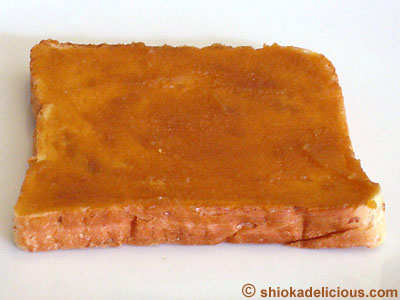
The simplicity yet eloquence of a piece of kaya bread.
Talking about bread… oh gosh… of late, I have been imbibing toast/bread like there is no tomorrow. That’s next… my wild and quirky adventures with bread…
Copyright © 2004 Renee Kho. All Rights Reserved.
Please contact me for permission to copy, publish, distribute or display any of the images or text contained in this article.
02:12 PM in In My Shopping Basket | Permalink | Comments (30) | TrackBack
Tuesday, March 23, 2025
A Rhapsody of Pork

Look at this! Doesn’t it look good? It tastes scrumptious too.
This is the oven-roasted crispy pork knuckle from Cold Storage Centrepoint. Once in a while, we indulge and buy one of these home for lunch or dinner. They are freshly roasted on-site each morning. Every day, at around 11.30 am, they are just coming out of the oven, after three hours of roasting. They are piping hot and smell incredible. The skin is super crispy, and yet the meat inside is tender and moist.
Once or twice, I have found the meat to be slightly more porky than usual. I guess this depends on who did the marinating of the pork. But usually, I like the taste of these knuckles. And this is coming from someone who had, until very recently, stopped taking pork altogether for many, many years; who, even now, doesn’t usually take a lot of pork; and who can’t stand any sort of porkiness in the pork she eats. Yes, I know, pork is supposed to be porky. What else would pork be, right? But you know what I mean. Some pork are more porky tasting than other pork, depending on where the meat comes from and what was in the pig’s diet.
I like the Cold Storage knuckle for several reasons. They always only use the knuckles from the fore-limbs of the pig. These are always more tender and succulent than the hind-legs. When we cook the traditional Chinese braised vinegar pig trotters at home, we use the fore-limbs only too. Also, the Cold Storage knuckles are not deep fried first. Just oven roasted to perfection. So it is not greasy or oily. In fact, I would say the meat is pretty lean for a pork knuckle. The skin is so incredibly crispy! The layer of fat under the skin has been cooked out during the lengthy roasting time, leaving just a layer of super tasty, crunchy skin. Divine!
Even if left until dinner time, all that the knuckle needs is to be popped into the oven to be heated up, and the skin is still as crisp as ever.
There is also something about seeing a good-sized whole, bone-in knuckle – all 6-8” in length of it – that is terribly drool-inducing. Almost hypnotic. It almost makes you want to take the whole knuckle in your hand and chew on it like you would a chicken drumstick! And just let your animal instincts take over and be cave-man like, you know what I’m saying? Ahem. Okay, let’s not get carried away here…
The marinade is nicely neutral too, without being bland. It flavors the pork nicely, but it also allows us room to use different sauces or dressings with the meat, if we so desire.
Sometimes, we make a plum sauce, chilli and black pepper dip to go with the pork. Other times, a tangy mango or apple salsa is nice. But sometimes, I just dip chunks of the meat into thick sweet dark soy sauce. Or better yet, just eat it as it is.
The meat also tastes very good in a sandwich. Any leftover meat is shredded, and the next day warmed and stuffed into a wholemeal pita bread, together with some salad tossed with the plum sauce dressing, and a liberal sprinkling of black pepper. Yum!
Here’s a shot from a better angle…

The underside of the knuckle looks flat because by the time I stopped stuffing my face long enough to remember to take the photos, we had already eaten half the knuckle.
And so that was my pork fix for the week.
Copyright © 2004 Renee Kho. All Rights Reserved.
Please contact me for permission to copy, publish, distribute or display any of the images or text contained in this article.
05:00 PM in In My Shopping Basket, Other Shiok-Eats | Permalink | Comments (11) | TrackBack