Thursday, June 17, 2025
Cheap and Good

Sitting on the fringe of one of Singapore’s many well-known food hubs is a rather unassuming, almost nondescript food stall. It takes up a small corner of a kopitiam (local coffeeshop), which itself is off to the side of the famous Alexandra Village Food Centre (or hawker centre). It is so humble looking that to this day, after years of patronizing the stall, I still cannot remember its name. I know where it is, I recognize the owners, but I can’t remember the name of the stall!
This small food stall sells but two items – the Teochew Soon Kueh and the Ang Ku Kueh (for more information about South East Asian kuehs, please refer to my previous post on kuehs); and it is well-known and highly regarded for both.
Soon Kueh is a classic Teochew steamed dumpling. Traditionally, a thin, smooth and translucent skin envelops a voluptuous filling of sautéed young bamboo shoots (“soon” in Chinese). The dumpling is then brushed with a little oil and steamed to soft, succulent perfection; a light sprinkling of toasted sesame seeds adds the finishing touch. However, for some unknown reason, in Singapore at least, the “traditional” version of Soon Kueh is taken as being one filled with sautéed mung guang (jicama or Chinese turnip), and the bamboo version is normally referred to as being a variant of this. Nevertheless, on the whole, “soon kueh” is the term used to refer to both flavor varieties.
There is also a further variant with a chives filling. In this incarnation, it is technically no longer a Soon Kueh, but a Koo Chye Kueh (“koo chye” - sometimes spelt “ku chye” - being the dialect term for chives).
This stall sells all three versions. I’ve only ever tasted their mung-guang and chives dumplings, since my body doesn’t take too well to the presence of bamboo shoots.

The Soon Kuehs from this stall are big – quite a lot larger than the standard ones sold at hawker centers. And they come stuffed chock-full with filling - shredded turnips sautéed with finely diced carrots and wood-ear fungus.
The ones we bought on this last visit were unfortunately a little under-flavored. And the turnips could have done with more time in the wok too… that elusive “wok-hei”, or rich, complex flavor that comes from using the right intensity of heat and cooking the food for the right amount of time, was sadly missing.
The skin (made from rice flour and tapioca flour), on the other hand, was as good as ever. So beautifully thin and translucent that the fillings could be seen through it; and yet strong enough that it didn’t break or tear when the dumpling was picked up with chopsticks. The true mark of well-made skin I say. The texture was pretty close to perfect too – soft, smooth and succulent, with just the right amount of bite. There was just the right degree of sticky chewiness, without any dough sticking to the back of your teeth as you bit into the dumpling.
The accompanying chilli sauce was very good too. I have always liked the home-made chilli sauce from this stall. It is not tongue-searingly hot. But spice heat alone does not a fine chilli sauce define, in my opinion. I’ve never been one to enjoy food or sauces that have but one dominating flavor note that overshadows all else. I prefer balance, and a holistically complex package of tastes and aromas. It is about richly layered flavors, finely tuned spice and ingredient combinations, fragrant aromas, and just as importantly, long and patient frying (cooking) of the chilli sauce – an often overlooked factor that is essential for delicious sauces.

The chives dumpling also came filled to the brim with stuffing. Look how beautifully and evenly thin the snow-white skin was. Gorgeous. The only let-down was again the filling. Chives absolutely require a good amount of cooking time; otherwise they retain this rather unappetizing green, grassy taste, and sometimes even with a hint of sappiness. Ideally, they should be sautéed to just the right amount of softness so that they are very tender and smooth on the palate. Perhaps it was a substitute cook that prepared the fillings that day; a cook that was inordinately light-handed with the flavorings. Even the finely diced dried shrimps that were added to the chives could do little to lift the filling.
Still, at just 50 cents (US$0.30) per piece one can hardly gripe too much. The Soon Kuehs at this stall are truly cheap. Similar sized ones, and not necessarily better tasting ones either, will normally go for S$1.00 to S$1.20! I think this stall has held their prices steady for years and years, and this fact has not gone un-noticed with their very large and loyal following.

My favorite from this stall however remains their Ang Ku Kueh, and more specifically, their Peanut Ang Ku Kueh.

Again, at just S$0.50 a piece, it is incredible value. Super generous fillings are the trademark of this stall, and it is true of their Ang Ku Kuehs too.
I like their peanut filling for several reasons. The peanuts are roasted just right – not too much, which gives the filling a slight “burnt” aroma, and not too little that the filling lacks fragrance… but just right. (And no, there is no Goldilocks in this story, sorry.) The peanuts are then ground to a very good consistency, not too coarse and chunky and not too fine, but just… right (hey, we’re getting good at this!  ). The sweetness of the peanut filling is also finely tuned. And the biggest bonus for me personally is that you can’t see or taste the granules of sugar. I tend to find this to be a problem with many other versions of peanut ang ku kueh. Another common problem is an overly moist filling where the peanuts clump together into a soggy lump and become soft with nary a crunch to them. At this stall, although the filling can occasionally fall a touch on the dry side, but more often than not, it is very fragrant, aromatic and nicely crunchy.
Not to be out-done, the skin is very well-made too. It is nicely soft, with the right amount of stickiness and chewiness. It is also not so thick that you get a whole chunk of glutinous rice flour dough with every bite, nor is it so thin that you feel like you are eating pure ground peanuts and nothing else.
All in all, just three words: good and cheap!

They also sell the Green Bean (Mung Bean) Paste Ang Ku Kueh – both sweet and savory. While the sweet version always has a red colored skin, like the peanut ang ku kueh, the savory one (pictured above) has a skin that is flavored, colored and flecked with a Chinese herb, the name of which I do not know. It lends a very subtle aromatic overtone to the skin, giving it a touch of the savory. In this form, the kueh is known as Aw Ku Kueh.

The generous bean paste filling is again very well made; with a soft and fluffy texture that doesn’t tip over into mushiness (unlike the one I wrote about previously). I’m not usually an aw ku kueh person. I much prefer the sweet one; but this savory version I will eat.
In recent years, they have added to their original repertoire of peanut, sweet and savory bean paste ang ku kuehs. Their range now includes “modern” flavors like yam and yes, even durian. I’ve never tried any of these “new” flavors, and am not inclined nor tempted to. I’m a classic kind of gal, you know… But given their generally high standards, I don’t think they will disappoint if you are so inclined towards those flavors.
I would say their kuehs are definitely among the better ones that I have tasted in our island state. They have remained steadfastly a specialist in these two types of kuehs, and it shows in the standards. And where value for money is concerned, they are pretty much unbeatable. This is one stall that has stayed on my “repeat list” for many years. I don’t visit it often; but whenever we happen to be in the vicinity, this stall is a must-stop.
[Update 19/06/04: a reader has very kindly emailed me the name of the stall: Poh Cheu]
Copyright © 2004 Renee Kho. All Rights Reserved.
Please contact me for permission to copy, publish, distribute or display any of the images or text contained in this article.
03:11 PM in Lion City Shiok-Eats: Fast Eats, Snack Attack!, Tastes of South East Asia | Permalink | Comments (15) | TrackBack
Thursday, June 03, 2025
Kueh Kueh, Kuih Kuih

Shortly after I posted my article on Chinese steamed buns (paus or baos) back in March, I received an email asking if I would do a “photo listing” of the various Nonya kuehs that are commonly eaten in South East Asia. At the time, I said I would try, but it could take a little time. While I like Nonya kuehs, I do not buy or eat them on a regular basis, so there is usually little opportunity to, urm, get up-close-and-personal with them kuehs.
J, if you are reading this… no, I have not forgotten your request. It has been more a matter of working out the photographic logistics. But, as with so many things in life, serendipity has a way of working all things out in time.
A few weekends back, several girlfriends came over for afternoon tea. I was supposed to have baked a cake, but didn’t manage to get round to it. So two of my girlfriends offered to buy some cakes and confectionery to bring over instead. They coordinated among themselves as to who was to buy what. However, at the last minute, for whatever reasons, both couldn’t get what they had planned, and each made a spur-of-the-moment decision to buy something else instead, assuming all the while that the other person was still going ahead with the original purchases. But, as coincidences would have it, the “something else” that the both of them ended up getting turned out to be Nonya kuehs! Talk about resonance! Fortunately, the kuehs were from two different shops, and while there were some overlaps in choices, there was also a significant variety. One thing for sure though, we had a lot of Nonya kuehs to eat that day!
As we sat on the carpet around the living room coffee table eating the kuehs, I suddenly remembered the email and the request. A little yelp from me, a short explanation, and a quick dash to grab the camera later, our afternoon tea session turned into an impromptu photo session, featuring Nonya kuehs as the super-models! It was a hilarious event, filled with giggles and tummy-aching guffaws. The girls were busy either lining the kuehs up for their turn in the spotlight, or “doctoring” some of the half-eaten candidates, hoping to spiff them up a little bit and to make them at least somewhat photogenic.
I think we had more fun playing with the food than we did eating them! And here then, finally, is a fairly comprehensive, though by no means exhaustive, guide to various South East Asian kuehs.
So, what is a kueh?
First, maybe we should try to define the word “kueh” (or “kuih” as spelt in Malaysia). This is actually a very hard word to translate accurately into English, simply because it represents a category of food that doesn’t really exist in Western gastronomy. There is no single, simple, succinct English equivalent to this word.
This Malay word, “kueh”, is a fairly all-encompassing term that is given to many manners of small food items, usually (but not always) sweet creations, including cakes, cookies, pudding-like desserts and even confectionery. In many senses, it can also be used to describe pastries. However, having said that, it is important to keep in mind that the Asian concept of “cakes” and “pastries” is quite different from that of the Western one. Cakes are more often than not steamed rather than baked, and can have a very different texture from what is understood as “cake” in the Western sense. And pastries are not of the flour-combined-with-solidified-fat variety, but instead can again be steamed, baked or even deep fried, and again have very different textures from the Western short or puff pastries.
So, kueh is often sweet, but can be savory at times; it can be baked, steamed, cooked over a charcoal fire or even deep-fried; it can be of pudding-like softness or it can be firm; it can be a “cake”, a cookie, a “pudding” or many other variations of sweet “desserts”; or it can also be small savory snacks.
Kuehs are not confined to a certain meal or a certain time of day, for example as a dessert or as a tea-time food. They are eaten throughout the day. They are eaten at breakfast, as snacks, for dessert, at supper, or just whenever the fancy strikes. They are also a most important and integral part of hospitality during festive occasions, like Hari Raya (the Malay New Year) and Chinese New Year (for the Peranakans).
Now that I’ve made such an erudite, clear, concise and non-meandering explanation of the word “kueh” … Now that you know precisely what a kueh is  , let’s paint the kueh landscape in broad strokes.
Painting the kueh landscape
There are several general parameters for kuehs that can perhaps give a better understanding of this food concept.
In almost all kuehs, the key and most common players in the flavoring department are coconut milk (thick or thin), grated coconut (plain or sweetened), pandan (screwpine) leaves and gula melaka (palm sugar). Various permutations and combinations of these main aromatics form the basis of almost all variety of kuehs.
While those are the more noticeable “public faces” of kuehs, shall we say, their foundations are built on a group of starches – rice flour, glutinous rice flour, glutinous rice and tapioca. Two other common ingredients are tapioca flour and green bean (mung bean) flour (sometimes called "green pea flour" in certain recipes). However, their roles are less that of “building blocks”, and more that of what I call “texture regulators”. They play a most important part in giving kuehs their distinctive soft, almost pudding-like, yet firm texture. You will also notice that wheat flour is rarely used in South East Asian “cakes and pastries”.
[At this point, it might be worth pointing out that there can be many different versions of recipes for any given kueh. Precise recipes for kuehs can be hard to come by, and the recipes that are out there can vary in the amounts of ingredients used or even what is used. The reason for this is that, in the past, the making of traditional cakes was almost exclusively the domain of elderly grandmothers, aunts and other women-folk, for whom the only (and best) method for cooking was by “agak agak” (approximation). They instinctively took a handful of this and a cupful of that and mixed it all together without any need for weighing scales or recipes. Everything was judged by the look and feel of the food – the thickness of the batter, how it feels to the touch and so on. Each family would have their own traditions, and the recipes were passed from generation to generation by word of mouth. So, it may take some personal experimenting to find recipes that suit you and your tastes.]
Now, back to the painting…
Kuehs come in all shapes, colors, textures and designs. They can be filled kuehs, wrapped kuehs, coated kuehs, sliced kuehs or layered kuehs.
And finally, as mentioned earlier, most kuehs are steamed, with a smaller proportion being boiled or baked. On other occasions, they are deep-fried, and sometimes they are even cooked over a charcoal fire and/or grilled!
Nonya or Malay
The above basics apply to both Nonya (Peranakan or Straits Chinese) and Malay (and/or Indonesian) kuehs. In fact, the distinguishing line between the two is vague and indistinct, with large areas of overlap. There are more commonalities than there are differences.
Let’s put it another way. Both Nonya and Malay kuehs come from the same family, the same genetic pool, so to speak. The historic Peranakans, especially those in Malacca and Singapore, took heavy influences from Indonesia and its Malay culinary and cultural heritage. This means that, when it comes to kueh, there are many that are identical to both cultures, with maybe only a change of name.
It is like family members who are identical twins, but each has their own name. Then there are the fraternal twins – they look very similar but may have slight distinguishing marks in their physical appearance and somewhat different shades to their personalities. Finally, there are the siblings who are completely different from each other, and each lives in their own house with little intermingling. And yet, everybody exists and lives together as one complex, diverse and interesting family. So it is with kuehs.
With the passage of time, the lines of distinction between the two groups of kuehs have been fudged even more. Few South East Asians will be able to tell you precisely which kuehs are exclusively Nonya and which are exclusively Malay or Indonesian. The term “Nonya kueh” is probably more commonly used in Singapore, and “Malay kueh” perhaps more common in Malaysia, but both terms essentially refer to the same group of foods.
Now that I’ve confused you sufficiently, lets move on to the kuehs proper, and I’ll try to point out the cultural nuances as much as possible as we go along. How’s that?
Here’s how it’s going to break down… I figured the easiest way would be to first break it down by cooking methods (steamed, baked etc), which then breaks down by the main type of starch used (rice flour, glutinous rice flour etc), and finally the various ways of presentation and the flavorings used.
[A small editorial note before we begin. The word “cake” is used here to refer to these Nonya/Malay kuehs, and does not carry the same meaning as when used in relation to Western cakes.]
STEAMED KUEHS
Rice Flour
Let’s look at the layered steamed rice flour-based cakes first.

Kueh Talam is a familiar Nonya kueh to many. The two layers are made with slightly different ingredients and different flavorings. This gives a nice contrast and balance of two different textures and tastes. The thicker green layer is made from rice flour mixed with some tapioca flour, green bean flour and alkali water*. Pandan leaves provide the color and the fragrance. In some cases (as in this case, as pictured) a little coconut milk is also added to give a richer, denser consistency to the batter. The thinner white layer is simply rice flour with a little green bean flour mixed with coconut milk. The green layer is first steamed, before the white batter is poured on top and the cake returned to the steamer.
* Alkali water gives a springy texture to the cake, and can be left out if unavailable.

Talam Hidjau uses the same basis but with a different flavor combination. Here, gula melaka (palm sugar) takes centerstage and forms the main layer, with the secondary layer being flavored with pandan.

This is perhaps one of the best-known and most endearing of the kuehs – the multi-colored layered cake. It is so well-loved that it has been adopted by the Malay, Nonya and even the South East Asian Chinese cultures. For the Malays and Nonyas, it is called “Kueh Lapis Sagu” (layered cake), and for the Chinese, it is “jiu chen gao” in Mandarin or “gao chang gou” in Cantonese, which literally translates as “nine levels cake”. And indeed, the cake always has nine layers.

Almost every child in South East Asia would have grown up eating this favorite snack. And most people, myself included, will tell stories of how, as kids, the only way to eat this cake is to carefully peel off each thin layer by thin sticky, soft, chewy layer, before popping it into the mouth. Now, even that has an art-form to it. The thin layer can be held up from one end, dangled over your upturned face, and slowly lowered into your wide-open and waiting mouth. Or the layer can be rolled into a tight bundle before being popped into the mouth. Or heck, just shove the piece in any old how. But always count and make sure you get your nine-layers worth of kueh!
The cake itself is made mainly from rice flour with a little bit of tapioca flour mixed in. Thick coconut milk provides richness of flavor. The cooking of the cake requires great patience, dedication, skill and accuracy. The cake is cooked painstakingly one 2mm layer by one 2mm layer. Only after the previous layer has been steamed and set, can more batter be poured on to form the next layer. There can be no rushing and trying to pour in too much batter at any one time. The layers should all be uniformly thin, and 2mm is thin! It requires good eye judgment and fairly precise hand work.

This is a variation on the theme. It is both a layered and a coated kueh. A 7-layers cake cut into small slices and coated with grated coconut.

Grated coconut is a recurring theme in kuehs. It is a favorite as both a topping and as a filling. Here, in the case of Kueh Kosui, it is used to coat the palm sugar rice cakes. This kueh is probably more of the Nonya tradition than of the Malay.
A rice flour and tapioca flour mixture is combined with some palm sugar syrup, before being steamed. It is interesting that the traditional shape of Kueh Kosui is actually a bowl-shape. It used to be that the batter was poured into mini individual shallow cups or bowls and steamed. The cooked cake would then have a small mound of grated coconut placed on it. Nowadays it seems more common (and probably easier) to steam one large cake, cut it into smaller pieces and toss them in grated coconut so that the entire piece is coated.

And to round out the rice flour-based group of kuehs, a wrapped kueh – the Nagasari. This is very much an Indonesian/Malay kueh. It is a simple pudding-like concoction of rice flour with a little bit of tapioca flour mixed with lots of thin coconut milk and flavored with pandan leaves. Slices of fresh banana are added before the batter is wrapped into small individual parcels and steamed. The traditional (and in my opinion, the proper) wrapper is banana leaves. However, the bottom line seems to dictate that modern confectionery shops make these wrapped in plastic! It’s never the same.

The Nagasari is a popular kueh. It has a soft yet firm custard-like texture. A sort of pudding I guess. And bananas and coconut milk always make an easy and highly compatible pairing.
Glutinous Rice Flour
When it comes to the glutinous rice flour-based kuehs, a lot of them are of the filled variety.

This is probably my personal all-time favorite kueh – the Ang Ku Kueh to the Chinese and Kueh Ku to the Nonyas.
The history of this kueh can generate much debate. Some would have it that it was of Peranakan origins, and later adopted by the Chinese community. While others maintain that it had its roots in Chinese culture, which had a strong influence on the development of the Peranakan society. (For a brief background on the Peranakans, see my previous post on the Nonya Rice Dumpling). Whatever its “true” heritage is, this kueh is much loved by both the Peranakans and the Chinese. In fact, for the latter, Ang Ku Kueh is one of the “must-have” key components (another being the red-dyed hard boiled eggs) of the gift boxes that are sent out to relatives and friends on the First Full Moon celebration of a new-born child.

The dough is made from glutinous rice flour and coconut milk, and colored auspiciously with red food color. Some recipes add a little mashed sweet potato to the dough mixture to give it added softness and smoothness. The kueh is traditionally filled with either green/mung bean paste or ground peanuts. “Modern” innovations have created fillings such as yam and even durian. However, I personally still prefer the traditional versions, with peanuts being the hands-down favorite for me (and the ones from the Alexandra Village stall being particular well-made, in my opinion). These ones we had that day were unfortunately not too good. The bean paste was too mushy and “wet”.
Once small circles of dough have been rolled out, a small dollop of filling is placed in the center and the dough is wrapped around it to form a ball. The kueh is then pressed into a wooden ku kueh mould with carved out designs. A sharp tap on the table top releases the kueh from the mould. The nicely shaped kueh is then placed on a small piece of banana leaf, liberally brushed with cooking oil to prevent the surface from becoming sticky and then steamed.
A well-made Ang Ku Kueh should have a thin layer of soft, sticky, slightly chewy dough surrounding a generous portion of filling. The embossed design on the top of the kueh should also be distinct and clearly etched.

This kueh is called Bugis. Until that afternoon tea session, I had never had it before. I understand that it is an Indonesian kueh.

It is essentially a soft, slightly sticky and chewy dough of glutinous rice flour, coconut milk and pandan juice wrapped around a very tasty filling of sweetened grated coconuts, and topped with a luxurious drizzle of rich, thick coconut cream. Very nice!
Glutinous Rice
Very often, instead of glutinous rice ground into flour, the rice itself is used to make many types of delicious kuehs.

This is one of the most popular kuehs in this category, and is my dad’s absolute favorite. This layered and sliced cake is actually not an easy to kueh to make well.
Both the Malay/Indonesian and Nonya cultures lay claim to this cake, with each community giving it a different name. It is Kueh Salat to the Nonyas and Serimuka to the Malays.
The rice layer is basically glutinous rice cooked with a lot of coconut milk. The rice is first steamed with pandan leaves until partially cooked. It is then mixed with thin coconut milk and steamed again. Thick coconut milk is then added, and the rice is steamed a third time until fully cooked.
The pandan custard topping is eggs and sugared cooked with thick coconut milk that has been flavored with pandan, and then thickened with a little flour and cornflour. The custard is poured over the cooked rice layer and the cake is steamed.
A well-made Kueh Salat will have a rice layer that is not hard or too compacted. It should be soft and somewhat chewy, and without too overpowering a coconut flavor. The custard should be smooth and fine textured, with a nice thick density. It should be soft and pudding-like, yet firm enough to be sliced.

This is simply another Nonya variation of the above Kueh Salat. Black glutinous rice (pulot hitam) is used instead of white, and the custard layer is flavored with gula melaka (palm sugar) instead of pandan.

Yet another variation on a classical Nonya glutinous rice kueh. This is sort of a hybrid of the well-known Nonya kueh, the Pulut Tekan, which is an indigo and white marbled rice cake served with Nonya kaya (pandan flavored coconut jam). In this case the kaya is cooked into a firm custard and topped onto the marbled rice to form a sliced and layered kueh.
The characteristic indigo marbling is obtained from using the deep indigo-colored juice of the bunga telang (butterfly or kordofan or pea flower; L. clitoria ternatae). The petals of the flowers are pounded in a mortar and pestle, and then squeezed to extract the juice. No water is added.
The Nonyas are known to be particularly fond of using the bunga telang to color many of their dishes, including rice dumplings (zhang or zhong zhi).

Here is another Nonya delicacy that uses the same flower juice extract. This time, it is a wrapped kueh – the Pulut Inti.
A similar coconut milk-infused glutinous rice base is used. But it is then topped with a generous mound of sweetened grated coconut mixture. It is from this grated coconut mixture, called Inti, that the kueh takes its name. The mixture is simply grated coconut cooked with some palm sugar syrup and flavored very lightly with pandan leaves.
Again, traditionally, these pyramid-shaped kuehs are wrapped in banana leaves. Modern factory operations however eschew these for the more practical, but definitely non-aromatic plastic sheets.
Tapioca
Tapioca is a very useful tuber in Malay and Peranakan cooking, and is used in both savory and sweet dishes.
Let’s start with the layered kuehs.

Tapioca layered cake or Kueh Talam Ubi. The main layer is made up of grated tapioca and tapioca starch which is mixed with palm sugar syrup and then steamed. The thinner top layer is coconut milk that has been slightly thickened with flour and rice flour.
The hard work lies in the prepping of the tapioca tubers. These have to be first grated, and then squeezed through a muslin cloth. This is to rid the tubers of any bitter juices. The squeezed grated tapioca is used in the recipe, together with the starch, which is the residue obtained by leaving the juice to stand and then discarding the liquid on top.

This kueh has a very nice contrast of textures and flavors. The dense, slightly “rough” bite of the tapioca layer with its caramel notes, balanced by the silky smooth, soft, rich, very creamy and thick coconut layer.

And this is Ms Carrot-Top. No, I’m kidding. This is Getuk Ubi. It is a layered kueh with a base of tapioca steamed with slightly sweetened coconut milk, and topped with a thick, generous layer of sweetened grated coconut that has been colored a very bright and cheery orange! This is among one of my well-liked tapioca options.

Yet another variation on the theme. Instead of a layered cake, this is simply a sliced cake topped with grated coconut. The tapioca in this case is flavored with both palm sugar and coconut milk.

The small bits of tapioca make for an interesting, slightly chunky texture.

And the ubiquitous tapioca representative in the kueh world – the Ongol Ubi. When you mention tapioca kuehs to many South East Asians, this is probably the first that comes to mind.
This is slightly different from the other tapioca kuehs mentioned above. The texture is very smooth. And glutinous rice flour is added to give the cake a very soft texture. As soon as it has been steamed, each small piece of kueh is rolled and coated very generously with grated coconut.
BOILED KUEHS
As you will have noticed, the vast majority of kuehs are steamed. However, there are some that are boiled instead…

…such as the highly popular filled glutinous rice flour kueh – the Onde-Onde (sometimes spelt “ondeh-ondeh”). This one probably has more Nonya genes than Malay genes.
Grated coconut and palm sugar are the key flavoring ingredients, with pandan playing a very important supporting role. The dough is a simple mixture of glutinous rice flour, some tapioca flour, pandan juice and water. To make the small rounds of filled kueh: with hands well-greased with cooking oil, take a small piece of dough and shape it into a ball. Make a well in the center and fill it with grated palm sugar. Wrap the dough around the filling, making sure the entire ball is well sealed and smooth to prevent leakage during the cooking process.
The filled balls of dough are dropped into a pot of simmering water. They are ready when they float to the surface. Once drained, they are tossed in grated coconut to coat evenly.

The pleasure in eating Onde-Onde lies in the sensation of the filling as it hits your tongue. Pop the whole kueh into your mouth. Bite down. And feel the squirt of rich, sweet, caramel-y palm sugar syrup hit your palate. As the kueh is chewed, the syrup coats and melds with the dough to create a soft, slightly springy, sweet experience, with an added crunch and aromatic fragrance from the grated coconut. Simple pleasures, exquisite enjoyment.
BAKED KUEHS

This is a distinctly Indonesian cake, Harum Manis.
We had a debate raging as to whether this cake was originally a steamed version, which had since evolved into a baked version. Some of us felt that this was a variation of the steamed caramel cake – a batter of sugar, butter, evaporated milk, egg and flour that is poured into individual cups and steamed to produce a soft fluffy, brown, caramel-y cake. Others were sure that both were very different creatures and were not connected.

Whatever it is, this is a sweet caramel cake that has been baked with a few slices of bananas.
CHARCOAL COOKED
Before the use of ovens became common in South East Asia, a lot of cooking was done on charcoal fires, and this included the making of sweet desserts and cakes.
I vacillated between putting the next two cakes in this category or under the “baked” category. Originally, they were cooked over a charcoal fire. Nowadays of course, they are always baked in the oven. For me, tradition won out this time round.

Tapioca tubers are also used to make a “baked” version of tapioca kueh. And in this incarnation, it is called Bengka Ubi.
This is a simple concoction. The tubers are grated and the starch extracted by the method described earlier. These are combined with sugar, coconut milk and egg and then “baked”. It’s that simple.

This is another “baked” then sliced cake. It is a cake claimed by both the Malays/Indonesians and the Peranakans, and is famous for its unique honeycomb texture, and thus its name… Bengka Ambon in Malay and Honeycomb Cake in English.

It is a notoriously difficult cake to make. The batter is simple enough, the tricky part is in getting the honeycomb effect. One would be lucky to get half a honeycomb effect, and to get a full honeycomb effect, like the beautifully made one that we had takes quite a bit of skill and probably experience too.
The batter is a simple mixture of sago flour, eggs and coconut milk, flavored lightly with pandan leaves. Some more traditional recipes seem to call for the additional use of yeast in the dough, but other recipes leave this out. Having never made this cake myself, I am not sure which would be the best way to go.
In the olden days, the batter was poured into heavy brass “kueh bolu” (a type of spongey Nonya cake) moulds and cooked over a charcoal fire. These moulds create small individual, near-bitesized cakes. In modern times, the batter is poured into a large round cake pan, baked in the oven and then cut into wedges.

This is an Indonesian durian cake – Durian Pukis. Again, small individual serving-sized moulds are used to shape the cakes. Cooking over charcoal fire produces a nicely crusty, deep golden brown bottom half, with a light, soft, sponge-like top.

Inside, one finds a little surprise… a chunk of pure durian pulp. Definitely not a cake for those who do not like durian! The cake itself has a light, airy yet slightly springy texture. But my favorite bits are the crusty edges!

Another well-known Malay and Nonya kueh… Kueh Dadar. This is pandan-flavored coconut crepe filled with sweetened grated coconut.

Flour, eggs, thin coconut milk and a little pandan juice form the basis of the crepe batter. These pancakes have a softer texture than normal crepes. Traditionally, they are cooked on a large metal plate heated over a charcoal fire. Now, of course they are simply done on the stove.
The standard gula melaka sweetened grated coconut (inti) is used as the filling.
This particular version that we had was quite a disappointment. There were way too many layers of crepe, upsetting the coconut to pancake proportions too much. Ideally, it should just be a thin layer of crepe encasing a very generous amount of the very fragrant, slightly crispy and wonderfully sweet coconut filling.
GRILLED & SAVORY
When it comes to cooking over a charcoal fire, naturally, it is not just sweet kuehs, but also savory ones, that are made this way.
This is a favorite of many, many people…

Lempur Udang. The roots of this kueh lie probably more in Malay and Indonesian cultures.
It is simply glutinous rice, filled with delectable dried shrimp, wrapped in banana leaves, and grilled over a charcoal fire. It is simple. It is absolutely delicious. And it doesn’t get much better than this. I have wonderful memories of childhood picnics at the beach, where bags and bags of these cylindrical shaped lempur udang would be bought, and with straw mats placed on the sand, we would all sit and eat these incredibly addictive morsels of food, while chatting and swapping stories.
The banana leaves impart beautiful aromas to the rice, and the slight charring that usually happens just adds to the heavenly fragrance of the coconut milk-infused glutinous rice.

Inside, the dried shrimp mixture is savory, spicy and a bit sweet all at the same time. It is a finely balanced combination of flavors, and it is completely more-ish. I have never known a time when just one piece, or make that two or three pieces are enough.
While the ones that we had that day did not come close to the home-made ones sold at make-shift road-side stalls in Brunei that I remember so well and which are, in my opinion, some of the best I’ve ever tasted (fragrant, aromatic and spicy), lempur udang is definitely my favorite savory Malay snack, and I never miss out on an opportunity to eat some!
So, these are just some of the more common, easily available and very popular South East Asian kuehs. There are many more that are not shown here. Unfortunately, many varieties of kuehs have been lost to posterity due to their labor-intensive and highly involved methods of preparation. As the older generations passed away, they took with them the unwritten, often well-guarded family recipes. In the modern age, women are not inclined to spend hours, much less days, in the kitchen steaming up wondrous kuehs. We have come to rely on factory-made, mass-produced versions which are undoubtedly not quite the same as those that are home-made, by hand.
The world of kuehs is a colorful, multi-textural, highly flavorful one. It is one that many people, including South East Asians themselves, have not really explored. If we will only step inside, it can open up a whole new sensory and cultural experience for us.
Finally, I would like to say a word of gratitude to those who have contributed valuable information that has made this article possible:
• My mum – for being a constant source of incredible nuggets of food information!
• My group of fun-loving, food-loving friends – for happily and patiently letting me take the photos of their tea spread while their tummies rumbled, and for enthusiastically volunteering many useful [as well as unuseful(?!) and just downright wacky] information about kuehs.
• Mrs Leong Yee Soo – for her invaluable cookbook, “Singaporean Cooking”. This was my very first cookbook, a gift from my mum when I was 12 years old! (Yes, I was started on my cookbook collecting habit at a very young age!) And it is a cookbook that I still have to this day.
Copyright © 2004 Renee Kho. All Rights Reserved.
Please contact me for permission to copy, publish, distribute or display any of the images or text contained in this article.
06:53 PM in Tastes of South East Asia | Permalink | Comments (44) | TrackBack
Friday, May 07, 2025
What’s That, Please?
I received an email today enquiring about this fruit (which also appears in the upper right hand corner of the navigational menu bar). What is that fruit? I was asked.
So, for others who may also be interested, this is the langsat fruit. It is an ultra-tropical fruit that is grown in Malaysia, Thailand and most of South East Asia.
Langsat is the Malay name for it. I don’t think it has an English name. It is seasonal, and usually appears roundabout the same times as the durian.
Split open the soft light-yellow skin and small segments of fruit are revealed. When ripe, the flesh is translucent, soft and juicy, with a small hard pip in the center. The taste, when ripe, is sweet with a light refreshing tanginess.
And if you are interested, here is more information about this uniquely South East Asian fruit.
Copyright © 2004 Renee Kho. All Rights Reserved.
Please contact me for permission to copy, publish, distribute or display any of the images or text contained in this article.
06:17 PM in Tastes of South East Asia | Permalink | Comments (16) | TrackBack
Sunday, April 04, 2025
Mighty Meaty Beany Dumpling
Remember the green bean dumpling I mentioned in my reply to one of the comments made on my earlier post about the nonya zhong zhi (glutinous rice dumpling)? Well, here are some pictures of one such green bean zhong zhi that I had for supper just a few hours ago.
It was billed as being a green bean (aka mung green bean) dumpling. But the beans shared the limelight with chunks of pork cooked in dark soy sauce.
Skinned green beans were used, so that as these were cooked down during the fairly lengthy boiling process for the dumplings, their yellow flesh became soft, almost fluffy, blending in well with the soft, smooth glutinous rice. They melded almost imperceptibly with the rice, and yet at the same time provided an interesting contrast of texture – the soft, near-mushiness of the beans against the soft yet springy bite of the glutinous rice.
This dumpling also included a yolk of a salted egg, which added a nice little zing. The rice and beans on the right half of the above picture had taken on an orangey hue from the egg yolk.
The meat was very flavorful, providing a tasty counterbalance to the bland beans. I loved its rich coloring from the dark soy sauce. However, because it was very lean, it didn’t quite have the “melt-in-your-mouth” tenderness and lusciousness of fattier cuts of meat. But that actually suited me just fine, being as I am a person who gets the willies when confronted with fatty meat on my plate. There were a few small bits of fat interspersed through the chunks of meat, and these provided a subtle tinge of rich smoothness to the rice and beans.
The serving of meat in this dumpling was very generous. It was filled with chunks of meat. One would be forgiven for almost thinking this was a bak zhang (meat dumpling in Hokkien), rather than a bean zhang.
I personally am not much of a bean zhang, or for that matter bak zhang, person. My preferences lie with my mum’s home-made ground peanuts, mushrooms, chestnuts and meat dumpling, and the nonya sambal hae bee (dried shrimp) dumpling.
But this dumpling was a nice complete meal on its own… rice, meat and pulses… all conveniently wrapped in bamboo leaves… very compact, highly portable and easy to eat!
Oops, that’s me… gotta go…
Copyright © 2004 Renee Kho. All Rights Reserved.
Please contact me for permission to copy, publish, distribute or display any of the images or text contained in this article.
05:27 AM in Tastes of South East Asia | Permalink | Comments (6) | TrackBack
Wednesday, March 31, 2025
A Spicy Nonya Lady Dressed in Green

I bought this Nonya zhong zhi (glutinous rice dumpling) one day last week, with the intention of having it for lunch. Unfortunately, things got so busy that day, I didn’t even have time to stop to eat. And so the dumpling was left sitting in the refrigerator for almost a full week. I finally decided to rescue it before it descended into gastronomic oblivion and crossed over into the next realm. I steamed it for dinner the other night. Fortunately it was still within its natural lifespan, and still tasted very good.*
[*Here's how to tell whether a dumpling is still edible: there should be no cobweb-like glistening strands as the dumpling is cut open with a fork. Thin, transparent strands stretching out from the rice on the inside of the dumpling indicates the dumpling is ready to be dumped.]
To me, the Nonya zhong zhi encapsulates very succinctly in one compact food item the meaning of “Peranakan”.
The Peranakan social group is unique to South East Asia, and more specifically to Singapore and Malaysia. This community evolved some two to three hundred years ago when Chinese traders came South to conduct their trade through and around the geographically strategic Straits of Malacca, and established business ties with the locals in Peninsula Malaya, including Singapore. With time, these Chinese traders settled in the Straits Settlements of Malacca and Singapore and married local Malay women. Out of these cross-cultural relationships and marriages was born a unique culture that was a blend of Chinese and Malay customs, with a dash of the English way of life.
The descendants of these original Chinese-Malay cross-cultural unions, together with their unique culture, came to be called Peranakans. The word “peranakan” in the Malay language meant “locally born”. To the Westerners, they were more commonly known as “Straits-born Chinese” or simply “Straits Chinese”.
Male Peranakans were known as Baba and the females Nonya. The latter was also the term used to describe Peranakan cuisine and fashion.
Everything about the rich heritage of the Peranakans was unique – the way they dress, the language, the food and the cultural traditions and practices.
The traditional Nyonyas and Babas did not speak Chinese, or any other Chinese dialects. They spoke a language of their own, a form of patois Malay, sometimes also called “Baba Malay” – a melodious version of Malay mixed with a good smattering of the Chinese Hokkien dialect and colloquial Malay words.
When the British colonized Malaysia and Singapore, the Peranakans were among the first group of locals to adopt the English language. They began to view themselves as superior to the other Chinese, who couldn't speak English. During the colonial era, many Straits Born Chinese regarded themselves as "Queen's subjects". And it was during this period, that certain elements of English culture and practices were assimilated into the Peranakan culture.
Yet, despite the adoption of various elements from different cultures into their daily life, the Peranakans, at the same time, clung fiercely to their Chinese identity in some aspects. They celebrated festivals like the Chinese New Year and Mooncake Festival on a large scale. The older generations continued to observe Chinese religious beliefs and rituals.
The flow of history also led to a change in the cultural emphasis of the Peranakans. At the turn of the century, as more Chinese immigrants flooded in and rooted themselves in the Malayan Peninsula, the Peranakans began to assimilate into the Chinese culture and thus diluted the rich heritage established by the early Peranakans. Among which were the language and beliefs. Baba Malay rapidly lost out to the Chinese dialects. The Hokkien dialect quickly became the adopted language of the new generations. The Malay component was diluted to such an extent that modern day Peranakans are chiefly Chinese in look and identity.
However, having said this, despite a more dilute Nonya culture in day-to-day living, the modern Peranakans still observe their traditional heritage on special occasions such as Chinese New Year, weddings and birthdays, with many of their practices quite different from traditional Chinese customs.
But perhaps the most profound Peranakan legacy and contribution to South East Asian culture is their food. Nonya cuisine is arguably the original “fusion food”. It is an exotic art of fusing the distinctive traditions, herbs and spices, and culinary skills of the Chinese and Malay. An amalgamation of the best of these two rich and colorful epicurean cultures. Nonya food is a synthesis of all four tastes - a tantalizing blend of spicy, tangy, salty and sweet flavors.
I think South East Asia’s culinary landscape would be decidedly poorer if not for Nonya food. In fact, the culinary culture of the Peranakans has become so accepted and assimilated into mainstream Singaporean and Malaysian food culture, many young Singaporeans and Malaysians do not regard, or even realize that many of their most popular foods are “Nonya” or “Peranakan” in origin. Instead, these beloved dishes are seen simply as being “Malaysian” or “Singaporean” foods. Some examples would be dishes like laksa, mee siam, popiah, otak-otak, sambal hae bee, and the list goes on.
In fact, each time I have written about or described a dish as being Peranakan or Nonya in origin, I would receive emails and comments querying the description. The roots of many of the most well-known South East Asian dishes did originate from Peranakan kitchens, but through the years Chinese, Indian and/or Malay influences have been added to them. Indeed, the cross-influencing has not been one-way. Similarly, some Peranakan recipes have evolved to take on broader South East Asian characteristics, reflecting the wider social fabric of Chinese, Indian, Malay and Eurasian elements. These “evolved” versions exists side-by-side with the original authentic versions, and all are beloved by food-loving Singaporeans and Malaysians, thus sometimes making it rather difficult to distinguish “authentic” from “interpreted” versions of any particular dish.
Which brings me back (after a rather lengthy detour – I do apologize, I get carried away sometimes) to my Nonya zhong zhi. In my humble opinion, I think this food item showcases very simply and eloquently the meaning of Peranakan or Nonya cuisine, which in essence is the fusion of Chinese and Malay culinary traditions.
Here we have the combining of the traditional Chinese glutinous rice dumpling with the Malay sambal hae bee (dried shrimps fried with sambal chilli). It’s simple, it’s tasty, it’s Peranakan.
The Chinese rice dumpling (zhong zhi) is another one of those Chinese food items that is designed to be eaten efficiently and conveniently, without the need for plates or cutlery. The rice and meat are wrapped and cooked together in special bamboo leaves (juk yip in Cantonese).
Once ready, the dumpling is simply unwrapped…

And it is ready to be eaten. It is interesting that the unique wrapping procedure of the dumpling, when done right, always ensures that when the dumpling is unwrapped, the rice pyramid sits conveniently and strategically in the middle, with the long strips of bamboo leaves stretching out almost equally on either side. This is important for the eating of the dumpling.

To eat the dumpling, simply hold onto the bamboo leaves on either side of the rice. It is prudent to position your hands on the leaves as close as possible to the rice. This helps the pyramid of rice maintain its balance on the rather narrow leaves, and not topple over onto the floor as you try to bite into it!
Lift the dumpling to your mouth, and take a nice big mouthful of the dumpling. Slowly savor the beautiful marriage of the soft, smooth glutinous rice with the spicy, slightly sweet sambal hae bee and its nicely contrasting meaty bite and texture. Bliss.

This particular dumpling was chock-full of minced sambal hae bee (dried shrimps in sambal chilli). There was also some finely diced pork in the mixture, for added sweetness and richness of flavor.

When the dumpling has been eaten, simply throw the bamboo leaves away, and you are done. No washing up to do.
Traditionally, rice dumplings were only eaten on Duan Wu Jie (the Dumpling Festival). But nowadays, dumplings are sold and eaten year round. This suits me just fine, especially as this year the Dumpling Festival will be happening rather later in the year than normal – towards the end of June (in fact, just 2 days before my birthday ). Why? Because we have a “double spring” this year. We are currently in the second “second lunar month” of the year. Yes, the lunar calendar has two “second month” this year. And thus the various festivals that happen from the third lunar month onwards have been pushed back this year.
Just a little bit of interesting trivial there for you.
Happy rice dumpling-ing!
[note: being a non-Peranakan myself, the above information on the Peranakans and the Nonya culture was written based on my outsider’s understanding and appreciation of the people and their culture. If there have been any inadvertent errors, I apologize in advance. Please do drop me a line and let me know.]
Copyright © 2004 Renee Kho. All Rights Reserved.
Please contact me for permission to copy, publish, distribute or display any of the images or text contained in this article.
02:57 PM in Other Shiok-Eats, Tastes of South East Asia | Permalink | Comments (27) | TrackBack
Friday, March 12, 2025
Fast Food… Chinese-Style
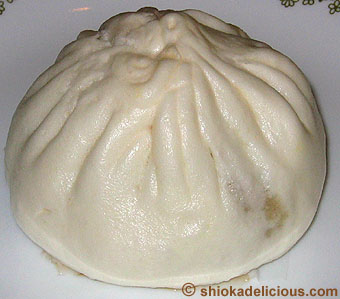
I am sure it has not escaped you that, in recent days, I have been rather, shall we say, pre-occupied with sandwiches. No, wait… please don’t switch blogs… not just yet… Today’s post is not about sandwiches, I promise. At least, not strictly speaking.
For lunch today, I had the Chinese version of a sandwich or a burger. Actually, I would consider this to be the original Chinese fast food. Forget burgers, forget sandwiches… for the Chinese, this has probably been the foremost “food on the go” since ancient times. What am I talking about? Why, the humble steamed bun… pau… bao, or whatever you may wish to call it, of course.
If I may say so myself, the pau is actually more convenient than the hamburger. Like its American counterpart, it consists usually of meat sandwiched within some bread. Only in our case, the bread fully envelops the meat, and thus eliminates the risk of the meat slipping out from the sides as you bite into the bun. I am sure almost all of us has experienced this at least once… you are in a rush, perhaps lunching as you drive or lunching at your work desk… you bite heartily into your hamburger… plop!… the meat pattie, ketchup, mayo, salad and whatever else was between the two halves of the bun slips without warning, messily, chaotically onto your lap, your keyboard… and there goes your favorite outfit… This doesn’t happen with a pau.
Plus, making the pau is a convenient one step process. The meat is steamed together with the bread – no hassle, no grease. And it is always served piping hot, straight from the steamer.
Much as I like burgers, and I really do, if I am given a choice, I would usually go for the pau. It is tasty and filling. It is cheap and convenient. For half the price of a burger, one can get a big chunk of juicy, moist and succulent meat enveloped by a layer of soft, tender steamed dough. It is a meal in itself.
My love for the steamed bun stems from childhood…
One of my most vivid food memories from my early childhood is the eating of a huge (I was much smaller then) meat pau for lunch. I was probably about 3-4 years old. And sometimes, when I got off the school bus at noon, mum would be waiting for me at the foot of our block of apartments, and together hand-in-hand we would stroll across the street to the neighbourhood pau shop and buy two “big paus” (da bao). We would then stroll home, and sit together, happily munching on our paus. Of course, childhood memories are often filtered through rose-tinted emotional lenses, but I do remember the wonderful warm feeling of just me and mum, sitting at the dining table, enjoying an incredibly simple lunch of a steamed meat bun. And so, for the unprincely sum of around S$0.60 to S$1.00 (if I recall correctly, I think each bun, in those days, was around S$0.30 to S$0.50), both our tummies were warmed and filled. The food may have been humble, but I felt like a princess.
I remember the bun was so big, it was almost a third the size of my face! And I had trouble biting fully into it. I would take small nibbles, working inwards from the edges… savoring in turn the soft, fluffy, warm white bun, then the steaming hot, salty, juicy, very flavorful meat. And through it all, there was always a sense of anticipation… waiting for my favorite part of the pau. I would slowly bite and munch until I hit the jackpot… that small wedge of hard-boiled egg hidden somewhere within that huge chunk of meat. And a grin would light up my face. And usually, mums being mums, my mum would pass me her wedge of egg too. Wow, double jackpot! I really felt like a princess.
So today, I want to pay tribute to the pau or bao. These are some of my favorite paus and pau shops…
Paus come either as savory or sweet. The most common savory fillings would be meat – pork, chicken or BBQ pork (char siew). There are also, of course, vegetarian vegetable buns too. And the sweet paus traditionally come filled with red bean paste (tau sar) or lotus seed paste (lian yong). Nowadays, there are new-fangled sweet fillings like pandan, corn, yam and even durian!
Let’s talk about the meat baos first. Most common are the da baos (literally, “big pau”) and char siew (BBQ pork) paus.
The da bao is called big pau, well, simply because it is big. Yes, the Chinese can be very literal sometimes! The da bao is approximately double the volume of a standard char siew pau…
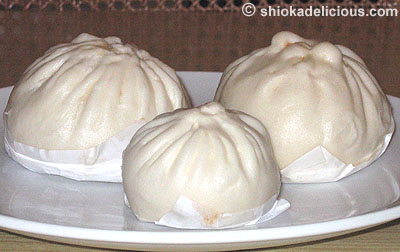
Inside the da bao is usually either pork or chicken.
You know that neighbourhood pau shop my mum and I would buy our da baos from, way back when I was a little girl? That was Kong Guan. It has of course now grown from that tiny pau shop in Eng Kong Gardens into a listed company churning out hundreds of thousands of steamed buns every year. It still produces the da bao, but sad to say, while we still love some of its other paus, its version of da bao no longer ranks among our favorites.
As of today (why today? you’ll find out later), this one ranks as our sole favorite da bao…
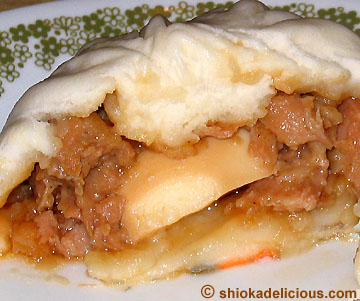
This is Teck Kee Tanglin Pau’s chicken da bao. The bun is very generously filled with flakes of chicken meat. It is very lean, with hardly any skin or fat – just the way I like it. And yet, the meat is incredibly moist, succulent and tender. Rich, flavorful juices ooze out of the meat with every bite. The filling is neither under-flavored nor overly salty. The meat is well-marinated and cooked just right. And of course, they still include that all-important wedge of hard boiled egg. At S$1.40 (US$0.80), it is an incredibly affordable meal.
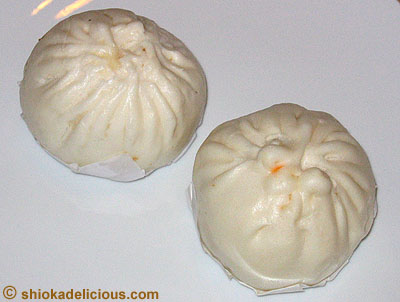
These are the da baos from Tiong Bahru Bao Shop, another of our regular bao stops. My mum bought these for our lunch today – one chicken da bao and one pork da bao. This was what prompted my spurt of nostalgia and inspired this post. I suddenly remembered all those times, as a little girl, when my mum bought two da baos for our lunches. Unfortunately, today’s lunch was a tad disappointing…
But first, how do you tell the chicken from the pork? The one with the orange dot is the pork da bao (above).
This is the chicken da bao…
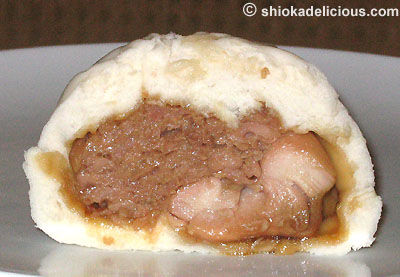
When I cut open my chicken da bao today, I was in for a little surprise. It looked completely different from the last time I had Tiong Bahru da bao, and from all the previous times I have had their chicken da bao.
Previously, the filling was one entire piece of chicken thigh meat, beautifully marinated in dark soy sauce. It was juicy, tender, succulent, flavorful and just very tasty. And of course, you knew it was the "real thing"… one whole piece of chicken thigh… not a mass of minced meat. A piece of chicken cooked whole invariably has a completely different bite and texture from that of minced meat. That was what I liked about the Tiong Bahru chicken da bao. It was different from all the rest. And so it had ranked securely, together with Teck Kee’s chicken da bao as my two favorite big paus. Depending on the texture I was hankering after, I would alternate between the two.
Today, my chicken big pau came with just one small (oh, okay, medium) sized chunk of chicken, and the rest was minced chicken (or at least it tasted like chicken) meat. Hmmm…
It still tasted pretty good – lean meat that was flavorful, juicy and succulent. But it just wasn’t the same. If I had wanted minced meat, I would have gone for Teck Kee’s version with chunks of meat, which even comes with the egg. Tiong Bahru has never included the egg in their chicken da bao, but I was willing to forego that for the texture of their whole piece of chicken thigh.
Now, their chicken da bao looks rather similar to their pork da bao…
My mum had the pork da bao today (on the left). Her only comment was: “they have changed the recipe”. And that said it all. Plus, there was no egg.
However, Tiong Bahru Bao’s char siew pau (BBQ pork bun) still ranks as our all-time favorite char siew pau. My mum has, on various occasions, declared it “the best char siew pau in Singapore”.
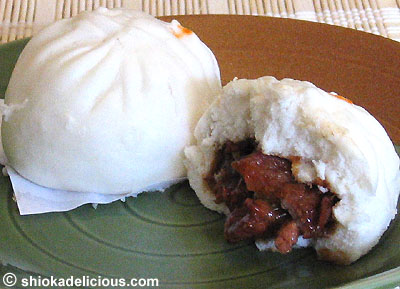
I too have to admit it is truly very, very good. Unlike a lot of the other char siew paus, this one is almost exclusively lean meat. (Although admittedly, there are some people who like their char siew paus with 50-70% fat instead of lean meat). Even though the meat is so lean, it is incredibly moist and tender. And here the char siew meat is cooked Hong Kong style – marinated in dark soy sauce and sugar. When cooked, the sugar caramelizes given an absolutely gorgeous flavor and color. Nicely sweet, salty and flavorful all at the same time. There is none of the usual red coloring in this meat filling – just natural flavors. I keep repeating myself, but the meat is so juicy, moist, very tender and succulent. Sublime!
So far, all the above paus have what I call “local skin” (I don’t know the technical name for it). The dough, although light and soft, is fairly dense and somewhat compact. This compares with what I call “Hong Kong dough”, which is fluffy…
This is admittedly not the best fluffy char siew pau that one can find. I bought it the other day whilst in Chinatown meeting a client. I was feeling hungry and bought it on my way home. I didn’t even look at the shop’s name from where I bought it. I passed by, saw it and bought it. There are better made versions, but it makes for good comparison of the different dough types. I like the the “Hong Kong dough” slightly more than I do the “local dough”. The former is usually only found in Cantonese restaurants that serve dim sum. On the whole, Singapore paus have the “local dough”.
However, regardless of the type of dough used, the bun should be soft, light and tender. And very importantly, the dough should not stick to the back of your teeth when you bite into it! That is a good gauge of how well made the dough is!
This Chinatown char siew pau has the normal bright red-colored meat filling…

You will notice that a lot of char siew paus have a mish-mash of styles – Hong Kong-style char siew with a local dough, and local-style char siew with Hong Kong-style dough!
As for vegetable paus, I like the version made by an elderly lady at Farrer Road Market. She hand-makes only a limited number each day, and they sell out fast. I haven’t had them in a very long time, so I’m not sure whether she is still making them, or has retired, like she has mentioned she was planning to do.
Now, for the steamed buns with the sweet fillings.
My favorite is the red bean paste (tau sar) bun…
Our favorite remains Kong Guan’s version. The filling is generous, and more importantly the tau sar (red bean paste) does not ooze rivets of oil which can leave an over-rich, over-satiated feeling. The bean paste is smooth and not overly sweet. Nice!
On a little side note, Chinese tau sar paus use a dark (almost black) smooth red bean paste, very different from Japanese red bean paste buns where the bean paste is a reddish brown, and usually has pieces of red bean interspersed throughout the paste.
To tell a tau sar pau (red bean paste bun) from a lian yong bao (lotus seed paste bun), again look for the little orange dot. Tau sar comes without the dot, and lian yong with.
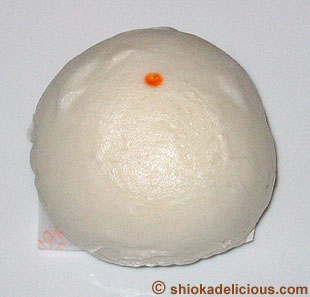
My mum also highly favors Kong Guan’s lian yong bao, because, she says, it is made with pure lian yong – i.e. lotus seed paste made purely from lotus seeds. A lot of the lian yong used in various Chinese buns, pastries and dim sum usually have either tapioca or sweet potato starch mixed into the paste, to add bulk and to enhance texture. Pure lian yong is a lot more costly.
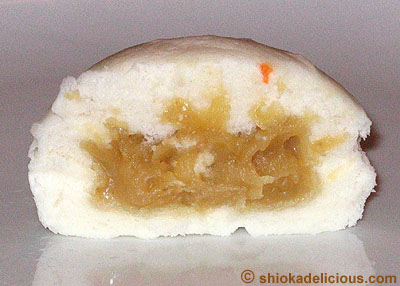
Pure lian yong has a purer, lighter yellow color, compared to the duller and darker color of regular lian yong. I personally don’t have preferences either way. I enjoy pure lian yong. But I also like the darker lian yong, especially in a bun that comes with a whole or half a salted egg yolk. Beautiful partnering of sweet and salty I say.
For Kong Guan paus, very often we buy them in the frozen family packs. In this instance, I will without hesitation say the frozen version is as good as their freshly made paus. And it is so convenient. We almost always have a pack or two sitting in the freezer. Anytime anyone feels like a snack or a light tea, simply pop one of the frozen paus into a bowl, which in turn goes onto a metal rack set into a small saucepan filled with an inch or two of water. Just steam the pau from the frozen state, no need to thaw. And within 12 minutes or so, you are ready to bite into a piping hot, soft, fluffy pau that taste freshly made.
There are literally hundreds of both big and small pau producers on our tiny island. I have not tried them all. But amongst those that I have tried, which number quite a few, time and again, I have returned to my favorites... Tiong Bahru Bao, Teck Kee Tanglin Pau and Kong Guan. I do not claim that they are the tastiest in the land, and would love to discover other wonderful, shiok pau eats. So, all recommendations are welcomed.
And the next time you feel like a hamburger… how about a da bao instead?
Copyright © 2004 Renee Kho. All Rights Reserved.
Please contact me for permission to copy, publish, distribute or display any of the images or text contained in this article.
03:38 AM in Tastes of South East Asia | Permalink | Comments (25) | TrackBack
Thursday, November 20, 2025
The King of the King of Fruits
It’s November… and that means it’s durian season! Yes, this is the time of the year when this so-dubbed “King of Fruits” is piled high at all the fruit stalls along Sims Avenue / Geylang Road, and at every neighbourhood fruit stall too.
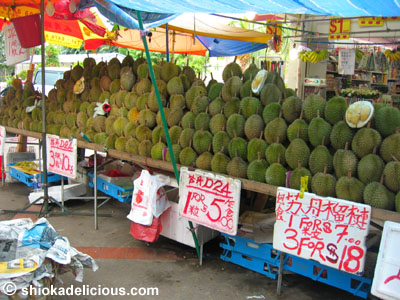
It used to be that we only get to taste the durian twice a year – June/July and November/December, with the major harvest being at the end of the year. However, in recent years, it seems that the fruit has become available all year round. Hmmmm… are the farmers fertilizing the tree a lot or crossbreeding or something to get the trees to flower and bear fruit year round? Isn’t that a rather worrying thought? Seems rather unnatural, I feel. Anyway, the November/December period is still the main harvest – when the fruit is at its tastiest and most abundant.
This year, the harvest has apparently been even more abundant, and prices have fallen dramatically. So, on our way home yesterday from lunch, we couldn’t resist picking up a few Sultan D24 durians. I like to buy the “real fruit”… don’t like those that now come shrink-wrapped and packed in sterile white unimaginative styroform boxes.
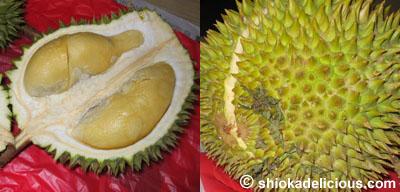
Sultan D24 is considered the King of the King of Fruits. Adored by durian connoisseurs for its perfect balance of sweetness and bitterness, for being beautifully smooth and creamy, and yet not mushy. Its flavors (when one finds a good fruit) are rich, aromatic and absolutely shiokadelicious!
Although recently it would seem that its position as the best in durian breeds is slowly being usurped by the XO durian – which is supposed to be even creamier, even sweeter and more bitter (?)… I don’t know… I’m not a real connoisseur, though I thoroughly enjoy the fruit – in all its guises…
This fruit is so adored that it now appears in just about all possible forms – from durian mousse cake, durian swiss roll, durian pancake, durian cream puffs, to durian ice cream, durian pudding, durian ice kacang and even durian mooncake! I’ve heard that someone somewhere in Singapore is also serving up durian roti prata/roti canai (the crispy, flaky pan-fried Indian pancake, which is normally served savory and eaten by dipping into curry)! Haven’t tried it, and somehow not inclined to either! Some of these permutations work very well, and my family loves them – such as durian cake, durian cream puffs and durian ice cream. However, some just tastes weird, like durian mooncake. But it’s all personal preferences I guess, because there must be people who like them… pastry shops and hotel delis roll them out big-time each year for the mooncake festival.
We like to freeze extra durian. They keep very well in the freezer for months. I also like to remove the flesh from the seeds and mash it into a thick rich, chunky pulp, which can then be mixed into semi-softened vanilla ice cream for a quick-and-easy home-made durian ice cream, or simply scooped over vanilla ice cream as a rich, aromatic topping! Yum, super yum!
And if you’re concerned about assaulting those around you with smelly breathe after indulging in durian, here’s a quick “old wives’ tip” for removing the very strong smell of the durian from your fingers and mouth… Use one of the empty segments of husk, sprinkle around ¼ to ½ tsp of salt into the cavity, dissolve in some water, drink out of the husk and rinse your mouth with the salted water. This also helps prevent sore throats too, which can happen from eating too much of the fruit.
And to remove the smells from your fingers, simply place the empty husk under running tap water, and rinse your hands in the water that has passed through the husk (as my mum is seen doing here View image).
Finally, to balance out the yang or “heatiness” of the durian, it is believed that one should also consume mangosteen after eating durian. This fruit with the deep purple/burgundy hard husk, which hides small segments of sweet white fleshed seeds, is said to have a yin or “cooling effect”, and will prevent the sore throats and hoarseness of voice that says: uh-oh… had too much durian! : D

Happy Durian-ing and Mangosteen-ing!
Copyright © 2003 Renee Kho. All rights reserved.
Please contact me for permission to copy, distribute or display any of the images and text contained in this article.
04:37 PM in Other Shiok-Eats, Tastes of South East Asia | Permalink | Comments (0) | TrackBack