Wednesday, September 15, 2025
Matrimony is Good for Your Eyes
That title probably caught your attention! 
But no, I’m not talking about marriage, but rather the “vegetable” Matrimony Vine. This is actually the branch and leaves of the same plant from which the Chinese wolfberry (gou qi) comes. In Chinese, the vine is (naturally) referred to as “gou qi cai” (in Mandarin) or “kou kay choi” (in Cantonese). [In other parts of South East Asia, it takes on the names “daun koki” (Indonesia) and “phon kao ki” (Thailand).]
Just as the dried fruit (gou qi) is very often used in Chinese cooking – most commonly in soups, both sweet and savory – so too are the leaves of the Lycium Chinensis plant cooked and eaten.
While the Chinese wolfberry is commonly accepted to have wonderful beneficial qualities for eyes, given its high beta carotene content, its leaves are less often associated with the same health benefits. However, a lot of Chinese families hold the belief, as passed down from generation to generation, that this vegetable also has amazing restorative powers for the eyes.
My uncle (mum’s older brother) for one is a firm believer. He used to often tell the story of how as a young lad, he suddenly suffered a loss of vision – not totally, but enough that he had the barest and the fuzziest of sight only. In those days (1950s), in this part of the world, top-notch specialist eye care was rare. Doctors simply told him he was going to lose his sight, and there was nothing they could do for him. In a panic, my grandmother cooked and fed him this gou qi cai, boiled into soup with the wolfberries, every day. And after a period of time, his sight was fully restored. He is now a professor of biology and he still stands by the curative powers of this vegetable!
Less dramatically, I remember as kids, all my cousins and I found, especially around the time of our exams (when we were - supposedly – mugging away at our books), that this vegetable appeared with alarming alacrity at our dinner tables. I guess our mothers fed us on the basis of the motto “bright eyes, clear eyesight… all the better to study with”! 
To this day, we still cook this vegetable very regularly – either in soup or sautéed. I tend to eat it now more for the taste – which I really enjoy; the health benefits are just bonuses on the side. I like the ‘unique’ texture of this vegetable; it is not crunchy or crisp like most other vegetables. Instead, once cooked, it has a very soft, smooth tenderness to it, with a tiny touch of bite.
Soup is probably the most common way of cooking the gou qi cai. It’s a mighty simple thing to cook. The only “troublesome” bit is the prepping of the matrimony vine leaves – not difficult, just highly time-consuming.
The stems and branches are not eaten; only the leaves are used. So, each leaf has to be painstakingly snipped from the vine. For us, we like to remove the stem completely (as seen in the picture above), so that there is no trace of any “tough”, chewy bits in the vegetable. This makes for incredibly tender leaves that almost melt in the mouth after cooking.
This is a painless (and almost enjoyable) activity to do when you’re just sitting around the kitchen table in the afternoon having a chat and a cup of tea; half an hour passes a lot quicker when you have company and interesting conversation!
Once trimmed, the leaves are thoroughly washed and drained, ready to be cooked. The branches are not discarded just yet though… they still have one final use before they go into the trash can.
Gou Qi Cai Soup
• Bring a pot of water (with enough liquid to make up the amount of soup you want) to a rolling boil. Pop in the bald branches (folded, so that they fit into the pot), and leave to simmer for about 20 minutes or so. [This is just to flavor the soup and extract the nutrition and vitamins from the branches before they are discarded.]
• Remove and discard the gou qi cai sticks.
• Put one chicken breast (skin removed) into the soup and simmer for about 20 minutes. [Feel free to use chicken bones or pork bones if those are preferred.]
• Add the gou qi cai leaves and about 1-2 generously heaped tablespoons of Chinese wolfberries (gou qi). On low heat, simmer, uncovered, for about 10 minutes or until the leaves are nicely tender.
• In the meantime, lightly beat several eggs (we usually use around three; more if serving a larger group of people), and season with a dash of light soy sauce, a pinch of sugar and a sprinkling of ground white pepper.
• Bring the soup back to a rolling boil, and pour in the lightly beaten eggs. Stir gently to break up the eggs. Remove the pot from the flame and allow the eggs to finish cooking in the residual heat ; do not overcook the eggs. [For this particular soup, I tend to prefer the eggs chunky. You may choose to swirl the eggs to form thin, elongated strands instead.]
* If a more full-bodied flavor is desired, the soup can also be seasoned with salt to taste or half a square of MSG-free, low sodium bouillon cube.
Another way that we very often cook this gou qi cai is to stir-fry it with eggs – almost like an omelette or even an egg pancake. I’m not sure if other families cook it this way; I haven’t seen it outside of my extended family. But this is rather tasty, I find – and great for those who don’t like soups, or don’t like their soups chunky and filled with lots of vegetables.
This omelette is hardly classy, elegant food – not by a long shot. However, what it doesn’t have going for it in the looks department, it does compensate for in the satiation department. This is essentially another one of those homey, down-to-earth, comforting soul foods that never fail to tug at the heartstrings.
Gou Qi Cai Omelette
• Cut some carrots into very fine juliennes.
• Add a little bit of oil to a hot wok, and sauté some minced garlic until fragrant but not colored. Drop in the carrots and fry until almost tender.
• Put in the washed and well-drained gou qi cai leaves and toss briefly. Cover the wok and allow to steam-cook for about 5 minutes or until leaves are tender. Do not add any water. [The leaves will leech some liquids, but that’s okay. These will be “absorbed” once the eggs go in.]
• Uncover, season with some salt to taste. Mix well.
• Lightly beat three eggs (or however many you would like to put in), and season them with a dash of light soy sauce, a pinch of sugar and a sprinkling of ground pepper.
• Slowly dribble the eggs into the wok. Let the eggs to set a little; resist the urge to ‘stir-fry’ the eggs at this point – this will produce mushy clumps of eggs.
• Once the eggs have set a little, flip the vegetable/egg mixture over (like flipping a pancake) and cook the other side.
• When the eggs are fully set, remove from the heat.
The eggs and vegetables take on a pancake-like form. The eggs will have a slightly subdued coloring due to the juices from the gou qi cai; the taste is not affected. [I’ve never tried this, as it’s way too fiddly for me, but if the duller coloring bothers you too much, simply drain the juices that are released by the gou qi cai before adding the eggs. This will ensure the colors of the eggs stay bright and cheery.]
What is it that they say about eyes being windows to the soul? So, maybe the matrimony vine can also have some knock-on effects in the marriage sphere after all.
Here’s to bright, sparkling and captivating eyes!
Copyright © 2004 Renee Kho. All Rights Reserved.
Please contact me for permission to copy, publish, distribute or display any of the images or text contained in this article.
02:21 PM in Home Cook: Soups, Home Cook: Vegetables | Permalink | Comments (20) | TrackBack
Tuesday, September 14, 2025
A Light Caress Upon My Palate
After yesterday’s meaty post, I thought today I would write about something light and delicate, and yet very sustaining, soothing and restorative.
Chinese soups can be terribly involved, elaborate and time-consuming things to cook up; all that business of double-boiling or even just long, patient slow-cooking. But they don’t have to be. There are days when you just want something warm and soupy; something to calm and comfort tired and frazzled nerves - and yet, you just don’t have the energy, time or inclination to fiddle in the kitchen. On days like those, a soup like this fits the bill perfectly.
This is one of the simplest, least fussy soups I know. It looks and sounds deceptively plain; but it has an appealing light, refreshing quality to it. The flavors are very delicate – a very light body with a subtle natural sweetness.
I like my soups very chunky – the ingredients usually far outweigh the soup itself. For me, it’s more a case of “eating” soup than drinking it. But it’s all highly amenable to adaptation to suit personal preferences; simply adjust the quantities and the ingredients to your desires. As such, there aren’t any fixed measurements in the recipe.
Wong Bok Soup
Chinese cabbage (“wong bok”) *, cut into chunky pieces
1 chicken breast, skin removed
1 big piece fresh ginger, smashed
½ piece bouillon cube **
* I like using the Chinese cabbage with the slightly greener, crinkier leaves (from Australia); I find them to be sweeter, crisper and also more tender than the yellow leaves variety (from China).
** Instead of using salt, I prefer to add a small amount of MSG-free, low-sodium bouillon cube to give the soup an enhanced depth of flavor. It’s pretty much up to you what you would prefer to do.
• In a thermal or standard soup pot, bring some water (however much is needed to serve everyone) to a boil.
• Add the skinned chicken breast and the ginger, and leave to simmer on a low flame for about 20-30 minutes. [In this particular instance, my “poultry guy” had, that morning, given me a bunch of chicken gizzards – something I absolutely adored as a child; simply boiled and dipped into dark soy sauce – so those went in too, together with the chicken breast.] ^
• Return the soup to a boil, add the vegetables and the bouillon cube, and allow to simmer for a mere 10 minutes or so, or until the cabbage is at the desired tenderness. [If seasoning the soup with salt, you may wait until the end to do so.]
• Serve hot.
I tend to cook the cabbage until it is very soft and tender; I find it helps to bring out the wonderful, delicate natural sweetness of the vegetable, which I enjoy very much. Some may prefer a cabbage that still has a slight crunchy bite to it; simply adjust the cooking time accordingly.
For me, this is just another (very light, healthy) way to eat my veggies! Plus, I get to drink some warm, soothing soup as a bonus. 
^ In case Singaporean readers are wondering, this soup was cooked many weeks back, in the days pre-fresh chicken ban; I’ve only just today managed to dig out the photo from under a pile of unposted photos. So, no, I do not have some top-secret, even-the-Government-doesn’t-know-about-it source for fresh chicken gizzards! 
Copyright © 2004 Renee Kho. All Rights Reserved.
Please contact me for permission to copy, publish, distribute or display any of the images or text contained in this article.
02:48 PM in Home Cook: Soups | Permalink | Comments (8) | TrackBack
Thursday, July 01, 2025
The Old Yellow One Returns

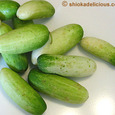
Two weeks back, I wrote about using old cucumbers to make soups; and there were a lot of queries about what this “old cucumber” looked like. So, here it is… the old cucumber with its skin on.
The skin is a medium brown with some reddish-brown overtones. It feels somewhat coarse to the touch, and has light “cracks” or veining.
Here is another view from a different angle…
I have tried looking for it in “The World Encyclopedia of Cooking Ingredients” by Christine Ingram (a rather informative guide which lists a lot of Asian ingredients), but the old cucumber is nowhere to be found. I’m thinking this is very much an Asia exclusive vegetable/gourd/melon, that doesn’t seem to travel or store well enough for it to make an appearance in Western markets.
The name “old cucumber” is a direct translation from its Chinese name “lao huang gua” (in Mandarin). I am not sure however if is indeed from the same family as the cucumber. It is several times the size of a regular cucumber, and of course also bears no physical resemblance to its namesake. My mum, on the other hand, says it is a cucumber that has been allowed to grow and “age” on the plant to reach the desired maturity.
Now, in place of this old cucumber, the winter melon can be used to cook soups in exactly the same way; we do it all the time. We very regularly cook both the old cucumber and winter melon in soups, and use the exact same recipe for both. I think winter melons should be more readily available in markets outside of Asia, as it seems to store much better than the old cucumbers.
[Note: the above link to the Cook’s Thesaurus lists the bitter gourd as a substitute for the winter melon; but I would say that this is most definitely not the case. The bitter gourd is very, very different from the winter melon in taste, texture and aroma; and is used very differently too in Chinese or Asian cooking.]
The winter melon has a very similar subtle, delicate taste and fragrance to the old cucumber, and both are eaten and their soups drunk for their “cooling” and detoxifying benefits on the body.
Here is a look at another old cucumber soup that we made very recently (yes, we do cook this soup very often, especially during the stiflingly hot weather days)…
Notice that the broth in this version is a lot lighter and clearer (more transparent) in appearance than the previous one. This is because the barley and red dates were cooked for a lot less time; thus giving the clearer, lighter colored broth. It’s pretty much down to personal preference which version tastes better. I personally prefer the clearer, lighter broth variant; but some like the broth with the thicker, fuller body that cooking the barley for a longer time produces. Whichever version you choose, this is a great body refresher and thirst quencher.
Copyright © 2004 Renee Kho. All Rights Reserved.
Please contact me for permission to copy, publish, distribute or display any of the images or text contained in this article.
07:07 AM in Home Cook: Soups | Permalink | Comments (6) | TrackBack
Wednesday, June 16, 2025
Old I May Be, But Tender and Sweet Am I
It is soup day again today, I’m afraid.
This is another “basic” soup that every family has a version of – old cucumber soup.
Yes, old cucumber. That’s what it is called in Chinese – lao huang gua. And that’s what it is.
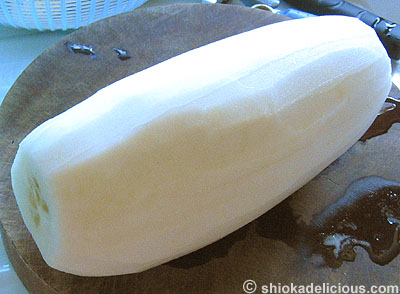
It is melon-like and large - on average, about 11-12 inches in length with a wide girth of, oh, maybe 5-6 inches. And unlike the green, crispy and crunchy young version, this has a soft gourd-like texture with a subtle sweet flavor.
(Sorry, the skin was already removed by the time it occurred to me to take some pictures. My apologies too for the rather unbecoming tint in the preceding picture as well as in the next 4 photos; I forgot to adjust the white balance setting.)
After the outer skin has been removed, cut the cucumber into wedges, and remove the seeds.
Next, cut the each piece into chunks, ready for cooking.
The other ingredients that are used to flavor and “enrich” the soup are red dates, pearl barley…
And corn…
Two ears of corn; husk removed and cut into halves.
Old Cucumber Soup
• Bring 3 soup bowls-ful of water to a boil, and pop in the old cucumber and corn. Let the liquids return to a boil before reducing the heat to low, and allowing the soup to simmer for about 1 to 1½ hours, or until the old cucumber is meltingly tender.
• About 30-40 minutes before the soup is ready, pour in the barley. [I usually avoid cooking the barley for an extended period of time, as this will produce a slightly “cloudy” soup with a thicker, somewhat “starchy-esque” consistency, reminiscent of a “barley water” drink (for those who are familiar with South East Asian drinks). The picture above actually shows the soup when the barley has been cooked for a long period of time; yes, I decided to put up pictures of how I don’t like to cook the soup! It is still perfectly drinkable and very tasty, but I just tend to prefer the soup to be clear and light in consistency. If you prefer a more viscous soup, add the barley at the beginning, together with the old cucumber and the corn.]
• 20 minutes before the soup is ready to be removed from the stove, add the dried red dates. [As mentioned in the previous post on Carrot Soup, it is best to cook the red dates for a short period of time. With extended cooking, the red dates will render the soup with a sour overtone.]
• Again, I don’t usually add any salt or other seasonings to the soup; preferring instead to simply let the delicate and subtle sweetness of the old cucumber, corn and red dates shine through. However, you may of course choose to season with salt to taste.
Note:
A variant of the soup can be made using chicken breast meat instead of corn to sweeten the soup and to give it body. Simply substitute the two ears of corn with one piece of bone-in, skinless chicken breast.
On a separate note, I have had several queries about the kind of pot I use to cook soups in. So, here it is…
This is what I use. It is a multi-layer insulated stainless steel thermal pot. However, most of the time, I no longer use the thermal plate which comes with the pot. I prefer to simply keep the pot on the electric element (it cannot be used on a gas flame) throughout the soup’s cooking process. And because of the way the pot is built (sorry, I don’t know the technical details), this speeds up the cooking time somewhat.
I understand that there is now a whole new generation of thermal pots on the market (my pot is 15 years old!), and these are great for cooking soups too – producing very flavorful results with nicely tender ingredients.
However, while a thermal pot is highly convenient in that you don’t have to stick around to watch the pot (literally speaking), any type of pot or saucepan with a lid can be used to cook soups. The only difference would perhaps be that some adjustments need to be made to the cooking times that I have stated in the recipes. So, fret not for a thermal pot if you are without. Soups cook well in just about anything!
Old cucumber soup… a wonderfully refreshing and nourishing soup. Old cucumber is said to be great for cooling and detoxifying the body’s system; barley is another natural cleansing and detoxifying ingredient; and red dates are said by the Chinese to be able to help build the blood and fortify the immune system.
Old cucumber soup… soup for both body and soul.
Copyright © 2004 Renee Kho. All Rights Reserved.
Please contact me for permission to copy, publish, distribute or display any of the images or text contained in this article.
05:54 PM in Home Cook: Soups | Permalink | Comments (17) | TrackBack
Monday, June 14, 2025
This Ain’t No Rabbit Food
Carrot soup. This is probably the most basic of all soups in a Chinese home-cook’s repertoire. It is the first soup that one learns to cook. And it is also the soup that one never really stops making. No matter how sophisticated a family’s palate becomes, no matter how much skills and experience the chef accumulates, this is a soup that gets returned to time and time again. It is light and refreshing. It is familiar and comforting. It is easy, fuss-free, fool-proof and tasty all at the same time. What more can be asked of a soup? Indeed.
As is the case with almost all Chinese (and Asian) soups, this is a light, clear broth that has been gently and naturally sweetened with carrots and the other ingredients.
I have two versions of this soup that I make alternately, depending on my mood. One uses chicken as the foundation of the broth, and the other is a purely vegetarian alternative.
Carrot and Onion Soup
(serves 4 approximately)
1 piece bone-in chicken breast, skinned
4 carrots, cut into chunks
2 big onions*, cut into large cubes
3 soup bowls water**
* Sweet onions, such as Spanish onions, would be absolutely lovely in the soup. Unfortunately, those are hard to find in Singapore, so I usually use the regular yellow onions, and they still come out wonderfully sweet and tender, after the fairly long cooking time.
** This is the way I normally measure out my water when I cook soup! As such I do not know the metric equivalent. Sorry.
There are just two steps to the cooking process:
• Bring the water to a boil.
• Add the rest of the ingredients. Allow the water to come back to a boil. Simmer on low flame for about 2 hours or so, or until the carrots are at the desired tenderness.
That’s it!
I don’t even add any salt. The family enjoys the soup as is. Just the natural sweetness from the chicken, carrots and onions. But of course, if you prefer, the soup may be salted to taste.
Carrot and Corn Soup
(serves 4 approximately)
This version uses corn and red dates to sweeten the soup and give it body.
2 ears of corn, skinned and cut into halves
4 carrots
1 handful of dried red dates
3 soup bowls water
• Bring water to a boil.
• Add the carrots and corn. Allow water to return to a boil, reduce heat to low, and leave to simmer until carrots are tender.
• Twenty minutes before the soup is ready, add the red dates. [These should always go in just before the end of the cooking period. Adding the red dates too early, and letting them cook for too long will give the soup a sourish tinge.]
And there you have it – carrot soup, Chinese-style. This soup is a wonderful palate refresher – a beautifully light, clear broth, with a wonderful natural sweetness. Healthy yet tasty. And so ridiculously easy to cook.
Even a rabbit would approve!
Copyright © 2004 Renee Kho. All Rights Reserved.
Please contact me for permission to copy, publish, distribute or display any of the images or text contained in this article.
05:00 PM in Home Cook: Soups | Permalink | Comments (8) | TrackBack
Thursday, May 13, 2025
There’s A Slug In My Soup!
This week is turning into something of a “soup week” on shiokadelicious! In keeping with this incidental and accidental “theme”, I thought I would feature yet another soup today. I’ve talked about a quick cooking, chunky soup in a clear broth, and I’ve talked about a slowly simmered, chunky soup in a clear broth, so I thought I would feature a starch-thickened soup today. I dug this one out of the archives. It is not a soup we cook very often. The last time we cooked it was during Chinese New Year, back in February this year, and that was when these soup photos were taken.
First, a cautionary note. What I am about to talk about may come as a shock to many Western palates. So, if you are in any way squeamish about “exotic” food delicacies, this would be a good time to stop reading, and come back and visit tomorrow. Otherwise, read on, and take a peak into some delicacies that are much loved by not only the Chinese, but also by many other Asian culinary cultures.
So, what’s on the menu today? Sea cucumbers and fish bladders.
Sea cucumbers are also known as “beche-de-mer” in French or “namako” in Japanese (which is another culinary culture that highly prizes this delicacy). These creatures of the sea have been revered by Chinese cooks since ancient times. Like a lot of ingredients in Chinese culinary traditions, the sea cucumber is not seen as merely food to fill the stomach, but also as medicine – a disease preventive and a longevity tonic.
Such a link can be inferred from the Chinese name for the sea cucumber – hai shen. This translates literally into “sea ginseng”. (For the sub-species of sea cucumber that has bumpy, almost spiky protrusions, it goes by the moniker “fang chi shen” or “square/four-sided thorny ginseng”, in reference to its appearance.)
Traditional Chinese Medicine (TCM) holds that these sea slugs have great benefits in nourishing the blood and fortifying the “vital essence” (jing) and “energy” (qi) of the body. They are thus commonly used to treat such “diseases” as weakness, impotence, constipation and frequent urination!
And perhaps such beliefs and claims are not entirely groundless from Western scientific and medical viewpoints. Studies have shown that sea cucumbers do indeed contain saponin glycosides, which have similar structures to the active constituents of such well-known tonic herbs as ginseng and ganoderma.
Further, these sea creatures have been shown to be a rich source of polysaccharide condroiton sulfate, which is well-known for its ability to reduce arthritis pain. According to certain studies, as little as 3 grams per day of dried sea cucumber has been helpful in significantly reducing arthralgia. Its action is similar to that of glucosamine sulfate, which is useful for treating osteoarthritis. These study results put a medical “stamp of recognition”, if you will, on what older generations of Chinese have simply “known” and believed. My own grandmother used to always tell us to “eat more sea cucumbers” should anyone complain about achy joints or feeling weak and tired in the legs. On a simplistic level, it was simply believed that the gelatinous quality of these sea cucumbers would bolster and support the ligaments and soft connective tissues of the joints and limbs. But now, they seem to have the scientific evidence to support their beliefs.
Even in the US, there are such companies as Coastside Bio Resources (which I found by doing a quick Google on sea cucumbers) which specialize exclusively in these sea creatures and their supposed health benefits. This Maine-based company is the largest harvester of sea cucumbers in the country, and produces encapsulated dry sea cucumber products that are used as remedies for arthritis.
In addition to the above arthritic benefits, sulfated polysaccharides have also been shown to inhibit viruses, and there is even a Japanese patent on sea cucumber chondroitin sulfate for HIV therapy!
And if that is not enough, some studies have even indicated potential anti-cancer properties in both the saponin glycosides and polysaccharide condroiton sulfates of the sea cucumber.
But medicine aside, the sea cucumber is much loved by Chinese and Asian food lovers for its texture. And even on a nutritional basis, this sea creature seems to come up on top and is indeed an ideal tonic food. It is higher in protein (at 55%) than most other foods except egg whites (at 99%), and it is lower in fat than most foods (at less than 2%). Again, modern science seems to have stepped in, and dried or extracted sea cucumber has been produced in capsule or tablet form and is used as a nutritional supplement. The fully dried material is said to have a protein concentration as high as 83%.
Not bad for a humble sea slug, I say!
However, let’s talk about sea cucumbers as food.
After the sea cucumber is collected, the internal organs are removed, and the dirt and sand are washed out of the cavity. It is then air-dried to preserve it. Very often it is sold in this dried form.
However, it is also common for the sea cucumbers to be sold in “hydrated” (and expanded) form in the wet markets. Many housewives (my mum included) prefer to buy them in this soft, pliable form, as the work that is required to prepare the dried form for cooking is rather involved and can take several days!
According to my mum, the sea cucumbers, if bought in their hard, dried forms, need to be soaked and rehydrated, boiled, soaked again and then cooked again in order to get them nice and soft and highly palatable. If not prepped properly, even when cooked into a dish, they will still be rather hard and chewy, with a rather unappetizing taste and smell. This whole preparation process, if done properly, can take up to 4-5 days!
The process is much simplified when the “hydrated” version is bought from the wet market. It is sold soaked in water, and needs to be prepped as soon as it is bought. All that is required, once you get the sea cucumbers home, is to pop them into a pot of boiling water that has been “seasoned” with a big piece of ginger, some Chinese rice wine and some green onions. This is to rid the sea cucumbers of any “fishy” tastes and smells. As soon as the water returns to a boil, immediately turn off the heat. The key is not to cook the sea cucumbers - it’s pretty much just a quick blanch. Keep them soaking in the water in which they have been blanched until they have cooled completely. Drain well. Store them individually or in serving-size portions in freezer bags, and they will keep in the freezer, in this prepped state, for up to six months. Whenever you want to cook some, simply defrost and they are good to go.
Fish maw or fish air bladder. And in Chinese, yu piao.
This is essentially the stomach lining of large fishes, the main function of which is to regulate water and oxygen flow in the fish to help it ascend or descend in the water. And contrary to what is said in the second link above, there are three types – actually two types, with one having two sub-types – of dried fish maw that are commonly sold.
The most commonly available is one which has a very light, very airy and crispy texture, almost like a puffed up rice cracker, if that is a good analogy. Such as the one pictured above. In this category of fish maw there are two preparation methods. The most common (with perhaps 90-95% of fish maw sold being prepared with this method) is where the maw has been dried and then deep fried in oil until it puffs up and expands.
Less easy to find is fish maw that has been “sand fried” or in Cantonese “tsar pao”. I’m not too sure about the exact treatment procedure, but I would imagine that the dried fish maw is “roasted” in hot sand, again until it puffs up and is light and airy. The picture above is of a “tsar pao yu piu” which we bought in Hong Kong. Apparently, such “sand fried” fish maw can only be bought in Hong Kong and even then only in out-of-the-way, obscure little dried seafood shops. My mum used to have us track down some for her each time anyone of us traveled to Hong Kong on business or pleasure!
The textures of deep fried fish maw and “sand fried” fish maw are pretty much the same. The only difference is, of course, in the oiliness and the greasy feel of the maw when it is cooked into dishes. However, even with the deep fried maw, if prepped right, it is possible to have non-oily tasting dishes. But more on that a little later.
The second type of fish maw is one that is simply dried but not fried. And it is sold in thin, hard, crispy sheets like this…
The texture is somewhat different, but it is still used in the same way as the puffy, light, airy versions when it comes to using it as an ingredient for cooking.
To prepare fish maw for cooking is a very simple process. Simply soak in some water until they soften, cut them into thin slices, and they are good to go.
However, if using the deep fried versions rather than the “sand fried” versions, my mum usually first soaks them to soften, then “wrings” them out to remove the oil, soaks them again, and repeats the “wringing” one more time if necessary. This removes a lot of the oil in the deep fried maw and prevents the final cooked dish from being too oily. Sometimes (or maybe a lot of the time) dishes cooked with fish maw are very oily and greasy simply for this reason. A “problem” that a simple “wringing” step in the prepping process will eliminate fairly effectively.
Right, after talking at length about fish maw, I have a little confession to make. I don’t eat fish maw. I feel rather queasy about eating fish maw. I’d eat sea cucumbers, snails, scorpions, and even the sperm sac of a whale (which I have eaten, and I don’t think it was really a whale, just a very, very large fish of some kind), but I won’t eat fish maw. I have this thing about eating intestines, stomachs and other similar innards – be they be of a pig, cow, chicken (the intestines of which I’m told is a much-loved delicacy in Japan) or a fish.
Having said that, I’m told fish maw soup is absolutely delicious, and my family loves it. So here is the sea cucumber and fish maw soup my mum made during Chinese New Year earlier this year.
Both sea cucumbers and fish maws are rather bland tasting ingredients on their own, and take almost all their flavors from the surrounding ingredients and seasonings. They are used primarily for their textures.
So, how does one cook them in a soup?
Sea Cucumber and Fish Maw Soup
It is all quite simple actually, that this is not even a recipe.
The key to the soup is in using a superior chicken stock base. A simple chicken stock is preferred. That is, no vegetables or spices are used to make the stock – just chicken and water. This keeps the flavors very pure and “true”. And it is cooked to a deep, intense concentration. Sometimes my mum steams chicken breast meat and uses the juices that result – the pure “essence of chicken” – to make the soup. The natural sweetness and purity of the flavors are outstanding.
Cut some carrots and fresh young ginger into very fine strips. Cut the pre-prepped sea cucumbers into thin or chunky slices (according to personal preferences). Cut the fish maw into slices or chunks. Also have ready some thinly sliced Chinese mushrooms.
Put everything together into a pot of superior chicken stock and slowly simmer. Lightly season with salt or light soy sauce to taste. (Or, as we often do, don’t add any further seasonings at all, and just savor the pure, light, natural tastes and flavors of the soup and the seafood.) Bring the soup to a rolling boil, and add a little cornflour solution to thicken the soup. Allow it to come back to another rolling boil. Slowly dribble in some lightly beaten eggs and swirl to form elegant egg strands throughout the soup. Drop in some chopped Chinese parsley. Stir to mix. Remove from the heat and serve. Some black vinegar, or sometimes even a dash of brandy, can be added to the soup before eating.
Lots of chunky ingredients in a slightly thickened broth base. Pure, light flavors. A hearty and nutritious soup. A uniquely Chinese delicacy.
So, the next time you find a slug in your soup, it could be a good and healthy thing!
[By the way, if you are very squeamish about eating fish maw and sea cucumbers, a similar thick, chunky soup can be made with strips of abalone, tofu, fish cakes or even chicken or pork instead. ]
Copyright © 2004 Renee Kho. All Rights Reserved.
Please contact me for permission to copy, publish, distribute or display any of the images or text contained in this article.
11:57 PM in Home Cook: Soups | Permalink | Comments (15) | TrackBack
More Soup for Thought
Following yesterday’s post about Chinese home-style lotus root soup, I received an email which raised a few good points about the general topic of Chinese soups and their place in our culinary culture that I had missed while writing the post. I thought I would share some of the points raised in that email and also add a couple of other points that I missed yesterday.
In the email, L. raised a good point about the function of soup in a Chinese meal. As I mentioned in the previous post, in an informal family dining context, most of time, the soup is served together with all the other dishes. However, in more traditional Cantonese families, the daily double-boiled soup (lai tong) is very often the first course of the meal. It is seen as a prelude to the main meal, a means to warm the stomach and prepare the palate for the dishes ahead.
In a formal dining context, such as wedding banquets, the timing of the appearance of the soup is somewhat determined by the type of soup it is. The thicker, starchier soups, like shark’s fin soup, are almost always the second course in the meal, served after the hot, cold or hot-and-cold combination starter dish. If it is a clear double-boiled soup, this may come towards the middle of the meal, being anywhere between being the second to the fourth dish of the meal. It serves partly to cleanse the palate, and partly to rest and whet the appetite for the rest of the meal ahead. Rarely do (savory) soups appear at the end of a Chinese meal. Most formal banquets will end with the fish course, or, if there is a rice or noodle dish, the meal will finish with the starch course, which follows from the fish dish.
Having said that, it is however a very common, popular and ancient practice to end a Chinese meal, whether formal or casual, with a sweet soup (tong shui). These soups can be as simple as green mung beans or red beans slowly cooked with rock sugar, or they can be more elaborate concoctions such as soy bean curd skin with egg whites and gingko; white fungus with dried longans and dried red dates; or double-boiled birds’ nests with rock sugar.
In modern times, sweet soups are no longer just consumed at the end of dinner, but are also consumed as an “anytime of the day” dessert or sweet snack. Many popular sweet soups are available throughout the day at hawker stalls, such as the local favorite, cheng tng.
I think I was perhaps not very succinct in yesterday's post in my differentiation of the different types of Chinese soups. So, I thought I would elaborate a little further.
As I had mentioned in yesterday’s post, Chinese soups are almost all based on a clear consommé broth, with the main variation to this being soups that are thickened by starch.
I had also mentioned that a lot of Chinese soups are cooked for extended periods of time, and in some cases, double-boiled to extract the maximum nutritional goodness from the soup’s ingredients. L. writes in relation to this:
The Chinese view of soups is also distinguished by the fact that it is the liquid (and not the ingredients) that is usually desired, especially so in herbal preparations. The liquid is the medium in which all ingredients surrender all their essences; the ingredients that remain usually lack flavour.
While this is true of soups that are cooked (usually by the double-boiling method) for “tonic” or “body-building” purposes, it is not the case for all Chinese soups. I would perhaps say that there are largely two main types of soups in this respect – soups that are boiled specifically for just the liquid, such as herbal soups, pure chicken essence and other such like; and soups that are not consumed as “tonics”, and where the ingredients of the soup are consumed as an integral part of the taste experience.
Examples of soups where only the broth/consommé is consumed:
• Pure chicken essence
• Chicken ginseng soup
• Chinese herbal soups
Examples of soups where the ingredients are added to enhance the entire soup experience:
• Ye lai xiang flower soup
• Lotus root and lotus seed soup
• Sea cucumber soup
• Shark’s fin soup
• Black chicken soup (here, the black chicken itself is also considered highly nutritious)
• Winter melon and barley soup
• Watercress soup
• Peanut soup
• Sprouted soy beans soup
• Black bean soup
• Seaweed soup
• Pig’s intestines soup
• Bak kut teh (pork ribs “tea” soup)
Just to name a few.
Now, in this latter group of soups, there is a further differentiation in cooking styles. And as L. writes:
There is also a difference between "kwun" and "poh" soups (Cantonese)… both mean to boil, but for different lengths of time. Take for example, water cress soup - it can be done both ways. But one yields a soup with vegetables that still retain a crunch (poh) and the other, vegetables with the texture of baby food (kwun).
There are basically two types of cooking styles – soups that are cooked very quickly (eg the ye lai xiang flower soup I have already posted about), and soups that are slowly simmered (eg lotus root soup, winter melon soup and so on).
Are you confused yet?
It’s quite simple really. In a nutshell, Chinese soups can be viewed from (or categorized by) the following perspectives:
• There are two main types of soups: clear soups or starch-thickened soups.
• Within the clear soups, there is a further distinction between soups where only the liquids are consumed, and those where the chunky ingredients play an important part in the taste experience. (Almost all starch-thickened soups fall into the latter category).
• And within the category of soups where ingredients are central to the eating experience, there is a further separation of the soups according to the cooking method - between soups that are cooked very quickly, and soups that are slowly simmered. (For soups where only the clear broth or consommé is drunk, they are almost invariably cooked by the double-boiling or at least, the slow simmer methods).
Sweet soups (tong shui) are almost always clear (with some exceptions, like tau suan, a starchy variation of the mung bean sweet soup), and are always chock-full of ingredients. A lot of the time, they do require a slow cooking over an extended period of time.
And that’s the subject of Chinese soups condensed, filtered, reduced, cooked down into one simple soup bowl! We Chinese are a complicated bunch aren’t we?
Copyright © 2004 Renee Kho. All Rights Reserved.
Please contact me for permission to copy, publish, distribute or display any of the images or text contained in this article.
11:30 PM in Home Cook: Soups | Permalink | Comments (4) | TrackBack
Wednesday, May 12, 2025
Of Heaven and Earth
As I was typing yesterday’s post, I suddenly realized that in the 5½ months that I have been writing this blog that was the first time I’ve written about soups – any soups, but more specifically Chinese soups, and Chinese home-style soups at that. So, I thought I should remedy the imbalance and post about another soup that we make very regularly at home.
Chinese family meals usually consist of several meat/fish and vegetable dishes and very often, a soup. Chinese-style soups are very different from Western soups. Almost all Chinese soups are built with a clear consommé/broth as the base. Soups are hardly ever of the creamy variety. At the most, it may be a thicker, starchier soup, such as a Sichuan sour and spicy soup. And even then, it is still a clear soup that is thickened with starch.
Chinese soups also tend to be very chunky, with lots of different ingredients cooked in the consommé/broth base. Again, the soup ingredients are almost never pureed to form a creamy, thick soup. A lot of emphasis is placed on putting together a combination of ingredients that have contrasting yet complementary tastes, textures, aromas and colors. And very often, the “ying” and the “yang” of the ingredients are also taken into account when deciding which ingredients to use in which soup.
In Chinese culinary culture, soups are not seen merely as perhaps a form of “lubrication” during the eating of a meal, but are regarded as the best and ideal means of delivering intense and concentrated nutrition. In traditional Chinese medicine (TCM), soups are the vehicle for medicine delivery. Herbs are boiled into a soup and drunk. When one feels tired or stressed, the elderly will “prescribe” a bowl of wholesome double-boiled soup “tonic” as remedy. If recovering from an illness or even childbirth, soups form the mainstay of the diet and the chief means of restoring and replenishing the body’s vital strength. An expectant mother will have various "intensely nutritional" and "fortifying" soups as an integral part of her pregnancy diet. Before young children are started on solid food, they are fed soups, and then gradually, rice porridge with soup and so it goes.
Indeed, soups form a key and central part of Chinese dining. For many, it would be almost sacrilegious to eat a meal washed down with water, juice or any other drink. A soup is very often a “must” at the family dinner table. And for certain dialect groups, like the Cantonese, such a great emphasis is placed on soups that all soups must be patiently double-boiled for many hours before they can be served.
Today I thought I would talk about an ingredient that is so ubiquitous in this part of the world, and yet held in such high regard that it has divine or heavenly implications. The lotus plant.
This is a much loved plant, especially for the Chinese. It has other-worldly significance. The lotus blossom has spiritual connotations of divine enlightenment, in both Chinese myths and legends as well as in Buddhism. The Gods and Goddesses of Chinese folklore all sat or “rode” on lotus pads. The lotus flower also signifies harmony and unity of family and nation.
In a more earthly context, the lotus plant provides an incredible source of food and medicine. All parts of the plant are utilized. Nothing is wasted.
The fresh flower (lian hua) petals are sometimes steeped in warm milk and used as a drink to help calm the mind and rest the emotions. Some attribute to it the ability to enhance meditative powers.
Meanwhile, the dried flowers are sometimes used as flavoring in the cooking of certain dishes.
But perhaps more centrally, the lotus plant is widely cultivated for the collection of its seeds (lian zi) and roots (lian ou). The whole plant is harvested in late summer when the seeds have matured.
The seeds are retrieved from the flower pad which is exposed when the blossom fades.
And even after the seeds have been collected, this dried up flower stem (he geng) is not discarded. It can be cooked and eaten too! It is also sometimes used medicinally.
The seeds themselves are much loved for their versatility in the kitchen. They are sold both fresh, vacuum packed…
Or dried…
Both versions of the seeds are used in savory soups (like the one I will be talking about today) and sweet dessert soups (such as “ba bao zhou” or “Eight Treasures Porridge”). Lotus seeds are also used as an integral part of dozens of other dishes (for example, as stuffing in poultry).
The seeds (and the roots too) are also candied for eating directly, and are a highly popular Chinese New Year goodie. (One of my personal favorites in fact!). Even more commonly, the seeds are made into the well-known lotus seed paste (lian yong) which are used to fill steamed buns (paus or baos) and mooncakes (yue bing).
These seeds also have rather auspicious symbolisms, and this is reflected in some of the ways it is used as food. The sound of the name “lian zi” is very similar to the Chinese phrase for “abundant progeny or offspring”. And thus, at Chinese weddings, it is a must for the bridal couple to be served a “gui yen hong zhao cha” which is a sweet “tea” made from boiling long yen, hong zhao and lian zhi (dried longans, dried red dates, lotus seeds). It symbolizes the early arrival of many descendants, especially sons. For the same reasons, this sweet soup is also served during Chinese New Year, to usher in the new year on an auspicious and hopeful note!
Inside the seed, there is a green embryo that is quite bitter. This is usually removed before the seed is sold as a food product. However, even this bitter embryo (lian zhi xin or literally, "lotus seed heart") is not left to waste. It is used in Chinese medicine to dispel “heatiness” from the body. It is also used for its sedative and antispasmodic effects, and ability to help reduce blood pressure.
The rhizomes or roots are used as food extensively throughout most of Asia – not only in China, but Japan, Korea, Thailand, Vietnam and so on. They are often consumed as a vegetable, and usually cooked in soups, or sometimes sautéed or steamed. They are also used in salads, as well as in desserts such as lotus roots stuffed with sweet glutinous rice.
(In Singapore, the roots used to be sold in the wet markets still covered with a thick layer of black soil, in the exact state they were in as they came out of the ground. Nowadays, it is of course all a little more refined, and the soil is scraped off and the roots cleaned before being sold. The root in this photo is not the freshest looking of roots as it had been languishing at the back of our refrigerator forgotten and neglected, and had only just been rescued from obscurity, just before it was about to pass over to the other side. And so, we cooked it for dinner! We’re get to that a little later.)
Finally, even the lotus leaves (he ye) have their uses. They are used as a flavoring and a wrapper for rice preparations such as in the dim sum dish “lo mai kai” or glutinous rice with chicken. The dried leaves are also used in TCM as treatment for the accumulation of “damp heatiness” (she re) in the body. They have also become popular for lowering blood lipids and treating a fatty liver!
Now, who would have imagined that such a humble plant as the lotus would provide such a wide range of uses and benefits! Is it any wonder that this specie of plant-life is so adored by the Chinese and Asians in general? So, the next time you see a lotus, perhaps stop and appreciate its wondrousness and celebrate its versatility.
This is one of my family’s favorite soups – soup of lotus root and lotus seeds, with white fungus and Chinese wolfberry.
Lotus Root & Lotus Seed Soup
This is not really a recipe, as the soup is rather simple and straightforward. As with almost all Chinese soups, it just requires a rather lengthy cooking time.
• Wash and clean the lotus roots thoroughly. Cut them along the cross-section into fairly thin slices.
This is dried white fungus (bai mu er) or snow fungus (xue er). Also known as white tremella mushroom. It is another versatile ingredient that is often used in savory soups and dishes, as well as sweet dessert soups. It is believed to help improve appetite, enhance the complexion and aid growth in children. It is also said to be beneficial for the health of the lungs, stomach and digestive tract.
• Soak the dried white fungus in water for about 20 minutes to soften slightly. Drain well.
• Bring a pot of water to a rolling boil, and add the lotus root slices and white fungus. These two ingredients require the longest cooking time. Leave the soup to simmer for about 3 – 3½ hours or until the lotus root is almost tender. (We usually use a thermal cooking pot for soups, and the time required is slightly reduced to about 2 – 2½ hours.)
• Then, add the dried lotus seeds, red dates (hong zhao) and Chinese wolfberries (gou qui zi).
Dried red dates, while supposedly able to “nourish” the blood, are also a great way to add natural sweetness to soups.
Dried Chinese wolfberries are said to help improve eyesight. They are also commonly used to treat anaemia, chronic coughs and lower back pain. They can be added to green tea – maybe half a handful – for a great-tasting drink. They can also be made into a marmalade with fresh orange peel. But most often, they are used, much like red dates, to give the soup a natural sweetness.
• Together with the red dates, wolfberries and lotus seeds, we usually also add 1 or 2 pieces of whole chicken breast to give the soup more body and richness. We prefer breast meat as it is less fatty, but chicken bones or carcasses may also be used. The meat (or bones) are removed and discarded prior to serving the soup.
These ingredients are added half way through the total cooking time as red dates break down and dissolve almost completely into the soup if cooked for too long. They also impart a sourish aftertaste to the soup if overcooked. Similarly for the wolfberries. As for the lotus seeds, we want to have them very tender but still whole in the final soup, as they lend wonderful texture as well as visual appearance, and so we don’t want to over-cook them.
• After the addition of these ingredients, continue to let the soup simmer for another 1 to 1½ hours or more, until the lotus roots and seeds are very tender.
• We normally do not add any additional salt at all to the soup, preferring instead to have a soup that is very light and “pure” in its flavors, letting each individual ingredient and their natural sweetness and “true” flavors shine through. However, if desired, add a pinch of salt to taste.
• When serving the soup, ensure that each portion has a nice mix of each ingredient, so that there is a nice balance of flavors and textures.
The soup is chunky with a nice variation of textures and flavors. The smooth softness, with a slight crunchiness, of the snow fungus. The soft, dense “nuttiness” of the lotus seeds. The sweetness of the wolfberrries. And of course, the unique texture and taste of the lotus roots. (By the way, the best lotus roots should be tender with an almost powdery texture when cooked.)
Light but complex. Simple yet rich. Homely and fulfilling.
Soups… a labor of love.
Copyright © 2004 Renee Kho. All Rights Reserved.
Please contact me for permission to copy, publish, distribute or display any of the images or text contained in this article.
01:31 PM in Home Cook: Soups | Permalink | Comments (16) | TrackBack
Tuesday, May 11, 2025
Serenading Love; Teasing the Palate

The “ye lai xiang” flower. A bloom that has been made famous by the popular 1960s Chinese ballad of the same name. I think many a Chinese Romeo would have serenaded their loves with this song. Indeed, I’m sure my own parents can recall well this song! And even to this day, the song “ye lai xiang” is still making the rounds in karaoke lounges across Asia.
“Ye lai xiang” when literally translated, means “night comes, fragrance”. And it perfectly describes this humble, warm-climate, flora. In a non-bloomed state, the flower is an almost non-descript green, as seen in the picture above. However, come nightfall, it blossoms into small off-white/cream-colored flowers, with a scintillating and heady fragrance that literally has had poets and writers, through the ages, waxing lyrical over it. Women have been entranced by its aroma, and have indeed, since ancient times, used it to help enhance their own attractiveness and their appeal to the opposite sex. So much so that the flower (and its fragrance) has acquired a reputation for being able to put people under an amorous spell!
And it is not only the Chinese culture that holds the ye lai xiang (Telosma Cordata) in high esteem. The Aztecs, in ancient times, used it as a natural remedy for such things as inflammation and spasms. The Indians, in modern times, continue to use it as part of Ayurvedic medicine. The essential oils extracted from the flower are still highly-prized to this day as an aid for achieving a meditative state, opening the crown chakra, enhancing psychic abilities, promoting serenity and peace of mind and heart, and stimulating creativity. Such wondrous capabilities all attributed to one single humble bloom.
For the Chinese, the ye lai xiang is not only used for its fragrance, but also as a refreshing and light culinary ingredient.
We cook the ye lai xiang very regularly at home. Very often in a soup. Sometimes in a simple stir-fry.
Only the young flower, that has yet to bloom, is used in cooking.
First, each tiny bud has to be separated from its sepals (the small petal-like parts at the base of the flower). In the top left hand corner are the whole flower buds. In the bottom left corner are the discarded stems and sepals. And in the top right corner are the small, tender, young buds that will be cooked and eaten.

This is a rather time-consuming and labor-intensive process. But finally, it is done, and it is a nice cheery sight to see a bowl full of the young ye lai xiang flowers.
Ye Lai Xiang Soup with Egg


This is such a quick and easy soup. It doesn’t even qualify as a recipe. But I really do enjoy the lightness and freshness of a ye lai xiang soup.
• In a medium saucepan, bring some water (or vegetable stock) to a rolling boil. Add some finely julienned carrots, and let them cook until almost tender.
• Add the ye lai xiang flowers. (I usually allow for about one large bloom per diner). Allow them to cook for 2-3 minutes.
• Bring the soup back to a rolling boil, and if not using vegetable stock, add one bouillon cube. Stir to dissolve. Return the soup to a boil.
• Add lightly beaten eggs that have been lightly seasoned with a dash of light soy sauce, a pinch of sugar and a dash of pepper (again, I usually provide for one egg per diner). Either swirl gently through the soup to form wispy egg strands, or, as I sometimes prefer, allow the eggs to cook into large pieces, to make for a chunkier soup. To get smooth, silky egg strands, it is important to have the soup at a strong rolling boil before adding the egg, and almost immediately after adding the egg, turn off the heat, and swirl quickly but gently to let the strands form and cook in the residual heat.
• Season soup with salt to taste, if necessary. I personally prefer a lighter, less salty soup, and so usually find that if using a bouillon cube, that in itself more than sufficiently salts the soup, and no additional seasoning is required.
• Serve immediately.
Ye Lai Xiang Soup with Home-made Fishballs

Sometimes, when I want a “higher-protein”, but light lunch, I would make this ye lai xiang soup, but with the addition of fresh, home-made fish balls.
• Simply add the uncooked fishballs together with the ye lai xiang flowers, and cook the soup as per the above.
• If making the soup as a meal in itself, I sometimes pop in two eggs (or more) per person.
And it’s done. And it’s scrummy!
Stir-Fried Ye Lai Xiang

We have only recently started to sauté the ye lai xiang flowers. We had not realized that the flowers could be stir-fried to delicious results, until we saw it on television not too long ago. Can’t remember what program it was, but a noted Chinese chef was demonstrating his favorite way of cooking the ye lai xiang.
We have sort of adapted it a little, and this is our family’s version.
• In a hot wok with a little oil, sauté some finely julienned carrots, until nearly tender.
• Add some finely julienned fresh young ginger, finely chopped shallots and garlic. Sauté briefly.
• Add finely sliced Chinese mushrooms (or fresh shitakes), and sauté until tender.
• Put the ye lai xiang flowers into the pan. Give it a quick stir-fry, before adding just a little bit of hot water, to give it a light gravy, and season with a little light soy sauce, a dash of Chinese rice wine, a light sprinkle of pepper and a pinch of sugar. Sauté to mix well, and allow the gravy to come to a boil.
• Remove from the heat. The flowers should still have a refreshing light crunch to them.
Everything (the seasonings used, cooking time and method) is kept very light, to complement the delicate nature of the flower and its taste.

It’s great when served simply with steaming hot rice.
Ye lai xiang… a delicate beauty that is light on the palate; soothing to the mind; uplifting on the heart; and inspirational to the soul.
Copyright © 2004 Renee Kho. All Rights Reserved.
Please contact me for permission to copy, publish, distribute or display any of the images or text contained in this article.
06:35 PM in Home Cook: Soups, Home Cook: Vegetables | Permalink | Comments (20) | TrackBack